PART 1
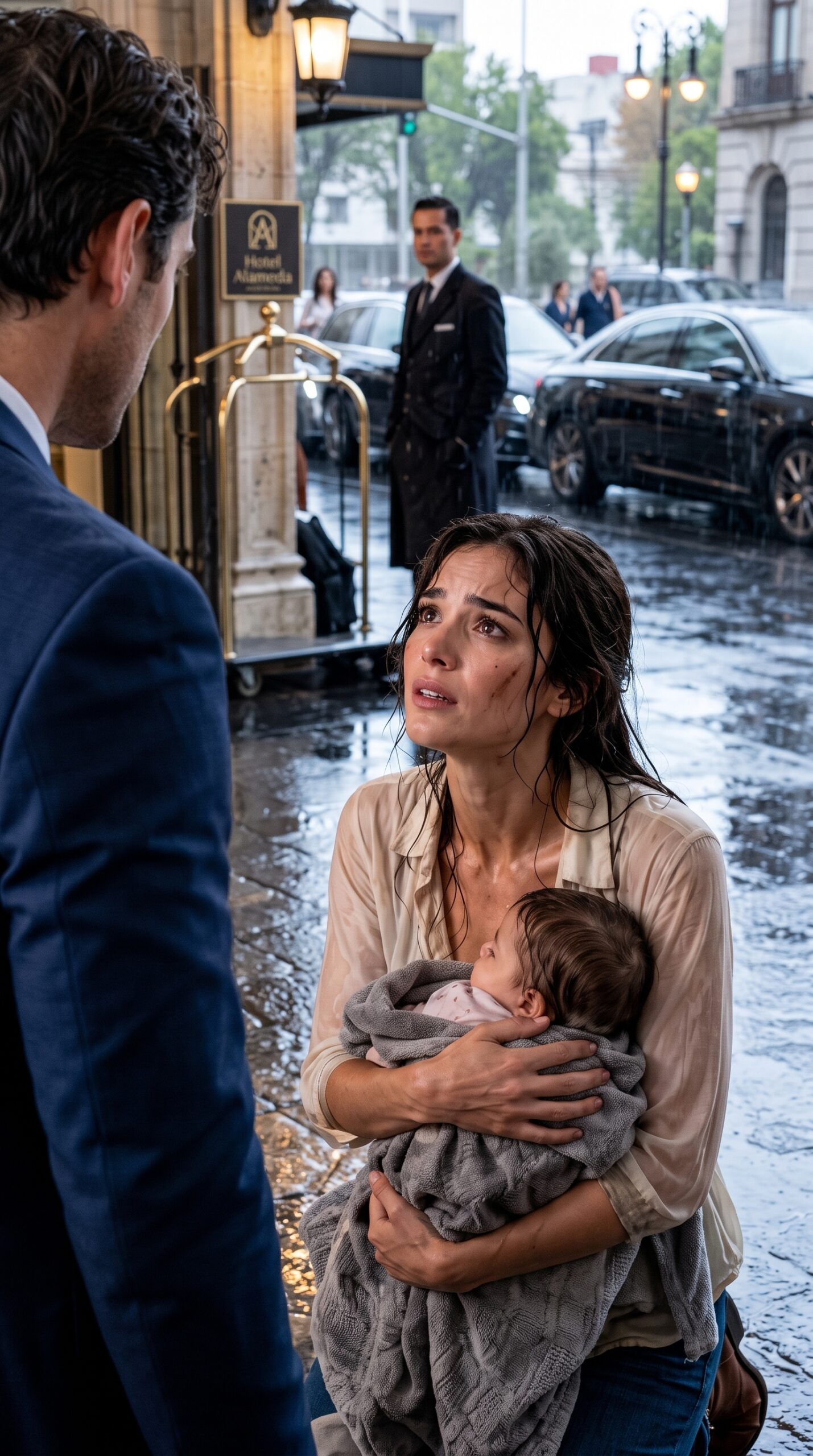
The rain fell on Paseo de la Reforma as if the entire city were weeping.
At the entrance of the Real Alameda Hotel, amidst honking taxis and executives rushing under umbrellas, a thin woman held a sleeping girl wrapped in an old blanket.
"Sir... don’t you need someone to wash dishes?" she asked, her voice broken. "I’ll do anything. My daughter hasn’t eaten in two days."
Damián Arriaga was entering the hotel with his cell phone in hand, his suit soaked, his mind trapped in a dinner with the family business board.
His mother, Doña Josefina Arriaga, was waiting for him upstairs.
As always.
Elegant, hard, perfect for the cameras, and poisonous in private.
Damián barely glanced. In Mexico City, one learns to look at pain out of the corner of the eye, because if you look directly, it weighs you down.
But the woman lifted her face.
And he stopped breathing.
"Renata..." he murmured.
The woman’s eyes widened in terror. Not surprise. Terror.
"Don’t say my name," she whispered. "Your mother is here."
Damián felt the floor shift beneath him.
Renata, his wife, had died two years ago. Or so he was told.
An accident on the road to Cuernavaca. A charred car. A closed coffin. A dentist hired by the family confirming the remains.
Damián had cried in front of a grave.
He kissed a photo.
He let himself be destroyed.
And now she was here, alive, trembling, with bruises on her face and a girl in her arms.
"The girl..." he managed to say.
Renata looked down at the little one.
"She’s your daughter. Her name is Lucía."
Damián froze.
The baby was just over a year old. That meant Renata had been pregnant when she disappeared.
From the restaurant’s window, a silver-haired woman watched without blinking.
Doña Josefina.
Damián understood that any reaction could condemn them.
He opened the hotel door and said aloud:
"There might be openings in the kitchen. Please come in, ma’am."
Renata lowered her head and entered behind him, as if she were a stranger.
In the elevator, no one spoke. Damián quickly sent a text from a hidden phone and tucked it away.
Upon reaching his suite, he locked the door with double security, turned off the internal cameras, and drew the curtains.
Then he fell to his knees.
Renata placed Lucía in his arms.
Damián hugged her as if the world had returned his heart after tearing it out.
"They told me you were dead," he said.
Renata swallowed hard.
"That’s what your mother wanted."
She told him the impossible.
They had kidnapped her after leaving a medical appointment. They paid a dentist to falsify her identification. They locked her in a house in Valle de Bravo. When Josefina learned she was pregnant, she ordered any record of the girl to be erased.
"Your dad left a clause," Renata said. "If you became incapacitated, the direction would temporarily pass to your wife. To me. Not to her."
Damián's cell vibrated.
Mom.
He answered.
"Where are you?" Josefina said. "Dinner starts in 15 minutes. And stop wasting time with beggars. That woman at the entrance gave me a bad feeling."
Renata paled.
Damián slowly hung up.
Then he looked at his wife, at his daughter, and opened a secret compartment in his portfolio.
He pulled out another cell phone.
"Elena," he wrote. "She’s alive. Activate everything."
Renata let out a sob.
Damián was about to leave when someone knocked on the door.
Not once.
Three sharp knocks.
Renata looked through the peephole and stepped back, breathless.
In the hallway stood two men in suits.
One spoke on the phone:
"We’ve found the wife. The girl is here too."
PART 2
Renata pressed Lucía against her chest and for a moment believed it was all over.
She thought Damián had turned her in.
She thought the nightmare of Valle de Bravo was starting again, but now in a hotel full of witnesses who wouldn’t see anything.
Then one of the men slid an ID under the door.
Private investigation. Family protection.
Renata placed a hand over her mouth.
They were not sent by Josefina.
They were the men Damián had secretly hired.
For two years, he pretended to be broken. He pretended to believe the accident story. He pretended to obey his mother, attend her dinners, sign papers, lower his gaze.
But he never stopped investigating.
He had hired Elena Robles, a former prosecutor who moved quietly, away from the newspapers and the powerful friends of the Arriaga family.
Elena had tracked accounts, drivers, doctors, ghost properties, and strange payments.
She was only missing one thing.
Finding Renata alive.
And that night, in the rain, fate had put her in front of him.
Damián kissed Lucía’s forehead and returned her to Renata.
"Don’t open for anyone," he said. "Even if they say my name."
"Where are you going?"
"To make my mother talk."
Renata grabbed his arm.
"Damián, that woman never loses. She never loses."
He looked at her with a calm that hurt.
"Today she will, trust me."
The main hall of the Real Alameda Hotel was filled with politicians, businessmen, lawyers, and advisors dressed as if they were about to celebrate something important.
Doña Josefina Arriaga sat in the center, wearing an emerald necklace and a saintly smile.
To her right was Bruno Lamas, CFO of the Arriaga Group and the man who had whispered decisions in her ear for years.
On the table was a black folder.
Damián knew what it contained.
A document declaring him emotionally unfit to lead the group.
Chronic depression. Instability. Unresolved grief. Absences. Erratic decisions.
All crafted by his own mother.
"Finally, my widowed son arrives," Josefina said loudly. "Always late, even to save his last name."
Some laughed uncomfortably.
Damián sat down without responding.
Bruno pushed the folder toward him.
"It’s a temporary transition, man. No one wants to take anything from you. We want to help you."
"How kind," Damián said.
Josefina shot him a lethal look.
"Don’t throw a tantrum. Since Renata died, you’ve become a nuisance."
The word 'died' landed on the table like a slap.
Damián took the pen.
On his hidden cell, a message from Elena appeared.
"We found the house. There are cameras, sedatives, baby clothes, forged documents, and a locked room. The caretaker has already spoken."
Damián took a deep breath.
"Before signing, I want to ask something."
Josefina sighed.
"Oh, Damián, don’t start with your dramas."
"What happened to Renata’s ring?"
Bruno answered too quickly.
"It burned in the accident."
Damián stared at him.
"Curious. The official report said no jewelry was found."
Silence thickened.
Josefina smiled without moving her eyes.
"Are you really going to ruin a corporate meeting talking about a little piece of jewelry?"
"No," Damián replied. "I’m going to talk about an empty grave."
A waiter approached and placed a white envelope in front of him.
Inside were copies of bank transfers to Dr. Abelardo Mijares, the dentist who identified the supposed remains of Renata.
The dates were clear.
Three days before the accident.
Bruno turned pale.
Josefina’s expression didn’t change.
"Forgeries," she said.
The hall doors opened.
Dr. Mijares entered, escorted by two federal agents. His shirt was wrinkled, his face sweaty, and his hands handcuffed.
Josefina stood up.
"I don’t know that man."
Mijares let out a bitter laugh.
"Now you don’t know me, ma’am? You paid me 4 million to say those remains were your daughter-in-law’s."
The advisors began to murmur.
A lawyer dropped his glass.
Bruno tried to pull his chair away.
Damián didn’t look at him. He was waiting for the real blow.
His cell vibrated again.
Elena: Bruno paid the rent for the Valle de Bravo house through three ghost companies. We also found recordings of Josefina talking about the baby.
Damián raised his eyes to his mother.
"Are you also going to say you don’t know your granddaughter?"
For the first time, Josefina lost color.
"Shut up."
"You made me cry in front of a false grave," Damián said. "You hugged me at the funeral while my wife was locked up, pregnant and alone."
Josefina slammed the table.
"That woman was going to destroy you!"
"No. You destroyed me."
She pointed at the folder.
"Sign, Damián."
He looked down.
Then he signed.
Josefina smiled with cold satisfaction.
But the oldest lawyer on the board took the sheet, reviewed it, and frowned.
"Mrs. Arriaga... this is not a valid signature."
"What do you mean?"
"Mr. Damián did not sign a waiver. He activated a coercion clause provided in the family trust. Everything attempted to be approved tonight is automatically invalidated."
Bruno muttered a curse.
Damián stood up.
"And everything said here is being recorded."
The small lights of the hidden cameras in the hall flickered.
Josefina looked around like a queen discovering her castle was made of cardboard.
Then the doors opened again.
Renata entered with Lucía in her arms.
The entire hall fell silent.
Some advisors stood up. Others crossed themselves. A woman whispered, "Oh, my God," almost inaudibly.
Damián walked toward them.
Renata wore dry clothes, but her face was still marked by fear. Lucía was awake, pressed against her chest, staring at the lights with wide eyes.
Josefina pointed at the girl.
"That child is not an Arriaga!"
Lucía began to cry.
Renata stepped up to the table and placed a small recorder in front of everyone.
"Then let’s listen to what you said when she was born."
Josefina’s voice filled the hall.
"That girl must not exist in any record. If Damián knows he has a daughter, I lose everything."
No one moved.
The recording continued.
"Renata can live as long as she obeys. But if she tries to escape, the girl pays first."
Damián closed his eyes.
Renata didn’t cry. Not anymore.
She had cried too much in that house, with sealed windows and an improvised crib next to the bed.
Josefina wanted to speak, but found no words.
Bruno stood up abruptly.
"I’ll cooperate," he said quickly. "I have emails, keys, accounts. It was all her order."
Josefina looked at him with contempt.
"Coward."
"No," Damián said. "A coward was hiding a pregnant woman because you couldn’t control your son."
Josefina turned to him.
"I did it for you."
Damián shook his head slowly.
"No. You did it for power."
Elena Robles entered the hall with a court order.
Behind her came more agents.
"Josefina Arriaga, you are under arrest for kidnapping, illegal deprivation of liberty, forgery, process fraud, and attempted murder."
Josefina let out a dry laugh.
"You don’t know who I am."
Elena didn’t blink.
"I do know. That’s why I came with eight patrols."
When the agents handcuffed her, Josefina still tried to approach Lucía.
"Let me see her," she demanded.
Renata stepped back.
"No."
"She’s my granddaughter."
Damián stepped in.
"You have no granddaughter."
That phrase hit her harder than the handcuffs.
For the first time, Josefina seemed old.
They dragged her out amidst screams, threats, and names of officials who that night didn’t answer calls.
No one defended her.
Not the advisors.
Not Bruno.
Not the lawyers who had eaten at her table for years.
The fall of Josefina Arriaga made national headlines.
The press dubbed the case "the living widow of Reforma."
In the Valle de Bravo house, they found medications, cameras, forged documents, baby clothes, and a room locked from the outside.
A truth even crueler emerged.
The remains used to fake Renata’s death belonged to Mariana Solís, a domestic worker who had disappeared three years prior.
Her family had never had money to demand answers.
Renata attended Mariana’s real funeral. She brought white flowers and hugged the young woman’s mother without saying much.
It didn’t need to be said.
The two women knew what it meant when someone powerful believed that a humble life could be erased without consequences.
Bruno submitted evidence and was convicted.
Dr. Mijares lost his license and also ended up in prison.
Josefina received a long sentence, but what hurt her the most wasn’t the years.
It was losing a useful last name.
No company.
No son.
No access to the girl she wanted to disappear.
Damián regained control of the Arriaga Group, but he didn’t celebrate with champagne or cameras.
He changed the bylaws.
No family member could take control without independent oversight.
Half of his shares legally passed to Renata.
And together they created a foundation to support families of missing women who had no money, contacts, or heavy last name.
Renata took time to sleep with the light off again.
It took time to walk alone in a parking lot.
It took time to trust when someone knocked on the door.
Damián didn’t ask her to "get over" anything.
He learned that loving after horror wasn’t about demanding smiles.
It was about staying.
It was about waiting.
It was about not letting go.
Lucía’s second birthday was in a small garden in Coyoacán.
There were no businessmen, no press, no important last names.
Just vanilla cake, poorly tied balloons, soft music, and a girl laughing with her hands covered in frosting.
Lucía ran to Damián, touched his face, and said:
"Daddy."
He closed his eyes as if that word had healed a two-year wound.
That afternoon, a letter arrived from prison.
The envelope bore Josefina’s name.
Renata left it on the table.
"Do you want to read it?"
Damián stared at the paper for several seconds.
Maybe before, he would have sought an explanation. An apology. A sign that his mother still had something human in her.
But he heard Lucía’s laughter.
He saw Renata in the sun, alive.
He took the letter and burned it in the grill without opening it.
"No," he said. "Some people don’t need a response. Just distance."
Renata rested her head on his shoulder.
Lucía came running with cake in her hand and accidentally stained their clothes.
For two years, Josefina wanted to turn them into ghosts.
But that afternoon, amidst laughter, sun, and crumbs of sweet bread, Damián understood something that many should remember:
Sometimes justice doesn’t come with revenge.
It arrives with a girl laughing in the arms of a mother no one could erase.