PART 1
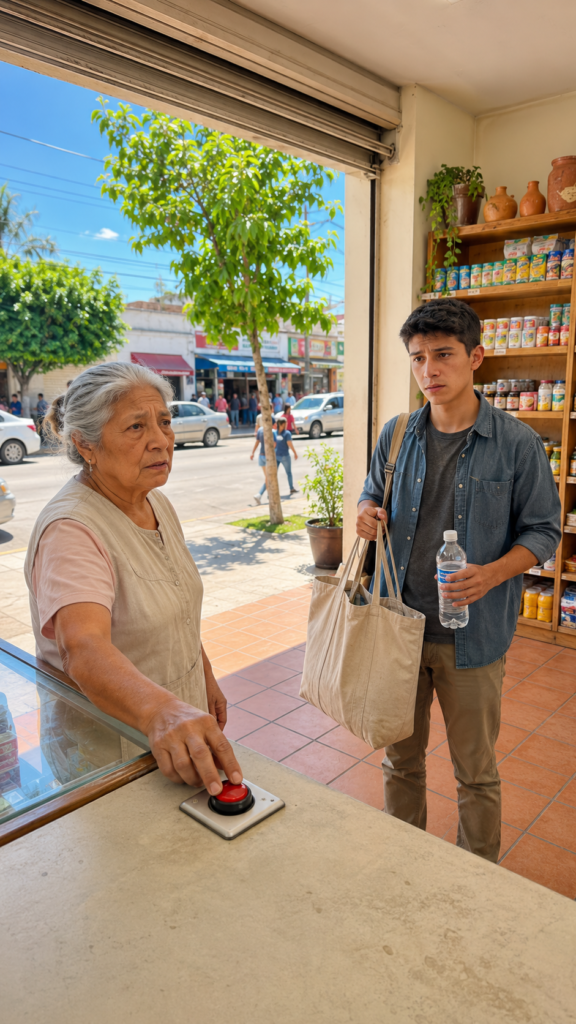
At 10:47 PM, Teresa Morales was about to close the shutters of her convenience store in Puebla when a young man stood at the entrance.
He had torn sneakers, wet clothes, and a scar running across his eyebrow. Teresa pressed the alarm button below the counter.
—I don’t want money, ma’am—he said—. Just let me clean the storeroom. I only need adult diapers and alcohol.
The boy was named Gael, and he claimed his mother had suffered a stroke. She was sent home unable to walk, and he was her only caretaker.
Teresa was wary, but she set him to work.
For two hours, he scrubbed the floor with icy water, organized boxes, and didn’t touch a single candy. When he finished, he received the products and cried like a child.
From then on, he came back every week.
First, he swept the sidewalk. Then, he unloaded suppliers. After a few months, Teresa gave him a permanent job and even a copy of the keys.
Gael was punctual, honest, and hardworking. Teresa, a widow without children, ended up caring for him like the son life never gave her.
But there was something strange.
He never allowed anyone to visit his mother.
—She’s very delicate, Doña Tere. She gets upset with strangers.
When Teresa offered to bring her friend Lupita, an IMSS nurse, Gael responded too quickly:
—No. Really, no.
Then he smiled, changed the subject, and continued organizing cans.
Months later, Teresa found a forgotten receipt next to the cash register: diapers, cream, alcohol, and a thick hardware lock.
She thought it was to protect the house.
Until a neighbor of Gael came in to buy coffee and dropped a phrase that churned her stomach.
—Stroke? I saw her walking around the yard three days ago, before he dragged her away.
Teresa wanted to believe it was just gossip.
But that night, Gael didn’t show up to close the store. In two years, he had never missed a day without warning.
At 10:31, she received an audio message.
—Doña Tere, if something happens to me, don’t go into the back room. I beg you.
Teresa grabbed the emergency key he had entrusted to her and drove to his house with her heart racing.
The house was silent. In the hallway, she found a locked door.
From the outside.
It was the same model as on the receipt.
She opened it.
Inside, it smelled of dampness, medication, and confinement. On a mattress lay a frail woman, tangled hair and cracked lips.
Upon seeing Teresa, the woman said her name.
Then she grabbed Teresa's wrist with brutal strength.
—Get me out of here… he has me locked up.
Teresa barely managed to pull out her phone.
—Let her go!
Gael stood at the door, pale, holding a bag of diapers.
—What did you do to your mother?—Teresa shouted.
Gael started to cry.
—You don’t know what she did to my sister. If I let her out, she’ll go looking for her. Next time, she could kill her.
Teresa was trapped between the two: the woman pleading for freedom and the boy swearing that the lock kept a girl alive.
Then the supposed invalid suddenly stood up, leaned close to Teresa’s ear and whispered something that turned fear into horror:
—Save him.
PART 2
Teresa froze.
She expected to hear “call the police” or “don’t believe him.” Instead, the woman fixed her gaze on Gael, as if the true prisoner were him.
Teresa released her grip, stepped back, and dialed 911.
—Ma’am, please call—Gael said, hands clasped together—. But let me speak first. Then I’ll turn myself in.
He didn’t block the exit. He didn’t raise his voice. He slumped against the frame, exhausted.
—My mom never had a stroke.
Teresa felt the floor tilt beneath her.
—Then what does she have?
—A brain tumor. They found it two and a half years ago. They operated, saw it was spreading, and closed her back up. They told me there was no treatment. That I should take her home to die.
Gael was 20 when he received that sentence. His sister, Renata, was only 12. In his wallet, he had sixty pesos and no one willing to take care of them.
The tumor hadn’t paralyzed his mother, but it had slowly destroyed her behavior.
There were days when Carmen cooked from memory, asked about Renata’s school, and caressed Gael’s face.
And others when she recognized no one.
During those episodes, she would break plates, throw objects, and attack anyone nearby. Then she wouldn’t remember a thing.
—I made up the stroke because people feel compassion for an immobile woman—he confessed—. But when you say a sick person gets violent, everyone wants her locked away.
Teresa looked at the mattress, the neatly arranged diapers, the medications, and a bucket of clean water.
The room still felt like a prison.
But it was also the only care facility that young man had been able to create.
—And what about your sister?—Teresa asked—. You said your mom did something to her.
Gael clenched his fists.
One afternoon, while he was unloading sacks at a market, Carmen had a crisis. When he returned, he found Renata hiding behind the refrigerator, trembling, blood on her blouse.
Carmen held a kitchen knife and was asking who that girl was that had entered her house.
Gael intervened. In the struggle, she hit him with a broken bottle.
That’s how the scar on his eyebrow was born.
That same night, he sent Renata to an aunt’s place in Querétaro. He told her their mother was in a special clinic and that when she got better, they would live together again.
—Every Sunday she asks me if she’s better—Gael murmured—. And every Sunday I tell her she’s a little better.
—You’re lying to her.
—Yes.
—You lied to all of us.
—Yes.
—And you locked up your own mother.
Gael lifted his tear-streaked face.
—I let myself be hated so my sister could continue loving her.
The phrase struck Teresa harder than any explanation.
Carmen, now calm, reached out her hand to her son.
—My boy—she whispered—. You’re so tired now.
Gael knelt beside the mattress and tucked in the blanket. He checked her back, changed the damp sheet, and gave her water with a patience that can’t be learned from any manual.
Carmen looked back at Teresa.
—When I’m well, I understand everything—she said with difficulty—. He thinks I don’t realize… but I do. He lost his job, his friends, his youth. That’s why I asked him to save you.
Teresa lowered her phone.
The rage still boiled in her veins over the lock. No one should live locked away. But she couldn’t ignore that Gael had been holding a tragedy for two years that would have overwhelmed an entire family.
—Why didn’t you ever ask me for help?—she asked.
—Because you care about me, ma’am. And if I told you, you would do the right thing.
—And what was the right thing?
—Call an ambulance. Take her to an institution. Sign papers. And let her die tied to a bed among strangers.
Teresa didn’t know how to respond.
At that moment, Carmen began to breathe with difficulty. Her hands trembled, and her gaze changed.
—You!—she shouted at Teresa—. You took my daughter!
She tried to get up and threw the glass against the wall.
Gael didn’t hit her or hold her down violently. He positioned himself between them, received a scratch on his neck, and spoke slowly:
—Mom, I’m Gael. You’re at home. Renata is safe.
Carmen tried to bite him.
Teresa saw real fear in the young man’s eyes. Not fear of being discovered, but fear that his mother would hurt herself.
Together, they managed to lay her down. Minutes later, Carmen was serene again and asked why Gael was bleeding.
He told her he had cut himself while working.
Another lie to protect her from herself.
Teresa didn’t call 911.
She called Lupita.
The nurse arrived near midnight. She examined Carmen, read the old prescriptions, and pulled Teresa aside in the hallway.
—This can’t go on—she said—. The lock is dangerous, but this boy is also at his limit. She needs palliative care, medication to control the crises, and supervision. He needs to sleep before he collapses.
Over the following days, Teresa did what she did best: mobilize people.
She spoke with a doctor from the health center, arranged for a home visit, gathered documents, and pressured until palliative care was obtained. Lupita taught Gael how to administer the medications and recognize the warning signs before each episode.
Teresa paid what the system wouldn’t cover.
She also made a decision that provoked a fight with half the neighborhood.
The neighbor who had seen Carmen walking called the police upon learning everything. The officers arrived while Gael was changing sheets.
—That boy had her kidnapped—screamed the woman from the sidewalk—. Take him away!
Other neighbors recorded with their phones. Some called for jail. Others accused Teresa of covering for him.
Gael didn’t defend himself.
He only asked that they not scare his mother.
Teresa came out with the medical file, the prescriptions, Lupita’s report, and the doctor’s assessment. She explained every crisis, every failed attempt to get support, and every risk.
The police spoke with Carmen during one of her lucid moments.
—My son didn’t kidnap me—she said—. He was wrong to lock me up, yes. But he did it because no one came when he asked for help.
That phrase quieted many shouts, but not all of them.
A social worker intervened. A plan for supervision, medical visits, and family support was established. Gael accepted every condition.
In front of everyone, Teresa pulled the lock from the door.
—This is over—she said—. Not because Gael is a monster, but because he won’t be taking care of her alone anymore.
The door would never be closed again.
Teresa organized shifts with Lupita and two neighbors who, after learning the truth, stopped gossiping and began bringing food.
That first night, Gael slept eleven hours straight in a chair, with his head resting next to the mattress.
Carmen lived for twenty-four more days.
There were calm afternoons when she recognized her son and asked him to play boleros. There were also crises, but the medications reduced the violence, and the lock was never needed again.
She died on a rainy dawn, in her bed, with Gael holding her hand and Teresa praying by her side.
Before she left, Carmen opened her eyes one last time.
—Forgive me, son.
Gael rested his forehead on her fingers.
—There’s nothing to forgive, Mom.
At the wake, Renata arrived from Querétaro.
She was already fourteen. She embraced her brother in front of the coffin and thanked him for taking such good care of their mom, for not abandoning her for a single day.
Gael looked at the scar reflected in the glass of the coffin.
He could have told her the truth.
He could have said that Carmen had tried to hurt her, that the mark didn’t come from a street fight, and that he had sacrificed two years to keep them apart.
He didn’t.
—Our mom loved you until the end—he said.
Renata cried against his chest, preserving the memory of the woman who used to braid her hair before falling ill.
Some time later, Gael returned to work at the store. He no longer bought diapers or alcohol. At first, every time the bell at the entrance rang, he jumped, as if someone were going to claim a life he didn’t know how to live any other way.
Teresa kept the lock in the drawer where she used to have the alarm button.
Sometimes she picked it up and remembered the first night she almost closed the shutters on Gael for his clothes, his sneakers, and his scar.
The lock no longer locked any doors.
But it weighed like all the questions no one asked her for two years.
Because that night, when Gael asked for diapers and alcohol, Teresa thought he was begging for charity.
The truth was far more painful.
His mother had just returned from the hospital to die at home, and he didn’t ask for food for himself. He didn’t ask for money. He didn’t ask for rest.
He only wanted her to be clean, unharmed, and with a little dignity.
Many continued to say that Gael had done something unforgivable.
Others insisted that any son would have called the authorities from day one.
Teresa never defended the lock.
She defended the boy who locked it because he was alone, scared, and convinced he would lose his entire family if he told the truth.
Since then, when someone enters her store looking disheveled, Teresa no longer presses the alarm button before listening.
First, she asks:
—What do you really need?
Because sometimes the person who seems most dangerous isn’t there to do harm.
Sometimes, they’ve been asking for help for years without knowing how to say it.