PART 1
The dinner seemed too elegant for the shame that was about to descend upon the table.
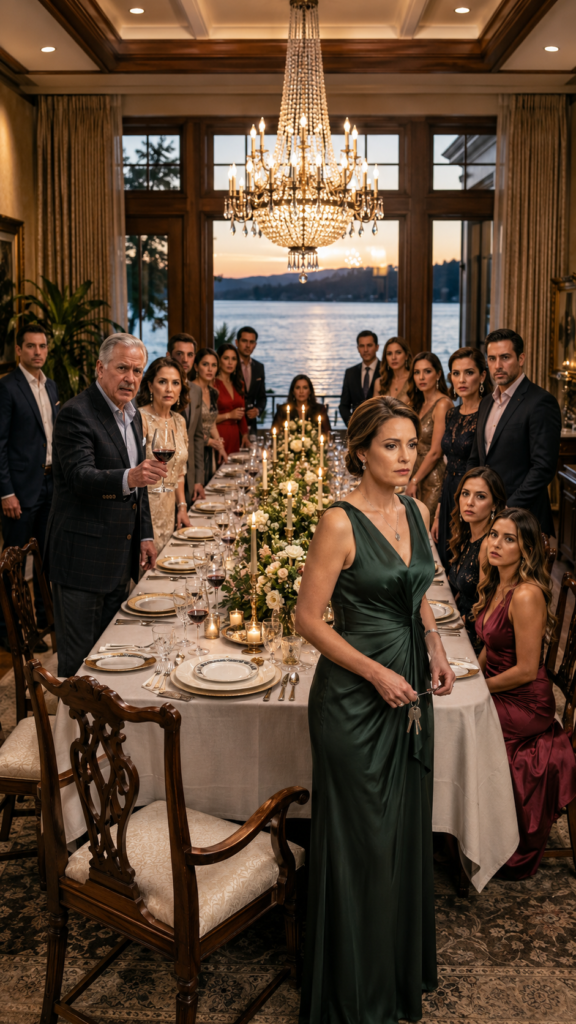
The family home in Valle de Bravo was lit with white candles, linen tablecloths, and glasses that sparkled as if the night were perfect. Outside, the lake looked dark under the August sky. Inside, more than 40 relatives laughed, toasted, and pretended that nothing ever broke in their family.
Mariana sat two seats away from her father.
She had driven almost five hours from Querétaro with her seven-year-old daughter, Sofía, just to attend the family anniversary. She arrived tired, yet still helped her mother arrange flowers, check napkins, and place name cards on each plate.
That was Mariana.
The one who always arrived.
The one who always solved.
The one who never caused drama.
At 9:16 PM, Gerardo Varela stood up with a glass of red wine in hand.
He was 68 years old, wearing a white shirt, a navy blue blazer, and that smile of a respected man that everyone in the family obeyed without question. The candlelight softened his face, as if he were a good father in an old photograph.
He raised his glass.
"To my three daughters," he said proudly.
Mariana barely smiled.
Three daughters was correct: Clara, Beatriz, and her. Her brother Tomás didn’t count in that equation.
But then Gerardo continued:
"To Clara, Beatriz, and Sara."
No one spoke.
No one corrected.
No one said, "Gerardo, you meant Mariana."
The silence lasted just a few seconds, but to Mariana, it felt like an eternity. Her aunt Renata, sitting across from her, looked at her with eyes filled with something strange. Not surprise. Not confusion. Guilt.
Then she looked down at her plate.
In that moment, Mariana understood that the mistake was not just a simple error.
Sara.
There was no Sara in her family.
Her mother, Patricia, kept smiling as if nothing was wrong. Clara wiped a tear of emotion. Beatriz squeezed her husband’s hand. The others began to clap with that cowardly discomfort of those who prefer not to get involved.
Mariana set her glass down on the table.
Slowly.
Cautiously.
Like someone placing something fragile before deciding they would no longer carry it.
She went upstairs to where her suitcase was. She hadn’t even opened it. That felt like a sign. She went back down, took Sofía by the hand, and left without saying goodbye.
In the car, as they drove away from the illuminated house, Sofía asked from the backseat:
"Mom... who is Sara?"
Mariana gripped the steering wheel tightly.
"I don’t know, my love."
And that was the first honest phrase anyone uttered that night.
PART 2
Mariana drove for two hours before stopping at a gas station on her way back to Querétaro.
Sofía slept with her head tilted, hugging a doll. Mariana didn’t cry. Not yet. She took out her phone and opened a note.
She wrote:
He said three daughters.
He said Clara, Beatriz, and Sara.
He didn’t correct.
Mom heard it.
Aunt Renata heard it.
No one said my name.
I left.
I won’t come back the same.
She stared at that last line until the screen blurred.
Mariana Varela was 34 years old, a tax accountant at a firm in Querétaro, a divorced mother, and the owner of a life she had built alone, weight by weight. Since she was a child, she had been the "strong" daughter, the one who didn’t ask, the one who understood, the one who adjusted so others wouldn’t feel uncomfortable.
When she was eight, she made her own lunch because her mom was always busy with Clara.
At twelve, she remembered payments, birthdays, school meetings, and Tomás's medicine.
At twenty-two, her father didn’t attend her college graduation because he had "an important meeting" at the hardware store he managed.
But he did attend every piano recital of Beatriz.
He did tape every soccer game of Clara.
He did spend whole nights in the hospital when Tomás got sick.
For years, Mariana told herself they were separate things.
An absence.
A birthday card without affection.
A last-minute gift.
A call that never came.
But separate things hurt less than a pattern. And that night, the pattern finally had a name.
Sara.
The following Tuesday, Mariana had 11 missed calls.
Four from her mother.
Three from Clara.
Two from Aunt Renata.
One from her father.
One from an unknown number.
First, she listened to Patricia's messages.
"Mariana, I don’t understand why you left like that. Your dad is confused. This doesn’t have to get big."
Then another:
"We have Clara’s birthday next month. I need to know if you’re going to contribute for the hall. We can’t let a misunderstanding ruin the family."
Contribute.
Mariana let out a dry laugh.
In that family, "contribute" always meant she paid.
Her father’s message was worse.
"Mariana, it’s me. I don’t know what happened last night, but your mom says you were upset. I hope you’re okay."
Nothing about forgiveness.
Nothing about "I said another name."
Nothing about Sara.
Just the old habit of making her seem exaggerated.
The last message was from Aunt Renata.
"Sweetheart, I saw your face. You’re not crazy. Call me if you want to know the truth."
Mariana called her with a trembling hand.
Renata answered on the second ring.
"That name didn’t come out of nowhere," she said.
Mariana felt the ground shifting beneath her.
"Who is Sara?"
Renata was silent for a few seconds.
"Sara Medina. She’s your father’s daughter."
The phrase didn’t explode.
It sank.
Heavy.
Cold.
Like a stone in her chest.
Sara was 33 years old. She had been born from a relationship Gerardo had when Mariana was a baby. Her mother, a woman named Lourdes Medina, lived in Toluca. Gerardo had been sending money for years, secretly, while Patricia pretended not to know or pretended to have forgiven.
But Patricia did know.
That was the cruelest blow.
It wasn’t just that her father had another daughter.
It was that her mother had helped orchestrate the lie so the table could still look pretty.
"Why didn’t anyone tell me?" Mariana asked.
Renata sighed.
"Because in this family, everyone expects you to take the hit, sweetheart."
That phrase hurt her more than any insult.
Days later, Patricia sent her a handwritten letter. It said four times that they loved her. It said twice that her father "didn’t mean to hurt you." It said that Mariana had always been "very sensitive."
But the word Sara didn’t appear.
Neither did "forgiveness."
In the end, Patricia wrote:
"I hope you think about what your absence is doing to this family."
Mariana folded the letter and put it in a yellow folder. On the tab, she wrote: Valle.
Then she opened a spreadsheet.
In one tab, she wrote: Facts.
In another: Money.
That night, she started to jot down everything she had paid for the family: $18,000 for her parents’ anniversary, $26,500 for the rental of a terrace, $11,000 for Beatriz’s farewell, $32,000 to fix the water pump at the lake house.
At midnight, the total exceeded $184,000.
In the last column, she wrote:
Received in return.
She left it empty.
The conflict exploded when Patricia asked her for money for Clara’s 30th birthday. She had reserved a restaurant in Polanco, with a three-course menu, open bar, and golden decorations.
The balance was $72,000.
"Your sister has had a tough year," Patricia said over the phone. "Don’t make this about you."
Mariana took a deep breath.
"I’m not going. And I’m not paying."
On the other end, there was silence.
Then Patricia said:
"See? That’s why we couldn’t tell you anything. You turn everything into a problem."
Mariana hung up.
For the first time in her life, she didn’t rush to fix what others had broken.
On the day of the party, Beatriz sent her photos without text.
Clara smiling beside golden balloons.
Patricia with a glass.
Gerardo hugging Clara.
And in the background, near the bar, a woman in a green dress.
Light brown hair.
Familiar face.
Gerardo looked at her sideways, with that tenderness Mariana had longed for her entire childhood.
Mariana zoomed in on the photo.
The woman had the same jawline as her father.
She texted Beatriz:
"Who is the woman in green?"
Three dots appeared.
They disappeared.
They returned.
"I don’t know. I think she’s a friend of someone."
Two minutes later, the photo vanished from the chat.
Beatriz had deleted it.
But Mariana had already saved it.
She named it: Woman in Green.
Sara ceased to be just a name.
Now she had a face.
Then Mariana called the lawyer who had helped her with her divorce. She was put in touch with a family property specialist, attorney Silvia Márquez.
Because there was another issue.
The house in Valle de Bravo wasn’t just "the family house."
A third of it belonged to Mariana.
Her grandmother Elena had bought it in 1982, after selling food for years outside a secondary school. When she died, she left it divided among her children. In 2019, an uncle wanted to sell his part, and Patricia convinced Mariana to buy it.
"This way it stays in the family," she said. "Besides, you’ll be able to use it whenever you want."
"Whenever you want" ended up being two weekends a year, as long as Clara didn’t have guests, Beatriz didn’t want to rest, or Patricia didn’t say it was "not a good time."
Mariana paid $940,000 for that part.
She thought buying a piece of the house meant buying belonging.
But her father erased her within that very house.
Silvia reviewed papers, payments, receipts, property taxes, and contracts.
"Legally, you own a third of it," she said. "You can sell it. First, you offer it to the co-owners, then proceed based on their response."
Mariana nodded.
"I want to sell."
Silvia continued checking documents and frowned.
"There’s something strange here. In the house’s insurance, there’s a person authorized for emergency access: S. Medina."
Mariana felt cold.
S. Medina.
Sara Medina.
"Since when?" she asked.
"Since last year."
That night, Mariana searched her email.
She found an old message, forwarded by her mother in 2020, about cleaning the house. An address started with s.medina.
The message said:
"Patricia, I can open the house on Friday before the girls arrive. Is the code still the same?"
The girls.
The same code.
That summer, Patricia had told Mariana she couldn’t go because "the house was full."
But Sara had the key.
Mariana printed the email and kept it.
Then came the real twist.
Sara wrote to her.
"I didn’t know you didn’t know about me. Your dad told me everyone was aware. He invited me to Clara’s birthday because, according to him, it was time to integrate me little by little. I thought you didn’t go because you didn’t want to hang out with me. I’m sorry."
Mariana took hours to respond.
In the end, she only asked:
"What did my dad tell you about me?"
Sara replied:
"That you were distant. That you didn’t like the family. That you had chosen your own life."
Mariana stared at the screen.
She, who had driven for hours to arrange napkins.
She, who had paid other people’s bills.
She, who had bought part of a house so it could remain "for everyone."
According to her father, she was distant.
The confrontation happened in a café in Satélite because Mariana refused to go to her parents’ house.
Gerardo and Patricia arrived together.
Patricia carried an expensive handbag, her lips pressed together, and the same look as always: that of a woman who didn’t come to ask for forgiveness, but to regain control.
Mariana placed a folder on the table.
"I know who Sara is."
Gerardo looked down.
Patricia closed her eyes.
No one asked, "What Sara?"
That said it all.
"She was born in 1991," Gerardo admitted.
One year after Mariana.
"And me?" she asked—"What was I while you held another life in secret?"
Gerardo didn’t answer.
Patricia did.
"You were fine. You were always fine. Clara needed more. Beatriz needed more. Tomás was little. Your dad was embarrassed. I was humiliated. You were the strong one."
Mariana felt something old break, but it didn’t bleed.
"I wasn’t strong," she said. "I was a child who learned not to disturb."
Gerardo cried.
"We never stopped seeing you."
Mariana stared at him.
"Dad, you toasted to your daughters in front of 40 people and said another name in my place. It wasn’t a mistake. It was practice."
Patricia banged the table with her fingers.
"Don’t exaggerate, Mariana. We wanted to introduce Sara carefully."
"Carefully?" Mariana pulled out another paper—"Was this also careful?"
Patricia paled.
The document had been secretly given to her by Sara. It was a draft where Patricia and Gerardo planned to convince Mariana to transfer her third of the house into a family trust with a "reduced value."
The beneficiaries were Clara, Beatriz, Tomás, and Sara.
Mariana didn’t appear.
Her part did.
Gerardo whispered:
"That wasn’t decided."
Mariana smiled without joy.
"But my disappearance was already drafted."
That was the moment Patricia lost her composure.
"After all we swallowed to keep this family together!"
"No, Mom," Mariana replied. "You didn’t keep the family together. You used me as adhesive tape."
The folder lay in the middle of the table: receipts, messages, insurances, deleted photos, emails, appraisals, trust drafts.
Mariana spoke calmly.
"I’m going to sell my part of the house to Aunt Carmen for its real value. Silvia will handle everything. Don’t ask me for money again. Don’t ask me for silence again."
Patricia leaned toward her.
"If you do this, you won’t be welcome in Valle anymore."
Mariana looked at her without blinking.
"I was never welcome."
The sale closed two months later.
$1,113,000.
Mariana transferred part to Sofía’s educational fund and another to her savings. She didn’t celebrate with champagne. She didn’t post anything. She merely closed a tab of her life that had been charging emotional interest for years.
Gerardo sent her a letter.
It said:
"I’m sorry you felt hurt."
Mariana underlined the phrase.
It didn’t say: "I’m sorry I hurt you."
It didn’t say: "I erased you."
It didn’t say: "I lied."
It was an apology without traces.
She replied with a brief letter:
"Dad, you didn’t use my strength. You used my silence. You didn’t forget my name that night. You practiced forgetting me for 34 years, and you finally said it out loud. I’m not available to repair a house I didn’t break."
Months later, Clara was the only one who reached out.
She cried, asked for forgiveness, and said something Mariana would never forget:
"I liked not knowing because if I knew, I had to decide what kind of person I was."
Mariana didn’t hug her immediately.
But she listened.
Because a true apology doesn’t demand a key. It simply knocks on the door.
Sara also stepped away from Gerardo for a time. She wrote to Mariana one last time:
"I spent years wanting a father and confused secrecy with intimacy. Thank you for telling me the truth."
Mariana replied:
"Build something honest."
She didn’t write "sister."
She didn’t write "family."
Those words need more than blood and shared pain.
Almost two years later, Gerardo called from an unknown number. Mariana answered by mistake while waiting for a call from Sofía’s school.
"Mariana, please, don’t hang up."
She looked out the window. Sofía was painting a yellow house under a purple sky in her art class.
"You have two minutes."
Gerardo breathed heavily.
"I didn’t understand what I did until you stopped answering."
"How sad that you needed my absence to notice my existence."
He cried.
"I’m sorry."
This time he didn’t add "if it hurt you."
He didn’t hide.
He just said: "I’m sorry."
Mariana let those words in. But she didn’t give them her life.
"Thank you for saying that," she replied, "but I’m not going to rebuild a father-daughter relationship just when you’re lonely enough to realize what’s missing."
There was silence.
Then she added:
"And one more thing, Dad."
"Yes."
"My name is Mariana."
Gerardo took a while to answer.
"I know."
She hung up.
When Sofía came out with her painting, she lifted it proudly.
"It’s our house, Mom. But I made it brighter."
Mariana looked at those crooked walls, the impossible sky, the light invented by her daughter.
And smiled.
Because for years she believed she had lost her place when her father toasted to another daughter.
But she hadn’t.
That night, she didn’t lose her place.
That night, she finally saw the whole table.
Then she stood up.
Left the glass behind.
Took her daughter.
And from that day on, when Mariana counted the people she had to save, she started with herself.