PART 1
"Dad, if you still have any love left for me, come to my graduation tomorrow."
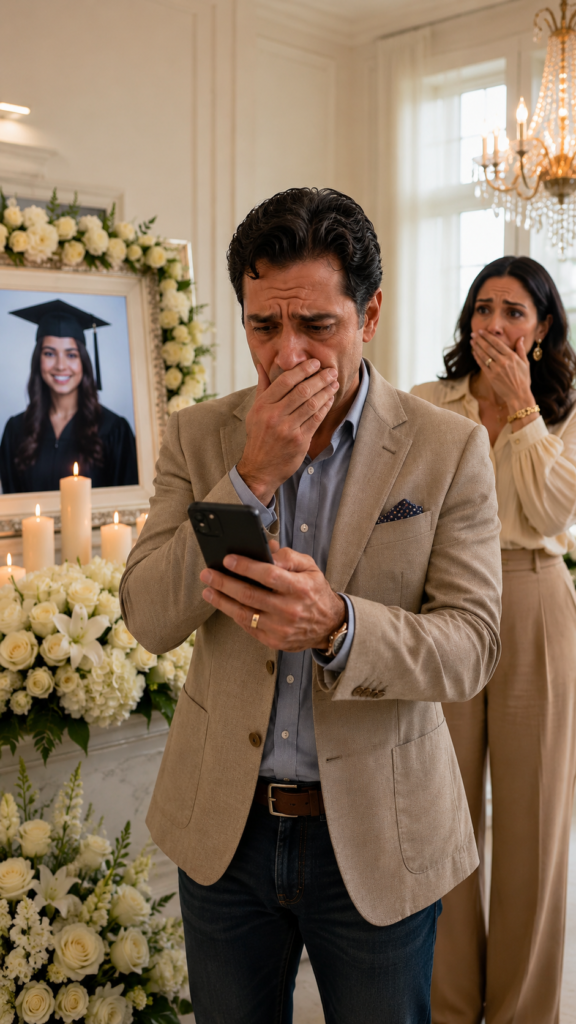
Santiago Miramontes read the message in the middle of the mass and felt his knees buckle.
The phone almost slipped from his hand onto the marble floor of the San Agustin Church in Las Lomas, as the priest spoke of the eternal rest of loved ones.
His daughter, Camila, had been dead for two years.
Dead on paper.
Dead in a white urn.
Dead in a massive photo, surrounded by expensive candles, orchids, and people dressed in black saying, "You're so strong, Santiago," without knowing anything.
But the message came from Camila's old number.
The same number his wife, Monica, claimed to have canceled after the accident on the Mexico-Toluca highway.
Santiago looked at the screen as if he were watching a hand rise from the grave.
Monica, immaculate in her black dress and pearls, noticed his expression and approached immediately.
"What happened?"
He couldn't speak. He just showed her the phone.
Monica read the message, and her face froze for less than a second.
Then she sighed, as if she were dealing with a sick child.
"My love, this is a scam. Someone knows you're vulnerable today."
Damian, Monica's son and financial director of the Miramontes corporation, appeared behind them.
"Give me the phone, Santiago. Digital security can trace this."
Santiago clutched the phone to his chest.
"No one touches this phone."
Monica lowered her voice.
"Camila is dead. You signed the documents. You were at the funeral."
"I stood before a closed casket," he replied. "I never saw her body."
The silence was colder than the church.
Damian turned pale.
"The hospital confirmed everything."
"The hospital confirmed papers," Santiago said. "Not my daughter."
The phone vibrated again.
A blurry photo arrived: a young woman in a black gown, standing in front of a university auditorium. On her left wrist shone a silver bracelet with a small star.
Santiago stopped breathing.
He had given that bracelet to Camila on her fifteenth birthday.
Monica tried to snatch the phone.
"Enough!"
Santiago reacted and grabbed her hand before she could touch the screen.
"Don't take her from me again."
The words came out with such rage that several guests turned to look.
Monica feigned tears.
"You're saying horrible things."
Santiago didn't respond.
That night, when everyone had left, he entered Camila's untouched room. Her law books, old sneakers, denim jacket, and a notebook where she had written the same phrase many times still remained:
"Don't be late, Dad."
The last time they spoke, Camila had said she wanted to study law, not business administration.
He mocked her.
"For what? To defend people who can't even pay you?"
Camila cried in anger.
"One day you'll be late. And you won't be able to fix it with money."
At 12:31 a.m., Santiago called Arturo Beltran, lawyer of his first wife, Isabel, Camila's mother.
Arturo read the messages, saw the bracelet, and asked the only thing that mattered:
"Did you see the body?"
Santiago shook his head.
"Monica said it was better to remember her as she was."
Arturo closed his eyes.
"Then we don't have a confirmed death. We have a story that's too convenient."
At dawn, Santiago was already at the airport.
Monica found the bed empty, the closet open, and the passport missing.
Damian saw her tremble for the first time.
"Mom… why are you so scared?"
She clutched her old cell phone, one nobody knew existed.
"Because if Camila shows up alive, everything we built on her grave is over."
PART 2
Santiago arrived in Guadalajara before 5 in the afternoon.
He didn't bring bodyguards.
He didn't bring a driver.
He didn't wear that untouchable businessman face he used to walk into meetings, restaurants, and banks where everyone cleared the way for him.
He carried a small suitcase, swollen eyes, and a guilt heavier than his last name.
Arturo walked beside him with a folder under his arm.
He had confirmed that that night, at a private university near Zapopan, a law student named Mariana Rios was graduating.
There was no clear school record prior to two years ago.
No parents registered.
No family photos.
Only a recent image with a gown, a fine scar near the eyebrow, and a silver bracelet with a star.
When Santiago entered the auditorium, families were already settling in with flowers, discreet balloons, and phones ready to record.
There were moms crying prematurely.
Proud dads adjusting ties.
Little siblings making jokes.
Santiago felt a miserable envy.
For two years, he had bought flowers for a grave.
When they announced the name Mariana Rios, the young woman stepped onto the stage.
She walked firmly, but not happily.
Like someone who learned not to fall even when the ground broke beneath her.
Santiago stood up without realizing it.
She received the symbolic diploma, turned to the audience, and her eyes locked with his.
She didn't smile.
She didn't cry.
She didn't run into his arms.
She just looked at him as one looks at someone searching among the living after having accepted too quickly the dead.
Santiago whispered:
"It's Camila."
Arturo didn't contradict him.
"Then someone had two years to erase her."
After the ceremony, Santiago tried to approach.
"Camila…"
The young woman paused for half a second.
But she didn't turn around.
An older professor placed a hand on her shoulder and accompanied her to a side exit.
Santiago understood something he had never wanted to understand: being a father didn't automatically grant him the right to enter where his absence had caused harm.
In Mexico City, Monica was already moving her pieces.
From a hidden cell phone, she called Dr. Ramiro Castañeda, former administrative director of the Hospital Santa Aurelia, where Camila had been taken the night of the accident.
"Santiago is at the graduation," she said.
There was silence.
"After two years, you can't call me like this, Monica."
"Don't talk to me about time. I bought time for everyone."
"The files are closed."
"Closed doesn't mean buried. I want to know who reviewed them."
Damian listened from the hallway.
He didn't understand everything.
But he understood enough.
His mother didn't speak like a worried wife.
She spoke like someone covering up a crime.
That same night, Santiago received a message from Camila's number.
"Santa Teresita Chapel, tomorrow 8:00. Come alone. If you bring cameras, I leave."
At 7:50, Santiago was already outside.
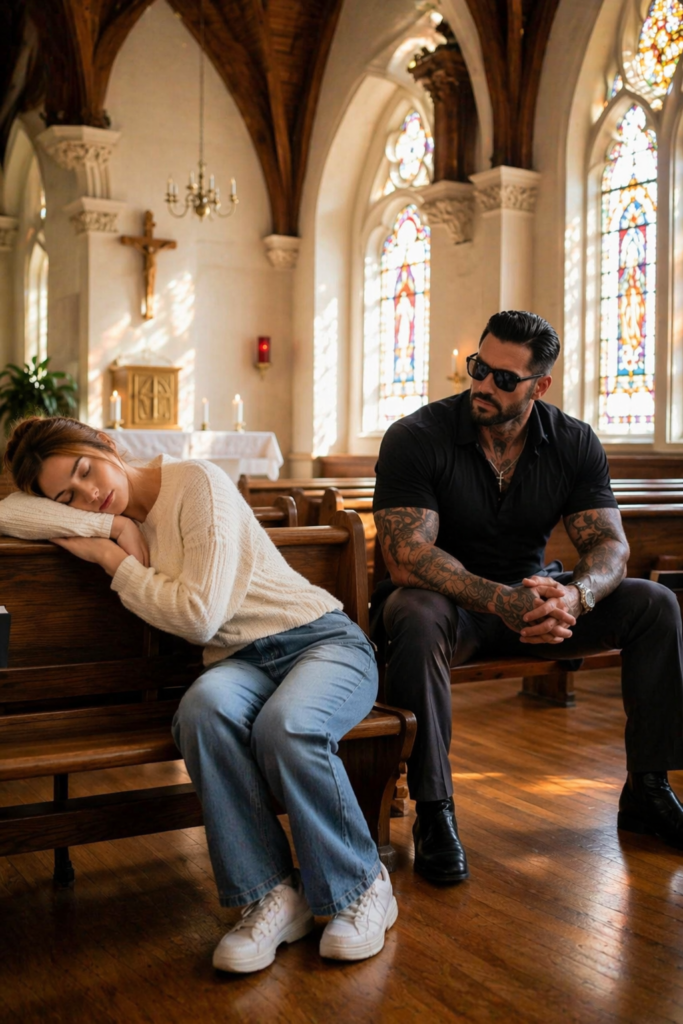
The chapel was simple, with light walls and worn wooden benches. Nothing like the churches where Monica organized elegant masses to look good in photos.
Camila was in the third pew.
She wore a white blouse, dark pants, and her hair was tied up.
The bracelet shone on her wrist.
Santiago approached slowly.
"Camila."
She didn't get up.
"Don't use my name as if you hadn't allowed it to be buried."
He sat at a respectful distance.
"I didn't know."
Camila let out a dry laugh.
"Of course. You never knew. You didn't know Monica called me 'nuisance' when you traveled. You didn't know Damian checked my emails. You didn't know they hid my law school acceptance letter. You didn't know I called you four times before the accident."
Santiago froze.
"You called me?"
"I wanted to come home. I wanted to tell you that you were right to be angry, but that I also had the right to choose my life. Your assistant said you were in a meeting and couldn't be interrupted."
Santiago remembered that night.
Monica walked into the meeting room crying.
Said Camila had died.
He didn't ask about the calls.
He didn't demand to see the body.
He didn't fight with the hospital.
He believed the documents because the documents hurt less than the guilt.
"I woke up not knowing who I was," Camila continued. "My face was bruised, my head was burning, and every memory came like shattered glass. A nurse told me that if I wanted to live, I shouldn't ask about my family. Later, a social worker brought papers. They said I was Mariana Rios. That I had no one. That if I insisted on my name, someone might finish what was started."
Santiago clenched his fists.
"Who gave the order?"
Camila finally looked at him.
Her eyes were no longer those of the rebellious girl he remembered.
They were those of a woman who had survived having her very existence stolen.
"People paid by your household. People who knew your money could turn a life into a file."
Outside, Arturo received a 62-year-old woman, a former nurse from Hospital Santa Aurelia.
Her name was Teresa Macias.
She arrived trembling, with a yellow envelope pressed to her chest.
"I didn't kill anyone," she whispered. "But I kept quiet."
Inside the envelope were copies of shifts, incomplete medical notes, and a nearly erased annotation:
"Rocio Hernandez, female, 23 years, no family present."
Arturo brought the documents into the chapel.
Camila read them silently.
"She was the other girl," she said with a broken voice. "The one in the same accident."
Santiago understood the full horror.
An unknown young woman, perhaps poor, perhaps sought by someone without power, had been buried under the name of Camila Miramontes.
And Camila had been hidden under another name.
It was not just identity theft.
It was a stolen grave.
Then Arturo's phone vibrated.
A note began to circulate on entertainment and business portals:
"Millionaire businessman falls for hoax of girl claiming to be his dead daughter."
The photo of Camila at graduation appeared enlarged, showing her scar as if it were proof of shame.
Camila didn't cry.
"Monica is trying to kill me again. Now with cameras."
Santiago stood up.
"I will tell the truth."
"With what?" she asked. "Tears? Guilt? She'll say I'm crazy, that I want money, that you're destroyed by grief. Your regret doesn't protect me, Dad. It could sink me."
The word "Dad" didn't sound like forgiveness.
It sounded like an open wound.
And yet, Santiago received it like a deserved punishment.
Monica called a press conference that afternoon at a hotel in Polanco.
She arrived dressed in white, with teary eyes and the perfect widow's voice even though she wasn't widowed from anything.
Behind her, they placed a massive photo of Camila before the accident.
"Two years ago, we lost our girl," she said in front of reporters. "Today, a woman pretends to take advantage of my husband's pain to extract money and destroy our family. We will not allow Camila's name to be tarnished."
The cameras broadcast live.
Then the back door opened.
Camila entered first.
She wasn't wearing an elegant dress.
Just dark clothes, her hair tied up, and the silver bracelet on her wrist.
Arturo walked beside her.
Santiago entered behind them.
The room erupted in murmurs.
Monica barely smiled.
"Santiago, you shouldn't be here."
He didn't reply.
Camila moved forward until she was in front of the cameras.
A reporter asked:
"Are you Mariana Rios or Camila Miramontes?"
She took a deep breath.
"For two years, I was forced to live as Mariana Rios because powerful people decided Camila Miramontes was more useful dead."
Monica slammed the table.
"That's a monstrous lie!"
Camila looked at her without blinking.
"Monstrous was using a closed casket to hide what you couldn't control."
One of Monica's lawyers demanded security remove her.
Santiago stepped forward.
"No one touches her."
He didn't shout.
He didn't need to.
For the first time, his authority wasn't protecting a company, but the daughter he hadn't protected when he should have.
Arturo connected his computer to the room's system.
A timeline appeared.
Night of the accident.
Admission of two women with unclear identification.
Stable patient: facial trauma, partial memory loss, controlled vital signs.
Critical patient: severe injuries, no family present.
48 hours later: administrative identity change.
Death certificate issued in the name of Camila Miramontes.
Discharge discreetly under the name of Mariana Rios.
Monica forced a laugh.
"Fake papers."
Camila raised her wrist.
"This bracelet was registered as a possession of the stable patient. Then it disappeared from the file. My dad gave it to me when I turned 15. Monica said it was lost in the car fire."
Santiago looked at the cameras.
"I confirm that bracelet belonged to Camila. It was never returned to me."
Then Arturo played the recorded statement from Teresa.
The former nurse recounted that an administrative order requested changing names, deleting calls, and keeping the stable patient away from any family.
She said the girl woke up asking for "Dad Santiago."
She said she cried every time she heard her real name.
Monica stood up.
"That woman was bought."
Arturo switched the slide.
Transfers from the Miramontes corporation to a medical consultancy without a contract appeared.
Fragmented payments.
Dates.
Intermediaries.
Then Damian entered the room.
Monica lost all color.
"Son, don't do this."
He moved forward with a cell phone and a folder.
"I spent years believing Camila was a threat to my place in this family. My mom fueled that fear. But there's a difference between feeling envy and burying someone alive."
Monica whispered:
"I did everything for you."
Damian shook his head, tears filling his eyes.
"No. You did it for yourself using my name as an excuse."
The final blow was a document signed years earlier by Isabel, Camila's mother.
Part of her shares would pass exclusively to Camila upon turning 21.
No one could transfer them without conclusive genetic proof of death.
Camila alive was an obstacle.
Camila dead opened the door.
Monica looked at Santiago with hatred.
"Are you going to destroy everything for a daughter who despises you?"
Camila answered before he could:
"No. He's going to destroy the lie that fed you."
The silence was brutal.
Santiago took the microphone.
He looked first at Camila, as if asking permission.
She didn't smile at him.
But she didn't stop him either.
"For two years, I accepted papers because I was a coward in the face of pain. Today I publicly recognize this woman as Camila Miramontes Rivas, daughter of Isabel Rivas and my daughter. I also acknowledge that another woman, likely Rocio Hernandez, was buried under her name. My family owes answers for both."
The conference ended in chaos.
Monica was surrounded by journalists and lawyers.
The hospital fell under investigation.
Dr. Ramiro Castañeda requested leave before being summoned.
Damian handed over files that implicated him as well.
Santiago could have blamed Monica, the hospital, the shock, everyone.
But when a reporter asked why he never demanded to see the body, he replied:
"Because I was a coward."
Camila heard that response from the hallway.
It didn't heal her.
But for the first time, the truth wasn't alone.
The following weeks were tough.
Camila didn't return to the mansion.
Santiago asked her once.
"I can give you a safe house."
She crossed her arms.
"Do you still think caring means buying walls?"
He lowered his gaze.
"Sometimes I don't know how to do it any other way."
"Learn."
And Santiago learned as men who always solved everything with money do: by waiting.
He waited when Camila didn't answer messages.
He waited when she declined dinners.
He waited when she decided which documents to submit and which memories she couldn't face yet.
Rocio Hernandez also had a face.
She was from Puebla.
She was 23 years old.
Her younger sister, Brenda, had spent two years hearing that maybe Rocio left because she wanted to.
Camila asked to be present when the truth was given.
Santiago asked to accompany her.
She agreed on one condition:
"You're going to listen. You're not going to speak first."
He obeyed.
Brenda cried holding a wrinkled photo of Rocio, without cameras, without a powerful last name, without elegant masses in Las Lomas.
That day Santiago understood that his tragedy was news because he was rich.
Rocio's had been buried because she was poor.
Months later, Camila created a fund named after Rocio Hernandez to support the identification of unclaimed individuals and provide legal advice to families without money.
"No photos of you handing out checks," she told Santiago.
He almost smiled.
"You sound just like your mom."
Camila remained still.
Isabel was still both wound and compass.
Almost a year later, Camila presented a talk on civil identity and disappearances in a small auditorium at UNAM.
There was no scandal.
No national press.
There were Arturo, Brenda, some professors, and Santiago, who arrived 25 minutes early with simple white flowers.
Before sitting down, he looked at Camila as if asking if he could take the front row.
She took a deep breath and pointed to the empty chair.
Throughout the presentation, Santiago didn't check his phone once.
When Camila spoke about the right to a name as the first form of existence, her voice trembled but didn't break.
She said a country reveals its soul by how it treats those not being searched for by anyone powerful.
Santiago lowered his head.
At the end, he stood and applauded.
He didn't make a show.
He just applauded like a father who, late and broken, was finally learning to arrive.
In the hallway, Camila approached him.
"You arrived early."
Santiago smiled sadly.
"I'm practicing."
She looked at the flowers.
"For me?"
"For you and for Rocio."
Camila took a flower and handed another to Brenda.
Then she walked towards the exit.
Santiago stayed one step behind, not intruding, not asking for hugs, not demanding forgiveness for having spoken the truth too late.
Near the stairs, Camila stopped.
"I still don't know how to forgive everything."
Santiago replied:
"I still don't deserve everything."
She looked at him, tears in her eyes.
"But you can walk with me to the exit, Dad."
The word came out small, wounded, imperfect.
Yet it opened a door.
And Santiago walked beside her, not arriving late, as the afternoon fell over University City, as if all of Mexico had to learn something many families forget: no last name is worth more than the truth, and no deceased should be left without their true name.