PART 1
—God took them because He knew they wouldn’t be okay with that mother.
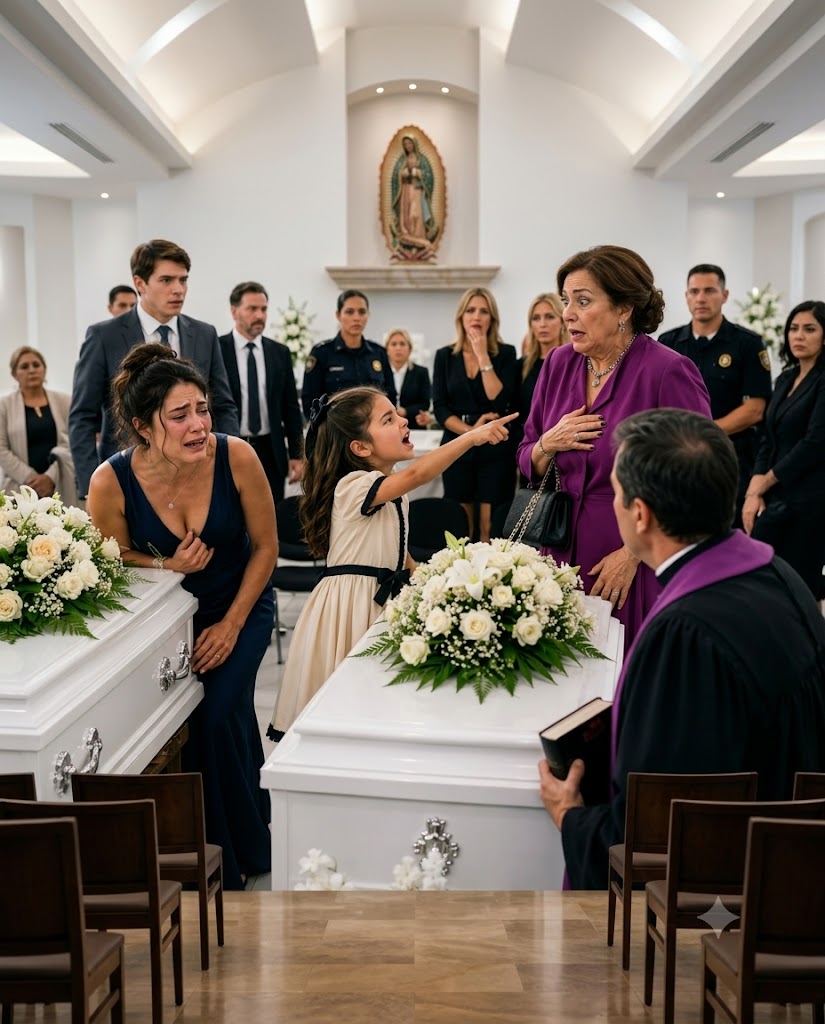
Doña Raquel's words pierced the funeral chapel like a knife.
No one said a thing.
Not the neighbors, nor the aunts, nor her husband’s cousins, nor the pastor who held the trembling Bible in front of two white coffins.
Fernanda Robles felt the air choke in her chest.
There lay her children, Diego and Bruno, her three-month-old twins, dressed in white outfits, surrounded by flowers, candles, and wreaths sent by people who had just a week ago congratulated her for having such a “beautiful family.”
The funeral home was in Toluca, near a noisy avenue filled with trucks and coffee vendors. Outside, life continued as if nothing had happened. Inside, Fernanda felt like the world had shattered forever.
Doña Raquel, her mother-in-law, stood next to the coffins in an elegant black dress, a silver rosary in hand, and her face perfectly made up.
She cried without tears.
Fernanda noticed that even amidst the pain.
—I warned you many times —Raquel continued, raising her voice—. A woman can’t raise three children if she’s tired, distracted, and wanting to do everything her way. But no one listened to me.
Several people lowered their gazes.
Others whispered.
—Poor lady, she really tried to help —murmured a neighbor.
—Fernanda always looked overwhelmed —said another.
Fernanda wanted to scream no. That she had cared for her babies every night. That she knew how many ounces they took, what time they woke up, when they breathed weird, when something was wrong.
She wanted to say that Raquel entered her home uninvited, moved her things around, corrected her in front of everyone, and made her feel useless.
But she couldn’t.
Her throat was closed.
Beside her, Julián, her husband, remained motionless.
He wore a gray suit, his gaze lost, hands crossed in front of his body. He didn’t defend Fernanda. He didn’t look at her. He didn’t say a word.
That hurt almost as much as the death itself.
Julián’s family filled the first half of the chapel. Folks from church, family meals, Sundays with pozole and fake smiles. They all seemed ready to believe that Fernanda had failed.
Her parents, Don Ramiro and Doña Elena, had arrived from Veracruz in the early morning. Her mother couldn’t stop crying. Her father looked at Raquel with silent rage.
Then a little cold hand took Fernanda’s fingers.
It was Sofía, her seven-year-old daughter.
The girl wore a simple black dress and shoes that pinched her feet. Her eyes were red, but she didn’t cry. She squeezed her mom’s hand three times.
It was their secret signal.
“I’m with you.”
Fernanda wanted to bend down to hug her, but Raquel spoke again.
—I went on Tuesdays and Thursdays to help them. I cleaned, organized, prepared bottles. But Fernanda never thanked me. Always with that victim face, as if someone were doing her harm.
Julián murmured:
—Mom, enough.
But he said it so softly it sounded like an apology, not a defense.
Raquel looked at him with false tenderness.
—No, son. There are truths that hurt. Your children would be alive if someone had put order in that house.
Fernanda felt something inside her break.
Then Sofía let go of her hand.
The girl walked slowly toward the pastor. The entire chapel watched. Fernanda tried to stop her, but she had no strength.
Sofía reached the front, pulled out an old cellphone from her little black bag, and spoke with a clarity that froze everyone’s blood.
—Pastor… can I show what my grandma Raquel put in my siblings' bottles?
Raquel turned pale.
Julián raised his head for the first time.
And Fernanda understood that the death of her babies hid a truth even more horrifying.
No one could believe what was about to happen…
PART 2
Three months before that funeral, Fernanda still thought her life was finally settling down.
She lived with Julián in a small house within a housing complex in Metepec. They had a yard with pots, a simple living room, and a sky-blue room for Diego and Bruno.
The twins had come after five years of treatments, tests, injections, loans, and sleepless nights crying in silence. Fernanda had endured cruel comments from Raquel throughout that time.
—A woman who can’t give her husband children should ask herself what she’s paying for —she once said in front of the whole family.
When Diego and Bruno were born, Julián cried as he held them.
—Now we’re complete, Fer —he said, kissing her forehead.
Fernanda wanted to believe everything would change.
But Raquel didn’t take long to show up.
At first, she came with blankets, medals of the Virgin, and meals “so you wouldn’t struggle.” Then she started to comment on everything.
—That’s not how you hold a baby.
—I don’t like that formula.
—You’re making them whiny.
—Sofía was already too old to be jealous, but you indulge her too much.
Fernanda worked from home making decorated cakes. Between orders, diapers, laundry, and sleepless nights, she felt like she was barely surviving. Still, she loved her children with a force she couldn’t explain.
Julián, a medical equipment salesman, traveled a lot to Querétaro, Puebla, and León. Every Tuesday and Thursday, he left before 6 in the morning.
And on those days, Raquel arrived.
One day, Julián handed her a copy of the key.
—My mom just wants to help, love. Don’t make a fuss.
Fernanda froze.
From then on, Raquel would enter without knocking. She’d rummage through drawers, move bottles around, throw away things she deemed “useless,” and take over the kitchen.
Sofía saw it all.
—Mommy, why does my grandma talk to you mean? —she asked one night.
Fernanda tried to smile.
—She doesn’t talk mean, sweetheart. She just has a different way of being.
Sofía scrunched her nose.
—No. She wants Dad to think you can’t take care of the babies.
Fernanda didn’t respond.
It hurt her that a little girl understood what her own husband refused to see.
One Thursday, Sofía pretended her stomach hurt so she wouldn’t have to go to school. Fernanda thought maybe she needed attention, so she let her stay home.
Around noon, the girl went to get water in the kitchen.
She stopped before entering.
Raquel was turned away, next to the table. She had two bottles open. Next to them was Julián’s briefcase, where he kept medical samples. She pulled out a little jar, crushed some pills with a spoon, and added the powder to the milk.
Sofía stood frozen.
Raquel saw her.
For a few seconds, she didn’t say anything.
Then she smiled.
—It’s vitamins so your siblings can sleep better. Good babies don’t bother.
Sofía didn’t answer.
That afternoon, Diego and Bruno slept too long. Fernanda tried to wake them for lunch, but they barely opened their eyes.
—See —Raquel said—. When one knows how to do things, the kids get discipline.
Fernanda felt fear, but when she told Julián, he sighed tiredly.
—Fer, really, don’t start. My mom raised three kids. She knows more than we do.
Sofía began to observe.
She saved an old cellphone Fernanda had let her use and started taking pictures from the hallway. She also wrote in a pink notebook everything she saw: dates, phrases, times, and how the babies slept after their grandma prepared the bottles.
Tuesday, June 4: “Grandma put in white powder. Said mommy was weak.”
Thursday, June 6: “The babies didn’t wake up to eat. Mommy got scared.”
Tuesday, June 11: “Grandma said if Dad got tired of mommy, she’d fix the house.”
The night before the death, Julián called from Puebla.
Fernanda looked at her twins sleeping, too still.
—Your children have slept so much —she said—. Something doesn’t feel right.
—You’re exhausted, love. Everything seems serious to you.
—It’s not that.
—Then let my mom help you. She’s not your enemy.
Fernanda remained silent.
At 5:13 in the morning, she woke instinctively.
She didn’t hear crying.
She didn’t hear movement.
Just silence.
She ran to the room and found Diego cold. Then Bruno just like him.
Her scream awakened Sofía, the neighbors, and everything that remained alive in that house.
The first investigation spoke of sudden death. Fernanda didn’t understand anything. Raquel arrived before anyone, hugged Julián, and then looked at Fernanda as if she already had a prepared sentence.
—I told you that you couldn’t —she whispered.
Now, in the chapel, Sofía held the cellphone in front of the pastor.
Raquel tried to approach.
—That girl is confused. She’s traumatized. Fernanda is using her.
Don Ramiro stepped in.
—You’re not touching my granddaughter.
The pastor looked at Sofía.
—Show it, dear.
The first photo appeared on the screen.
Raquel was in the kitchen, with two open bottles and the jar in her hand.
A murmur ran through the chapel.
—That doesn’t prove anything —Raquel said—. I was cleaning.
Sofía slid her finger.
The second photo was clearer. The label of the medication was visible: a strong sedative, one Julián carried as samples for doctors.
Julián staggered closer.
—Mom… what did you do?
Sofía showed another image. Raquel tilted the spoon over the bottle.
Then another. Closing it.
Another. Shaking the milk.
Another. Doing the same with the second.
Fernanda felt the floor drop away beneath her feet.
—Did you give my babies medicine? —she asked in a voice that didn’t seem like her own.
Raquel tightened the rosary.
—It was just to help them rest. They cried too much. You made them nervous.
—They were three months old —Fernanda shouted—. They were babies!
—And you didn’t know how to control them —Raquel retorted, losing her mask—. That house was a mess. My son worked; you spent your time crying, Sofía did what she wanted, and those kids screamed as if they owned everything.
The chapel exploded.
Doña Elena let out a heart-wrenching cry. An aunt of Julián began to pray. Someone called the police. Nadia, Julián’s sister, covered her mouth and said:
—Mom, tell me this is a lie.
Sofía pulled out the pink notebook.
—I wrote it down too.
Fernanda knelt beside her.
—My love…
—I’m sorry, mommy —the girl said—. I thought that if I gathered evidence, Dad would believe me.
That phrase destroyed Julián.
Sofía read with a trembling voice:
—Thursday, June 13. Grandma said: “Today they will sleep like angels, and your mom will stop playing the martyr.”
The silence was horrific.
Raquel tried to walk toward the exit, but two men blocked her way. Minutes later, police cars arrived, and an agent from the Prosecutor’s Office took the cellphone and the notebook as evidence.
—No one touches anything —she ordered.
Raquel began to scream that it was a trap, that Fernanda hated her, that Sofía was a manipulated girl.
But when they put the handcuffs on her, she still had the audacity to look at Fernanda.
—This is your fault. If you had been a good mother, I wouldn’t have had to intervene.
Fernanda didn’t respond.
For the first time, she didn’t need to defend herself.
The truth was already there.
The following days confirmed the worst. Toxicology tests revealed lethal levels of the sedative in Diego and Bruno’s bodies. They also found searches on Raquel’s computer about sleeping medications for babies, dangerous doses, and infant respiratory arrest.
It hadn’t been an accident.
It had been control.
Raquel wanted to prove that Fernanda was incapable. She wanted Julián to let her in more, decide more, control more. The babies weren’t people to her. They were a test in her war against her daughter-in-law.
Julián collapsed.
One afternoon, sitting in the living room, he looked at the empty cribs and began to cry.
—I gave her the key —he repeated—. I left the briefcase. I called you exaggerated.
Fernanda watched him from the door.
She would have run to comfort him before. She would have also carried his guilt.
But not anymore.
—Your mother killed them —she said—. But you opened the door every time I asked you not to.
Julián lowered his head.
—I know.
—You stayed silent when she humiliated me. You stayed silent at the funeral. You stayed silent until a seven-year-old girl had to do the adults’ work.
He couldn’t answer.
The trial came months later.
Raquel entered the courtroom dressed in black, as if she were still playing the role of the suffering grandmother. Her lawyer tried to say it had all been “a mistake,” that she just wanted to help, that Fernanda was unstable.
But then Sofía testified.
The girl walked to the front with a psychologist by her side. Before sitting down, she squeezed her mom’s hand three times.
Fernanda understood.
“I’m with you.”
Sofía talked about Tuesdays and Thursdays. About the bottles. About the jar. About her grandma’s phrases. About how her mom tried to wake the babies to eat. About how no one listened because Raquel spoke loudly, and everyone was afraid of her.
When they showed the photos, Raquel stopped looking at the judge.
The verdict was clear. Raquel was found guilty for the deaths of Diego and Bruno and sentenced to life in prison.
She didn’t cry for her grandchildren.
She screamed that they had ruined her life.
Julián signed the divorce weeks later. He didn’t fight for the house or the money. He only asked for therapy to be able to see Sofía someday, if she wanted.
Fernanda moved with her daughter to Veracruz, near her parents. They rented a small apartment in front of a quiet street, without spare keys, without imposed visits, without rosaries used as masks.
Sofía started therapy. She had nightmares about bottles and Raquel's voice. One night she asked:
—Mommy, do Diego and Bruno know that I tried to save them?
Fernanda hugged her so tightly she could barely speak.
—They know you loved them. And they know you were braver than all of us.
A year later, Fernanda began to tell her story in talks about domestic violence. She didn’t do it out of pity. She did it so other women could understand that abuse doesn’t always come with blows.
Sometimes it comes with advice.
With a key.
With phrases like “I just want to help.”
With a family that prefers to remain silent rather than discomfort the wrong person.
At Diego and Bruno’s grave, Sofía left a letter.
“Dear little brothers: they can’t hurt you anymore. I told the truth. I’m sorry for not saying it sooner. I love you so much. Your sister Sofía.”
Fernanda cried as she read it.
Because her children wouldn’t return.
But her daughter had achieved something many adults didn’t dare to do: to face the horror and speak the truth.
And sometimes, in a family, silence kills more than hatred.