PART 1
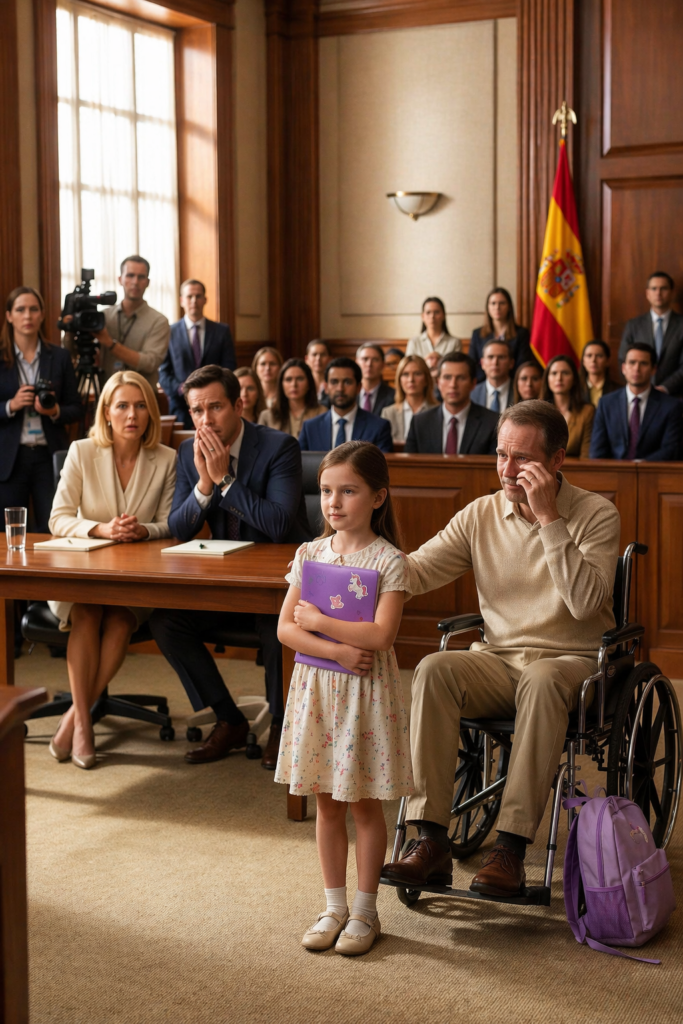
The Family Court in Mexico City was packed that morning, as if it were not a custody hearing but a national scandal.
In the hallways, there were cameras, lawyers with expensive briefcases, employees from a tech company, and relatives who hadn't visited in years but now showed up with concerned faces.
They all claimed to be there for Camila.
Camila Ríos was 7 years old, wearing a school uniform, a poorly done braid, and a pink backpack where she kept a purple folder covered in moon stickers.
The adults looked at her with pity.
They thought she understood nothing.
But Camila understood too much.
Her father, Gabriel Ríos, was seated in a wheelchair next to his lawyer. For the past 3 years, he had been living with amyotrophic lateral sclerosis.
His body had weakened gradually.
His hands no longer responded as they used to. His voice came out slower. Some days he needed help just to hold a glass.
But his mind was still intact.
He remembered meetings at LuzAlta, the software company he had founded from an apartment in the Portales neighborhood. He remembered contracts, passwords, birthdays, allergies, songs, and the name of the stuffed rabbit Camila hugged when it rained.
Still, that day his family wanted to use his illness as a weapon to take away the one thing he loved most.
Paola, Camila's mother, arrived in a white suit, high heels, and dark glasses even though they were indoors.
She had abandoned Gabriel when the girl was 2 years old.
She said she couldn't handle the illness.
She said she felt trapped.
She said she needed to breathe.
But for 5 years, she didn't attend school meetings, wasn't at the hospital when Camila had a peanut allergy reaction, didn't send birthday gifts, didn't ask about her homework, nor did she learn which story gave her nightmares.
Now she returned saying she wanted to rescue her daughter.
Beside her was Tomás Ríos, Gabriel's younger brother.
He wore the face of an exemplary uncle, but his eyes never sought Camila.
They looked at the judge.
They looked at Gabriel.
They looked, above all, at the documents of LuzAlta, the company now worth millions.
The plan was crystal clear, though no one said it out loud.
Paola would request custody.
Tomás would request temporary management of Gabriel’s assets and decisions due to supposed incapacity.
And between the two of them, they would take the girl, the house, the shares, and the control.
Judge Irene Maldonado entered the courtroom, and everyone stood.
She had a serious face, one of those women who had already seen too many families break apart over money.
“This hearing is not a theater,” she said. “This is not a place for posing for cameras. Here, we decide the well-being of a child.”
Paola lowered her gaze.
Tomás clenched his jaw.
Paola’s lawyer began first.
He said that Gabriel was an admirable man, but sick.
He said that Camila lived surrounded by medicines, nurses, and fear.
He said a child shouldn’t grow up watching her father fade away.
Then he showed photographs.
Camila opening the apartment door.
Camila reaching for a box of pills.
Camila pushing Gabriel’s wheelchair.
Camila next to a medication dispenser.
Murmurs filled the room.
It seemed terrible.
It seemed like a stolen childhood.
It seemed like a girl turned caregiver.
Gabriel closed his eyes.
Not because the photos were false, but because they were cropped.
Yes, Camila helped sometimes.
But she also went to school, took drawing classes, ate quesadillas with Lidia, the nurse who lived with them, watched movies on Fridays, and fell asleep listening to stories her dad read to her with an ever quieter voice.
Gabriel’s lawyer was about to respond when a tiny voice cut across the room.
“Excuse me, Your Honor.”
Everyone turned.
Camila stood up with her purple folder clutched to her chest.
Paola made a gesture of embarrassment.
Tomás let out a mocking laugh.
The judge looked at her carefully.
“What is it, Camila?”
The girl took a deep breath.
“I’m my dad’s lawyer.”
Some laughed.
A reporter even lowered his camera to cover his mouth.
But Camila walked to the front, placed the purple folder on the table, and opened the first section.
Then everyone saw there were no drawings.
There were receipts, message screenshots, complete photos, transcribed audios, and a letter signed by Paola accepting money from Tomás.
Laughter died abruptly.
And Paola turned pale when Camila pointed to a sheet and said:
“There’s how much they paid her to come for me.”
PART 2
Judge Maldonado raised her hand before Paola’s lawyer could shout an objection.
“Silence,” she ordered.
Nobody moved.
Camila remained standing by the table, her fingers trembling over the purple folder.
She didn’t seem like a child throwing a tantrum.
She seemed like a child tired of listening to lies told by adults who thought her age made her invisible.
Gabriel’s attorney, Héctor Salinas, approached slowly.
He didn’t snatch the folder from her.
He didn’t treat her like a baby.
He simply crouched in front of her and asked if she wanted him to explain what she had brought.
Camila nodded.
“But show everything,” she said. “Not just the ugly bits.”
The judge authorized a review of the material with caution, as it involved a minor.
Tomás turned red.
Paola placed a hand on her neck, as if the folder was choking her.
The first section showed the complete photos.
In the image where Camila reached for a box of pills, Lidia, the certified nurse, was also visible, reviewing the prescription and preparing a glass of water.
In the photo where Camila pushed the wheelchair, the full video showed Gabriel jokingly saying:
“Let’s see, captain, take me to the window.”
They only moved two meters.
Then Gabriel stopped the electric chair, sat her beside him, and showed her how Venus looked from the cloudy afternoon.
In the door image, Jacinto, the driver, was also seen entering with grocery bags.
Camila wasn’t holding a household alone.
She lived in a home where everyone did small things to help each other.
The second section had schedules.
Lidia covered mornings and nights.
Jacinto took Camila to school in Narvarte.
Mónica Treviño, the operational director of LuzAlta, handled any company emergencies.
The child psychologist, Dr. Valeria Sosa, visited Camila twice a month since Gabriel’s diagnosis.
There were invoices.
Contracts.
Medical reports.
Letters from teachers.
Photos of school festivals.
Pediatric check-up notes.
Everything indicated the same: Camila wasn’t living abandoned.
She lived in a different, complicated, fragile family, yes, but full of care.
Then Attorney Salinas opened the third section.
The atmosphere changed.
They were message captures between Tomás and Paola.
In one, Tomás wrote:
“If the girl stays with you, Gabriel breaks. I’ll request management due to incapacity, and you won’t struggle. LuzAlta will be in my hands.”
In another, Paola replied:
“I’m not going back to make a fool of myself for free. I need a guarantee.”
Then appeared a transfer of 350,000 pesos.
The concept read: personal support.
Paola’s lawyer stood up.
“Your Honor, this could be manipulated.”
The judge looked at him without blinking.
“Then it will be explained. But for now, it will be incorporated for review.”
Tomás let out a dry laugh.
“Please, we are talking about a 7-year-old girl. Someone manipulated her.”
Gabriel opened his eyes.
For the first time in the entire hearing, he spoke.
His voice came out rough, low, but firm.
“Don’t you dare say that about my daughter.”
The room froze.
Gabriel breathed with difficulty.
“Camila heard what you said in my hallway because you talked about money thinking a child wouldn’t understand. But she understands. And it hurts that she understands.”
Paola lowered her head.
The judge ordered a recess.
Outside, reporters gathered like flies around the door.
Paola tried to approach Camila.
“My love, you don’t know everything. I just wanted to protect you.”
Camila hid a little behind Lidia.
“Protect me from my dad or from being without money?”
The phrase was so simple it hurt more than a punch.
Paola didn’t answer.
Tomás did.
“That girl turned out cheeky because of Gabriel.”
Lidia stepped forward.
“Don’t mess with the girl.”
Tomás looked her up and down.
“You’re an employee.”
Lidia raised her chin.
“And yet I’ve been at her birthday more times than her mom and uncle combined.”
When they returned to the courtroom, the first witness was Dr. Mauricio Aranda, a neurologist recommended by Tomás.
He arrived in an impeccable coat, with a calm voice and an international resume.
He admitted that Gabriel had a progressive disease.
He admitted his mobility had reduced.
He admitted that in the future he would need more assistance.
But when Attorney Salinas questioned him, the facade began to crumble.
“Doctor, does Gabriel Ríos currently show cognitive deterioration?”
“No.”
“Can he make legal decisions today?”
“Yes, with physical support if fatigued.”
“Can you affirm he will lose his mental capacity in the next 6 months?”
“Not with certainty.”
“So you are talking about a future possibility, not a present incapacity.”
The doctor swallowed.
“Correct.”
Tomás stopped looking ahead.
Then Dr. Valeria Sosa testified.
She explained that Camila showed no signs of being forced to care for an adult.
She said she had worries, of course, because she loved her father and knew he was ill.
But she also said she was a secure, affectionate child with stable routines and a very clear understanding of who had stayed by her side.
“Camila does not reject her mother due to manipulation,” said the psychologist. “She observes her with caution from experience.”
Paola covered her mouth.
For a moment, it seemed to truly hurt her.
But some pains come too late.
And arriving late doesn’t erase 5 years of absence.
Paola’s lawyer insisted that a child shouldn’t live among ramps, medical devices, and nurses.
He said that wasn’t normal.
Then Attorney Salinas requested to show a video recorded 3 weeks earlier.
It was Camila’s 7th birthday.
Gabriel had prepared a treasure hunt in their Roma Sur apartment.
Each clue was hidden in an important place for her.
Under the keyboard where she practiced music.
Inside a book about planets.
Behind a box of cookies.
Next to a bougainvillea pot on the balcony.
Gabriel followed her in his motorized chair, laughing quietly when Camila ran too fast and skipped clues.
When she got stuck, he didn’t give her the answer.
He asked questions.
“What shines even when it’s far away?”
“Where do you keep what you don’t want to lose?”
“What did you see quickly but didn’t look at well?”
In the end, Camila found a telescope wrapped in silver paper.
She screamed so loudly that Lidia came running with a spoon in her hand.
Gabriel laughed until the cough forced him to stop.
Camila hugged him around the neck carefully.
Not with fear.
With that tenderness children learn when they love someone fragile.
The room fell silent.
That video showed what the cropped photos couldn’t.
It showed play.
It showed patience.
It showed an adapted childhood, yes, but not a destroyed one.
It showed a sick father creating joy with what he could still give.
The hearing continued the next day.
That night, Paola went to Gabriel’s apartment.
Camila didn’t receive her.
The girl was asleep.
Gabriel received her, with Lidia nearby for security.
Paola entered the living room like someone treading a place they once abandoned and discovered life didn’t wait for them.
She saw drawings stuck on the refrigerator.
She saw low shelves for Camila to reach her books.
She saw ramps.
She saw photos of festivals, vaccinations, piñatas, tasks, lost teeth, and burnt breakfasts.
In none did she appear.
Paola broke down.
At first, she didn’t apologize.
At first, she told the truth.
Tomás had approached her 4 months earlier.
He told her Gabriel was weak.
He told her the company needed “someone healthy.”
He told her she could get her daughter back and secure her future.
He promised her a house in Coyoacán, a high monthly allowance, and a share of the stocks if she supported the custody request.
Paola accepted.
Not because she had awakened as a mother.
Not because she missed Camila to the point of breathlessness.
She accepted because she had debts, because her new partner had left her, and because she was terrified of ending up with nothing.
“I told myself kids get used to things,” she confessed, crying. “I told myself she’d be fine with me even though I hadn’t been there. What a lousy mother I was.”
Gabriel didn’t insult her.
That was worse for her.
He just looked at her with exhaustion.
“Camila isn’t an emergency exit for your life, Paola.”
Then she truly cried.
Not like in court.
Not with pretty tears.
She cried with a broken face, like someone finally seeing the extent of the damage they caused.
The next day, before the judge delivered a ruling, Paola stood up.
Her lawyer tried to stop her.
She didn’t let him.
“Your Honor, I filed this request saying I was concerned for my daughter. The truth is I came back for money.”
The silence was brutal.
Paola continued.
“Tomás Ríos offered me financial security if I requested custody of Camila and supported him in controlling Gabriel’s decisions. I accepted. I wasn’t a mother for 5 years, and I didn’t become a good mother because Gabriel got sick.”
Tomás stood up, furious.
“Shut up, Paola! You’re sinking yourself!”
The judge banged the table.
“Mr. Ríos, one more word, and I will order you removed from the court.”
Paola trembled as she breathed.
“Gabriel has been the father I didn’t know how to be. Taking Camila away would be cruelty to both.”
Then she withdrew her petition.
Without Paola, Tomás’s plan fell apart.
Attorney Salinas presented more messages, transfers, and a draft act where Tomás had already prepared internal changes to take control of LuzAlta as soon as Gabriel was declared incapable.
The judge ordered copies sent to the Public Ministry for possible procedural fraud and attempted improper administration.
Tomás didn’t leave in handcuffs that day.
But he left defeated, with cameras following him to the sidewalk.
And sometimes public shame weighs more than handcuffs.
The ruling was clear.
Gabriel retained cognitive capacity.
His support network was sufficient.
Camila should remain in the home where she was known, heard, protected, and loved.
The judge called the girl to the front.
Camila walked slowly. Her shoes squeaked on the floor.
“Camila,” Judge Maldonado said, “being brave doesn’t mean carrying what isn’t yours to bear. But today you helped this court see the truth.”
Camila looked at her dad.
“I just didn’t want them to lie about him.”
The judge softened her voice.
“Family isn’t measured by who shares blood. It’s measured by who stays when life gets tough and by who puts a child before their ambition.”
Paola left through a side door.
Tomás left among cameras, unable to hide his face.
Gabriel and Camila left together.
Lidia walked behind with the purple folder in her arms, as if carrying something sacred.
That could have been the end.
But it wasn’t.
Eight years later, Camila Ríos appeared before a commission of the Mexico City Congress.
She was 15, wearing a navy blue blazer, her hair tied back, and the same now worn purple folder.
Behind her was Gabriel, weaker, his voice almost gone, but his gaze intact.
Camila spoke in favor of a reform for children and adolescents to truly be heard in custody, guardianship, and family care processes.
She asked for clear language.
She asked for psychological support.
She asked for independent advocates.
Some deputies said children were easy to manipulate.
That they didn’t understand legal matters.
That opening that door would complicate trials.
Camila asked for the microphone.
“They confuse age with awareness,” she said. “A child may not understand a file, but they do understand who hugs them when they tremble, who abandons them, and who shows up only when there’s money.”
The phrase went viral that same afternoon.
Months later, the reform was approved.
The press called it the “Camila Law.”
It made her uncomfortable.
Gabriel loved it.
Over time, father and daughter created a foundation to support minors in family trials.
Not just with lawyers.
Also with therapists, legal language translators, and adults willing to listen before deciding.
Paola changed little by little.
Not like in the movies.
There were no perfect hugs or immediate forgiveness.
She started by sending letters without requesting visits.
Then she sent a silver pen that had belonged to Camila’s grandmother, a rural teacher from Oaxaca who taught girls to read when almost no one listened to them.
In the note, she wrote:
“Words only matter when used to defend the truth.”
Camila didn’t forgive her immediately.
Maybe never completely.
But over the years, she understood something: growing up doesn’t always mean erasing the damage.
Sometimes it means not letting the damage dictate.
Tomás, later on, did something unexpected.
He donated 5,000,000 pesos to the foundation without conditions.
When Camila asked why, he answered with a voice that no longer sounded arrogant:
“Because I saw my niece defending other children and thought maybe I would have been less miserable if someone had defended me.”
Camila accepted the money.
She didn’t accept an apology he never knew how to say properly.
Gabriel lived long enough to see her graduate in law.
He lived long enough to be front and center when Camila won her first child defense case.
He lived long enough to tell her, with his voice turned to air, that LuzAlta wasn’t his true legacy.
“You are my legacy,” he told her. “And every child you don’t leave alone.”
He died two years later, at home, with Camila holding his hand and Lidia praying softly by the window.
On the day of the funeral, Camila placed the purple folder on her dad’s desk.
She no longer needed to carry it to be believed.
But she never threw it away.
Five years later, leaving Congress as a newly sworn legislator, a reporter asked what had started it all.
Camila smiled.
She didn’t think of politics.
She didn’t think of money.
She thought of a sick dad who still read her stories.
She thought of a girl who knew exactly who loved her.
She thought of a room full of adults laughing at a purple folder.
And she thought of the silence that followed, when the truth lay open on the table.
At 7 years old, Camila Ríos said in a courtroom:
“I’m my dad’s lawyer.”
She wasn’t a lawyer yet.
But she was telling the truth.
And in a family where everyone wanted to use a man’s illness to take away what he loved most, the truth was enough to start justice.