PART 1
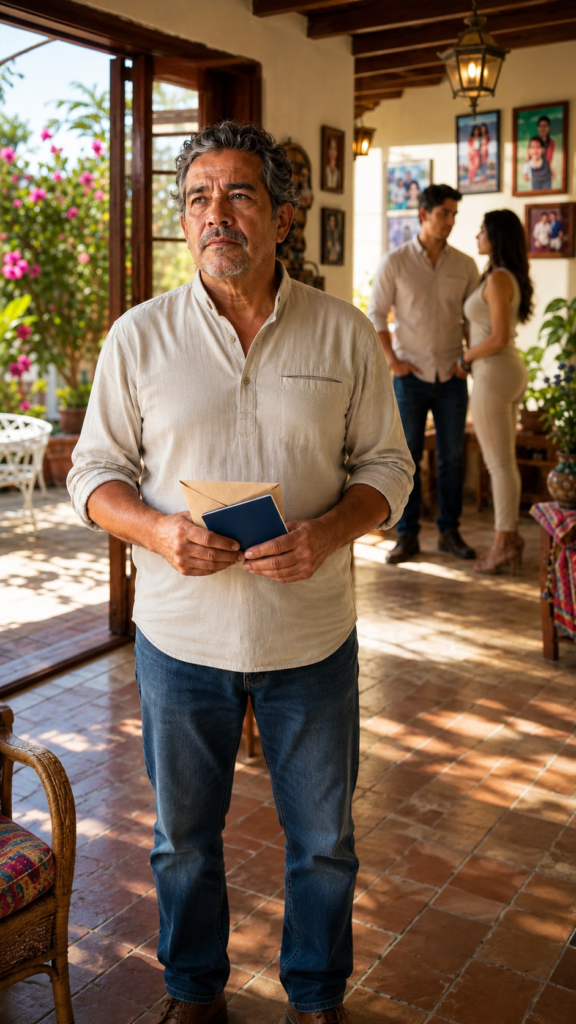
Don Manuel Rivera was 52 years old when he received the news he never imagined he would hear.
His older brother, Julián, had died in San Blas, Nayarit, after spending half his life working among boats, nets, and the smell of salt. They hadn’t communicated much, but Julián never forgot the younger brother who became a widower at a young age and raised his son alone.
That morning, in a bank branch in Tepic, Don Manuel received a notebook, several documents, and a sum of money that made his hands tremble.
He wasn’t a movie millionaire.
But for a man who had counted coins to buy beans, tortillas, and medicine, this inheritance felt like a miracle.
As he traveled back to Guadalajara by bus, Don Manuel could only think about his family.
He thought about fixing the house in the Oblatos neighborhood, replacing the metal roof in the backyard, painting the rooms, buying a new washing machine for Paola, and opening a savings account for his two grandsons.
He didn’t want to show off.
He wanted to share.
He had built that house himself, brick by brick, after years of working as a mason, loader, and night watchman. He had raised Ricardo, his only son, since his wife died when the boy was only three years old.
So, when he arrived that night, he tucked the documents into a blue folder and walked toward Ricardo’s room.
He was excited.
He even smiled before knocking.
But he stopped when he heard Paola’s voice, his daughter-in-law.
—Seriously, Ricardo, how much longer is your dad going to live here? We don’t have any privacy. The kids can’t even run without him getting in the way. The house feels like it still belongs to him.
Don Manuel froze.
Ricardo spoke quietly.
—Well, it is his, Paola. He built it.
—Oh, don’t start with that. You’re his only son. One day it will be yours. It’s better if he gets used to it. Find him a cheap little room, or put him in a nursing home. Something. But I don’t want him here anymore.
The silence weighed like fresh cement.
Then Ricardo said something that shattered his father’s heart.
—I can’t just kick him out like that… but yeah, the truth is he’s already a burden.
Don Manuel clutched the folder to his chest.
There were the papers for the inheritance he had thought to use for them.
There was the future he wanted to gift them.
And behind that door was the son for whom he had gone without food many nights, the boy for whom he had walked in the rain with a cheap cake because he couldn’t afford a taxi.
Paola spoke again.
—Tell him tomorrow. If he gets sentimental, just give him 1,500 a month and that’s it. He needs to understand that we deserve to live too.
Don Manuel didn’t knock.
He didn’t shout.
He didn’t demand.
He just stepped back slowly, as if he had just entered a stranger's house.
He went out to the backyard, looked at the lemon tree he had planted the day of his wife’s funeral, and felt something inside him extinguish.
That night he didn’t sleep in his little room next to the laundry.
He packed two changes of clothes into an old backpack, tucked the blue folder away, and left without making a sound.
Before closing the door, he heard his youngest grandson call from the hallway:
—Grandpa, are you leaving?
Don Manuel bent down, kissed the boy’s forehead, and answered with a broken smile.
—I’m just going for a little walk, my boy.
But when he crossed the street, he understood he wasn’t going for a walk.
He was going to disappear from the lives of those who had already erased him first.
PART 2
Don Manuel arrived in Mazatlán two days later, with tired eyes and the backpack slung over one shoulder.
He didn’t choose that place for tourism.
There lived Ernesto, an old work friend, one of those who don’t ask too many questions when they see a man with a face in pieces. They had worked together on a construction site near the boardwalk over 20 years ago when they both still believed their bodies could withstand everything.
Ernesto opened the door to his home, and upon seeing Don Manuel, he didn’t say, “What happened?”
He just hugged him.
—Compadre, that face isn’t from vacation.
Don Manuel let out a sad laugh.
—I came to remember who I am.
During the first few days, he didn’t talk much.
He walked along the boardwalk at dawn, watched the boats return with fish, and sat on a bench with a cup of coffee. The sound of the sea reminded him of his brother Julián, whom he hadn’t visited as much as he should have.
One afternoon, Ernesto asked about the blue folder.
Don Manuel placed it on the table and told him everything.
The inheritance.
The idea of fixing the house.
The voices behind the door.
The phrase that continued to buzz in his head: “he’s already a burden.”
Ernesto pressed his lips together.
—Look, Manuel, there are children who get so used to your sacrifices that they confuse them with obligation.
Don Manuel lowered his gaze.
—I didn’t want them to thank me every day. I just didn’t want to be treated like old furniture.
That same week, he received another call from the notary in San Blas.
The man spoke seriously, as if correcting a grave mistake.
—Don Manuel, there are additional documents. Your brother Julián didn’t just leave you money.
Don Manuel straightened up.
—What do you mean, not just money?
—He also left in your name 60% of a fishing cooperative, three commercial premises in downtown San Blas, and a trust that generates monthly income. Everything is legally transferred.
Don Manuel was left breathless.
His whole life he had thought about surviving.
And suddenly, without asking for it, he had enough to live comfortably, to help, and to decide without asking for permission.
But the money didn’t give him immediate joy.
It gave him clarity.
The next day he visited a modest nursing home in Mazatlán. Ernesto knew the director, a woman named Madre Socorro, even though she wasn’t a nun. They called her that because she had spent 18 years caring for elderly people whom their families had left “for a little while” and never returned.
Don Manuel entered thinking he was only going to donate paint.
He left with his heart in pieces.
He met Don Chema, who kept a plastic bag with little cars for a grandson who was now 22 and had never come to see him.
He met Doña Lupita, who styled her hair every Sunday because her daughter “surely was coming this time.”
He met a man who asked every day if it was Christmas because his family promised to pick him up in December… six years ago.
That night, Don Manuel couldn’t sleep.
Not just from sadness.
But because he understood that his pain wasn’t unique.
It was a silent epidemic.
The next day he spoke with the notary and a lawyer in Mazatlán. He asked to organize his assets, protect the inheritance, and create a fund to support abandoned elderly people.
He also did something he had never done before.
He changed his will.
Not out of revenge.
Out of dignity.
As Don Manuel began to rebuild himself, in Guadalajara the house filled with tension.
Paola pretended to feel relieved in the first days.
—See, Ricardo, he left on his own. We didn’t even have to say anything.
Ricardo tried to believe her.
But every corner of the house reminded him of his father.
The broken step that Don Manuel had fixed with an improvised mixture.
The door he had varnished at Christmas.
The table where he taught him math when Ricardo failed in middle school.
One night, his eldest son, Emiliano, 7 years old, asked:
—Dad, did Grandpa leave because we didn’t want him anymore?
Ricardo was left speechless.
Paola answered from the kitchen:
—Don’t say things like that, my love. Your grandpa left because he wanted to.
But the boy lowered his voice.
—I heard when you said you were going to send him away.
Ricardo slowly turned to Paola.
She went pale.
—Kids make things up.
Ricardo didn’t respond, but from that day on, he started sleeping poorly.
Three weeks passed.
Don Manuel didn’t answer calls.
He only sent a brief handwritten letter:
“Ricardo:
I’m fine.
Don’t look for me out of guilt.
Don’t talk to me out of need.
If one day you want to see me, let it be because you still remember that I am your father.
Dad.”
Ricardo read that letter twelve times.
Paola read it once and threw it on the table.
—How dramatic. He should be thankful we gave him a roof.
Ricardo looked at her as if he didn’t recognize her.
—Did we give him a roof? He built this house.
—Well, you’re his son. Don’t be foolish. Besides, he’s old. Sooner or later, everything will be ours.
That phrase was the first real crack in the marriage.
But the true explosion came two months later.
A neighbor, Doña Meche, arrived with hot gossip.
—Paola, did you hear? They say Don Manuel is in Mazatlán living like an important man. That he put money into a cafeteria for old people and that he even appears on the municipality’s website.
Paola took her phone and searched.
There it was.
A photo of Don Manuel, in a white shirt, smiling alongside several elderly people in front of a new sign:
“Comedor Dignidad Don Julián Rivera.”
Below, a note mentioned the support of a wealthy heir from a fishing cooperative in San Blas.
Paola felt her stomach turn.
Not from excitement.
But from ambition.
That night she showed the post to Ricardo.
—Did you know this?
Ricardo read in silence.
His eyes filled with tears as he saw his father smiling in a way he hadn’t seen in years.
—He looks good —he said barely.
Paola slammed her hand on the table.
—Don’t be stupid, Ricardo! Your dad has money. A lot of money. And he’s spending it on strangers.
—They are abandoned elderly people.
—And what about us? We are his family.
Ricardo raised his gaze.
—Family? You wanted to kick him out.
Paola didn’t stop.
The next day she contacted a lawyer known to her cousin. She asked if they could challenge the decisions of an elderly person for “possible mental deterioration.” The attorney, unethical and too hungry for money, told her that if they could prove abandonment, confusion, or external manipulation, they could try to control his assets.
Paola didn’t need more.
She began to fabricate a story.
She told neighbors that Don Manuel had gone “missing.”
She posted on Facebook that they were worried because the old man “wasn’t well mentally.”
She even searched for old photos where Don Manuel looked tired or poorly dressed to imply neglect.
Ricardo found out when his phone filled with messages.
“Hey, does your dad have dementia?”
“Has Don Manuel shown up?”
“How sad that an old man is alone with money.”
Ricardo confronted Paola in the living room.
—What did you do?
She didn’t flinch.
—What you don’t have the guts to do. If your dad is giving away money, someone needs to protect him.
—Protect him or steal from him?
Paola slapped him.
The children listened from the hallway.
That night, Ricardo did something he should have done from the start: he traveled to Mazatlán.
He arrived at the community cafeteria on a Friday afternoon. Don Manuel was serving red rice to several elderly people, wearing a simple apron and a peace that hurt Ricardo more than any shout.
When Don Manuel saw him, he didn’t smile.
Nor did he kick him out.
He simply said:
—You’re here.
Ricardo approached with wet eyes.
—Dad, I’m sorry.
Don Manuel set the ladle down on the table.
—Why are you here, Ricardo? Because you miss me or because you found out about the inheritance?
The question pierced him.
Ricardo swallowed.
—At first… I don’t know. I was confused. But when I saw what Paola did, I understood that if I didn’t come now, I would lose you forever.
Don Manuel took him for a walk along the boardwalk.
Ricardo cried there like a child.
He confessed that he had allowed too many humiliations. That Paola had been telling him for years that Don Manuel was a burden, that he hadn’t defended him, and that he was ashamed to admit it.
—When Mom died, you didn’t let me fall —Ricardo said—. And I let you fall.
Don Manuel closed his eyes.
It hurt to hear that.
But it was also the first clean truth he had received from his son in a long time.
—Son, love isn’t shown by crying when everything is broken. It’s shown when someone is still there, sitting at the table, waiting for a place.
Ricardo lowered his head.
—I know.
Then Don Manuel revealed his own decision.
The house in Guadalajara would remain his. He wouldn’t sell it because his grandchildren lived there. But Ricardo would have to pay a symbolic rent to the elderly fund, take care of the expenses, and sign an agreement acknowledging legally that the property belonged to Don Manuel.
The inheritance wouldn’t automatically pass to Ricardo.
Seventy percent would go to the Julián Rivera Foundation for abandoned elderly people.
Twenty percent would be for his grandchildren’s education, protected in a trust.
And only ten percent would be available for Ricardo if, with actions and not just words, he rebuilt his relationship with his father.
Ricardo accepted, crying.
Not for the money.
For the shame.
But Paola didn’t accept.
When she found out about the agreement, she lost control.
She traveled to Mazatlán with her mother and a lawyer. She arrived at the cafeteria wearing dark glasses, an expensive bag, and a victim’s tone.
—Don Manuel, we came to rescue you. You’re not thinking clearly. These people are taking advantage of you.
The elderly people stopped eating.
Madre Socorro stood up.
Don Manuel calmly wiped his hands.
—Paola, no one took anything from me here. They returned something that had been taken from me in my own home.
—What thing?
—Dignity.
Paola smiled with contempt.
—You’re confused. We have proof that you left without notice, that you’re giving away money, and that you need family supervision.
Then came the twist no one expected.
Don Manuel’s lawyer entered with two people from the Prosecutor’s Office and a social worker.
Doña Meche, the neighbor, was also there.
And she had an audio on her phone.
The night Paola and Ricardo spoke behind the door, Doña Meche was in the adjacent yard watering her plants. She had recorded part of the conversation because Paola had been saying for weeks that Don Manuel “was stealing food” and she wanted proof of her mistreatment.
The audio was clear:
“Find me a cheap little room for him, or put him in a nursing home.”
And then Paola’s voice:
“If he gets sentimental, just give him 1,500 a month and that’s it.”
Paola turned pale.
But that wasn’t all.
The Prosecutor’s Office had screenshots of her false posts, messages to the lawyer where she inquired how to declare Don Manuel incapable, and a suspicious transfer that Paola had made from Ricardo’s account to pay for the initial procedure.
Ricardo looked at his wife with disgust.
—Did you use my account?
Paola exploded.
—I did it for us! That money should belong to the family, not to a bunch of strangers!
Don Chema, from a table, raised his voice with sadness.
—Honey, those old strangers were once family to someone too.
The cafeteria fell silent.
Paola was summoned for falsehood, attempted fraud, and moral damage. Her lawyer disassociated himself as soon as he saw the evidence. Her mother, who had arrived very angry, ended up sitting outside, not knowing whom to blame.
Ricardo returned to Guadalajara with his children and asked for a separation.
It wasn’t a pretty ending.
It was a necessary ending.
For months, Ricardo traveled to Mazatlán every two weeks. At first, Don Manuel received him coldly. There were no long hugs or easy forgiveness. Just coffee, walks, and awkward conversations.
But over time, something began to heal.
Emiliano and his little sister visited the cafeteria one Sunday. They brought drawings for the grandparents. Emiliano hugged Don Manuel and said:
—Grandpa, my dad doesn’t say you’re a burden anymore.
Don Manuel looked at Ricardo.
Ricardo lowered his eyes, broken.
Don Manuel stroked the boy’s hair.
—No one is a burden where they are truly loved, my dear.
A year later, the Comedor Dignidad was feeding more than 80 elderly people a week. The fishing cooperative financed medicines, consultations, and workshops. The commercial premises paid fair wages to caregivers.
Don Manuel never bought a luxury truck.
He never moved into a mansion.
He only rented a small apartment by the sea, with a hammock, a coffee maker, and a photo of his wife alongside a pot of lemons.
One afternoon, Ricardo asked him if he would ever fully forgive him.
Don Manuel looked at the sunset over Mazatlán.
—I’ve already forgiven you, son. But forgiving doesn’t mean leaving the door open again for someone to trample me.
Ricardo nodded, crying silently.
That was the lesson that hurt him the most to learn.
That a father can love with all his heart and still set boundaries.
That blood doesn’t give the right to humiliate.
And that sometimes, the greatest inheritance isn’t the money someone receives, but the courage to understand, even if it’s late, that no one who gave their life for a family deserves to end up being treated like a burden.