PART 1
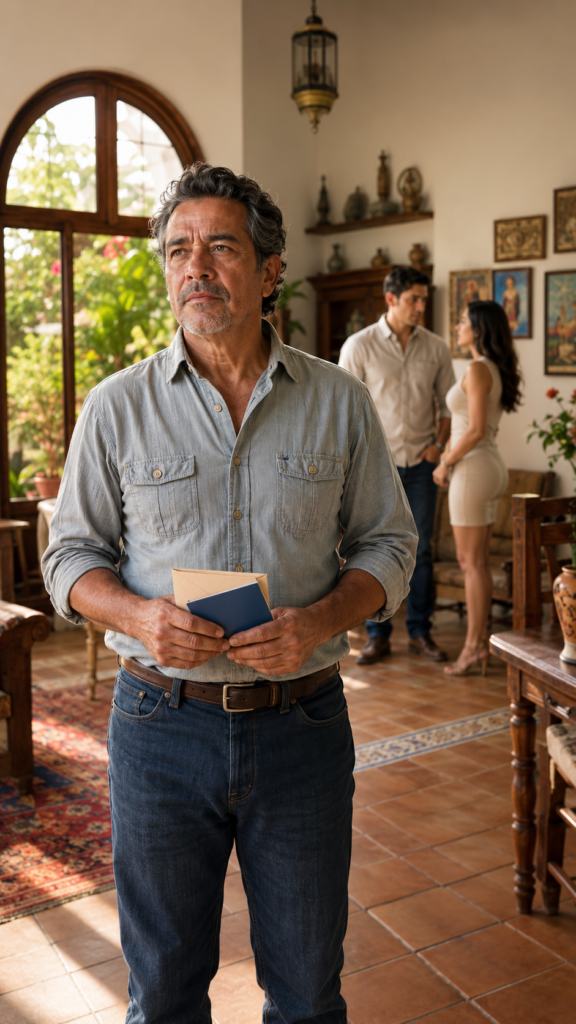
At 52 years old, Manuel Ortega thought life was finally giving him a break.
That morning, he walked out of the bank with a ledger in his hands and a figure he had to read four times to believe. His older brother, who had passed away weeks earlier in San Blas, Nayarit, had left him an inheritance that Manuel never imagined receiving.
On the way home, he thought of Ricardo, his only son, Paola, his daughter-in-law, and his two grandchildren.
He didn't want to brag.
He wanted to fix the leaky roof, replace the rusted windows, and expand a room so the kids wouldn’t have to sleep cramped together. He even imagined taking them on vacation to Mazatlán for the first time.
That humble house on the outskirts of Tepic was built by his own hands.
First, he constructed a room with used bricks. Then he added the kitchen, the bathroom, and the patio where the lime tree he planted when his wife died still grew.
Manuel had been a widower when Ricardo was just two years old.
Since then, he worked as a bricklayer, a loader at the Central de Abasto, and a tool repairman. There were days when he ate nothing but tortillas with salt so his son wouldn’t go without milk or notebooks.
That night, he stored the bank ledger in a folder and walked toward Ricardo's bedroom.
He was about to knock when he heard Paola's voice.
—How much longer is your dad going to live here? We don’t fit anymore, and he’s always interfering with the kids. This house doesn’t even feel like ours.
Manuel froze.
Ricardo took a moment to respond.
—He's my dad, Paola. I can’t just kick him out like that.
—Then find him a little room. We’ll give him something every month, and that’ll be that. He’s old, man. What more does he need? Plus, when the house is in your name, we can sell it and buy something better.
Manuel's heart hit a dead stop.
When the house was in Ricardo’s name?
The deed was still stored in a metal box beneath his bed. He had never ceded ownership.
Then he heard his son say something even worse.
—Let me talk to him. I’ll tell him we need to mortgage it and that he has to sign some papers. That way we can put it in my name without him suspecting.
Paola let out a brief laugh.
—Exactly. And then we can rent him a room far away. After all, he always says he’d do anything for you.
Manuel felt the hallway tilt beneath his feet.
For thirty years, he had lived for that son.
He had turned down jobs out of state so as not to leave him alone, sold his wife’s tools to pay for his college, and allowed Ricardo to come back home with his family when he lost his job.
Now they were plotting to deceive him and take away the only thing he had built.
He didn’t open the door.
He stepped into the yard, sat beneath the lime tree, and pressed the folder against his chest. He didn’t cry; the pain was too deep to turn into tears.
That night, he walked to a bench by the Mololoa River.
For the first time, he remembered that before being a father, a grandfather, and a provider, he was also Manuel.
The next morning, he went to the bank, changed access and provisional beneficiaries. Then he visited a notary to protect the house and review the entire inheritance.
Upon returning, Ricardo was waiting for him with some documents on the table and a smile that Manuel would never look at the same way again.
—Dad, I need you to sign this. It’s just a formality to help the family.
Manuel took the pen, read the first page… and discovered that his own son had already forged his signature.
PART 2
Manuel didn’t raise his voice.
He set the pen down on the table and pretended to search for his glasses to hide the trembling of his hands.
—I’ll review them later.
Ricardo tried to stop him.
—There’s no need to read so much, Dad. It’s just a power of attorney to process the mortgage.
Paola appeared from the kitchen.
—It’s for everyone’s good, Mr. Manuel. Seriously, don’t distrust your own son.
Manuel put away the documents and left without arguing.
That same day, he took them to Attorney Gabriela Salcedo, the notary who was reviewing the inheritance. It took her only a few minutes to confirm the truth: it was a broad power of attorney to sell, mortgage, and transfer the house.
On two pages, there was a forged signature and an old copy of his identification.
—This isn’t a family matter —Gabriela warned—. It’s an attempt at fraud.
Manuel lowered his gaze.
—He’s my only son.
—And he’s an adult who knows what he’s doing.
She advised him to report it. Manuel still didn’t want to.
He didn’t seek to destroy Ricardo, but he needed to know how far he would go.
He updated the deed, placed the property into a personal trust, and established that no one could sell it without his presence and certified authorization.
Then he bought a ticket to Mazatlán.
At home, he said he would help Ernesto, an old friend from the port, for a few days. Paola smiled with a relief she couldn’t hide, and Ricardo didn’t even accompany him to the bus station.
Manuel left with a backpack, three changes of clothes, and the folder that contained the inheritance and evidence of the betrayal.
Before closing the gate, he looked at the lemon tree he had planted when his wife passed away.
He had spent thirty years fulfilling the promise not to abandon his son.
But staying to allow himself to be humiliated wasn’t love.
It was forgetting oneself.
Ernesto lived near the boardwalk in Mazatlán. When he saw him at the door, he didn’t ask questions.
He just hugged him.
—Compadre, that face isn’t one of vacation.
—I need to start over.
For several days, Manuel walked along the shore, sipped coffee while watching the boats, and slept straight for eight hours.
No one called him a burden.
No one made him feel like he had to ask permission to exist.
One afternoon, he received a call from Gabriela.
His brother hadn’t just left him money. He was also the owner of three commercial properties, a majority stake in a fishing cooperative, and a trust with monthly income.
The wealth was enough for Manuel to live comfortably for the rest of his life.
Ernesto heard the news and warned him:
—Money changes people.
Manuel slowly shook his head.
—It doesn’t change anyone. It only reveals what was already inside.
Instead of buying a luxury car, he visited a nearby nursing home.
The walls were damp, the beds were old, and the dining room barely served beans and rice.
One man hadn’t received a visitor in seven years.
A woman dressed up every Sunday because her son promised to come “next week.”
Another elderly man kept a doll for a granddaughter who no longer answered his calls.
Manuel left with his heart shattered.
He paid for the bathrooms to be repaired, bought mattresses, and funded a community kitchen for elderly people living alone.
In less than three months, the neighbors began to call him “Don Manuel, the one from the dining room.”
He always responded:
—I’m just giving back a little of what life has given me.
Meanwhile, in Tepic, Ricardo and Paola enjoyed the empty house.
Paola took over Manuel’s room, threw out several boxes of his things, and called an agent to ask how much the property was worth.
The problem arose when they tried to initiate the mortgage.
The bank rejected the documents. The house was protected, and the forged signature had been recorded as an irregular transaction.
The notary warned Ricardo that any new attempt would be reported.
Paola exploded.
—Your dad set us up!
Ricardo looked at her as if he had just woken up.
—No. We wanted to deceive him.
—You forged the signature.
—Because you said it was the only way.
—And you accepted.
The argument ended with a slammed door.
That night, Ricardo found a letter under the mattress.
“Dear son:
I’m fine.
I needed to discover if I could still walk alone.
Don’t look for me out of obligation, fear, or money.
If one day you come, let it be because you truly want to see me.
Dad.”
Ricardo read those lines five times.
Then he remembered his ninth birthday.
It was raining so hard that the streets looked like rivers. Manuel arrived soaked with a small cake.
When the boy asked why he hadn’t bought an umbrella, his father smiled.
—Because then I wouldn’t have enough for the candles.
The memory broke him.
But before he could call Manuel, Paola came in waving her phone.
A local page showed Don Manuel inaugurating the dining room. The article mentioned the cooperative, the properties, and the trust.
Paola’s eyes widened.
—Your dad is rich.
Ricardo felt ashamed as he heard how his voice changed.
—A minute ago, you said he set us up.
—Call him. Tell him the kids miss him.
—Do they miss him, or do you miss him now that you know how much he has?
Paola didn’t answer.
Days later, she convinced him to travel to Mazatlán.
—You apologize, and we fix this as a family.
—Fix what?
—The inheritance, dude. You’re his only son. Everything should be yours.
For the first time, Ricardo clearly heard the ambition he had preferred to ignore before.
Still, he went.
He wanted to see his father, even though he no longer knew if it was remorse or fear of losing everything that drove him.
They found Manuel serving food in the nursing home’s courtyard.
He wore a simple shirt, a sauce-stained apron, and a smile that Ricardo hadn’t seen since he was a child.
Paola ran to hug him.
—Mr. Manuel! The kids are devastated without you.
Manuel didn’t return the embrace.
—I called twice. Neither of you wanted to answer.
Paola froze.
Ricardo asked to speak to his father alone.
In front of the sea, he apologized. He said he was under pressure, that Paola manipulated him, and that he would never have really used that power of attorney.
Manuel listened.
Then he took out a recorder.
Months earlier, he had installed a camera in the living room due to thefts in the neighborhood. The device had captured the entire conversation.
Ricardo’s voice rang out with absolute clarity:
—I’ll tell him to sign. If he doesn’t understand, better. Once the house is in my name, we’ll see where to put him.
Ricardo paled.
—Dad, I…
—Don’t place all the blame on Paola. That voice is yours.
At that moment, Gabriela and Ernesto approached.
The notary carried a file.
Manuel had decided not to press charges for the forgery, as long as Ricardo acknowledged the facts and renounced any claim to the house.
Paola let out a laugh.
—You can’t leave your son with nothing! That house belongs to him too.
Manuel stood up.
—No. I built it. You lived there without paying rent for eight years.
—But we’re your family!
—Family doesn’t forge signatures to kick an old man out of his home.
Paola lost control.
—You’re getting old! Why do you want so many properties? Ricardo is your blood.
An elderly woman named Teresa, who had been listening from a table, took Manuel’s hand.
—Blood doesn’t give permission to humiliate anyone, dear.
Ricardo stopped Paola before she could respond.
—Enough. We did this, not my dad.
For the first time, he accepted his guilt without excuses.
He signed the declaration and handed over the keys.
Manuel explained to him that he wouldn’t disinherit him out of revenge, but he wouldn’t reward his betrayal either.
He had created a foundation to support the nursing home, the dining room, and vocational scholarships for underprivileged youth.
The house in Tepic would become, after his death, a temporary home for abandoned elderly people.
Ricardo would receive only a fund for the education of his two children, managed by a third party. Paola wouldn’t be able to touch it.
—Are you going to give everything to strangers? —she shouted.
Manuel looked at her calmly.
—Strangers gave me a place at their table when my family wanted to take my chair.
Paola stormed out, hurling insults at him.
Ricardo didn’t follow her.
He stood before his father, crying like the nine-year-old boy he once was.
—I don’t want your money. I want to know if you’ll ever be able to forgive me.
Manuel took his time to respond.
—Forgiveness doesn’t mean immediately trusting again.
Ricardo nodded.
In the following months, he found a job, rented an apartment, and started therapy. Paola filed for divorce when she realized there would be no fortune for her.
Ricardo visited Mazatlán every two weeks.
At first, Manuel barely spoke to him. Then they repaired some dining tables together and resumed having coffee by the sea.
Trust didn’t return all at once.
It was rebuilt like that old house: brick by brick, with effort, patience, and calloused hands.
One year later, Ricardo brought his children to the dining room.
The youngest hugged Manuel and asked why he helped so many people.
Don Manuel looked at the tables filled with faces that no longer waited alone on Sundays.
—Because no one should feel like a burden in the place where they gave their life.
Ricardo listened with moist eyes.
He had lost an inheritance, a home, and the right to demand.
But he still had the chance to become a different kind of son.
Manuel understood that defending his dignity hadn’t left him without family.
It had shown him who came for love, who for interest, and who was truly willing to change.
Because parents can give everything for their children.
What they should never give up is their right to be respected.