PART 1
—In this house, we do what I say, Mom. It’s that simple.
Doña Carmen heard that phrase the first night she arrived at her son Ricardo’s apartment in Del Valle, and she felt something tighten in her chest.
Ricardo said it while pouring wine, smiling as if it were a joke. But Carmen recognized that tone. She had heard it for 28 years in the voice of her late husband, Rogelio.
At 67, she had just sold her little house in Toluca and agreed to move in with her son because he insisted too much.
—You can’t live alone anymore, Mom. Something could happen to you. Plus, Paola and I want to take care of you.
Paola, his wife, had nodded with a sweet smile.
—Come on, Doña Carmen. You’ll be in good company. I promise you’ll lack for nothing.
Carmen accepted for Paola, not for Ricardo.
From the first day, she noticed that the apartment looked like something from a magazine: shiny floors, huge windows, a beige living room, an immaculate kitchen. Everything was in its place, except for tranquility.
Ricardo was the commercial director of a pharmaceutical company. He always spoke loudly, always made decisions, always corrected.
—Paola, my mom takes her coffee without sugar. Is that so hard to remember?
—Sorry, love.
—Paola, don’t make that face.
—Yes, sorry.
—Paola, when I speak, you listen.
And Paola would lower her gaze.
Carmen noticed small but painful details. Paola’s hands trembled as she served the soup. She quickly closed her phone when Ricardo came in. She wore a sweater even though it was hot. She asked for permission even to buy bread.
One night, Carmen woke up suddenly.
It was 3:00 AM.
The shower was running.
The sound of water hit hard, as if someone was trying to wash something away.
Carmen sat up in bed. She thought Ricardo might be up late working. The next morning, during breakfast, she cautiously asked:
—Son, did you take a shower in the middle of the night?
Ricardo didn’t even look at her.
—Stress, Mom. Don’t start with your weird questions.
Paola dropped her glass of juice.
It shattered against the floor.
Ricardo slowly got up.
—See? That’s why you can’t do anything right.
Paola knelt to clean up, murmuring apologies. Carmen wanted to help her, but Ricardo placed a hand on her shoulder.
—Let her. She needs to learn.
That phrase chilled her blood.
The next morning, it happened again.
3:00.
Water.
A dry thud.
A muffled moan.
Carmen walked barefoot down the hallway. The bathroom light spilled out from under the door. It wasn’t shut properly.
She approached the crack.
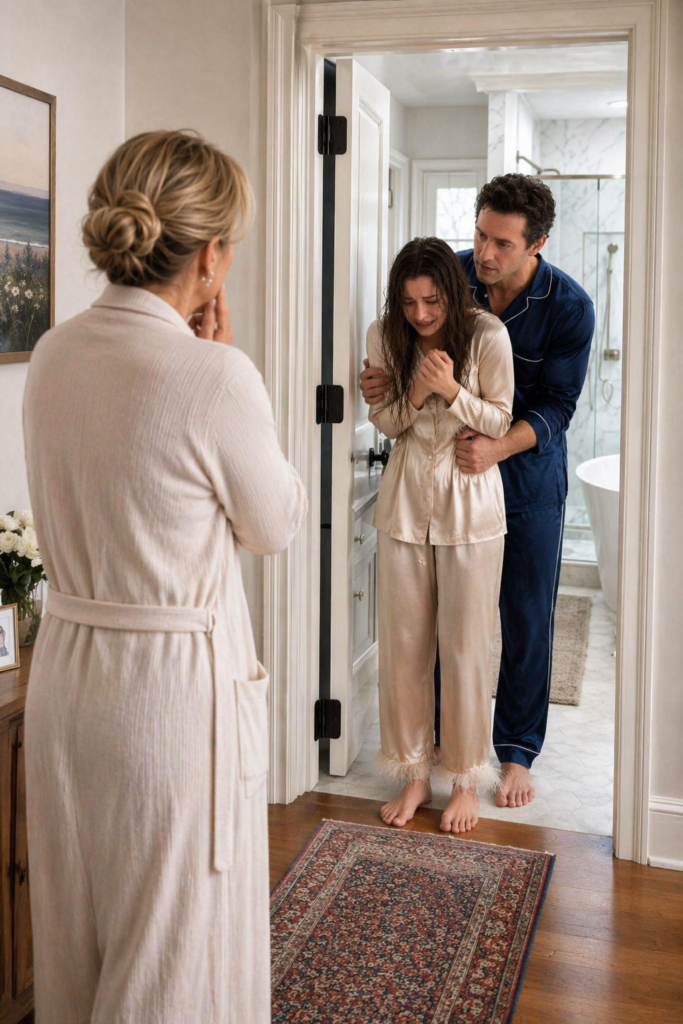
And saw Paola under the shower, fully dressed, soaked, trembling. Ricardo was gripping her arm tightly while the cold water poured over her face.
—Are you going to answer me in front of my mother again? —he whispered—. Look at me when I’m correcting you.
Paola could barely breathe.
Carmen felt the past crash down on her. She saw Rogelio, the slammed doors, the broken dishes, her own hidden bruises.
She wanted to go in.
She wanted to scream.
But the old fear left her paralyzed.
She retreated, crying silently.
At 6:00 AM, with a small suitcase, she left for a senior residence in Coyoacán.
Before leaving, she saw Paola in the kitchen, with swollen eyes and wet hair.
And she understood she had just abandoned someone in the same hell she had escaped.
She couldn’t imagine how terrible things were about to get…
PART 2
The residence was called Casa Jacaranda. It had wide patios, iron benches, knitting classes, a dining room with floral tablecloths, and a small chapel where several ladies prayed out of habit, not always out of faith.
To anyone else, it would have seemed a peaceful place.
For Doña Carmen, it was an elegant sentence.
No one shouted there. No one slammed doors. No one turned on the shower at 3:00 AM.
But every night, when she closed her eyes, she saw Paola soaked, trembling, her face bent under the cold water.
Carmen repeated to herself that she was old, that she had no strength, that Ricardo was her son and that a mother doesn’t report her own blood.
But then she remembered something else.
She remembered young Carmen, who also waited for someone to see her, believe her, help her.
And no one came.
For a week, she didn’t answer Ricardo’s calls. He left increasingly harsh messages.
—Mom, you’re being dramatic.
—Don’t be ridiculous.
—Paola is fine. You always invent tragedies.
—If you keep this up, you’re never coming back to my house.
Carmen deleted the messages, but she couldn’t erase the tremor in Paola.
One afternoon, while sitting in the garden, a gray-haired woman approached with a cup of tea.
—Carmen Salgado? The History teacher from Secondary School 14?
Carmen looked up.
It was Teresa, a former classmate from Toluca. They embraced, surprised and emotional. They talked about students, ailments, widowhood, and how quickly life becomes an old album.
After a while, Teresa confessed something.
—My daughter left a violent marriage 5 years ago. I almost lost her for staying silent.
Carmen felt a blow to her chest.
Teresa told her that her son-in-law was charming at family gatherings, the kind who carries bags, opens doors, and kisses his mother-in-law on the forehead. But at home, he humiliated her daughter, isolated her, controlled the money, and then cried, promising to change.
—And how did she manage to leave? —Carmen asked, almost voiceless.
—With proof, comadre. And with someone who wouldn’t let go. Audios, photos, medical reports, messages. Without that, everyone said it was just couple fights.
That night, Carmen couldn’t sleep.
The next day, she asked to speak with the social worker at the residence. She put Carmen in touch with attorney Valeria Montes, a specialist in domestic violence.
Carmen told her everything, even what she had seen through the crack.
The lawyer didn’t judge her. She just took notes and spoke firmly.
—Doña Carmen, your daughter-in-law needs to know she has an escape, but don’t pressure her. When a woman tries to leave, the risk increases. We need to prepare a network, documents, evidence, and a safe place.
—And what if it’s already too late?
—Then we need to act faster, but with a clear head. Not just with anger.
Carmen agreed.
Three days later, Paola appeared at the residence with a bag of mandarins.
She wore heavy makeup on her left cheek, long sleeves, and a smile so fragile it seemed taped on.
—Ricardo told me to come to convince you to return —she said—. He says you’re being very bad.
Carmen took her to a secluded bench under a jacaranda.
—Paola, the night I left, I saw what Ricardo did to you in the bathroom.
Paola’s smile vanished.
—No, Doña Carmen. You misunderstood. It was an argument. He was nervous. I provoked him.
Carmen felt tears welling up.
—I said that for 28 years too. That I provoked him. That he was tired. That he was a good man deep down. That for the kids, for the house, for what people would say. But a executioner doesn’t need reasons, daughter. He needs silence.
Paola covered her face with her hands.
At first, she only cried. Then she started to talk.
She recounted how Ricardo had asked her to leave her job as a graphic designer because “a decent wife doesn’t go from office to office.” He checked her phone, forbade her from seeing friends, controlled what she bought at the store, and reviewed the receipts as if they were evidence of a crime.
He had also taken her cards.
—He gives me cash —Paola said—. If I spend 20 pesos more, he asks me what I wasted it on.
Carmen took her hands.
—Has he hit you many times?
Paola lowered her gaze.
—Not always with his hand. Sometimes he locks me in. Sometimes he wakes me up with cold water. He says that’s how I stop being sassy.
Carmen pressed her lips together to keep from screaming.
Then Paola whispered the secret that terrified her the most:
—I’m pregnant. I’m almost 7 weeks along.
Carmen froze.
For years, Ricardo had said at family gatherings that Paola was “defective,” that she didn’t give him children, that because of her, he wasn’t a dad. He humiliated her in front of cousins, aunts, and neighbors.
And now that she was pregnant, he used it as a threat.
—He says that if I leave, he’ll take the baby. That with his money, he can prove I’m crazy. That no one would give a child to an unstable woman.
Carmen felt something inside her break, but this time it wasn’t fear.
It was rage.
—Paola, listen to me carefully. You’re not alone. But we have to do it carefully.
Over the next two weeks, Carmen and attorney Valeria built a plan.
Paola saved copies of documents on a USB hidden inside a cream jar. She recorded insults with a phone app. She photographed bruises. She sent Carmen messages with exact times. She checked her account statements and discovered something else: Ricardo had opened a credit line in her name without permission.
That was the first twist of fate.
Ricardo wasn’t just abusing her.
He was also putting her in debt to leave her with no way out.
The lawyer gathered everything. Prepared a complaint, a request for protective measures, and entry into a temporary shelter.
But the hardest moment was still ahead: getting Paola out of the apartment without Ricardo noticing.
The opportunity came on a Friday.
Ricardo had a dinner with executives in Polanco. Paola was supposed to stay home, “calm and without doing anything foolish.” Carmen waited outside the building with a taxi and a small suitcase.
At 8:40 PM, Paola came down in the elevator.
She looked pale, wearing dark glasses and carrying a backpack.
Carmen could barely hug her.
—Let’s go, daughter.
But just as they were about to leave, Ricardo appeared at the entrance of the building.
He wasn’t in Polanco.
He was waiting for them.
—How nice —he said, smiling without humor—. My mom and my wife playing their little victim game.
Paola froze.
Ricardo snatched the backpack and threw it to the floor. Clothes, papers, and a box of prenatal vitamins scattered across the marble.
He looked at the box.
Then looked at Paola.
—Since when do you know?
Paola didn’t answer.
Ricardo grabbed her arm.
—Go back upstairs. Right now.
Carmen stepped in.
—Don’t touch her.
Ricardo let out a low laugh.
—Mom, don’t get involved in my marriage.
—Your marriage isn’t a prison.
He moved so close that Carmen could smell his expensive cologne.
—You should be on my side. I’m your son.
Carmen looked at him with tear-filled eyes.
—That’s what hurts me the most.
The building guard pretended not to see. A neighbor peeked from the elevator and quickly hid again. No one wanted trouble.
Ricardo yanked Paola.
She screamed.
Carmen pulled out her phone and dialed attorney Valeria. Before she could speak, Ricardo snatched the phone from her.
—That’s enough, nosy old woman.
He hurled it against the wall.
Carmen watched the device smash, and for a second, she was 30 years old again. She was the silent wife of Rogelio once more. The woman who looked down to avoid provoking more blows.
But this time, she didn’t look down.
She stood her ground in front of Ricardo and shouted with all her strength:
—Help! He’s hitting his pregnant wife!
The scream echoed in the lobby.
Ricardo raised his hand.
He didn’t get to touch her.
Two police officers entered through the main door.
Attorney Valeria, who had suspected something was wrong with the interrupted message, had called 911 and was on her way with the evidence folder.
Ricardo tried to play it cool.
—Officers, this is a family misunderstanding. My mother is confused. She’s an elderly person.
Paola, trembling, took off her glasses.
She had a black eye.
The policeman changed his expression.
—Ma’am, do you want to leave here?
Paola looked at Carmen.
Carmen nodded.
—Yes —Paola said, almost in a whisper—. Yes, I want to leave.
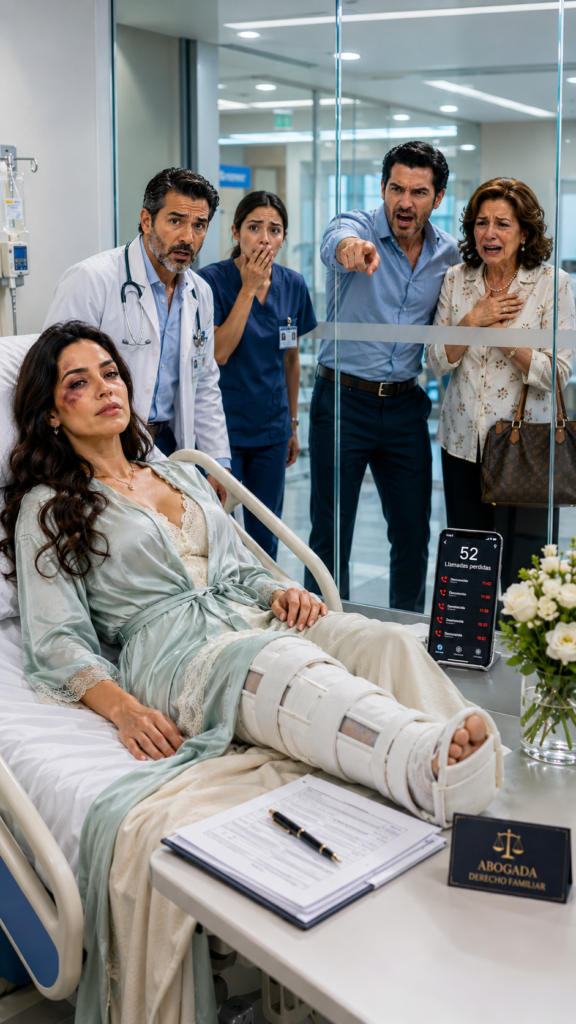
That night, they took her to a hospital to certify her injuries. Later, by the lawyer’s order, she entered a temporary shelter.
Ricardo wasn’t immediately arrested, but he received restraining orders. He couldn’t come near Paola or communicate with her.
He exploded.
He called relatives, friends, co-workers. He said Paola was manipulated, that Carmen was senile, that it was all a scheme to take his money.
The family divided.
An aunt said:
—Oh, Carmen, but he’s your son. How can you do this to him?
Carmen replied with a calm that took her decades to learn:
—I didn’t do this to him. He did it to himself.
The case seemed complicated. Ricardo had expensive lawyers, contacts in the company, and an impeccable reputation. Paola, on the other hand, was scared, unemployed, and pregnant.
But then came the twist no one expected.
The building guard sought Carmen out at the residence.
His name was Martín, and he had been working there for 9 years. He looked guilty.
—Doña Carmen, I saw a lot of things and played dumb. I’m sorry. But I can’t anymore.
He handed her a USB drive.
Inside were videos from the lobby and hallway cameras. Not just from Friday.
Also from several early mornings.
Ricardo pulling Paola out of the elevator by the arm. Ricardo pushing her against the wall. Ricardo taking her phone. Ricardo entering the bathroom with her at 3:00 AM while she cried.
The strongest video had audio from the hallway.
—Without me, you’re nobody —Ricardo said—. And that baby, if it exists, is going to be mine, not yours.
When attorney Valeria presented the recordings, Ricardo’s version crumbled.
She was no longer an “exaggerating wife.”
She was no longer a “confused mother.”
It was clear, repeated, documented violence.
Ricardo’s company suspended him. His lawyers sought a settlement. The complaint continued. Paola obtained protective measures, provisional support, financial compensation for the fraudulent credit, and initiated the divorce.
Ricardo asked to speak with Carmen.
She agreed to see him just once, in the presence of the lawyer, in a mediation room.
He arrived thin, haggard, without a tie. For the first time, he didn’t seem to own the world.
—Mom —he said—, I was wrong. I lost control. But you know I’m not a monster.
Carmen felt the word break her soul.
—That’s what your father said after every blow.
Ricardo clenched his jaw.
—Don’t compare me to him.
—Then don’t repeat his story.
He lowered his voice.
—Paola is carrying my child. You can’t take that away from me.
Carmen looked at him sadly.
—No one took it from you, Ricardo. You put it at risk every time you chose fear as a way to command.
Ricardo cried.
Perhaps out of guilt. Perhaps out of rage. Perhaps because for the first time, the consequences were named.
Carmen also cried, but she didn’t hug him.
Months later, Paola rented a small apartment in Portales. It had white walls, a tiny kitchen, and a window where the morning sun came in.
It wasn’t luxurious.
But no one shouted there.
Carmen visited her on Saturdays. She brought soup, fruit, pastries, and gossip from the residence. Paola started therapy. She began designing again from home. She recovered her bank account. She bought a used crib and painted it mint green.
When the baby was born, in a public hospital in Coyoacán, it rained over the city.
Paola named her Aurora.
—Because that means starting anew —she said, exhausted, with the baby in her arms.
Carmen looked at her and felt something inside her, broken since Rogelio, finally find a soft place to rest.
Paola took her hand.
—Doña Carmen… you could have left and forgotten about me. But you returned. You saved my life.
Carmen shook her head.
—No, daughter. You saved yourself when you said, “Yes, I want to leave.” I just did what someone should have done for me many years ago.
Paola cried in silence.
Carmen held Aurora and kissed her tiny forehead.
For a time, Ricardo continued sending messages from different numbers. He promised to change, asked to see the baby, blamed his childhood, his stress, his dead father, everyone but his own hands.
Paola didn’t answer.
Carmen didn’t either.
Justice moved slowly, as it often does. But it moved. Ricardo lost prestige, money, and that mask of a perfect man he had so carefully maintained. The family that once defended “unity” began to keep silent because the videos had said what Paola couldn’t say for years.
Carmen continued living in Casa Jacaranda.
Some early mornings, she woke up at 3:00.
Her body remembered what her mind tried to order.
But she no longer heard a cruel shower behind a closed door. Sometimes she heard the audio Paola sent her from her apartment: Aurora’s babbling, a small laugh, a lively home.
Then Carmen understood something that many Mexican families still discuss quietly:
Blood doesn’t obligate you to protect abusers.
A mother can love her son and still refuse to cover for him.
Because family doesn’t break when a woman speaks.
Family breaks from the first time someone screams, hits, and everyone around decides to turn a blind eye.