PART 1
The heat in San Miguel del Arroyo didn’t just hit; it punished.
At noon, the main street felt like a searing iron. Dust lifted with each step, clinging to skin as if it, too, hungered.
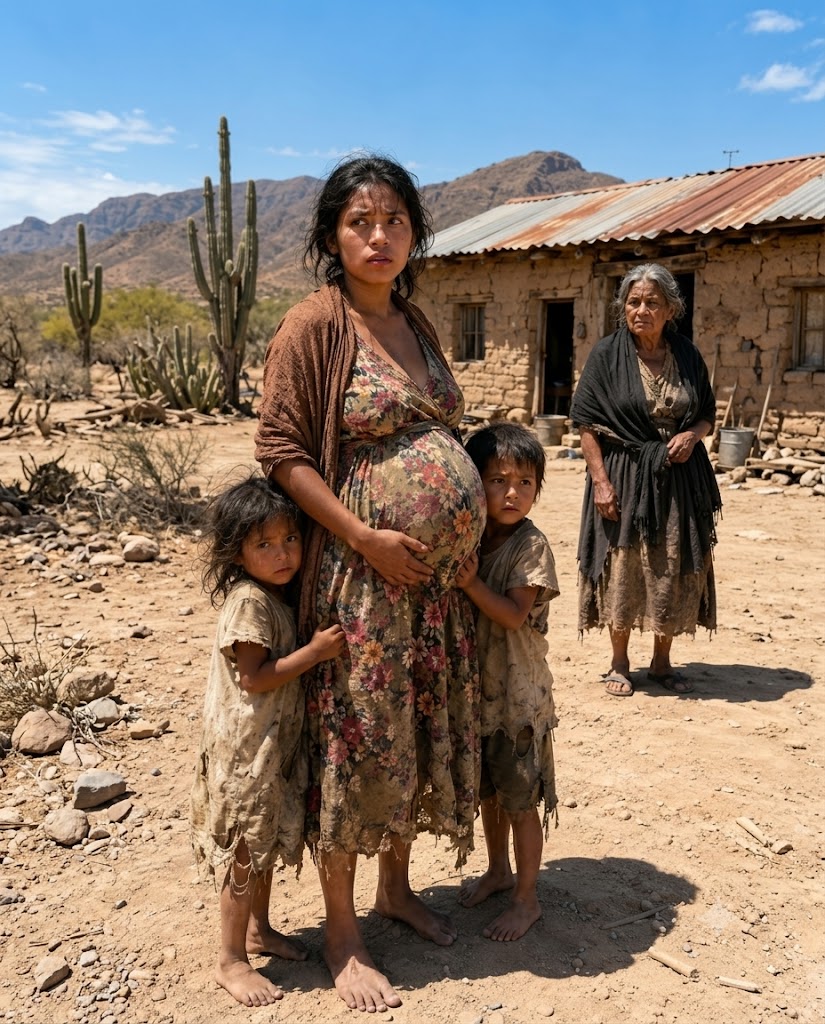
Clara walked slowly, one hand pressed against her back, the other cradling her seven-month belly. By her side were Diego, six, and Anita, four, their faces flushed, cracked lips, and weary eyes.
They hadn’t tasted food since the night before.
But what broke them wasn’t the hunger.
It was the thirst.
Clara had just buried Julián Rivas, her husband. They told her he died at a construction site near Monterrey, that he fell from scaffolding, that it was a tragedy.
They handed her a backpack filled with his clothes, 2,000 pesos folded in an envelope, and a sheet she signed, although she barely understood what it said.
Then they kicked her out of the boarding house where they had lived.
With no money, no family, and two children, Clara did the only thing left to her: she sought the village where Julián was born.
He had never wanted to speak of that place.
When Clara asked about his mother, his homeland, or his past, Julián would grow serious and say:
— I left San Miguel alive by pure miracle. Don’t ask me to return, even in thought.
But Julián was gone.
And Clara needed someone to lend her a hand.
The first house had bougainvillea at the entrance and a water jug full by the door. Clara knocked gently.
— Good afternoon… could you spare a little water for my children?
A woman peeked through the curtain. Hearing the surname Rivas, her face hardened. She said nothing. Just closed the curtain.
At the second house, a man replied from inside:
— We don’t keep other people’s problems here.
At the third, a lady crossed herself as if Clara carried a curse.
— Get out before the people see you.
Diego tugged on his mother’s skirt.
— Mom, my mouth burns.
Clara swallowed hard, but there was nothing to swallow.
She kept walking.
At the fourth house, a boy burst into laughter from the shade.
— Rivas? No way. Are there still any of them left?
At the fifth, a woman turned on the faucet to wash the patio. Water flowed across the floor, shining, fresh, alive. Anita took a step toward the puddle, but Clara stopped her before she could bend down.
The woman turned off the faucet and said:
— Don’t even think about it. That water isn’t for you.
At the sixth house, an old man in a hat spat near Clara’s feet.
— Your husband was a meddler. You better keep walking.
The seventh house was the largest in the village. It had a black gate, cameras, a new water tank, and a white truck under a roof. There lived Don Evaristo Molina, the man everyone greeted with respect and fear.
Clara knocked.
Don Evaristo stepped out in a clean shirt, expensive boots, and a look that didn’t question; it commanded.
— Who are you?
— Clara… widow of Julián Rivas. I just need water for my children. Then we’ll leave.
The man’s expression changed.
It wasn’t surprise.
It was hatred.
— Your Julián should have taught you that the Rivas have no business coming to ask here.
Clara tightened her hold on Anita against her leg.
— Sir, please. They are just kids.
Don Evaristo looked at her belly and smirked with contempt.
— And that one you’re carrying is also here to claim what doesn’t belong to them, right?
Clara felt cold despite the sun.
— I don’t understand.
The man stepped closer and lowered his voice.
— Understand this, girl: if you want your kids to keep breathing tomorrow, grab your belly and get out before it gets dark.
The gate slammed shut.
Diego no longer asked for water. He stood there, pale, as if he had just learned that adults could also be monsters.
At the end of the path, among dry prickly pears and rusty sheets, there was a nearly fallen adobe house. People said an old blind woman lived there, crazy and dangerous, who slept hugging a machete because she hated all of San Miguel.
Clara feared no crazy woman.
She feared watching her children die under the sun.
She staggered to the door.
Before she could knock, the wood creaked.
An old woman stepped out of the shadows. She had white eyes, skin burnt by years, and a worn machete gripped in her hand.
— Who trespasses on my land? — she growled.
Clara raised her hands.
— My name is Clara. I am Julián Rivas’ wife. I beg you for water for my children.
The old woman stood frozen.
Then she lowered her gaze to Clara’s belly, as if she could see it with her heart.
Her fingers trembled over the machete.
— Holy Mother… that baby carries my son’s blood.
PART 2
Clara felt her legs give way.
Diego hid behind her. Anita stopped crying, paralyzed by the broken voice of that woman. The machete still rested in the old woman’s hand, but it no longer seemed a threat.
It seemed like a wound.
— Your son? — Clara asked, barely breathing.
The old woman swallowed hard.
— Julián Rivas was my boy.
Silence fell over the little house like a stone.
Clara had imagined many things on her journey. That Julián’s family would reject her. That his mother had died. That perhaps he was ashamed of his roots.
But she never imagined finding her mother-in-law alive, blind, alone, and hidden at the end of the village.
— He said he had no mother — Clara murmured.
The old woman pressed her lips together.
— To save me, he had to pretend I was already dead.
She opened the door urgently.
— Get in. Quickly.
She didn’t say it tenderly. She said it as someone who knows danger walks behind.
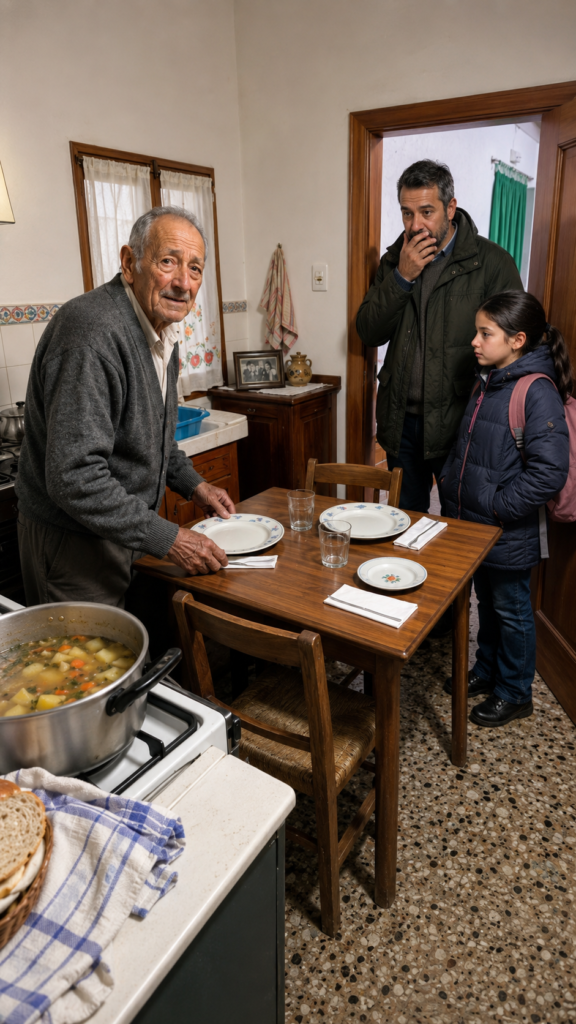
Inside the house, it was hot, but there was shade. On one wall hung an old shawl. On a shelf was a yellowing photo of a thin young man, with a sad gaze.
Clara approached.
It was Julián.
Younger, thinner, with the same eyes as Diego.
The old woman felt her way to a corner, lifted a blanket, and pulled out a clay pitcher. She poured water into an enamel cup.
— First the children.
Diego drank desperately. Anita took the cup next, with both hands, not letting go until her mother carefully took it from her.
When Clara drank, the water scraped her throat because it was so dry.
And yet, it tasted like life.
— Why do they hate us? — she asked.
The old woman sat slowly, placing the machete on her knees.
— Because Julián wouldn’t let himself be robbed.
— Don Evaristo said he was a meddler.
— Here, they call a meddler anyone who doesn’t bow down.
The woman breathed deeply.
— My name is Petra Rivas. This land belonged to my family. The old well, too. My father dug it when there was nothing but stone, thorns, and hunger. For years, half the village drank water from there without paying a cent.
Clara hugged her belly.
— So what happened?
— The drought came. And with it, ambition. Don Evaristo wanted to take the well to water his walnut trees and sell water to private tankers. He was going to leave the village on its knees.
Petra lowered her head.
— Julián found the papers. Deeds, community agreements, water rights. Everything was in the name of the Rivas. He went to the municipality, sought a lawyer, wanted to file a complaint.
— And is that why he fled?
The old woman touched her white eyes.
— One night, four men came in. They beat me until I was blind. They ransacked the house looking for the documents, but they didn’t find them. Then they went after Julián. They threatened him with killing me if I spoke.
Clara felt her chest shatter.
Julián hadn’t been a coward.
He had shouldered a war she never knew.
— He never told me anything.
— Because if he told you, he’d put you in the crosshairs too.
Petra turned her face toward Clara’s belly.
— And now you are the target. Your children are heirs. That baby, too. As long as one of you lives, Don Evaristo cannot sleep peacefully.
Clara looked at the poor house, the dirt floor, the cracked walls.
— But we have nothing.
Petra let out a bitter laugh.
— That’s what they want you to believe. A poor person with papers still has rights. What happens is that no one believes the poor.
Then a brutal knock shook the door.
Anita screamed.
Diego clung to his mother.
— Petra! — roared Don Evaristo from outside —. We know you have that woman in there!
Another blow sent dust falling from the ceiling.
— Get her out with her brats! We don’t want any more Rivas in this village!
Clara stood up, but a sharp pain shot through her back. She bent over with a groan.
Petra turned her head.
— What’s wrong?
Clara couldn’t respond.
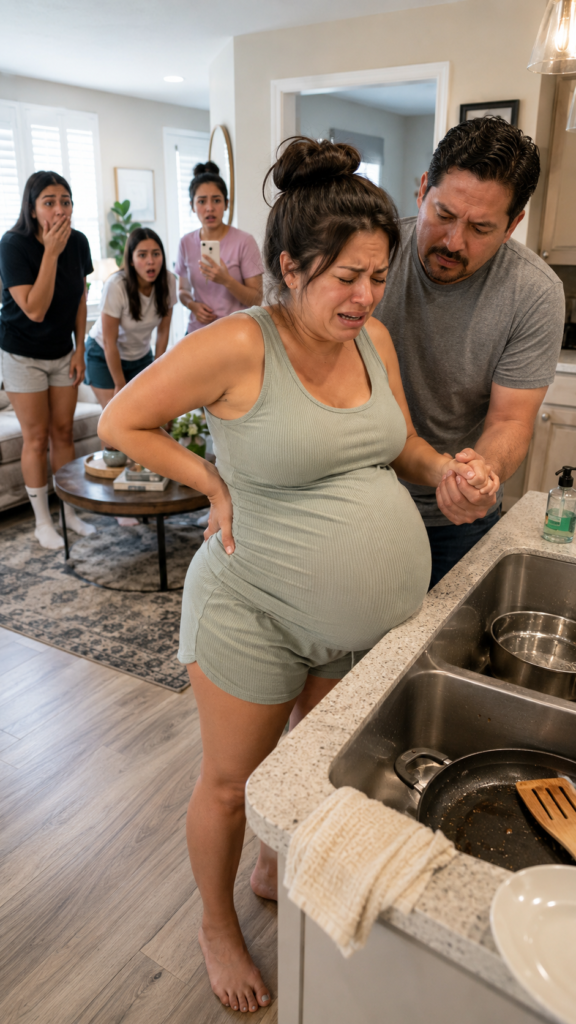
Another pang split her belly. She felt warm fluid trickle down her legs.
— No… not yet. She’s seven months along.
The old woman clenched her jaw.
— The birth has come early.
Outside, Don Evaristo knocked again.
— Open up or we’ll tear down this hovel!
Clara fell to her knees. Diego started to cry.
— Mom, please don’t die.
That plea pierced Petra.
The old woman rose slowly. For a moment, she no longer seemed a defeated old woman, but a dry root refusing to die.
She took the machete in both hands, removed the bar, and flung the door open.
Light poured in like fire.
Outside were Don Evaristo and four more men, wielding sticks, machetes, and cowardly faces. Neighbors peered from windows, walls, and ajar doors.
The same ones who denied Clara water.
Petra held the machete high.
— The first one who steps into my house will lie here, bastards.
Don Evaristo tried to laugh.
— Step aside, crazy old lady. That woman is here to rob us of our water.
— She’s here to claim what you stole from my son.
A murmur swept through the street.
Don Evaristo raised his voice.
— Julián died for being a troublemaker. And if that child is born, it will also bring misfortune.
Silence fell immediately.
Clara, from the floor, heard every word.
The neighbors heard it too.
And so did a boy named Nico, who had pulled out his phone, hiding behind a truck.
Don Evaristo noticed too late.
— Delete that, kid.
— No — said Nico, trembling —. Not this time.
A woman stepped out from the crowd. It was the same one who had closed the curtain at the first house.
Her name was Doña Meche, and her eyes were filled with shame.
— I heard it too — she said —. We all heard.
Don Evaristo glared at her.
— Shut up, old woman.
But she took another step.
— No. We’ve stayed silent for many years. We also saw when they took Julián out of the village. We also knew he was sent to Monterrey to silence him. And we all know that fall wasn’t an accident.
Clara felt the world crash down around her.
— What did she say?
Don Evaristo moved toward Doña Meche, but Petra swung the machete with unexpected speed. The blade glinted in front of the man’s chest.
— Touch her, and I’ll split you open like a sack of corn.
The four men stepped back.
For the first time, Don Evaristo didn’t seem the master of the village.
He looked like an old man trapped by his own words.
But inside the house, Clara cried out again.
The baby was coming.
Petra shut the door and barred it.
— Diego, bring me those blankets. Anita, give me the cup. Clara, listen carefully: there’s no doctor, no ambulance, and no time. But you’re not alone, mija.
Clara cried, drenched in sweat.
— I can’t.
Petra cupped her face in her rough hands.
— Yes, you can. You walked under the sun with two thirsty children. You knocked on seven doors and none broke you. You made it here carrying life in your belly and pain in your soul. Don’t tell me you can’t now.
For hours, the little house filled with screams, prayers, and broken breaths.
Petra, blind, moved as if her hands remembered ancient wisdom. She boiled water, cleaned rags, touched Clara’s belly, and told her when to push.
Diego hugged Anita in a corner.
Outside, no one dared to enter.
The entire village listened.
They listened to the woman they had chased away. They listened to the children they denied a glass of water. They listened to Petra scream:
— Push for Julián! Push for your children! Push because the Rivas weren’t born to ask for permission!
As the sun began to set, a small cry broke the afternoon.
At first, it was weak.
Then stronger.
Then impossible to ignore.
Petra received the baby with trembling hands. She was tiny, red, fragile. But she breathed. She fought for life as if she had known before birth that they wanted to erase her.
— It’s a girl — said Petra.
Clara extended her arms.
— Hope — she whispered —. Her name will be Hope.
The old woman stood still.
— That’s what my mother was called.
And then she cried.
Not like someone who loses.
She cried like someone who just regained a piece of everything that was taken from her.
That same night, Nico took the video to the Public Prosecutor's Office of the neighboring municipality. Doña Meche went with him. Then three more neighbors followed.
Not because they suddenly found courage.
But because fear had changed hands.
The recording of Don Evaristo opened an investigation. Then a driver appeared who confessed to having taken Julián to Monterrey on the order of the boss. He said Julián didn’t fall from any scaffolding. They summoned him to 'settle things about the well' and then handed him over to men linked to a construction company that wanted to exploit the area’s water.
Julián’s death ceased to be an accident.
The papers Don Evaristo swore didn’t exist appeared weeks later inside a metal box buried behind his warehouse. They weren’t turned in out of remorse. They were turned in by his own nephew when he realized they were going to blame him.
The village split in two.
Some defended Don Evaristo because they had eaten from his hand.
Others began to ask for forgiveness because shame no longer let them sleep.
But Clara wanted no late tears.
She wanted justice.
With the help of an agrarian lawyer, she proved that the old well belonged to the Rivas family. Diego, Anita, and little Hope were recognized as legitimate heirs.
Don Evaristo lost control of the water, lost his position in the community, and faced charges for dispossession, threats, and the reopened investigation into Julián’s death.
The day they took him to testify, he passed by Petra’s house.
She sat outside, with Hope sleeping in her arms. The machete rested beside her chair.
Don Evaristo glared at her with hatred.
— Crazy old lady — he muttered.
Petra smiled faintly.
— And yet, a crazy old lady beat you.
Clara didn’t leave San Miguel del Arroyo.
She stayed.
Not because the village deserved her, but because her children deserved the land and water for which their father had given his life.
As months passed, the well served the community again, but this time under clear rules. No one decided again who deserved to drink and who did not.
Diego and Anita learned to walk with their heads held high. Hope grew up hearing that she was born on the day an entire village had to hear the cries of a girl they tried to deny before seeing her.
Petra never regained her sight.
But every afternoon she sat in front of the well and smiled when she heard the water flow.
The rusty machete hung above the door.
Not as a decoration.
As a warning.
Because there are people who only help when the camera is rolling. There are villages that talk of unity but shut the door when a mother arrives with her dying children.
And sometimes justice doesn’t arrive in a patrol car or wear expensive suits.
Sometimes it arrives old, blind, furious, with a machete in hand… and with the heart of a mother who has nothing left to lose.