PART 1
When Tomás Rivas boarded Aeroméxico flight 702 from Bajío to Mexico City, all he wanted was to sit down, review his presentation, and take a deep breath.
He wore a simple white shirt, dark jeans, worn sneakers, and a black backpack containing his laptop, three folders, and a folded letter written in purple crayon.
He didn’t look like a businessman.
He didn’t look important.
He looked like a tired dad who hadn’t slept much.
His nine-year-old daughter, Sofía, had slipped that letter into his backpack before leaving for school.
“Dad, don’t let anyone make you feel small. You can do it.”
Tomás had read it four times before boarding.
Since his wife Mariana passed away two years ago, Sofía had become his compass, his reason, and his greatest fear.
He worked until dawn for her.
He built a tech platform that helped airlines organize crews, delayed flights, luggage, and schedules without breaking their employees.
That day, he was headed to Mexico City to sign the biggest contract of his life with the airline Sol del Norte.
A contract worth 48,000,000 pesos.
His seat was 2A, first class.
He had bought it 18 days in advance.
It wasn’t an upgrade, it wasn’t a gift, it wasn’t a favor.
It was his.
But as soon as he placed his backpack under the seat, a woman with enormous glasses, an expensive beige suit, and a strong perfume stopped next to him.
“Excuse me, you’re in my seat,” she said without fully looking at him.
Tomás looked up.
“I think there’s a misunderstanding. This is 2A.”
She let out a dry laugh.
“Yes, exactly. My seat.”
Her name was Rebeca Santillán, a famous consultant known on social media for giving business leadership talks. She held a Diamond membership with the airline and had the attitude of someone used to having everyone step aside.
A young flight attendant, Daniela, quickly approached.
“Is there a problem?”
Rebeca didn’t even lower her voice.
“Yes. This gentleman is in my spot. I have an urgent meeting in Polanco, and I need to work in peace.”
Tomás pulled out his boarding pass.
“Here it says 2A.”
Daniela looked at him.
Then she looked at Rebeca.
And her face changed.
Not because of the information, but because of the appearance.
Rebeca looked like first class.
Tomás did not.
“Mr. Rivas,” Daniela said with a stiff smile, “we can move you to 3C. It’s basically the same, same cabin, same service.”
“No,” Tomás replied.
“It’s just one row.”
“It’s my seat.”
Silence fell heavily.
A man in 1B lowered his newspaper. A lady began recording discreetly with her phone.
Rebeca crossed her arms.
“Oh, please. There’s always someone who wants to make a scene over nothing.”
Tomás took a deep breath.
“I’m not making a scene. I’m asking you to check the manifest.”
Daniela was uncomfortable.
The head flight attendant, Mauricio, appeared with a tablet.
“Sir, to avoid delaying the flight, we ask that you cooperate.”
“Cooperating doesn’t mean giving up my seat.”
Rebeca leaned toward Mauricio.
“I’m Diamond Plus. You know who I am.”
Mauricio swallowed hard.
Tomás saw the doubt in his eyes.
And then he saw something worse.
He saw that they had already decided.
Captain Ramiro Valdés stepped out of the cabin with a stern face.
“Mr. Rivas, my crew has offered you a reasonable solution.”
Tomás placed his pass on the table.
“The reasonable solution is to check the manifest.”
The captain barely looked at the paper.
“If you don’t follow instructions, we’ll have to ask you to leave the plane.”
Tomás touched Sofía’s letter inside the folder.
“My daughter told me today not to let anyone make me feel small.”
No one spoke.
“You’re asking me to teach a nine-year-old that rules don’t matter if someone with more money and a more important face shows up.”
The captain clenched his jaw.
“Last chance. Take your things.”
Tomás lifted his gaze.
“Then you’ll have to remove me.”
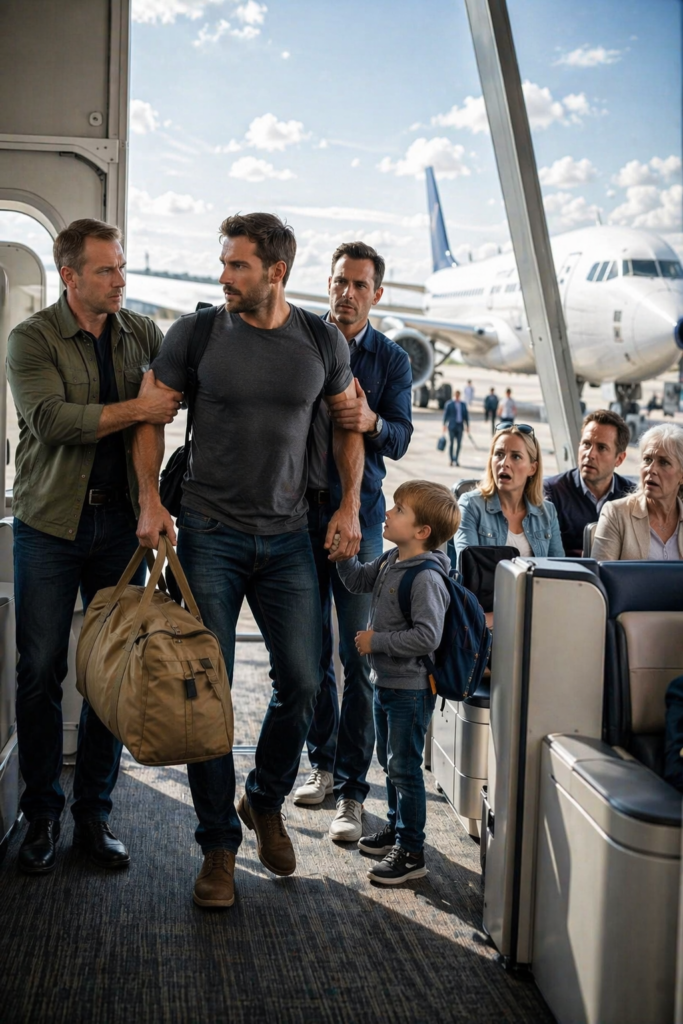
Four minutes later, airport security entered the plane.
Tomás didn’t shout.
He didn’t insult anyone.
He didn’t resist.
He simply took his backpack, his laptop, and Sofía’s letter.
Before leaving, he turned to the passengers.
“My name is Tomás Rivas. Seat 2A is mine. The airline has the records. Sooner or later, someone will read them.”
He walked down the aisle.
And before they closed the plane door, Rebeca Santillán sat in 2A as if she had just won a battle.
PART 2
The first video was uploaded to the internet at 9:41 AM.
It was published by a passenger named Iván Meza, an accountant from Querétaro who was sitting two rows back.
He didn’t write much.
He simply said:
“I just saw how they kicked out a dad with a valid first-class ticket to give his seat to a rich lady. He asked them to check the manifest. No one wanted to.”
The video lasted 1 minute and 38 seconds.
You could see Tomás sitting in silence.
You could see his boarding pass on the table.
You could see Daniela asking him to change seats.
You could see Rebeca standing, impatient, as if the world owed her apologies.
You could see the captain ordering him to be removed.
And you could see Tomás walking with dignity, without raising his voice.
That’s what fueled people’s anger.
Because he didn’t look like a violent man.
He looked like a humiliated man.
At 10:05, the video had already racked up 25,000 views.
At 10:17, a journalist from Monterrey shared it.
At 10:26, Sol del Norte’s social media team stopped responding with automated messages.
At 10:31, Patricia Aranda, the airline’s operations director, was standing in her Santa Fe office watching the video for the third time.
“Find out who he is,” she ordered.
Her assistant, Fernanda, opened the system.
“Passenger Tomás Rivas. Flight 702, León to Mexico City. Seat 2A.”
On the other side of the table, Ernesto Saldaña, the vice president of strategic alliances, was frozen.
“Did you say Tomás Rivas?”
Patricia turned.
“Do you know him?”
Ernesto took the laptop, leaned closer to the video, and paled.
“He’s the founder of RivasTech.”
The room went silent.
RivasTech wasn’t just any provider.
For six months, Sol del Norte had negotiated with the company to modernize its internal system for crews, luggage, delayed flights, and family permits.
The initial contract was for 48,000,000 pesos.
But the real value could double if the program worked in three airports: CDMX, Monterrey, and Guadalajara.
And Tomás Rivas was the man who was supposed to sign that day at 1:30 PM.
He wasn’t just any passenger.
He was the reason half the board of directors was waiting in Reforma.
Patricia didn’t scream.
That made her more terrifying.
“Get the flight manifest.”
Fernanda typed quickly.
The result appeared on the screen.
Seat 2A: Tomás Rivas.
Purchased 18 days earlier.
Paid in full.
No duplicates.
No seat changes.
No conflict.
Patricia closed her eyes for one second.
“And Rebeca Santillán?”
Fernanda searched.
“Assigned to 4C. Executive class. No approved upgrade. No processed change.”
Ernesto muttered a curse.
Patricia picked up the phone.
The flight hadn’t taken off yet.
That saved the airline from a corporate tragedy.
And destroyed several people in a matter of minutes.
Meanwhile, Tomás was at the customer service desk, with his backpack on the floor and his boarding pass in hand.
The agent looked at him with fear.
“Sir, I’m trying to understand what happened.”
“So am I,” he replied.
His cell phone vibrated.
Sofía.
Tomás felt the anger he had stored turn into a knot.
He answered.
“Hey, shorty.”
“Dad… Regina’s mom saw a video. Are you okay?”
Tomás closed his eyes.
The airport noise continued around him: luggage, announcements, coffee machines, people running.
“I’m fine.”
“Why did they kick you off?”
He looked at the purple letter inside the folder.
“Because some adults forgot how the rules work.”
Sofía fell silent.
“Did you do something wrong?”
“No.”
“Did you shout?”
“No.”
“Were you rude?”
“No.”
Another silence.
“Then that’s good.”
Tomás almost let out a sad laugh.
“Good?”
“Mom used to say that when you don’t shout, the truth is louder.”
It pained Tomás’s chest.
Mariana lived on in Sofía’s phrases.
“Yes, my love. Your mom used to say that.”
“Are you going to make it to your meeting?”
“I’ll try.”
“Don’t let them take your seat, Dad.”
Tomás looked toward the boarding gate.
“I won’t let them.”
When he hung up, he received a call from Ernesto Saldaña.
“Tomás, tell me exactly what happened.”
Tomás recounted everything.
The names.
The times.
The seat.
The pass.
The refusal to check the manifest.
Rebeca’s comment.
The captain’s order.
He didn’t insult anyone.
He didn’t threaten to cancel the contract.
That made Ernesto feel worse.
“Stay there, please. I’ll call you in five minutes.”
“Ernesto.”
“Yes?”
“I need to get to Mexico City.”
“I know.”
“No. You know there’s a meeting. It’s not the same.”
Ernesto fell silent.
“My daughter asked me if I did something wrong. That’s what your airline did this morning.”
Ernesto’s voice changed.
“I understand.”
Inside the plane, Rebeca Santillán had already accepted a glass of mineral water.
She was seated in 2A, checking her phone with a triumphant smile.
Daniela was at the front galley, trembling hands arranging glasses.
Mauricio pretended to check his tablet.
Captain Ramiro was in the cabin.
No one knew that half of Mexico was already watching them from outside.
The internal phone rang.
Daniela answered.
“Front cabin.”
“Stay on the line for Patricia Aranda,” said a voice from the ground.
Daniela felt a chill down her spine.
Patricia didn’t greet.
“Is Tomás Rivas on that plane?”
Daniela looked toward 2A.
“Not currently.”
“Why not?”
“There was a seat conflict with a premium passenger, and Mr. Rivas rejected an alternative.”
“Did you check the manifest?”
Daniela went silent.
“We checked his pass.”
“That’s not what I asked.”
Mauricio was already pale.
“No, ma’am.”
“Did Ms. Santillán have a first-class seat?”
Daniela swallowed hard.
“She usually receives upgrades…”
“Did she have a first-class seat?”
“No.”
Patricia’s voice was low.
“Remove Ms. Santillán. You and Mauricio are immediately off duty, subject to investigation. The captain will receive instructions from operations. Ground staff is entering now.”
Daniela couldn’t respond.
“Do you understand?”
“Yes, ma’am.”
The call ended.
At that moment, the captain opened the cabin door.
His face no longer held authority.
It held fear.
An operations supervisor named Marisol Herrera entered the plane with two more employees.
She walked straight to 2A.
“Ms. Santillán, we need you to take your belongings and exit the plane.”
Rebeca looked up, offended.
“Excuse me?”
“You’re occupying a seat that doesn’t belong to you.”
The murmur spread through the cabin like fire.
Rebeca let out a laugh.
“This has already been resolved.”
“It was resolved poorly.”
The words fell clean, strong, definitive.
Rebeca looked at Daniela.
Daniela didn’t look back.
That’s when she understood the power had shifted.
“I’m a Diamond Plus client. I know people in this airline.”
Marisol nodded.
“Then you can call them from the terminal.”
A lady on the other side murmured:
“Now that’s convenient.”
Everyone heard.
Rebeca stood up, furious, took her suitcase down from the compartment, and walked out with her chin held high, although her face was turning red.
For the first time that morning, no one rushed to protect her comfort.
Daniela and Mauricio were given formal notices.
The captain received suspension from operations.
They weren’t dramatic words.
They were worse.
Immediate removal from duties.
Credentials suspended.
Priority investigation.
By 4:00 PM, the three would be fired.
Not because Tomás was important.
But because they had ignored valid documentation, removed a passenger without cause, and allowed a client’s status to outweigh the truth.
At 10:58, Tomás returned to the boarding gate.
The terminal didn’t feel the same anymore.
People recognized him.
Some looked at him with pity.
Others with respect.
Rebeca was at the counter, talking on the phone in an aggressive tone.
When she saw him, she pressed her lips together.
“This is your fault.”
Tomás stopped.
He looked tired.
“No. It’s yours.”
And he kept walking.
Marisol was waiting for him at the entrance of the tunnel.
“Mr. Rivas, your seat is ready.”
Tomás nodded.
As he entered the plane, the cabin fell silent.
There was a new crew.
A new captain introduced himself over the speaker and apologized for the delay, without giving details.
It wasn’t necessary.
Tomás walked to 2A.
He sat down.
For a moment, that seat no longer felt like a luxury.
It felt like a line.
The line some people cross when they think the other will remain silent out of shame.
The woman who recorded part of the video, sitting in 1A, leaned over.
“Sorry.”
Tomás looked at her.
“You didn’t do it.”
“No,” she replied, “but I took too long to say something.”
That phrase stuck with him.
At 11:24, flight 702 took off toward Mexico City.
Before putting his phone in airplane mode, he received a message from Sofía.
“Did you get your seat back?”
Tomás wrote:
“Yes.”
She replied almost immediately.
“Good. Bring me a chocolate concha.”
Tomás smiled for the first time all morning.
When he landed, the video had over 800,000 views.
Upon arriving at the Reforma building, everyone in the boardroom had already seen it.
No one mentioned it at first.
That was more uncomfortable.
Ernesto stood up.
“Tomás, before we talk about the contract…”
“Let’s talk about both things,” he interrupted.
He placed Sofía’s purple letter next to his folder.
“I’m here because the work matters. Your employees need better schedules. Your flights need secure systems. The families of your staff need humane rules. I’m not going to throw away months of work because three people made a terrible decision.”
Everyone breathed a sigh of relief too quickly.
Tomás raised his hand.
“But don’t confuse my presence with forgetting.”
The room tensed again.
For two hours they reviewed the agreement.
Tomás maintained the proposal.
But he added a public condition.
Sol del Norte would have to change its boarding policy and publish a clear apology.
No lukewarm phrases.
No “we apologize for the confusion.”
No blaming the passenger.
The next day, the airline issued a statement signed by its CEO.
It acknowledged that Tomás Rivas had been unjustly removed from his seat 2A.
It confirmed that Rebeca Santillán did not have an assignment in first class.
It accepted that the crew did not verify the manifest.
And it announced a new rule:
No passenger could be moved from a paid and confirmed seat without documented verification from the system.
No membership level could override a valid ticket.
No expulsion from the plane could be ordered without verified cause.
The apology went viral almost as much as the video.
Many said the airline only acted because Tomás was powerful.
Tomás knew they had part of a point.
That’s why he demanded the policy.
Fame fades.
The internet’s outrage lasts little.
But a written rule can protect those who have no connections, no millions, or a company waiting for them in Reforma.
Daniela, the flight attendant, wrote an email three days later.
She offered no excuses.
She didn’t blame Rebeca.
She didn’t say she was pressured.
She only wrote that she had seen the boarding pass and chose not to respect it because she judged Tomás by his clothes, by his backpack, and by not looking “first class.”
Tomás read the email in the kitchen while Sofía had cereal for breakfast.
“Is it from the lady on the plane?” she asked.
“Yes.”
“Did she apologize?”
“Yes.”
“Are you still mad?”
Tomás thought.
“A little.”
“Are you going to reply?”
“Yes.”
He wrote slowly.
“Thank you for saying it without excuses. I accept your apology, but I won’t minimize what happened. The harm wasn’t just asking me to move. It was deciding in advance who deserved comfort and who didn’t deserve truth.”
Sofía watched him.
“That was a dad response.”
Tomás smiled.
“What does that mean?”
“That it was kind, but it was scary.”
Rebeca Santillán never apologized.
Her publicist spoke of “confusion on board.”
But the internet didn’t buy it.
She lost two speaking engagements.
A brand removed her photo from a campaign.
And a private university suspended her invitation to a leadership forum.
For years, Rebeca had been paid to teach how to “read the room.”
This time, the room read her.
Three weeks later, Tomás flew again.
This time he took Sofía.
It was her first trip to Mexico City, and she looked at the airport as if it were Disneyland with luggage.
“Why do people run if all the planes have a time?” she asked.
“Because adults are weird,” Tomás replied.
At the gate, the agent scanned their tickets.
“Good morning, Mr. Rivas. Miss Sofía. Seats 2A and 2B.”
Sofía looked at him.
“Are they ours?”
Tomás handed her the pass.
“Check it yourself.”
She read.
“2A and 2B.”
“Then yes.”
As they entered the plane, a flight attendant named Marisol asked to see their tickets.
She compared them with her tablet.
“Everything’s correct. Welcome.”
It took less than 10 seconds.
It should have taken that long from the first time.
When the plane took off, Sofía pressed her forehead against the window.
“Dad, everything looks small from here.”
Tomás looked at the clouds.
He thought of Mariana.
He thought of seat 2A.
He thought of the people who record, those who stay silent, those who abuse, and those who learn late.
Then he looked at his daughter.
“Some things do,” he said. “But people don’t.”
Sofía turned.
“People don’t?”
“Never.”
She smiled and looked back at the sky.
Tomás took out the purple letter, now wrinkled from being carried around.
“Dad, don’t let anyone make you feel small. You can do it.”
He flipped it over and wrote underneath:
“I didn’t let them.”
Then he handed it to Sofía.
She tucked it into her backpack as if it were something valuable.
Because it was.
And as the plane climbed firmly over Mexico, Tomás understood that sometimes dignity doesn’t shout, doesn’t push, and doesn’t boast.
Sometimes it just sits in the place it belongs, waiting for the truth to catch up to those who believed they could take everything from it.