PART 1
Lucía Salgado had been walking for 10 hours among tables topped with glass, orchid arrangements, and champagne glasses worth more than everything in her apartment.
The gala was held in a historic hall in downtown Mexico City. Senators, businessmen, television hosts, and families who appeared in magazines talking about solidarity.
Lucía didn’t think about them.
She thought about the two months of overdue rent and her 15-year-old brother Emiliano’s inhaler, which was nearly empty.
To the 300 guests, she was invisible.
A hand serving champagne. A forced smile. Someone they could snap their fingers at without even looking her in the face.
Then she saw an elderly woman alone, near the dance floor.
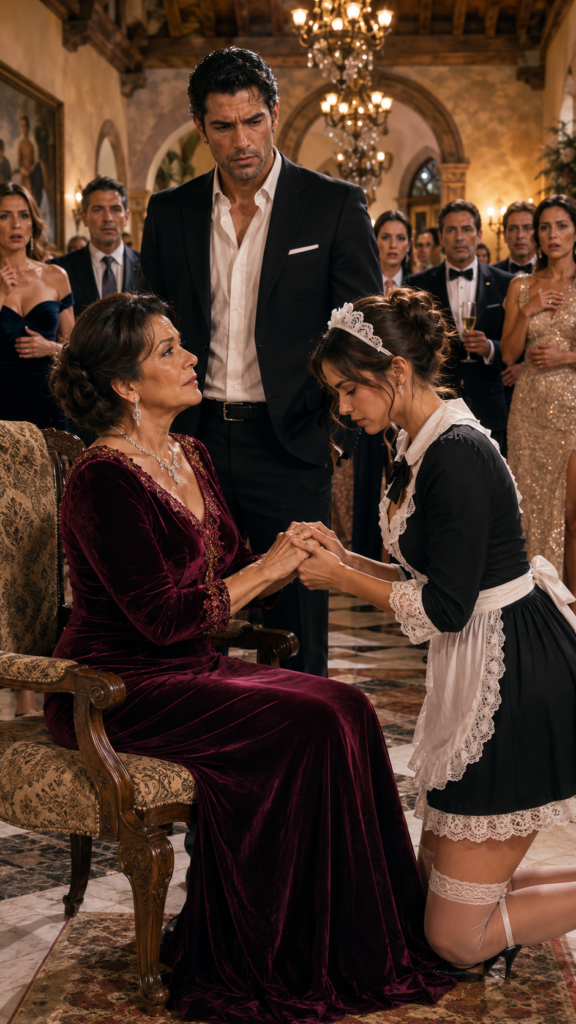
The woman wore a dark blue velvet dress, elegant but from another era. She clutched a small embroidered bag to her chest and looked around as if she didn’t recognize the place.
Lucía approached to ask if she needed help, but she didn’t get there in time.
The elderly woman lost her balance and brushed against Beatriz Valverde, the wife of a senator and honorary president of the organizing foundation.
Beatriz's glass of red wine spilled all over her white dress.
The entire hall fell silent.
“Useless old woman!” Beatriz shouted. “Do you have any idea how much this dress costs?”
The elderly woman trembled.
“I’m sorry, dear… I felt the floor moving.”
“Don’t call me dear. People like you shouldn’t even enter events of this level.”
Some guests looked down.
Others discreetly took out their phones.
No one intervened.
Lucía felt something burning in her chest. She set the tray down on a table and walked up to them.
“Enough.”
Beatriz turned slowly.
“What did you say?”
“It was an accident. The lady already apologized.”
“No one asked for your opinion, waitress.”
“No. But someone had to say it.”
A murmur swept through the hall.
Beatriz stepped so close that Lucía smelled her perfume.
“Tomorrow, you’ll never work in any hotel in this city again. Do you understand?”
Lucía knew she could carry out the threat. She knew she needed that paycheck. She knew Emiliano needed to breathe.
Still, she didn’t back down.
“She can buy another dress. What she can’t buy is an education.”
Several guests gasped.
Beatriz raised her hand.
Before she could touch her, a deep voice echoed from the staircase.
“Dare you.”
Everyone turned.
Alejandro Montemayor descended dressed in black. He owned construction companies, private hospitals, and security firms.
He was also the man no one spoke of too much because rumors, disappearances, and agreements that never reached court always surrounded his name.
Beatriz lowered her hand.
Alejandro crossed the hall without looking at anyone. He stopped in front of the elderly woman, and his expression changed completely.
“Mom,” he said, wrapping an arm around her. “I’m here.”
The woman breathed a sigh of relief.
Alejandro looked at the 300 guests.
“Everyone saw my mother cry. No one did anything.”
Then he fixed his gaze on Lucía.
“Except you.”
Lucía swallowed hard.
“I just did what was right.”
“No. You did what none of them had the courage to do.”
Beatriz tried to speak, but Alejandro silenced her with a look.
“From this night on, whoever touches Lucía Salgado touches me.”
The hall froze.
Lucía didn’t understand how he knew her name.
Then the elderly woman saw the small pendant she wore around her neck, grasped it with trembling fingers, and whispered something to Alejandro.
For the first time, the most feared man in Mexico lost color in his face.
PART 2
Alejandro took his mother to a private room and ordered that no one approach Lucía.
She followed him, furious.
“I didn’t ask for protection.”
“I know.”
“Then don’t talk about me as if I were your property.”
Alejandro remained still. No one spoke to him like that.
“You’re right,” he admitted. “That was a bad way to help.”
Mercedes, the elderly woman, continued to examine the pendant. It was a small silver door, worn by the years.
“Who gave it to you?” she asked.
“My mom, before she died.”
“What was her name?”
“Elena Salgado.”
Mercedes began to cry.
Alejandro closed the door of the room.
“My mother knew yours.”
Lucía let out a nervous laugh.
“That doesn’t make sense.”
“Your mother worked years ago at a community clinic funded by our foundation,” Mercedes explained. “She saved my daughter when she was a child.”
Lucía thought of Emiliano, of his nearly empty inhaler, and the irony of serving drinks at a gala that raised money for respiratory diseases.
Mercedes opened her embroidered bag and pulled out a brass key.
“Elena asked me to give this to you when you were brave enough to use your own voice.”
Lucía felt a chill.
“My mom died six years ago.”
“And I’ve been waiting to find you for six years.”
The key opened a storeroom in the Doctores neighborhood.
That same night, Alejandro offered to take her, but Lucía accepted only on one condition: Emiliano would go with her, and no one would decide anything for the two of them.
On the way, they passed by the pharmacy. Alejandro paid for the inhaler, but Lucía noted the exact amount on her phone.
“I’m going to pay you back.”
“It’s not necessary.”
“For you, maybe. For me, yes.”
Alejandro didn’t argue.
The storeroom smelled of dampness and old paper. Behind a mirror, they found a filing cabinet filled with invoices for medications that never made it to clinics and lists of children rejected for lack of inhalers, antibiotics, and oxygen.
“Did they steal all this?” Emiliano asked, pale.
Alejandro read several documents.
“They used shell companies. The money came out as donations and went back to private accounts.”
“Whose?”
Alejandro found a signature and clenched his jaw.
It was his father’s, Vittorio Montemayor.
The signature of Senator Valverde, Beatriz’s husband, also appeared.
Lucía looked at him with disdain.
“That’s why your family organizes galas. They steal medicine and then take photos helping the poor.”
“I didn’t know this.”
“But you knew something was rotten.”
Alejandro didn’t reply.
That silence was enough.
Emiliano found a USB drive stuck beneath a drawer. When he connected it to an old laptop, a video of Elena appeared.
Lucía stopped breathing.
Her mother looked young, tired, and still strong.
“If you’re watching this,” she said in the recording, “it means I couldn’t protect you with silence anymore.”
Elena explained that she had discovered the diversion of medicines at the clinic. Vittorio promised to report it but backed out when he realized his name would be destroyed.
Senator Valverde, on the other hand, turned the fraud into a national network.
And someone else had tried to infiltrate to gather evidence.
“Your father,” Elena said, looking into the camera, “did not die in that accident.”
Lucía stood up so quickly that she knocked over the chair.
Emiliano stepped back.
Her father, Miguel Salgado, had been declared dead 13 years earlier when a building under construction collapsed in Toluca.
Elena revealed that Miguel faked his death with the help of an accountant named Daniel Ponce.
Then he took the place of the main administrator of the network, a man known as “Arturo,” to copy accounts, contracts, and recordings.
“Did Mom know he was alive?” Emiliano whispered.
The video continued.
“Miguel believed that disappearing would keep you safe. I never agreed. Protecting someone without letting them choose can also be a form of abandonment.”
Lucía looked at Alejandro.
The phrase hit him like an accusation.
The video ended with an address and an instruction: to deliver the memory to federal prosecutor Mara Beltrán.
Before leaving, the phone hidden in the box began to ring.
Lucía answered.
“Hello?”
A male voice replied:
“Firefly.”
Only her father called her that.
Lucía's legs trembled.
“Dad?”
“Listen to me. They know you found the storeroom. Don’t trust the local police. Go to Mara.”
“You’ve been alive for 13 years?”
There was a painful silence.
“Yes.”
“And you let us believe you were dead?”
“I thought it was the only way.”
“Mom died waiting!”
“I know.”
Miguel didn’t defend himself. That made it hurt more.
Before hanging up, he said something that changed the direction of all her rage.
“Alejandro didn’t participate. For three years he’s been delivering information to the prosecution, although he didn’t know I was the main informant.”
Lucía turned to him.
Alejandro looked as surprised as she did.
Two trucks followed them from Doctores, but they managed to reach the federal building on Paseo de la Reforma.
Prosecutor Mara Beltrán showed no surprise at seeing the memory.
“We’ve been waiting for this for six years.”
Lucía placed the USB on the table.
“I want guarantees for my brother.”
“You’ll have them.”
“And I don’t want the Montemayor name to bury the case.”
Mara looked at Alejandro.
“That also depends on him.”
Alejandro pulled out his phone and called his board.
“Suspend all operations of the foundation. Hand over the servers. No one deletes a file.”
On the other end, they tried to convince him.
He hung up.
“My father protected this network,” he said. “I protected it by keeping silent. No more.”
The memory contained evidence against officials, suppliers, doctors, and companies. The most devastating file was a recording of Beatriz Valverde.
In it, she argued with her husband about the diverted medications.
“I don’t care where the money comes from,” she said. “As long as the foundation continues paying for my events, let the hospitals solve their problems.”
The woman who had humiliated Mercedes over a dress knew that sick children were left without treatment to finance her luxury.
The prosecutor made arrests that same morning.
Senator Valverde tried to leave the country.
Beatriz was arrested at her residence while still wearing the gala bracelet.
The news exploded on social media. Many guests who had recorded the humiliation without helping posted messages of indignation, as if they had never kept silent.
Three days later, Miguel Salgado returned to Mexico under federal custody.
Lucía saw him behind glass.
He had gray hair, a scar on his jaw, and the same habit of rubbing his knuckles when he was nervous.
“I don’t know if I can hug you,” he said.
“You can’t.”
Miguel nodded.
“Not yet.”
For two hours, Lucía confronted him about the lost birthdays, Elena’s death, and the nights when Emiliano couldn’t breathe.
Miguel didn’t demand forgiveness; he accepted every blow.
“I thought saving you meant deciding for you,” he said. “I was wrong.”
His cooperation avoided a long sentence, but he received judicial supervision and the obligation to work for years on recovering the stolen money.
Alejandro appeared publicly and spoke without lawyers at his side.
“A foundation cannot call itself charitable if its priority is to protect its name,” he said before the cameras. “My family allowed reputation to be worth more than the lives of sick people.”
He announced that the assets would go to an independent council and would fund a network for families without access to medicines.
Mercedes proposed calling it Open Door, like Lucía’s pendant.
Lucía accepted to work there as a community promoter while resuming her social work studies.
She did not accept a gifted position or a salary above the standard.
Emiliano received treatment from a pediatric pulmonologist named Sofía Montemayor.
She was Mercedes’s youngest daughter.
The same girl Elena had saved years ago.
When Emiliano discovered the connection, he burst into laughter.
“So my mom helped you, your mom helped my sister, and now you’re helping me breathe. Seriously, these families are so weird.”
Sofía smiled.
“Weird, yes. But no longer silent.”
Beatriz published an apology written by lawyers. No one believed her.
From preventive prison, part of her assets ended up, by court order, in the medicine fund.
“Money doesn’t erase what she did,” Lucía said.
“No, but it can repair something of what she destroyed,” Mercedes replied.
Open Door opened in the old clinic. There were no chandeliers or champagne, but families, doctors, neighbors, and volunteers.
Miguel stood at the back.
Lucía went to him.
“You came.”
“You invited me.”
“I’m trying to believe you won’t disappear again.”
“And I’m trying to deserve that you believe it.”
They didn’t hug.
But they stayed together.
Outside, Alejandro waited on the stairs.
“That night I said you would be under my protection,” he commented.
“Yes. That sounded quite controlling.”
“It was.”
“And now?”
Alejandro extended his hand, not as an order, but as a question.
“Now I want to know if you’ll let me walk by your side.”
Lucía looked toward the center.
Mercedes was teaching three children how to cheat at cards. Emiliano was arguing with Sofía about why inhalers should have better colors.
Her father was carrying boxes of files for the prosecutor’s office.
They had all failed: out of fear, ambition, or believing that silence was protection.
Lucía took Alejandro’s hand.
“You can walk by my side. But no one decides for me again.”
“Deal.”
The door of the center remained open behind them.
The truth had destroyed reputations and sent the guilty to prison, but it had also returned voices, medicines, and opportunities.
And in the end, the young woman everyone thought was just a waitress didn’t need a powerful man to rescue her.
What changed her life was having spoken when 300 people chose to remain silent.