PART 1
"Stop everything! My baby is moving!"
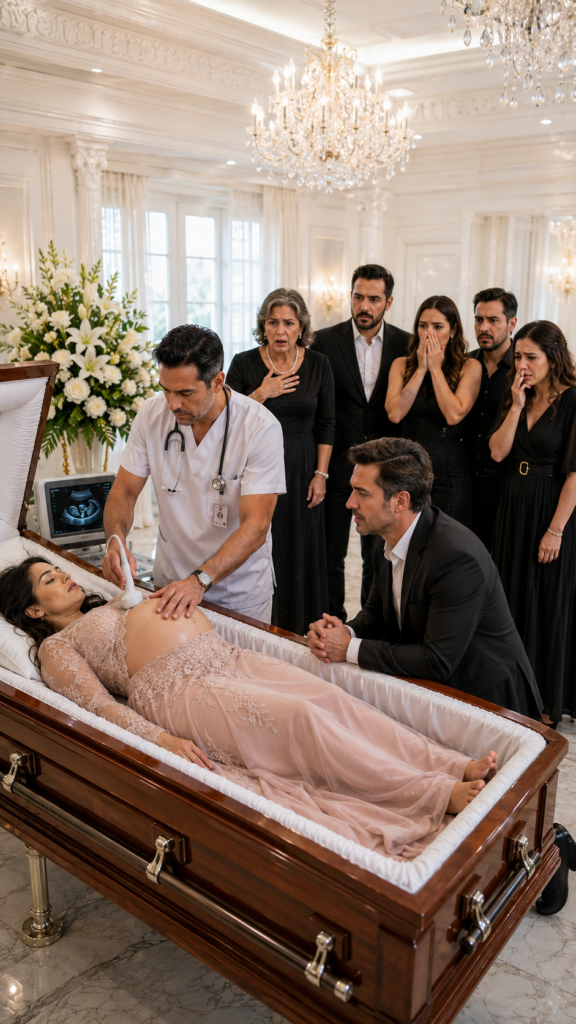
Diego Rivas's scream froze the Iztapalapa crematorium. No one breathed. No one dared to touch the lid of the casket where Valeria Montes, his wife, supposedly lay at rest, seven months pregnant.
Until that moment, everyone had acted as if death was final: white flowers, flickering candles, hushed whispers, and a urn prepared far too soon. Doña Gloria, Valeria's mother, wept with a rosary between her fingers, but kept insisting that it was best to cremate her quickly.
"My daughter doesn’t deserve to be seen like this," she said. "Sign it, Diego. Let her rest."
Diego couldn't even hold the pen.
Valeria was thirty years old, a nurse in a clinic in southern Mexico City, and expecting their first child. They had named the baby Mateo since the ultrasound showed him moving his little legs as if he were dancing.
The night before, at 10:47, Diego received a call that shattered his life.
They told him Valeria had had an accident on the Mexico-Cuernavaca highway. The rain, a curve, the car crashing against the wall, all of it instantaneous. Cold, clean words, far too orderly for such a brutal tragedy.
When he arrived at the scene, they wouldn’t let him approach the car. He saw patrol cars, red lights, a tow truck, and a tarp covering the vehicle. He also saw Tomás, Valeria's brother, soaked in the rain.
"Don’t ask, brother-in-law," he said. "It was horrible. Just let it all end."
That phrase stuck with Diego.
Tomás never let things just end. Tomás always wanted to handle everything.
Now, in the crematorium, Tomás stood by the door, checking his phone repeatedly. He wasn’t crying. He wasn’t hugging his mother. He just stared at the casket with a strange tension, as if he feared something inside might speak.
A funeral worker approached with a folder.
"Mr. Rivas, we need your authorization."
Diego looked at the blank signature line. Then he looked at the casket.
"I want to see her one last time."
Doña Gloria lifted her head.
"No, Diego. Don’t do this to yourself."
"She was my wife," he replied, his voice breaking. "And my son is with her."
The worker hesitated, but opened the casket.
Valeria lay pale, perfectly arranged, hands crossed and her belly covered by a light dress. Diego approached, trembling. He wanted to say goodbye, but couldn’t.
Then he saw it.
A small movement beneath the fabric.
He thought it was his pain. A shadow. A cruel illusion.
But it happened again.
The belly moved once more.
Diego plunged his hands into the casket and screamed with a force that erupted from his soul:
"Call an ambulance! My son is alive!"
Tomás stepped back, pale as paper.
And when the sirens began to wail outside, everyone understood that the worst was just beginning.
PART 2
Paramedics stormed into the crematorium, pushing people aside without asking. One carried a portable monitor, another a red backpack, and a young doctor bore the face of someone who had seen ugly things before, but nothing like this.
"How many months?" she asked.
"Seven," Diego said. "His name is Mateo. Please, tell me he’s alive, not that he was."
The doctor didn’t answer. She only placed a sensor on Valeria’s belly and asked for silence.
The entire crematorium fell still.
Five seconds passed.
Then eight.
Afterward, the device emitted a weak, rapid sound, almost lost.
But it was a heartbeat.
"There’s fetal activity," the doctor said. "The baby is alive. We need to transfer her now."
Diego felt the ground slip away beneath him. He wanted to cry, wanted to pray, wanted to break everything. But he could barely hold Valeria’s cold hand as they lifted her from the casket.
Doña Gloria collapsed into a chair.
"My God... my grandson..."
Tomás, however, didn’t come closer. He remained glued to the wall, clutching his phone tightly.
A prosecutor arrived minutes later because this was no longer a simple funeral procedure. There was a pregnant woman declared dead, a cremation almost authorized, and a living baby inside a body that no one had checked properly.
"Who asked to cremate her so quickly?" the agent asked.
Diego looked at his mother-in-law.
Doña Gloria cried louder.
"Tomás said it was best. That Valeria wouldn’t have wanted a long wake."
Everyone turned to him.
"And now are you going to blame me for wanting to avoid suffering?" Tomás spat. "Seriously, how low can you go?"
Diego said nothing. Mateo was first.
The ambulance sped toward the General Hospital. Diego climbed aboard without asking. During the ride, he held Valeria’s hand and spoke to her belly as if his voice could bridge death.
"Mateo, hang in there. Daddy’s here. Don’t give up, champ."
In the hospital, doctors and nurses rushed with the stretcher. Diego was stopped before the operating room.
"You can’t go in."
"My wife is in there," he said. "My son too."
A nurse squeezed his shoulder.
"We’re going to try to save the baby."
The word “try” fell on him like a stone.
The hallway smelled of bleach, old coffee, and fear. Diego sat down, his black suit covered in dust from the flowers. Doña Gloria prayed silently. Tomás paced back and forth, sweating despite the cold.
At 6:32 PM, a nurse rushed out with an incubator.
At 6:39, a cry echoed.
Tiny.
Raspy.
But alive.
Mateo had been born.
Diego covered his mouth to silence his scream. They let him see him for just a few seconds: tiny, red, tangled in tubes, waving his arms as if battling the world.
"He’s in critical condition, but he’s alive," a doctor said. "He’s going to neonatal therapy."
Diego wanted to thank them, but before he could speak, another doctor emerged from the operating room with a serious expression.
"Mr. Rivas, we need to notify the prosecutor."
"Why?"
The doctor lowered her voice.
"What we found in your wife’s body doesn’t entirely correspond to an accident."
Diego felt a sharp blow to his chest.
At that moment, Tomás’s phone vibrated on a chair. The screen lit up and displayed a notification before it locked:
"Is the cremation done yet?"
Tomás lunged to grab it, but the agent was quicker.
"That phone stays here."
"You have no right," Tomás protested.
"Then explain to me why someone is asking about that while your sister has just been pulled from a casket."
Doña Gloria looked at her son, mouth agape.
"Tomás... tell me it’s not true."
He didn’t answer. He just clenched his jaw.
The investigation changed that same night.
The prosecutor ordered them to examine Valeria’s car, retrieve highway cameras, analyze her phone, and suspend any funeral proceedings. Diego learned that the initial report had gaps. Too many.
The paramedic who supposedly confirmed the death hadn’t recorded fetal signs. The body’s transfer was done with a strange haste. And the authorization to cremate her appeared prepared before Diego had arrived at the crematorium.
But the worst came when they reviewed Valeria’s last messages.
Two days before the accident, she had written to Tomás:
"I’m not covering for you anymore."
"I’m going to tell Mom about the debts."
"Don’t ask me for money again."
Tomás’s last message read:
"See you today. You better not play the saint, because we all have secrets."
Diego read that in a copy of the file and felt nausea.
Valeria had never told him everything. She once only mentioned that Tomás was in trouble, that he owed money, and that their mom continued to defend him like he was a child. Diego thought they were just normal family disputes.
They weren’t.
Tomás owed over 600,000 pesos in loans, credit cards, and clandestine bets. He had used Doña Gloria’s name to borrow money. He had also taken Valeria’s jewelry and pawned it, claiming it was "to save a business."
Valeria discovered it three weeks before she died.
And she kept evidence.
In her email were photos of receipts, screenshots of transfers, and a file labeled "In case something happens to me." Diego couldn’t open it without his hands shaking.
Inside was a note:
"If something happens to me before Mateo is born, check Tomás. I don’t want to think badly of my brother, but I’m scared of him."
Doña Gloria read that phrase and let out a scream that echoed down the hallway.
"I told her to help her brother... I told her family shouldn’t abandon each other..."
Diego said nothing. What could he say? Sometimes family doesn’t abandon you. But sometimes family pushes you into the abyss and still expects you to thank them.
The strongest evidence appeared the next day.
In Valeria’s car, beneath the passenger seat, they found a half-empty bottle of water. It didn’t seem important until the forensics detected traces of a sedative. One that Valeria wasn’t allowed to take during her pregnancy.
Cameras at a gas station before the exit to Cuernavaca showed Tomás buying that same brand of water. Then it showed Valeria arriving, getting out of the car, and arguing with him in the rain.
There was no audio, but the image was clear.
Valeria touched her belly. Tomás spoke too closely. She tried to leave. He offered her the bottle. She rejected it. He insisted. Finally, she took a small gulp.
Eighteen minutes later, the crash occurred.
Tomás said it was a coincidence.
He said Valeria was nervous.
He said maybe she had taken something herself.
He said so many things that even his own mother stopped looking at him.
But there was still the twist that finally sank him.
The agent found a conversation on Tomás’s phone with a funeral home. He had asked how long it took to cremate a body if "the family didn’t want any scandals." He had also sent a photo of the preliminary medical report before Diego received it.
"How did you have that document?" the agent asked.
Tomás fell silent.
At that moment, everyone understood.
He not only knew more than he said.
He had tried to erase the truth before anyone could find it.
When they arrested him, Tomás glared at Diego with rage.
"You’re taking my family from me."
Diego approached slowly. His eyes were red, but his voice was steady.
"No. You killed your sister for money. And you almost burned your nephew alive to save your own skin."
Tomás wanted to respond but couldn’t.
Doña Gloria fell to her knees before him.
"What have you done, son? What have you done?"
For the first time, Tomás cried. But his tears didn’t seem to be of remorse. They seemed like fear.
Mateo spent 41 days in neonatal therapy. Diego learned to live watching numbers: oxygen, temperature, grams gained, milliliters of milk. He celebrated things he would have never noticed before, like his son breathing one more minute without help or squeezing a finger with his tiny hand.
Each visit was a miracle and a punishment.
He looked at Mateo and saw Valeria.
He remembered her laughter, her cravings for mango with chili, the way she spoke to the baby at night, saying:
"Your dad pretends to be tough, but he’s a big crybaby."
Diego cried in secret next to the incubator.
"You were right, Vale. I am a big crybaby. But I swear I won’t let go of him."
The trial took months. The prosecution presented the messages, the bottle, the cameras, the toxicology, the debts, and the rushed cremation. The defense tried to paint Tomás as a desperate man, someone who didn’t measure the consequences.
But Valeria didn’t die from a mistake.
Mateo wasn’t almost cremated due to a misunderstanding.
And Diego didn’t lose his wife due to bad luck.
The judge found Tomás guilty of causing the events that led to Valeria’s death and putting Mateo’s life at risk. Doña Gloria didn’t scream. Diego didn’t either. Justice didn’t feel like a victory. It felt like a door closing late, when the damage had already entered.
Years later, Mateo grew up knowing his mom loved him before he ever saw her face. Diego spoke to him about Valeria as if she still walked the house: the nurse who helped everyone, the woman who bought yellow socks because she said babies shouldn’t always wear blue, the mom who saved him even when everyone thought she couldn’t.
In a blue box, Diego kept the hospital bracelet, Mateo’s first photo, an ultrasound, and a copy of the report that stopped the cremation.
He didn’t open it often.
It wasn’t necessary.
Every birthday, Doña Gloria brought white flowers. She sat close to Mateo, watched him play, and whispered:
"Your mom was very brave."
Diego always corrected softly:
"She is brave. Because she’s still here."
And every time someone said the dead don’t speak, Diego thought of that casket, of the white fabric moving just slightly, of that hidden heartbeat where everyone had already signed the end.
Because there are truths that don’t come shouting.
Sometimes they just tremble once… waiting for someone broken to still have the courage to look.