PART 1
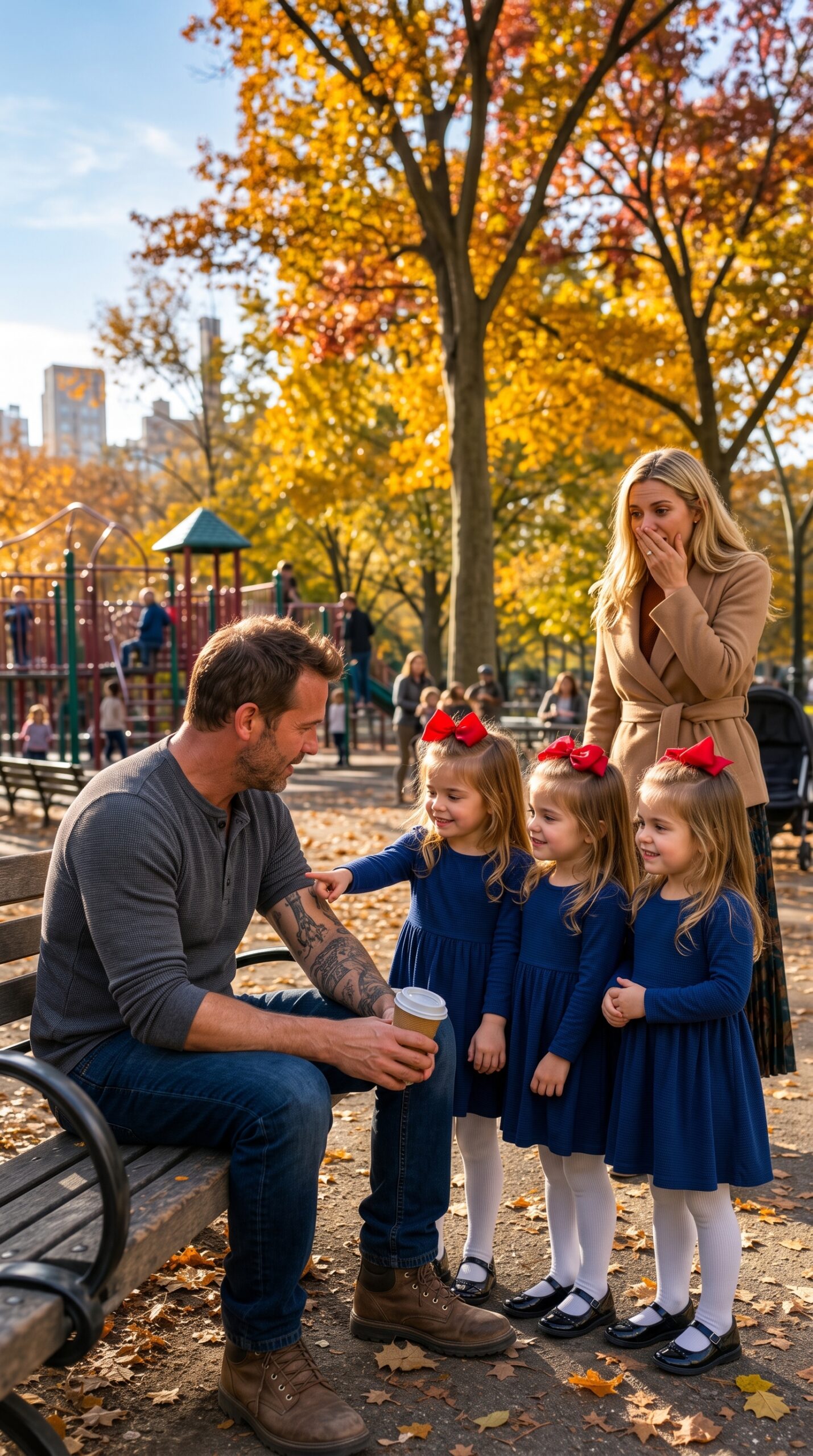
The three girls stood before Diego Andrade as if they had been searching for him their entire lives.
He was sitting on a bench in Chapultepec Park, a cold coffee in hand and a dinosaur backpack at his feet, waiting for his son Matías to finish playing on the swings.
It was Saturday morning. Families were scattered around, balloon vendors were hawking their wares, couples were taking photos, and children were running with cotton candy in hand.
Diego, 34 years old, wasn’t expecting anything unusual. He just wanted one quiet hour after a grueling week working as a technician at a private security drone workshop.
Then he heard a polite little voice.
—Sir… our mom has a message for you.
Diego looked up.
In front of him stood three identical girls, about seven years old. They wore light dresses, beige sweaters, perfectly styled bows, and shoes so clean they looked like they had never touched the ground.
One of them was staring intently at his forearm.
—What message? —Diego asked, trying to smile.
The girl in the center pointed to the small tattoo he had near his wrist.
It was a broken compass.
—Our mom has exactly the same tattoo as you —she said.
Diego felt the sounds of the park vanish suddenly.
That tattoo wasn’t just any design.
Eight years earlier, during an impromptu trip to Guadalajara, Diego had met a woman named Camila in a bar near the tapatío Chapultepec.
She never mentioned her last name. She never talked about her family. She wouldn’t answer calls. She laughed as if fleeing from something, but her eyes always seemed sad.
That night, they walked until dawn. On a napkin, they drew a broken compass, saying it represented two lost people who had found the same north for just one night.
The next day, they tattooed the drawing.
Then Camila vanished without leaving a number, an address, or an explanation.
Diego returned to what was then the Federal District with a wound he never confessed.
—What’s your mom’s name? —he asked, his voice barely above a whisper.
The three girls exchanged glances.
The youngest opened her mouth, but an elegant woman in a gray suit with a nervous expression came running.
—Renata, Lucía, Valeria, we need to go right now.
Diego stood up.
—Excuse me, they spoke to me first.
The nanny forced a smile, but her eyes scanned Diego’s tattoo as if she’d just seen a weapon.
—I’m sorry. The girls shouldn’t talk to strangers.
—They just mentioned something about their mom.
The woman paled.
—Mrs. Monterrubio is waiting for them.
Diego froze.
Monterrubio.
That surname wasn’t just any surname in Mexico. Monterrubio Transport, Monterrubio Hotels, Monterrubio Foundations. A family so powerful they appeared in magazines, news reports, and social columns.
As the nanny led the girls toward a black armored truck, the girl in the center turned.
She pressed her little hand against the glass before climbing inside.
And when the door closed, Diego caught her saying:
—Mom said that if we found the man with the compass… we shouldn’t tell him our last name.
PART 2
The truck took off before Diego could take a single step.
For several seconds, he stood frozen in the middle of the park, his heart pounding as if it wanted to leap out of his chest.
A few meters away, Matías was running toward him with a popsicle in hand.
—Dad, who were those girls?
Diego looked down the avenue where the truck had disappeared.
—I don’t know, champ.
But it was a lie.
He did know something.
He knew that a part of his past had just sat before him with three identical faces and honey-colored eyes, exactly like Camila’s.
That night, after putting Matías to bed in his small apartment in Portales, Diego opened his old laptop.
The screen took a while to boot up. He waited with shattered patience.
He typed a single search:
“Camila Monterrubio triplets.”
Results appeared immediately.
Camila Monterrubio Salvatierra. Chairwoman of Grupo Monterrubio. Businesswoman of the Year. Heiress to an empire of transportation, customs, and hotels. Philanthropist. Most influential woman in Mexico in logistics.
Diego clicked through article after article.
In almost every photo, she looked immaculate, dressed in expensive suits, wearing discreet jewelry, with that same gaze of someone who could never rest.
Then he found an image from a gala in Polanco.
Camila was seen from behind, wearing a black dress that plunged to her shoulder blades.
Diego stopped breathing.
On her left shoulder was the broken compass.
The same crooked line. The same incomplete north. The same crack in the center that he had drawn on a napkin with a tequila-shaking hand and hope.
It wasn’t similar.
It was identical.
Diego continued searching.
The girls were named Renata, Lucía, and Valeria Monterrubio. They were seven years old. They were born in a private clinic in Houston, according to an old article that talked about Camila’s “family miracle.”
There was no father mentioned.
No husband. No partner. No donor. Nothing.
Just a phrase repeated by the press: “Camila Monterrubio chose motherhood alone.”
Diego closed his eyes.
The dates lined up too perfectly.
That night in Guadalajara had occurred eight years before, in August. The girls were born seven and a half months later, premature, according to another article.
His stomach knotted.
The next day, Diego tried to convince himself he was exaggerating. Maybe Camila had copied the tattoo. Maybe the girls were just curious. Maybe life was playing a cruel joke.
But at 6:20 PM, while picking Matías up from school, he received a call from a private number.
—Is this Diego Andrade? —a female voice said.
He stopped beside the gate.
—Who’s speaking?
There was silence.
Then he heard a breath he recognized, even though it had been eight years.
—It’s Camila.
Diego tightened his grip on the phone.
—So it was you after all.
—We need to talk.
—Now? After eight years?
—Not over the phone.
Camila asked to meet that same night at a discreet café in San Ángel.
Diego left Matías with his neighbor, doña Chayo, a lady who had been helping him since he had been left alone with the boy.
At 9:15, he arrived at the place.
Camila was already there.
She wasn’t the simple woman from Guadalajara anymore. Now she wore an ivory jacket, her hair tied back, bodyguards outside, and a face that mixed fear with exhaustion.
But when Diego saw her eyes, he could no longer hate her so easily.
—The girls are mine, aren’t they? —he asked without sitting down.
Camila looked down.
—Yes.
The word fell between them like a stone.
Diego let out a dry, incredulous laugh.
—And you thought you’d tell me when? When they turn 18? When they accidentally found me again?
—It wasn’t that simple.
—Don’t give me that, Camila. Three girls. Three daughters. And you raised them as if their father were dead.
She tightened her grip on her coffee cup.
—For my family, that was easier.
Diego felt rage.
—Easier for whom? For your magazines? For your partners? For your luxury surname?
Camila lifted her face.
—To keep them alive.
Diego fell silent.
The phrase disarmed him.
Camila took a deep breath and began to tell the truth.
When she returned from Guadalajara, she knew she was pregnant. At first, she thought about looking for Diego, but she found she didn’t have his full last name or his phone number. She only knew that he worked in technology and lived in Mexico City.
Then her father, don Augusto Monterrubio, found out.
The old businessman exploded in rage.
Camila was the only heiress. The company was negotiating with banks, politicians, and foreign partners. A pregnancy with a “low-class” man, as he called Diego, could destroy the perfect image they had built.
—I was locked up for three weeks in the house in Lomas —Camila said—. They took away my phone. My dad ordered hotel records, cameras, payments, everything, to be erased.
Diego looked at her incredulously.
—And you let them do that?
—I was 26 years old, and everyone depended on my signature. They threatened to take the babies away as soon as they were born.
Camila explained that don Augusto hired lawyers to declare that the girls were born through assisted reproduction in the United States. They invented documents, medical records, and a clean story for the press.
Then came the worst part.
When Camila insisted on looking for Diego, her father hired investigators. They found a Diego Andrade, but not him: another man with a fraud record in Querétaro.
With that false record, don Augusto convinced Camila that the real Diego was dangerous.
—I was shown pictures, reports, supposed complaints. I was pregnant with three babies, isolated, scared. I believed them.
Diego swallowed hard.
—Did you never doubt?
—Every single day.
She adjusted her jacket slightly.
The tattoo of the compass appeared on her shoulder.
—That’s why I never removed it.
Diego wanted to say something cruel, but he couldn’t.
There was real pain in Camila’s voice. Still, that didn’t erase seven years.
—The girls ask about their dad —she said—. I told them that someday, when it was safe, the compass would bring him back.
Diego stood up.
—No. Don’t turn this into a fairy tale. You had money, lawyers, drivers, power. I had nights without dinner to pay rent and raise Matías on my own.
Camila blinked.
—Matías?
Diego clenched his jaw.
—My son. His mom died when he was one year old. Since then, I’ve been both dad and mom. So don’t tell me it was impossible to find me.
Camila covered her mouth.
—I didn’t know.
—Of course, you didn’t know. You never asked.
The conversation ended badly.
Diego left the café with boiling blood.
But two days later, he received a yellow envelope in his workshop.
Inside were copies of records, photos, medical evidence, and a handwritten note from Camila.
There was also a private DNA test done with samples from the girls and an old sample of Diego, taken from a glass that, according to the letter, the nanny had collected in Chapultepec.
Diego fumed as he read that.
But the result was there.
Probability of paternity: 99.99%.
Renata, Lucía, and Valeria were his daughters.
The letter ended with a sentence:
“I no longer want to protect a lie. I want them to know who you are, even if you hate me.”
That same afternoon, the news exploded.
An entertainment portal published photos of Diego in Chapultepec and a venomous headline:
“Alleged biological father of the Monterrubio triplets appears out of nowhere.”
Within hours, the Monterrubio family moved their influences.
Diego lost two contracts from the workshop. A truck followed him home. A lawyer in a tailored suit arrived with a document offering him 5,000,000 pesos to sign away any rights to the girls.
—It’s a unique opportunity, Mr. Andrade —the lawyer said—. With that money, you can secure your son’s future.
Diego glanced at the paper.
Then he looked at Matías, who was in the living room putting together a puzzle.
—My children are not for sale —he replied.
—Think it over. The Monterrubios don’t lose.
Diego tore the document in half.
—Well, it’s about time they learned.
The next day, Camila did something no one expected.
She called a press conference at the Grupo Monterrubio headquarters.
Everyone thought she was going to deny Diego.
But she appeared with the three girls holding hands.
Next to her was not her father.
It was Diego, in jeans, a simple shirt, and the same visible tattoo.
Journalists began shouting questions.
Camila approached the microphone.
—For seven years, I allowed my family to hide the identity of my daughters’ father. Out of fear, pressure, and cowardice. Today, it ends.
Don Augusto, sitting in the front row, stood up furiously.
—Camila, shut up.
The microphones picked up everything.
The girls were frightened. Diego took one step closer to them.
Camila didn’t back down.
—My father forged documents, manipulated information, and made me believe that Diego Andrade was a dangerous man. He also tried to buy his silence just 24 hours ago.
A murmur swept through the room.
Don Augusto shouted:
—I did it all for the surname!
Camila turned to him with tears in her eyes.
—No, Dad. You did it for control.
Then came the twist no one saw coming.
The nanny, that woman in the gray suit, stepped onto the stage with a USB in her hand.
Her name was Marina, and she had taken care of the girls for six years.
—I have recordings —she said, her voice trembling—. Don Augusto ordered that the girls never talk about the tattoo. He also ordered surveillance on Diego after the meeting in Chapultepec.
The recordings played for everyone.
Don Augusto’s voice rang clear:
“If that mechanic gets close, we destroy him. Camila isn’t going to lose control of the group over three girls who shouldn’t even know him.”
Renata began to cry.
—Did grandpa say that about us?
The silence was brutal.
Don Augusto tried to approach, but Diego stepped in front of him.
—Not another step.
Camila embraced her daughters.
For the first time in years, the most powerful woman in the country looked like a broken mother.
The consequences arrived quickly.
The Prosecutor’s Office opened an investigation into forgery, threats, and possible influence peddling. Grupo Monterrubio lost partners. Don Augusto resigned from the board 48 hours later.
But the hardest part didn’t happen in court.
It happened one Sunday, in the same Chapultepec Park.
Camila took the girls without drivers, without cameras, without perfect dresses. Just in sneakers, sweatshirts, and a bag of sweet bread.
Diego arrived with Matías.
The four children looked at each other curiously.
—Are you our brother? —Lucía asked.
Matías, nervous, hugged his stuffed dinosaur.
—I think so.
Valeria smiled.
—How cool. We’ve never had a brother before.
Diego had to look away.
Camila sat next to him on the bench where it all began.
—I don’t expect you to forgive me quickly —she said.
—I don’t know if I can.
—I understand.
The girls played nearby, laughing as if life had hidden nothing from them.
Diego looked at his tattoo.
For years, he believed that broken compass was a reminder of a woman who had abandoned him.
Now he understood it was also a shared wound.
—I’m not going to take the girls from you —he said—. But I’m not going to be a Sunday visitor or a family secret either.
Camila nodded, crying silently.
—You’re right.
Months later, a judge officially recognized Diego’s paternity. Shared progressive custody was established and family therapy for the five children, because Matías also needed to understand why suddenly he had three sisters.
Don Augusto tried to regain influence, but the girls no longer wanted to see him.
Not because someone prohibited it.
But because a seven-year-old girl can forget many things, but not the sound of her own grandfather treating her like a surname problem.
The first birthday they spent together wasn’t in an elegant hall or a private club.
It was at Diego’s house, with chocolate cake, basket tacos, crooked balloons, and neighbors singing off-key.
Renata gifted her dad a drawing.
There were five children, a mom, a dad, and a compass not broken anymore, but taped together with golden tape.
Below, she wrote in crooked letters:
“Now we found north.”
Diego read the phrase and was left speechless.
Camila cried.
Matías hugged his three sisters as if he had known them forever.
And that night, while the girls slept on inflatable mattresses in the living room, Diego understood something that hurt and healed at the same time.
There are families that break apart because of adult lies.
But sometimes it’s the children, with an innocent question in a park, who force everyone to tell the truth.





