PART 1
When Doña Mercedes Alvarado returned from the hospital and saw her orchard turned to mud, she didn’t scream at first.
She stood at the entrance of the ranch, her medicine bag pressed tightly against her chest, staring at the uprooted roots as if they were bodies strewn in a war.
For 46 years, she and her husband Ignacio had cared for this land on the outskirts of Uruapan, Michoacán.
These weren’t just ordinary apple trees.
They were 12 hectares of ancient trees, nearly extinct heirloom varieties, grafts that Ignacio had perfected over 30 years, sought after like gold by cideries in Mexico and the United States.
The jewel of the ranch was the Roja Alvarado, a deep-colored apple, sweet and tart, frost-resistant and registered as a conservation plant material.
Ignacio used to say that each tree had a memory.
So when he died of a heart attack, Mercedes didn’t sell a single hectare.
Every afternoon she walked to the oak by the stream, where his ashes lay, and whispered softly:
—We’re still here, old man.
But the Grupo Lomas Doradas didn’t understand memory.
The developer had bought 300 hectares around her to build a luxury subdivision with an artificial lake, a golf course, and huge houses for people who wanted to flaunt nature without getting their shoes dirty.
Only one property remained.
Mercedes’s.
At first, they offered her 48 million pesos. Then came the phone calls. After that, threats disguised as advice.
Patricio Roldán, the acquisitions director, personally visited the ranch with an expensive smile and clean shoes.
—Doña Mercedes, be reasonable. You’re getting old. You can’t take care of all this by yourself.
She looked at him without lowering her coffee cup.
—My husband is under that oak. My trees are not for sale.
Patricio pretended to be patient.
—Progress doesn’t stop for sentimentalism.
—Then tell progress to stay out of my home.
From that day on, the annoyances began.
Trucks kicking up dust, ditches flooding pastures, city inspectors for the slightest nonsense, and rumors that Mercedes wasn’t right in the head anymore.
But she kept photos, dates, plates, and names.
She wasn’t a helpless old lady.
She was a country woman with a back bent from work, but not from fear.
One Tuesday, Mercedes went to Morelia for a cardiologist appointment.
At 8:20 in the morning, 3 excavators, 2 bulldozers, and several trucks broke through the southern fence of the ranch.
The contractor, Abel Neri, checked the markers and spoke into his radio.
—The line doesn’t match, boss. This seems to be the lady’s land.
Patricio’s voice replied coldly:
—Tear it all down. I want it clean by morning.
For 4 hours, the machines crushed 70 years of history.
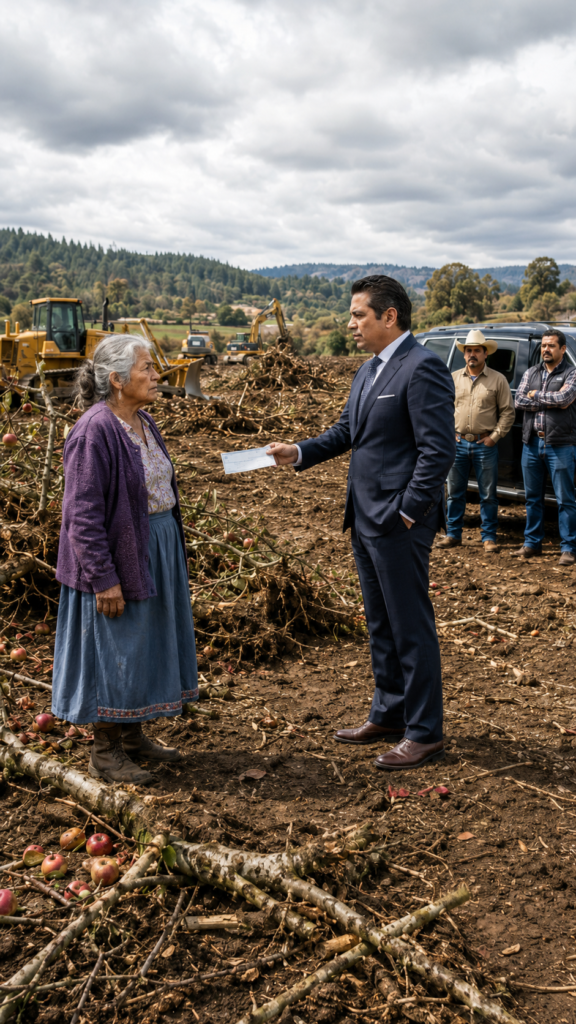
When Mercedes arrived, she fell to her knees among crushed apples, broken metal tags, and black earth smelling of diesel.
Then Patricio appeared with a check in his hand.
—It was a mapping error, Doña Mercedes. We offer you 150,000 pesos for the wood and grass.
She raised her tear-streaked face, but her eyes held no pain anymore.
They were icy.
—Do you think you destroyed firewood, Mr. Roldán?
PART 2
Patricio held the check as if he still had control.
Mud splattered on his fine shoes, and that seemed to bother him more than the fallen trees.
—I understand your feelings, Doña Mercedes. They were old trees. But don’t make this bigger than it is.
Mercedes stood slowly.
Her hands trembled, not from weakness but from contained rage. She walked to a broken branch and picked up a bent metal tag, still marked with the registration code of the living conservation bank.
—My husband took 30 years to create this variety.
—With all due respect, ma’am, you’ll have to prove that.
—I will prove it.
Patricio smiled, no longer pretending to be tender.
—My lawyers can drag any lawsuit out until you’re exhausted. Think carefully. At your age, a lawsuit like this isn’t in your best interest.
Doña Mercedes tucked the tag into her sweater pocket.
—At your age, kid, you should still know not to threaten a woman who has already buried the love of her life.
Patricio lost his smile.
—You’re making a mistake.
—No. The mistake was yours when you thought a lonely widow had no roots.
That night, Mercedes didn’t sleep.
She opened the safe that Ignacio had hidden beneath the floorboards of the study. Inside were his grafting notebooks, maps, bloom photos, contracts with cideries, university certificates, variety records, and letters from researchers who had visited La Esperanza.
Each folder smelled of old paper and patience.
Mercedes caressed Ignacio’s handwriting.
—I’m sorry, old man. I couldn’t protect them.
But by dawn, she was no longer crying.
At 7:30, she entered the office of Clara Mendoza, an agrarian lawyer from Morelia known for fighting against sugar mills, mining companies, and municipal presidents who thought they owned the world.
Clara reviewed the documents in silence.
As she flipped through the pages, her expression changed.
—Doña Mercedes… do they know what they destroyed?
—They think they were old trees.
Clara closed a folder and took a deep breath.
—Then they’re in for a hell of a surprise.
First came the experts.
Dr. Santiago Uriarte, a specialist in fruit conservation, walked among the fallen trunks with tears in his eyes. He didn’t speak for several minutes.
He crouched down, picked up a broken root, examined the recovered tags, and requested Ignacio’s notebooks.
Then he looked at Mercedes.
—This wasn’t an ordinary orchard. This was living agricultural heritage.
The report was devastating.
The Roja Alvarado couldn’t be replaced with trees bought from a nursery. Each mature specimen represented decades of selection, future production, contracts, genetic value, and adaptation to the region’s climate.
They had lost 110 mature trees of that variety alone.
Adding the other heirloom apples, the irrigation system, soil restoration, lost contracts, and genetic damage, the initial amount was 96 million pesos.
But Clara went further.
She demanded comprehensive compensation, projected damages, aggravated property damage, invasion of private property, and willful destruction of registered plant material.
The lawsuit landed on the desks of Lomas Doradas on a Monday morning.
Patricio opened it as if expecting a minor nuisance.
Then he saw the figure.
288 million pesos.
—What the hell is this? —he shouted.
His lawyer didn’t respond immediately.
—Patricio, this isn’t a normal lawsuit.
—They were apple trees.
—No. Legally, they were registered genetic material. And if they prove it was intentional, the company is doomed.
Patricio slammed the table.
—It was the contractor’s mistake.
—You better hope the contractor says the same.
But Abel Neri no longer wanted to bear the blame alone.
Lomas Doradas tried to pin it all on him. They left him without pending payments, threatened to blacklist him from future projects, and even leaked that he had worked drunk.
That’s when they made their second mistake.
Abel kept messages.
The trial began months later in Morelia.
The courtroom was packed with farmers, students, journalists, neighbors, and even cider producers who had signed contracts with La Esperanza.
Mercedes arrived in a simple gray suit, carrying a dry branch of the Roja Alvarado inside her bag.
Patricio arrived with dark circles under his eyes.
He no longer looked like the man who smiled in front of a muddy widow.
The defense repeated the same old story.
Confusing maps. Human error. Poor communication. Reckless contractor.
Clara waited.
Then she called Abel Neri to the stand.
The man ascended the witness box, his face pale.
—Mr. Neri —Clara asked—, did you misidentify the line?
Abel swallowed hard.
He glanced at Patricio.
—No.
A murmur filled the room.
Clara raised an eyebrow.
—Explain.
—I told Mr. Roldán that the markers didn’t match the map. I told him that this orchard belonged to Mrs. Mercedes. He told me to follow the modified map and tear it all down.
Patricio turned red.
—That’s a lie.
Abel pulled out his phone.
—He also texted me that the lawyers would take care of “the widow.”
The message appeared on the screen.
The room froze.
Clara didn’t smile.
—Was there any extra payment that day?
Abel looked down.
—Yes. 300,000 pesos for “cleaning urgency.”
The judge called for silence.
But it was too late.
The truth had cut through like a machete.
Then came the twist nobody expected.
Clara presented security footage taken from Doña Elvira’s house, the neighbor.
In the video, Patricio’s black truck was seen stopped in front of the ranch the night before. A man was seen getting out and moving the measurement stakes near the southern fence.
The man was Patricio.
Mercedes closed her eyes.
She finally understood it hadn’t been mere ambition.
It had been calculated, measured, and executed cruelty.
The defense attempted to argue that the video was blurry, but Clara delivered another blow: an audio of Abel on the radio, recorded by the excavator’s system.
—The line looks odd, boss.
And Patricio’s voice replied:
—Tear it all down. By the time that lady comes back, there will be nothing to discuss.
Mercedes squeezed the dry branch in her bag.
She didn’t cry.
She didn’t want to give him even one more tear.
The verdict came weeks later.
Grupo Lomas Doradas was found responsible for invasion, willful destruction, and aggravated property damage. They were ordered to pay 288 million pesos, legal costs, ecological restoration, and the permanent suspension of the subdivision.
Patricio was fired, sued by his own counsel, and blacklisted from several business chambers.
Investors pulled out funds within 30 days.
The banks demanded payments.
The dream of the “eco-friendly” subdivision was left abandoned, with half-built houses and tarps flapping in the rain.
The town talked for months.
Some said Mercedes had exaggerated.
Others said someone had finally put a stop to the rich who think everything can be bought.
But Mercedes didn’t celebrate with parties.
Nor did she move to live by the sea.
With part of the compensation, she bought, at a bargain price, the 300 hectares surrounding her ranch.
The same land that Lomas Doradas wanted to fill with concrete returned to the hands of someone who knew how to listen to it.
She had useless roads removed, debris cleared, and empty houses dismantled.
With the help of the university, she recovered living root fragments she had stored in a greenhouse and founded the Ignacio Alvarado Trust for the Conservation of Heirloom Apples.
She planted 10,000 new trees.
Not all were the same as the lost ones.
Some varieties would never return.
That hurt like a wound that doesn’t heal.
But the land responded.
Three years later, in spring, the hills where luxury trucks were supposed to roam filled with white and pink flowers.
Where there was to be a golf course, bees buzzed.
Where Patricio envisioned pipes, concrete, and easy money, roots grew.
Mercedes, now 75, walked to the oak by the stream with a small basket.
Inside, she carried the first young apples from the new orchard.
They were imperfect, reddish, with golden spots.
She placed one on the ground where Ignacio’s ashes rested.
—They took away half our heart, old man —she whispered—. But they couldn’t uproot our roots.
The wind stirred the new branches.
For the first time since that Tuesday, Mercedes didn’t just feel loss.
She felt continuity.
Time later, she opened the sanctuary once a month on Sundays.
Families from Uruapan, Morelia, Pátzcuaro, and nearby towns arrived. The children learned to graft. The farmers recovered ancient varieties. The cideries returned to buy fruit with a new label:
“Harvest from La Esperanza.”
One afternoon, a little girl asked her:
—Doña Meche, why didn’t you sell when they offered you so much money?
Mercedes looked at the young trees under the blue Michoacán sky.
—Because there are things that aren’t for sale, dear.
—Like the land?
Mercedes smiled.
—Like dignity.
And thus, the widow they thought would be easily erased ended up turning her ruins into the most important agricultural sanctuary in the region.
Patricio wanted to erase an orchard to build empty houses.
But Mercedes made a forest of memory grow.
And every spring, when thousands of flowers covered La Esperanza, the town remembered a lesson that hurt and healed at the same time:
never confuse a patient woman with a defeated woman.
Because some roots, even when yanked out with machines, spring back stronger than before.





