PART 1
The sun beat down on the old road of San Jacinto as if it wanted to crack the stones.
Elena walked, pushing a rusty shopping cart, one of those that squeaks even when empty. Inside were two bags of clothes, a torn blanket, a burned pot, and the crumpled papers proving that the abandoned little house was all that was left for her children.
Behind her trailed her seven kids.
The oldest, Mateo, was fourteen and walked with his back straight, even though his eyes were closing from exhaustion. At times, he carried Lupita, the youngest, who was three and no longer cried loudly because even crying took energy.
Since her husband Julián had died in a municipal job, Elena had stopped being “the good girl of the neighborhood” and became “the poor widow with too many kids.”
Her mother-in-law told her she could no longer take her in.
Her brothers-in-law slammed the door in her face.
And some neighbors whispered when they saw her pass:
—Poor thing… but really, why did she have seven?
As if children were a fault.
As if love could be canceled when poverty struck.
That morning, they had been kicked out of the room they rented behind a convenience store. The owner cried, but confessed that some men from the municipality had come asking about her.
—Leave, Elena. I don’t want trouble. They aren’t here to chat.
Elena didn’t argue.
She had run out of the strength to ask for favors.
So she headed toward a little house on the outskirts of town, a property that Julián had inherited from his father. Nobody wanted it because it was far away, with cracked walls and a sunken tin roof.
But it was hers.
And when a mother has seven hungry children, a ruin can seem like a palace.
As they approached a bend surrounded by dry prickly pears, Mateo stopped.
—Mom… there’s someone lying down.
Elena looked toward the ditch.
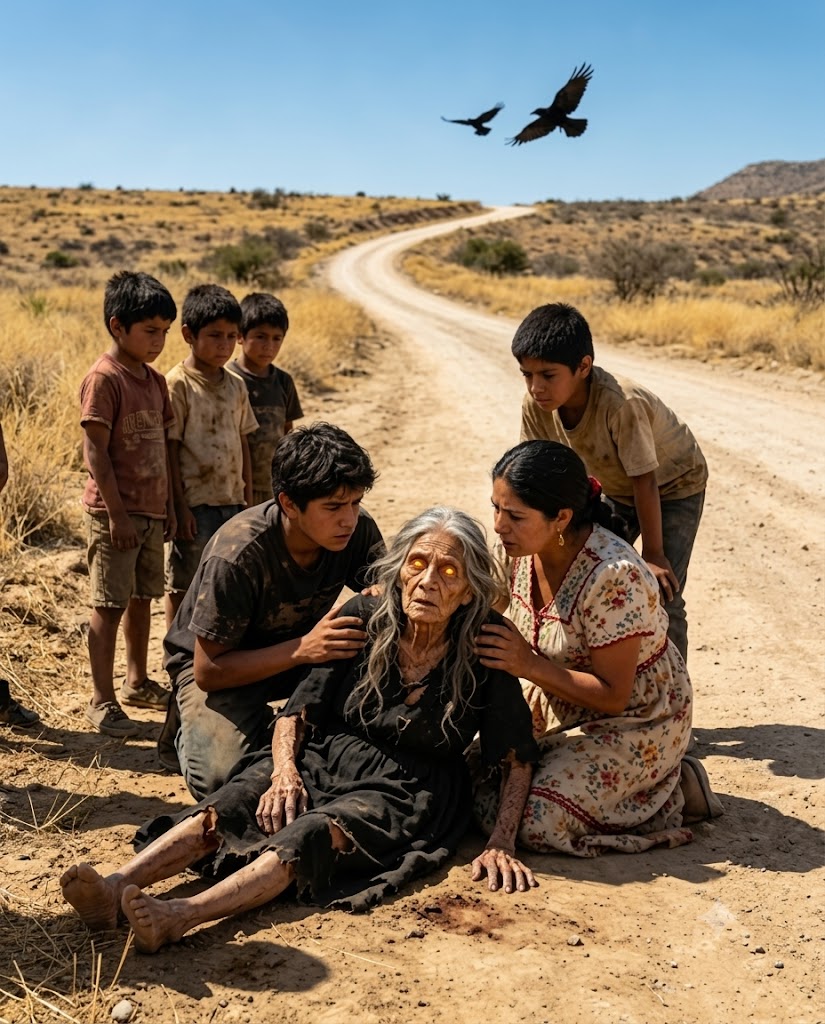
An elderly woman lay between the dirt and the bushes, her gray shawl soaked in dust. She had blood on her forehead, a leg bent at an odd angle, and broken sandals.
Her white hair looked like ashes.
—Don’t get close —Mateo whispered—. It’s doña Jacinta.
The children huddled closer to Elena.
They all knew that name.
Doña Jacinta, the healer from the hill. The woman who performed cleansings with rue, who cured frights, who knew who was sick before they even spoke of it. Some brought her candles in secret; others called her a witch out loud.
A truck passed slowly.
The driver rolled down the window and shouted:
—Leave her there! That old woman only brings misfortune.
Then he sped off, raising a cloud of dust.
Elena stood frozen.
She had no money.
She didn’t have enough food.
She didn’t even have a safe place for her children.
But she saw the elderly woman struggling to breathe and felt a familiar pain in her chest.
Because an abandoned woman quickly recognizes when the world has decided to let someone die.
She stepped closer.
—Ma’am… can you hear me?
Doña Jacinta opened her eyes.
They were clear, firm, as if they didn’t belong to a woman lying in the dirt.
She grabbed Elena's wrist with unexpected strength.
—Don’t leave me here, daughter.
Mateo shook his head quickly.
—Mom, seriously no. They’ll blame us if she dies.
Elena looked at him.
—Son, they’re already blaming us for everything.
Together, they lifted the elderly woman into the cart. The other children walked in silence, looking back as if the hills had eyes.
They arrived at the little house as the sky began to turn orange.
The door wouldn’t close properly. There was dampness on the walls. The floor was packed dirt.
But Elena took a deep breath.
—Here we will start again —she said, even though she didn’t fully believe it herself.
She laid doña Jacinta on the least torn mat. She cleaned the blood off her forehead with water from a bucket and split the last hard roll into eight pieces.
She gave the elderly woman hers.
—Why are you helping me if you have nothing? —doña Jacinta asked.
Elena barely smiled.
—Because when one has nothing, one can still choose not to be evil.
The healer looked at her for a long time.
That night, the seven children slept tightly under the same blanket. Elena mended a shirt for Mateo by candlelight, trying not to think about the hunger of the next day.
Then doña Jacinta spoke from the darkness.
—Julián didn’t fall from the job site.
The needle slipped from Elena’s fingers.
She stopped breathing.
—What did you say?
The elderly woman slowly sat up.
—Your husband was murdered.
The wind rapped against the tin roof.
Elena felt anger and fear rise together in her throat.
—Who are you to say that?
Doña Jacinta pressed the shawl against her chest.
—I’m the woman who saw what everyone was too afraid to tell.
Before Elena could respond, a truck braked outside.
The children woke startled.
Then there were three sharp knocks on the door.
KNOCK.
KNOCK.
KNOCK.
Doña Jacinta whispered:
—Don’t open. They came for the house… and if they can, also for your children.
PART 2
Elena felt her blood rush to her feet.
Mateo jumped up and grabbed an old stick that was next to the wall. The other children huddled in a corner. Lupita covered her mouth with her little hands as if even breathing could get them in trouble.
Outside, the truck’s engine remained running.
—Doña Elena! —a man’s voice shouted—. Open, we’re here to help you. Don’t make this harder.
Elena recognized the voice.
It was Rogelio Cárdenas, the director of public works for the municipality. A man who appeared in photos handing out food, hugging children during campaigns, and promising drinking water in neighborhoods where even the pipes didn’t exist.
He was also the one who signed the report of Julián’s death.
“Work accident due to worker negligence.”
Elena had never forgotten that phrase.
As if her husband had been guilty even of dying.
Doña Jacinta sat slowly.
She no longer looked so weak. Her gaze held a firmness that made Elena uneasy.
—Your Julián found something beneath this land —she said softly—. It wasn’t buried money or legendary gold. It was water.
—Water?
—A deep spring. Clean. Enough to supply several ranches when the drought comes strong. Julián wanted to register it in his family’s name.
Elena shook her head.
—He never told me anything.
—Because he wanted to surprise you when he had the papers ready. He wanted your seven children to never go to bed hungry again.
Another knock shook the door.
—Open up already! —Rogelio yelled—. We know the old woman is in there. And we know you’re alone.
Mateo tightened his grip on the stick.
—My mom isn’t alone.
Elena looked at him with a broken heart.
He was just a child, but life had already forced him to stand like a man in front of criminals.
Doña Jacinta pointed to a large stone in the corner of the house.
—Under that stone is a can. Julián hid it there before he died.
Elena hesitated, but ran.
With Mateo’s help, she moved the stone. The earth was loose. She dug with her nails until she touched metal.
She pulled out a rusted cookie can.
Inside were documents wrapped in plastic, photographs of the land, a USB drive, and a folded letter with her name on it.
The handwriting was Julián’s.
Elena brought her hand to her mouth.
—It can’t be…
At that instant, the door burst open.
The wood crashed against the wall.
Four men entered.
Rogelio was at the front, wearing a pressed shirt, expensive boots, and that false smile of a public official who thinks everything can be bought.
Three guys with black caps followed behind.
—Oh, Elena —Rogelio said—. Just look at the fright you’re giving your kids.
His eyes dropped to the can.
The smile vanished.
—Give it to me.
Elena hugged the papers to her chest.
—Is this why they killed Julián?
Rogelio let out a dry laugh.
—Your husband was stubborn. He was offered money. A lot, for someone like you. But he wanted to be dignified.
Mateo stepped forward.
—You ordered him killed!
One of the men pushed him against the wall. Elena screamed and ran toward him, but another guy grabbed her arm.
—Calm down —Rogelio ordered—. No one has to get hurt. Just sign the transfer of the house, and we’ll let you go with your kids.
Elena felt nauseous.
—And if I don’t sign?
Rogelio looked at her as if he already had the answer prepared.
—A widow without a job, without food, and living in a crumbling house can be considered incapable. The welfare department could take the children away. You’ll see.
The words fell like stones.
Elena hugged the documents tighter.
They didn’t just want to take her house.
They wanted to rip her children away to break her.
Doña Jacinta stood up.
Elena then noticed that the elderly woman no longer trembled.
—You’ve always been a coward, Rogelio.
He looked at her with hatred.
—You should’ve stayed lying in the road.
Everything became clear.
Doña Jacinta hadn’t been run over by accident.
They had left her there to keep her from speaking.
—You saw what happened to Julián —Elena whispered.
The healer nodded.
—I saw when they argued at the job site. I saw when Rogelio told him that if he didn’t sign, his children would pay. I saw when two men pushed him from the third floor. And I saw when they changed the report before the ambulance arrived.
Rogelio clenched his jaw.
—Gossiping old hag. Who’s going to believe you? Even those who ask you for remedies call you a witch.
Doña Jacinta reached under her shawl.
She pulled out an old cell phone with a cracked screen.
—Maybe not me. But they’ll believe your voice.
She pressed a button.
The recording filled the little house.
“Julián isn’t going to sign. Make it look like an accident. And Jacinta has to be silenced too. That old woman saw too much.”
Elena felt the world shatter.
The children listened, frozen.
Mateo cried silently, with the adult rage trapped in a child’s body.
Rogelio lunged at the elderly woman.
—Give me that!
Mateo stepped in with the stick.
One of the men pulled out a knife.
Elena thought they were all going to die that night.
But then, outside, sirens sounded.
First distant.
Then so close that the red and blue lights seeped through the cracks in the walls.
Rogelio turned pale.
—What did you do, damned old woman?
Doña Jacinta raised the phone.
—I sent the recording and the location before they knocked on the door.
A voice boomed from outside:
—State Police! Come out with your hands visible!
The men panicked.
One tried to run out the back. Another dropped the knife. Rogelio grabbed Elena by the neck and pulled her in front of him as a shield.
—Tell them to leave! —he screamed in her ear—. Or your children will be left without a mother!
Elena looked at her seven children.
She saw Mateo with blood on his brow.
She saw Lupita trembling.
She saw Julián’s letter lying on the dirt floor.
And something inside her, something that hunger, humiliation, and abandonment had not managed to kill, rose up.
—No.
Rogelio tightened his grip.
—What did you say?
—I said no, asshole.
Mateo bit the hand of the man holding him. The other children pushed an old table against Rogelio’s legs. Elena broke free and fell to the ground, covering Lupita with her body.
The police stormed in.
There were shouts, boots, dust, and crying.
Rogelio ended up handcuffed, face down, with his fancy shirt covered in dirt.
—This isn’t over —he spat—. You don’t know who you’re messing with.
Doña Jacinta approached and looked down at him.
—Yes, we do. With a thief who feared an honest construction worker, a widow without money, and seven hungry children.
Rogelio lowered his gaze.
Hours later, the little house was filled with agents, forensic experts, and neighbors who had previously crossed the street to avoid greeting Elena.
Now everyone wanted to know.
Commander Salazar reviewed the papers, the USB drive, and the photographs.
—Mrs. Elena —he said seriously—, your husband documented threats, plans of the spring, and names. This doesn't just reopen the case. This is going to bring down several in the municipality.
Elena finally opened the letter.
She read it with trembling hands.
“My Elena, if anything happens to me, don’t sell the house. Beneath this land is the future of our children. Don’t trust Rogelio or my cousin Armando. He gave them a copy of the papers.”
Elena felt the blow empty her chest.
Armando.
Julián’s cousin.
The one who carried the coffin.
The one who later told her to sell the little house “before she got into more trouble.”
The one who brought her 500 pesos to the wake so everyone would say he was a good man.
The betrayal hurt almost as much as the death.
The next day, Armando was arrested at the Querétaro bus terminal, attempting to escape with 180,000 pesos in cash. On his cell phone, they found messages with Rogelio.
“When the widow signs, we’ll give you the rest.”
“Pressure her with the kids.”
“Without a house and without food, she’ll bend easily.”
Elena vomited upon hearing it.
They didn’t just want a plot of land.
They wanted to break her as a mother.
They wanted to use her children's hunger as a chain.
In the following weeks, the town changed its tune.
Those who had previously called her exaggerated began to refer to her as “doña Elena.” The neighbors brought rice, beans, used clothes, and apologies that came too late.
—I’m sorry, Elena. One didn’t know.
But Elena knew something.
She knew that many people don’t help not because they can’t, but because they prefer not to get involved.
The investigation confirmed that Julián had been pushed at the municipal job site. The report was altered. An expert was paid off. Rogelio planned to sell the land to a bottling company using front men.
Doña Jacinta testified before the prosecutor’s office.
Nobody called her a witch out loud anymore.
Though she laughed when someone called her a healer.
—I’m called a witch when they want to scare me, and a healer when they need me to cure their fright.
Elena didn’t sell the house.
With legal support, she registered the spring as family property. Then, a cooperative from the town helped to install a small system to provide water to several families.
She didn’t get rich overnight.
Real life doesn’t work like a cheap novel.
But her children stopped going to bed with empty stomachs.
Mateo returned to middle school.
Lupita stopped hiding tortillas under her pillow.
And Elena, for the first time in a long time, walked through town without lowering her head.
One afternoon, she found doña Jacinta sitting by the water spring, watching how the sun sparkled on the surface.
—You saved us —Elena said.
The elderly woman shook her head slowly.
—No, daughter. You saved me first, when everyone else walked by.
Elena fell silent.
The water sounded clean, alive, as if Julián still spoke from the earth.
Mateo approached and said half jokingly:
—So you were a witch after all.
Doña Jacinta looked at him seriously.
—No, kid. I’m just old. And an old woman who observes is worth more than ten men who boast of knowing everything.
The children laughed.
Elena did too.
That night, she stored Julián’s letter in a new box, along with the evidence that changed her destiny.
Then she looked at her seven sleeping children and understood something that hurt, but also healed.
Poverty hadn’t taken her dignity.
Abandonment hadn’t taken her heart.
And stopping for an injured woman on the road, when she herself had nothing, was the act that saved her whole family.
Because sometimes a miracle doesn’t descend from the sky.
Sometimes it lies in a ditch, covered in blood and dust, waiting to know if there is still humanity left in someone.





