PART 1
Damián Valcárcel thought he was following a defenseless waitress.
That was the first lie he told himself.
He had seen her for a month in an old café in Santa María la Ribera, one of those places that survive on reheated coffee, stale pastries, and customers who arrive at dawn because they don’t want to go home.
Marisol Aranda worked there from 6 PM to 2 AM. She wore a faded blue uniform, worn-out sneakers, and had her hair pulled back with a black scrunchie. She rarely smiled. When she did, it seemed like she was apologizing for existing.
Damián always sat at the corner table.
He didn’t go for the coffee. It was terrible.
He went because in his penthouse in Polanco, everything smelled of marble, silence, and enemies. Because Doña Elvira, his mother, kept repeating that a man like him shouldn’t get attached to anyone. And because his brother Ramiro was already saying that Damián was becoming weak.
“A waitress is making a fool out of you, man,” Ramiro told him in front of five family members.
Damián didn’t respond.
He just looked at him.
And Ramiro lowered his gaze.
But the phrase lodged in him like a dagger.
Marisol didn’t seem to know who he was. To her, he was just the man in the dark suit who ordered black coffee, left a thousand pesos under the plate, and never asked anything.
He liked that.
In her world, everyone wanted favors, protection, money, or revenge. Marisol just filled his cup and left.
That night, at 1:18 AM, two drunk men entered. One wore a leather jacket, had a poorly trimmed beard, and smelled of cheap beer. The other wore a black cap and had eyes too alert to be drunk.
Damián noticed.
So did Marisol.
“Hey, sweetheart,” said the one in the jacket, slamming his fist on the table. “Bring us some sandwiches and a smile.”
Marisol placed two menus on the table.
Her knuckles were bruised. Under the collar of her uniform, a yellowish line marked her neck, like an old bruise.
Damián clenched his cup.
“What are you going to order?” she asked.
The man grabbed her wrist.
“First, tell me what time you get off.”
Damián slipped his hand under his jacket.
Marisol didn’t scream. She didn’t tremble. She didn’t even pull away her arm.
She simply lowered her gaze slightly towards his fingers.
“Let me go.”
“Don’t be a killjoy. We’re just playing.”
She touched a heavy bottle of Valentina sauce with two fingers, still not lifting it.
“I told you to let me go.”
There was something in her voice that extinguished the man’s laughter.
The drunk let go of her, threw the menu aside, and walked out, cursing. The one in the cap followed him, but before leaving, he looked at Marisol as if confirming an address.
Damián watched.
At 2:06 AM, Marisol closed the café, turned off the neon sign, and stepped out into the drizzle wearing an old military jacket.
Damián followed her in a black truck without plates.
He told himself it was to protect her.
But in reality, he needed to know who this woman was, with bruises of a victim and eyes of a killer.
Marisol walked toward some abandoned warehouses near San Rafael. She didn’t walk like someone afraid. She scanned reflections in windows, shadows under cars, rooftops.
Then she entered a dead-end alley.
Damián got out of the truck, pulled out his gun, and crept along the wall.
Then he saw the two men from the café emerge from the shadows.
They didn’t look drunk anymore.
One aimed at Marisol.
“Give us the memory.”
She didn’t back down.
“I have it.”
Damián raised his weapon.
But he couldn’t pull the trigger.
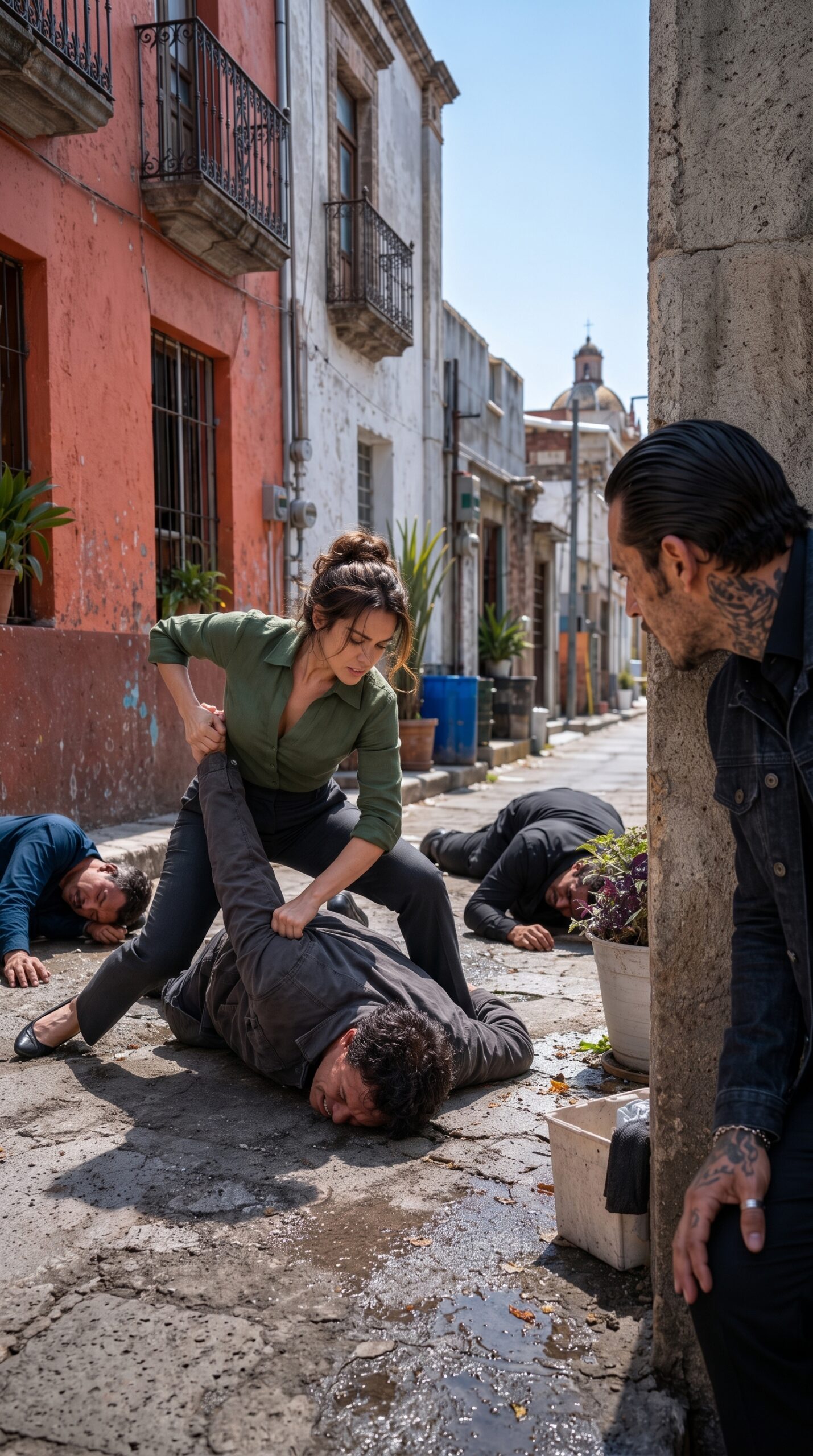
Marisol moved like lightning. In six seconds, the first man fell to the pavement with a broken knee. The second tried to draw a gun, but she smashed the sauce bottle she had hidden in her sleeve against him, snatched the weapon, and left him gasping on the ground.
The rain continued to fall.
Marisol searched one of their pockets and pulled out a black USB drive.
Then she walked toward the exit.
As she passed the wall where Damián was hiding, she didn’t look back.
She only said softly:
“Don’t follow me again, Mr. Valcárcel.”
PART 2
For seven days, Damián didn’t return to the café.
But he couldn’t get Marisol out of his head.
He had seen men kill since he was fifteen. He had witnessed betrayals, ambushes, and bodies disappear in the canals of Xochimilco without anyone asking anything. But he had never seen a waitress with bruises move with such dry, cold precision, almost militaristic.
It wasn’t strength.
It was training.
And that unsettled him more than any threat.
Damián sent Tavo, his trusted hacker, to dig up everything about Marisol Aranda. Tavo worked in a basement in the Doctores neighborhood, surrounded by monitors, cables, and cheap soda cans. He claimed he could find even the most hidden sin of a judge.
But with Marisol, he came up empty.
Her CURP didn’t match. Her INE was real but too clean. The apartment she rented in Guerrero was paid in cash by a ghost company. She had no old photos, no family, no debts, no medical history, and no social media.
As if she had been born an adult.
“Boss,” Tavo said, pale in front of the screen, “this girl doesn’t exist.”
Damián fell silent.
“Or worse,” Tavo added, “she exists because someone with a lot of power wanted her to.”
That same afternoon, in the family home in Las Lomas, Doña Elvira was waiting for him with the table set and a sharp gaze.
Ramiro was there, pouring tequila as if he already owned the place.
“I hear you’re still investigating the waitress,” Doña Elvira said.
Damián took off his black gloves.
“I hear many things.”
“A woman without family, surname, or history doesn’t approach men like you by chance.”
Ramiro laughed.
“Maybe she didn’t even approach, Mom. Maybe my brother is just chasing her like a teenager.”
Damián glared at him.
“Be careful.”
“Or what?” Ramiro spread his arms. “Are you going to break my face over a waitress?”
Doña Elvira slammed her palm on the table.
“Enough. This family cannot afford weaknesses.”
Damián stared at his mother.
His whole life, she had asked him to be a monster to protect the family name. Now she was accusing him of not being one enough.
“Marisol isn’t my weakness,” he said.
Ramiro smirked.
“Then give her up.”
No one spoke after that.
Because at that table, even silence had fangs.
The response came two nights later.
Iván Voronin, a Russian involved in arms, ports, and corrupt police, requested a meeting in an abandoned packing plant in Iztapalapa. The place smelled of rotten fruit, diesel, and old fear.
Damián went with four men.
Voronin was waiting for him with twelve.
“Your waitress killed two of my men,” the Russian said in harsh Spanish. “And took something she doesn’t understand.”
Damián didn’t flinch.
“She’s not mine.”
Voronin placed a folder on a metal table.
Inside were photos of Marisol entering the café, exiting the Metro, buying bandages at a pharmacy, and walking near the port of Veracruz weeks before.
“The USB has an encrypted list,” Voronin said. “Real names of undercover agents in networks from Mexico, Colombia, Spain, and Eastern Europe. If opened on the right market, over 300 people will die before Friday.”
Damián felt something shift violently in his head.
Marisol hadn’t stolen money.
She had taken a bomb from the wrong hands.
“And why do you think I have her?” Damián asked.
Voronin smiled.
“Because your brother said you protected the ghost.”
For the first time in years, Damián felt cold.
Not from Voronin.
But from Ramiro.
As he left the packing plant, Damián ordered to go to the café.
The place was closed. The neon sign was off. The chairs were on the tables. A handwritten sign on the door read:
“Closed for repairs.”
Damián pushed the door.
Inside it smelled of old coffee and bleach.
On the corner table, where he always sat, was a sugar packet. Nothing else. But on the back someone had written in blue ink:
“It’s begun.”
Damián understood too late.
On the way back via Viaducto, a tow truck blocked their path. Then two black trucks appeared from behind.
Santos, his driver, cursed.
“We’re trapped, boss.”
The bullets hit the armor like hail.
Damián rolled down the window and fired three times. One of the attackers fell, but there were too many. Santos took a bullet in the shoulder, and the truck crashed against the side wall.
The engine died.
The world filled with smoke, rain, and glass.
“Get out on my side,” Santos grunted, bleeding.
“I’m not leaving you.”
“Stop being stubborn, boss.”
Voronin’s men advanced with rifles, vests, and soldier-like movements. They weren’t ordinary hitmen.
Damián checked his magazine.
He had four bullets left.
Then, from the pedestrian bridge, a shadow fell onto the roof of an enemy truck.
Marisol appeared dressed in black, hair loose, and a silenced pistol in hand.
She didn’t shout. She didn’t threaten. She didn’t waste a single movement.
She took down the first man from behind, snatched his rifle, shot at the tires of the second truck, and moved through the broken lights as if the rain obeyed her.
One tried to grab her by the neck. She broke his wrist against the door.
Another tried to shoot her from the ground. Marisol kicked the gun into a drain and aimed at his forehead.
“Sleep, bastard.”
She hit him with the butt of the gun.
When it was all over, Viaducto was filled with smoke and groaning bodies.
Marisol opened the door of the armored truck.
“Your driver is bleeding out. Move.”
Damián helped carry Santos with her. They climbed into an enemy truck and fled through back streets to a clandestine clinic beneath an abandoned veterinary office in Doctores.
While a doctor removed the bullet from Santos's shoulder, Marisol sat in front of a broken mirror, cleaning a cut on her eyebrow.
Damián approached with a gauze.
“Let the doctor do it.”
“He’s busy saving the only decent man you have left.”
He didn’t respond.
He gently cupped her face. Marisol could have broken his hand. She didn’t.
“Who are you?” Damián asked.
She looked at him in the mirror.
For the first time, she didn’t seem like a tired waitress or an armed ghost.
She looked like a woman exhausted from surviving.
“I was called Lucía Medina before I was killed in a file.”
Damián pressed the gauze against her wound.
“Explain.”
“I worked for an international unit. We infiltrated criminal networks using false identities. If something went wrong, the government denied everything, and we disappeared. Marisol Aranda was one of my eight lives.”
“And the café?”
“Underneath runs a fiber line connected to Voronin's servers. I needed to copy an encryption key. The USB is useless without that key.”
Damián understood.
“That’s why you put up with insults, miserable shifts, and beatings.”
Marisol lowered her gaze.
“The beatings weren’t part of the job. They were from a supervisor who thought a lone woman would always stay quiet.”
Damián’s jaw hardened.
“Tell me his name.”
“I didn’t come to ask you for revenge.”
“I didn’t ask that.”
Marisol looked at him with tired sadness.
“That’s your problem, Damián. You think protecting means destroying.”
He fell silent.
Because no one dared to tell him truths like that.
Marisol pulled out a small cell phone and placed it in his hand.
“Before the attack, I intercepted audio. You have a rat in your house.”
Damián played the first recording.
Ramiro’s voice filled the clinic.
“My brother leaves the café at 2:30. He’s with Santos. If they kill him clean, the family won’t fight. I take the chair, and you keep the route to the port.”
Damián didn’t blink.
The second audio was worse.
Ramiro gave license plates, schedules, warehouse codes, and names of loyal men. He also offered to hand over Marisol.
In the third, Doña Elvira could be heard.
She didn’t sell Damián.
But she knew.
“Ramiro, don’t do something stupid. Your brother is still your brother.”
And Ramiro replied:
“Then pretend to be deaf, Mom.”
Damián turned off the cell phone.
That silence hurt more than any bullet.
At 6:45 AM, he returned to Las Lomas with his shirt stained with blood. Marisol accompanied him, but she stayed in the truck, holding the USB in one hand and the gun in the other.
Doña Elvira was in the living room with a rosary.
Ramiro came down the stairs in a bathrobe, pretending to be sleepy.
“What a miracle, brother. I thought you were resting.”
Damián placed the cell phone on the marble table.
“Listen to yourself.”
The first audio played.
Ramiro lost all color in his face.
Doña Elvira closed her eyes.
“Damián…”
“Did you know?” he asked.
She didn’t answer.
That was the response.
Ramiro tried to pull a hidden gun from under the robe, but two of Damián’s men were already pointing at him from the entrance.
“Kill me,” Ramiro spat. “That way everyone sees what you are.”
Damián walked toward him.
For ten seconds, everyone thought he was going to shoot.
But Damián put his gun away.
“No. Monsters bury secrets. I’m going to bring them to light today.”
Ramiro scoffed.
“Now you think you’re good?”
“No. But you reminded me that blood also rots.”
Damián handed over Ramiro alive, with audios, accounts, and routes, to the agents Marisol needed to save. He also handed over part of Voronin’s business so that the list would lose value and the undercover agents could escape before Friday.
Doña Elvira didn’t scream.
She simply sat on the couch, clutching the rosary until it marked her fingers.
“It was your brother,” she whispered.
Damián looked at her with a broken calm.
“And you were my mother.”
That phrase aged her twenty years.
At noon, Marisol received confirmation: the list had been blocked, 300 identities relocated, and Voronin detained in a warehouse near Veracruz thanks to the information provided by Damián.
But that didn’t mean peace.
It meant she had to disappear again.
Damián took her to the port in a cargo truck, surrounded by boxes of mango and spare parts. No luxury escorts. No suits. No last names.
At the dock, the wind tousled her hair. The cut on her eyebrow seemed like a small signature of all she had survived.
A boat was leaving for Belize before nightfall.
“You shouldn’t remember me,” Marisol said.
Damián pulled out the sugar packet she had left at the café from his jacket.
“It’s too late.”
She smiled faintly.
“Ghosts don’t return.”
“In Mexico, even the dead come back if they owe a truth.”
Marisol looked at him for a long time.
She didn’t kiss him.
She simply placed two fingers over his chest, right where his heart was beating.
“Then don’t let your family finish killing it.”
Then she boarded the boat without looking back.
Damián stayed at the dock until her silhouette disappeared into the Gulf.
That night he returned to the closed café. The tables were still empty. The neon was off. The smell of burnt coffee lingered like a stubborn memory.
On the counter, he found a clean cup.
Inside was another sugar packet.
This time it said:
“Thanks for not shooting.”
Damián kept it alongside the first.
From then on, every dawn, the most feared man in the city ordered black coffee in different places across Mexico. Some were good. Others terrible.
But none tasted like Marisol’s.
And maybe that’s why he could never forget her.
Because there are people who come to save you not from the enemy standing in front of you, but from the monster your own family taught you to be.





