PART 1
At 9:18 PM, in the Grand Hall of a hotel in Polanco, Dr. Adrián Vargas received a standing ovation for saving poor children.
He wore a black tuxedo, a serene smile, and that decent man's voice that made even the most suspicious ladies say, "What a good kid, really."
Beside him, under the spotlights, stood Valeria Benítez.
She wasn’t smiling out of happiness.
She smiled because Adrián had ordered her to.
Valeria was the coordinator of the Carvajal Foundation, an organization that funded pediatric surgeries in Mexico City, Puebla, and Oaxaca. At 29, she had an impeccable career and a rare ability to resolve crises without raising her voice.
That’s why Esteban Carvajal trusted her so much.
Esteban was the president of the foundation, owner of hotels, private hospitals, and a world of connections in Reforma. Everyone called him cold, calculating, difficult.
Valeria knew another side.
She knew that when he saw an injustice, he couldn’t stay still.
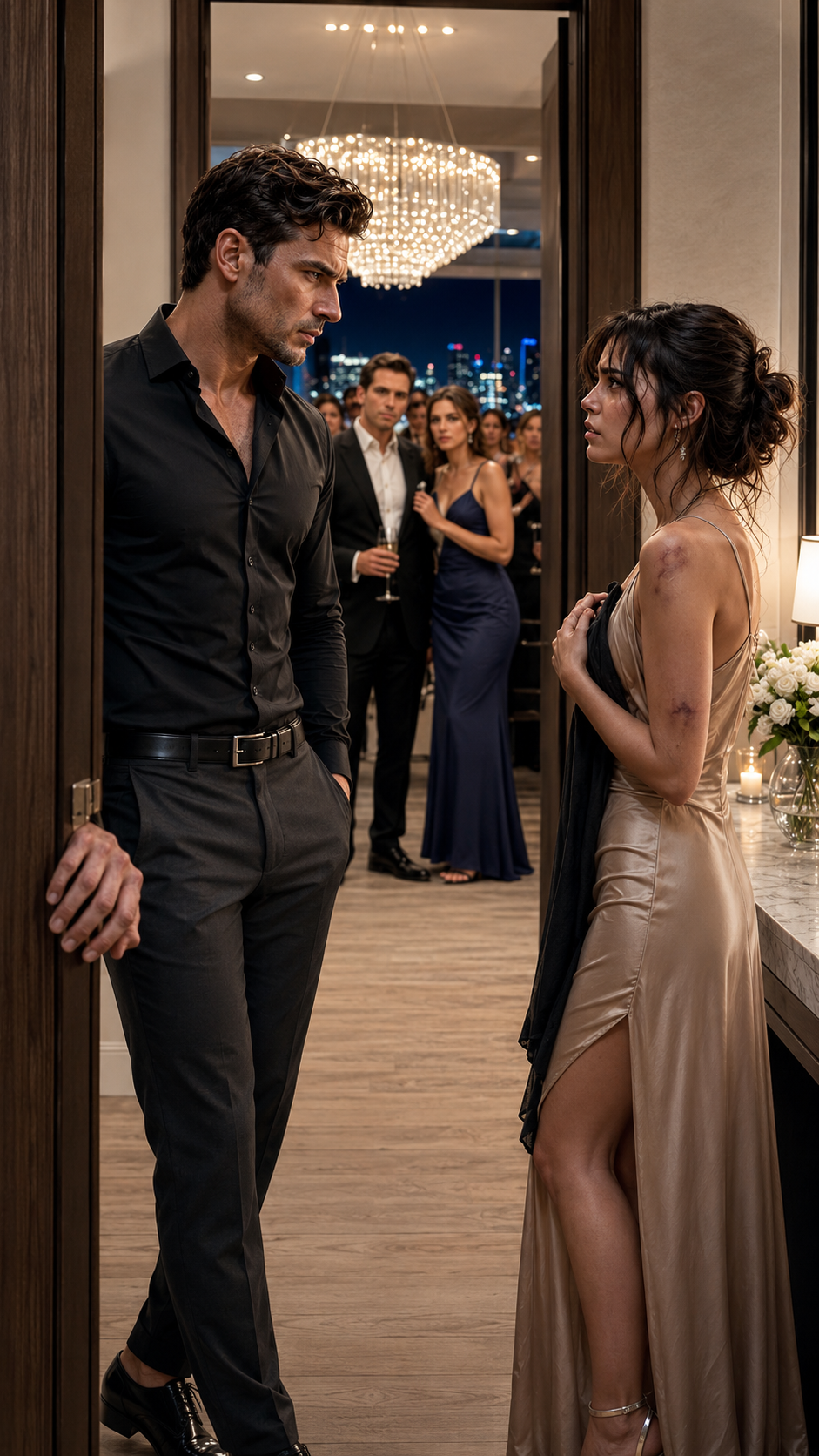
That night, Esteban had found her in a hotel dressing room, trying to change out of a wine-stained blouse. When he lifted her jacket, he saw the bruises on her arms and ribs.
He didn’t shout.
He didn’t touch her.
He only asked:
"Was it Adrián?"
Valeria didn’t respond.
And that was enough.
Below, 300 guests applauded the most beloved surgeon at the Santa Lucía Children’s Hospital. The media called him “the angel of the operating rooms.” The mothers of his patients brought him sweet bread, rosaries, and handwritten letters.
No one knew that in private he controlled Valeria's finances, monitored her bank statements, demanded passwords, and punished her with silences that lasted days.
No one knew that a week earlier, he had shoved her against the kitchen wall because she wanted to visit her sister in Guadalajara.
And no one knew that on that very night, before arriving at the gala, he had grabbed her arm in the parking lot and whispered:
"You’re not going to make me look bad, are you?"
That’s why Valeria went on stage when Adrián called her.
He took the microphone.
"I want to thank the woman who reminds me every day what compassion means."
The cameras turned toward her.
"Valeria," said Adrián, extending his hand. "Soon I will have the honor of calling you my wife."
The crowd applauded, enchanted.
Valeria looked at Esteban, standing on the other side of the stage.
He wasn’t forcing her to do anything.
He was just waiting.
Then she did something minimal, almost invisible.
She stepped back.
She didn’t let Adrián take her hand.
Adrián maintained his smile, but his eyes hardened.
The gala continued.
After the speech, Valeria retreated behind the stage, trembling. Esteban found her by the service hallway.
"You’re not going with him," he said.
"It’s my decision."
"I know. But you have to make it before the night ends."
Before Valeria could respond, Clara, the event director, appeared with a blue velvet box.
"Mr. Carvajal, I found the volunteer who left this. Well… the name they used."
Esteban opened the box.
Inside were a pair of silver cufflinks, engraved with the initials A.V.
Adrián Vargas.
But the box bore the initials E.C., as if they belonged to Esteban Carvajal.
Clara swallowed hard.
"His real cufflinks were on the podium. These were found in his private office."
Valeria felt her stomach tighten.
Adrián had never entered Esteban’s office.
Or so they thought.
Underneath the lining of the box was a folded paper.
Esteban opened it.
The message was written in large letters:
ASK DR. VARGAS WHAT HAPPENED TO ELENA MORÁN.
Valeria didn’t know that name.
But Esteban turned pale.
"Who is Elena Morán?" she asked.
"A surgical resident who disappeared from the hospital six years ago," he replied. "The hospital said she resigned."
At that moment, a security guard rushed in with a tablet.
On the screen was a woman entering through the loading area wearing a surgical gown and cap.
The image was blurry.
But Valeria recognized her face from an old photo in Adrián's studio.
That woman was Elena.
And the recording had been taken 43 minutes earlier.
PART 2
The hallway froze.
From the hall came laughter, violin music, and the delicate clinking of glasses. Outside, by the service elevators, Valeria felt as if the real world had just split in two.
Clara looked at the screen.
"Security says she entered with a fake hospital ID. She went up to the executive floor, was near Mr. Carvajal's office for 4 minutes, and then went down the stairs."
Esteban’s eyes remained glued to the image.
"Where is she now?"
"In the underground parking lot."
Valeria took a step back.
Then her phone vibrated.
Unknown number.
There was no greeting.
Just a picture.
Adrián appeared in a medical file, six years earlier, alongside Elena Morán. Between them was an open file.
At the bottom, written in blue ink, was a phrase:
VALERIA, YOU WERE NEVER THE FIRST.
Before she could breathe, another message arrived.
But maybe you’re the only one who can prove what he did.
And then an address within the same hotel:
Basement 2. Laundry storage. Come alone. Elena is waiting.
Valeria lifted her gaze.
Esteban already knew something had arrived.
"What is it?"
She showed him the phone.
His face changed.
"You’re not going alone."
"The message says alone."
"That doesn’t mean safe."
Valeria clenched the phone with both hands.
"If Elena has been hiding for six years and took the risk to come here, she must be desperate."
"It could also be a trap by Adrián."
"Then I need to know."
Esteban didn’t argue. He took out his phone and called the head of security.
"Without making noise. Check basement 2. Cameras, exits, everything. Nobody touches Miss Benítez."
Valeria looked at him.
"You said you wouldn’t decide for me."
"I’m not deciding. I’m preventing you from disappearing too."
The phrase landed like a stone.
For the first time, Valeria understood that what had happened to Elena wasn’t just old hospital gossip.
It was a warning.
They took the service elevator down. Clara stayed upstairs pretending Valeria was reviewing a supplier issue. Esteban walked two steps behind, giving her space.
When they arrived at basement 2, the smell of detergent, dampness, and old metal filled the hallway.
In the laundry storage, a skinny woman, with her hair pulled back under a cap and a fine scar on her eyebrow, waited next to a cage of white laundry.
It was Elena Morán.
She didn’t look crazy.
She looked like someone who had been sleeping with one eye open for years.
"Valeria," she said. "I’m sorry for scaring you."
"What do you want from me?"
Elena looked at Esteban.
"He can stay. If Adrián has already put him in the middle, he might as well listen."
Esteban remained silent.
Elena pulled out a USB drive, several copies of files, and a laminated photograph.
"Six years ago, I was a cardiovascular surgery resident. Adrián was my supervisor. Everyone adored him. Just like now."
Valeria felt sick.
"Were you a couple?"
Elena looked down.
"That’s what I thought. He said I was brilliant, that one day we would run a clinic together. Then I began to notice strange things: changed files, patient signatures that didn’t match, experimental surgeries approved by families who barely knew how to read."
Esteban stepped forward.
"Do you have proof?"
"That’s why I came."
Elena explained that Adrián had used poor patients from Oaxaca and Chiapas to test a new procedure before having formal authorization. When one child died due to a complication, the hospital covered it up as an "inevitable cardiac failure."
Elena wanted to report it.
Adrián convinced her to wait.
Then he emotionally locked her down just like he did with Valeria: checking her messages, telling her no one would believe her, that a resident without money couldn’t ruin a famous doctor.
When she insisted, a fake psychiatric record appeared.
"They declared me unstable," Elena said. "The hospital accepted my supposed resignation. My family received a letter saying I needed rest. But I never signed that."
Valeria could hardly breathe.
"Why didn’t you speak up before?"
"Because Adrián had edited videos. It looked like I was stealing medications. It looked like I was harassing patients. He told me that if I opened my mouth, he would send me to jail."
Elena’s voice broke.
"And because I was pregnant."
Valeria froze.
So did Esteban.
Elena took out a small photo.
It was a five-year-old girl, dark-skinned, with big eyes and a mole by her lip.
"She’s Adrián’s daughter," she said. "He never knew. Or so I thought."
Valeria covered her mouth with her hand.
The twist was brutal.
Adrián hadn’t just destroyed a woman before her.
He had also left a daughter hidden in fear.
"Why come today?" Esteban asked.
Elena looked at Valeria.
"Because I knew he was going to announce your wedding. And because two weeks ago, someone from the hospital looked up my address in Veracruz."
"Adrián?"
"No. His legal assistant."
Valeria then understood something worse.
Adrián wasn’t afraid of the past.
He was preparing to erase it again.
Upstairs, Esteban’s phone vibrated.
It was security.
"Dr. Vargas just went down to basement 2."
Elena turned pale.
Valeria tucked the USB drive inside her jacket.
"We don’t run," Esteban said. "We walk toward the cameras."
They stepped into the hallway.
Adrián appeared at the end, still in his tuxedo, still holding the crystal award.
It seemed absurd.
A gala hero chasing ghosts among laundry baskets.
"What a dramatic scene," he said.
Valeria felt the old fear trying to settle back in her chest.
But this time Elena was there.
Esteban was there.
And Valeria's phone was recording.
"What did you do to Elena?" she asked.
Adrián smiled with false sorrow.
"Poor Elena. She was always fragile."
Elena clenched her fists.
"You said that six years ago."
"Because it was true."
"No," Valeria said. "You say that when you need no one to hear a woman."
Adrián looked at her.
"She’s manipulating you too, Esteban."
"She doesn’t need to manipulate me," Esteban replied. "She just needed someone to stop pretending not to see."
Adrián advanced.
"Give me that USB, Valeria."
His tone was no longer sweet.
It was an order.
"What USB?" she asked.
For the first time, Adrián lost control.
"Don’t play dumb!"
The shout echoed in the parking lot.
And also in Valeria’s phone.
Adrián realized too late.
He looked at the ceiling cameras.
He looked at Esteban.
He looked at Elena.
The hospital hero had just shown his true face in the only place he couldn’t edit it.
Security arrived in under 20 seconds.
Clara did too, with two foundation lawyers and the hospital director, who had come down thinking it was a logistical issue.
He found something else.
He found Elena alive.
He found altered files.
He found Valeria with visible bruises on her wrist.
And he found Dr. Vargas demanding a memory stick with supposedly nonexistent evidence.
The news didn’t explode that night on social media because Esteban wanted it to.
It exploded because a nurse at the hospital, upon seeing Elena, started crying and said in front of everyone:
"I signed as a witness to her resignation because I was forced."
Then came more voices.
An anesthesiologist.
A file clerk.
The mother of the child who died.
For years, everyone had had a piece of the puzzle, but no one had dared to put it on the table.
Until Valeria said no.
At 2:40 AM, Adrián left the hotel without an award, without applause, and without the perfect smile. He wasn’t arrested that night, but his license was suspended, his access to the hospital was frozen, and the prosecutor opened an investigation for falsification of files, domestic violence, threats, and medical negligence.
Elena handed over the USB.
Valeria submitted the recordings, messages, and photos of her injuries.
Esteban provided the hotel cameras in full, without cuts, without favors, and without under-the-table deals.
Months later, Adrián tried to say it was all a smear campaign.
But there was no longer a single woman standing against his reputation.
There were files.
There were videos.
There were testimonies.
There was a five-year-old girl who deserved to know the truth without carrying the shame of her father.
Valeria didn’t marry.
Nor did she run into Esteban’s arms like in a cheap novel. Healing wasn’t romantic. It was slow, uncomfortable, filled with therapy, sleepless nights, and days when she still checked the door twice.
But a year later, she returned to the Carvajal Foundation.
Not as a coordinator.
As the director of the new medical whistleblower protection program.
At the entrance of the hospital, they placed a simple plaque:
"Compassion is not shown on stage, but when no one is watching."
Some people said Valeria exaggerated.
Others said she should have reported it earlier.
But those commenting never lived with a man who smiled for the world and tightened his grip when the door closed.
That’s why the story went viral.
Because everyone had applauded the perfect doctor.
But only two women knew the truth.
And when they finally spoke, all of Mexico had to ask itself an uncomfortable question:
How many heroes do we continue to celebrate just because no one has survived long enough to tell what they do in silence?





