PART 1
In the apartment in Portales, Renata's scream was so loud that Claudia dropped the spoon into the pot of broth.
It wasn’t a tantrum.
It wasn’t hunger.
It was that desperate, choked sobbing that froze her blood before she even reached the living room.
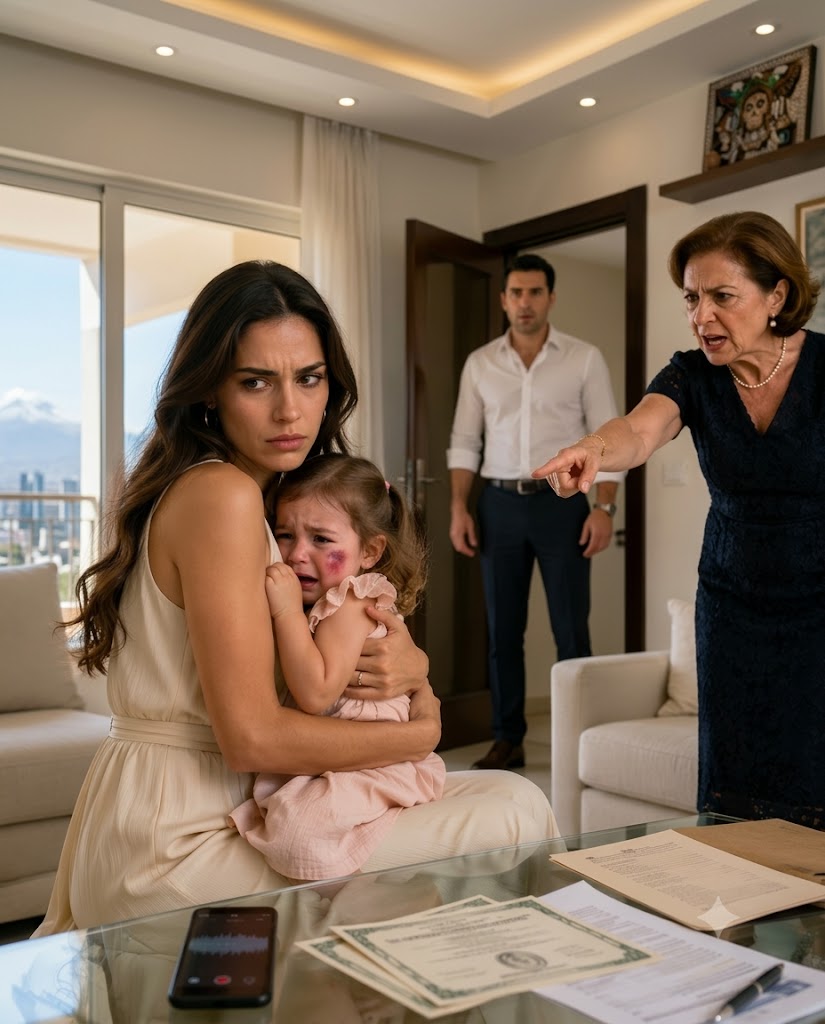
When she entered, she saw her 2-year-old daughter sprawled on the floor next to the coffee table, blood staining her pink shirt and a red handprint across her cheek.
Doña Rosa, her mother-in-law, stood before the child, arms crossed, serious.
“To teach her not to touch what isn’t hers,” she said, as if she had corrected a dog.
Claudia picked up Renata with trembling hands.
“What did you do to her?”
“I taught her a lesson. She grabbed a sausage from Gael’s plate. That girl is a burden, Claudia. All she does is get in the way, cry, and want everything.”
Gael, Leonardo’s supposed nephew, sat on the couch with a tablet on his lap. He was 8 years old and watched the scene without saying a word, as if he already knew he could do whatever he wanted in that house.
Claudia took a deep breath.
For almost a year, she had endured Doña Rosa living under her roof. The woman had come “temporarily” from Toluca, claiming to have blood pressure issues, knee pain, and a sadness no one believed was enough to keep her from living alone.
But temporarily had turned into every day.
She slept in a bedroom paid for by Claudia.
She ate from her pantry.
She used the extra medical card Claudia had arranged for her.
And still, she treated her like an unwanted guest in her own home.
Gael had come with a sad story, too. According to Leonardo, he was the son of a cousin who couldn’t take care of him. Claudia paid for his school, uniforms, glasses, sneakers, and even soccer lessons.
Renata, on the other hand, was always “the whiny girl.”
If Gael spilled juice, it was mischief.
If Renata cried, it was manipulation.
If Gael wanted more meat, Doña Rosa served him first.
If Renata asked for bread, the mother-in-law would say:
“Let her learn, because women don’t always get what they want.”
That Sunday, Leonardo was supposedly in Querétaro for work. Claudia was preparing food when she heard the slap.
Now she saw the blood on her daughter and understood that she had allowed too much.
She sat Renata at the dining table, wiped her nose with a wet napkin, and whispered softly in her ear.
“It’s okay, my love. Mommy is here.”
Doña Rosa huffed.
“When Leonardo gets here, you’ll see. He knows how to bring order.”
Claudia stood up slowly.
“The only one who will learn something today is you.”
The slap she gave Doña Rosa sounded sharp.
The second one was harder.
The mother-in-law fell onto the couch, hand flying to her face, scandalized.
“You hit me! Me, you old hag!”
“You hit a 2-year-old girl,” Claudia said. “And you still dare to feel like a victim.”
Then she took out her cell phone and called the bank.
“Good afternoon. I want to cancel an additional medical card under the name of Rosa Méndez immediately. Yes, right now.”
Doña Rosa stopped crying.
“You can’t do that. I have pending medical exams.”
“My daughter also has blood on her face because of you.”
The mother-in-law dialed Leonardo through fake sobs.
“Your wife has gone crazy! She hit me! She took away my hospital privileges! All because that spoiled little girl stole food from Gael.”
Claudia took Renata and locked herself in her bedroom.
But before closing the door completely, she heard Doña Rosa lower her voice.
“Hurry, Leonardo. If Claudia starts checking papers, she’ll find out about the boy.”
Claudia froze.
Because in that instant, she understood that the blow to her daughter hadn’t started a family fight.
It had opened the door to a huge lie.
And Leonardo was already on his way to try to close it.
PART 2
Claudia laid Renata down on the bed, hugging her stuffed bunny, and activated the recorder on her phone.
She didn’t know what “the boy” meant, but she recognized that tone.
Doña Rosa no longer sounded sick.
She sounded trapped.
“No, don’t say anything over the phone,” she whispered in the living room. “Get here quickly. If she finds the blue folder, everything crumbles. Your wife isn’t stupid.”
Claudia felt a horrible chill in her stomach.
The blue folder.
She remembered seeing one several times in the cabinet where Doña Rosa kept medical prescriptions, saint cards, and old envelopes.
She never opened it because she didn’t want to pry.
Now she understood that maybe she should have.
The elevator dinged 12 minutes later.
Leonardo entered without asking about Renata.
He didn’t say, “How’s my daughter?”
He didn’t say, “Where’s the doctor?”
He only said:
“What did you do, Mom?”
Doña Rosa cried instantly, like a soap opera actress.
“Your wife hit me. She canceled my card. All because I defended Gael. That little girl stole food, I corrected her, and she went crazy.”
There was silence.
Then Leonardo let out a phrase that shattered something inside Claudia.
“I told you not to provoke her when I wasn’t around.”
Claudia opened the door.
Leonardo turned and saw Renata with a swollen nose, trembling lip, and marked cheek.
For one second, Claudia waited to see horror.
But all she saw was annoyance.
“Claudia, don’t make a scene. Let’s take her to the pediatrician and be done with it.”
“First tell me what truth you’re hiding about Gael.”
Doña Rosa fell silent.
Leonardo clenched his jaw.
“Don’t start with your attacks. You hit my mom. That’s serious.”
“More serious is your mom hitting our daughter.”
“It was an accident.”
Claudia raised her phone.
“How curious. She just said that if I checked papers, everything would fall apart.”
Leonardo’s face changed.
Doña Rosa whispered:
“Take that phone away from her.”
Then Gael appeared in the hallway. He was barefoot, tablet pressed to his chest, looking at Leonardo with fear.
“Dad…” he said.
The word fell like a brick.
Claudia felt the air leave her.
Gael covered his mouth, but it was too late.
Leonardo closed his eyes.
He didn’t correct the boy.
He didn’t say he was mistaken.
He said nothing.
And that silence was the cruelest confession.
“Gael isn’t your nephew,” Claudia said, almost in a whisper. “He’s your son.”
Doña Rosa jumped up furiously.
“And what did you want? For my grandson to grow up without support? You had money. You could help.”
“With a lie?”
“You just gave Leonardo a girl,” the mother-in-law spat. “Gael is a boy. He carries the last name. He needed a place.”
Claudia looked at Renata sleeping, her face swollen.
Everything clicked into place.
The privileges.
The phrases.
The humiliations.
The hatred disguised as education.
Gael wasn’t the poor nephew that the family protected.
He was Leonardo’s secret son, hidden in his house so Claudia would support him.
“Since when?” she asked.
Leonardo tried to approach.
“It’s not as you’re thinking.”
“Don’t you dare use that phrase with me.”
Doña Rosa, anxious, glanced toward the entryway cabinet. Claudia followed that glance.
She went straight for it.
Opened the drawer.
Pulled out prescriptions, envelopes, folded papers, until she found a blue folder secured with a rubber band.
Leonardo advanced.
“Claudia, put that down.”
“Not another step.”
Inside was Gael’s birth certificate.
Father: Leonardo Santillán Cruz.
There were also receipts for tuition paid from an account linked to Claudia’s business, a line of natural cosmetics she had built from scratch.
There were transfers to a woman named Pamela.
Medical receipts.
Printed messages.
And a legal draft with a highlighted phrase:
“In case of separation, ensure maintenance and preferential patrimonial protection for the minor Gael S.”
Claudia kept reading.
There was another page with her name.
“Claudia: unstable, aggressive, jealous, possible risk to the minor. Reacts violently when contradicted.”
Her hands trembled.
It wasn’t just infidelity anymore.
It was a plan.
They wanted to make her seem crazy.
To provoke her.
To use her reactions against her.
Maybe take her money.
Maybe force her to support her husband’s secret child even after separating.
“You two prepared everything,” she said.
Leonardo shook his head.
“You’re exaggerating.”
But Doña Rosa lost control.
“You always thought you were so fancy because you sell creams and soaps! We needed proof of how you really are. I didn’t want the girl to bleed so much.”
The silence was brutal.
Claudia felt sick.
Because that phrase was no longer a defense.
It was a confession.
She took a deep breath, picked up Renata, and called the pediatrician first.
“Doctor, I need you to check my 2-year-old daughter today. She received a strong blow to the face. I want medical documentation.”
Then she called her lawyer.
“Lucía, I need you to come. My mother-in-law hit Renata, my husband brought his son into my house posing as a nephew, and I found papers to accuse me of being violent.”
Lucía didn’t ask if she was sure.
She just said:
“Don’t argue. Record everything. I’m on my way.”
Leonardo tried to take the folder from her.
Claudia backed away.
“Don’t come near me.”
“You’re not going to destroy my family over a sausage.”
Claudia looked at the bloodstained shirt.
“No, Leonardo. Your family was destroyed when they thought a girl was worth less than your lie.”
At that moment, Gael began to cry.
“I have the video,” he said softly.
Doña Rosa turned as if something had stabbed her in the back.
“Shut up!”
Lucía arrived 15 minutes later with a private doctor and 2 police officers who accepted to come due to the injury of a minor.
Gael unlocked his tablet with trembling hands.
The video lasted 43 seconds.
It showed Renata walking to the table. She took a sausage from the plate, but not to eat it.
She offered it to Gael.
The girl wanted to share.
Then Doña Rosa’s voice could be heard:
“Let’s see if this teaches your mom.”
The hand went up.
The slap sounded sharp.
Renata fell to the floor.
And Doña Rosa said:
“Cry loud, so she comes.”
Claudia felt her heart break in a way she couldn’t explain.
It hadn’t been a burst of anger.
It hadn’t been a correction.
It had been a trap using her daughter’s face.
The doctor examined Renata and confirmed nasal bruising, a hematoma on her cheek, and marks compatible with an open-hand impact.
Lucía kept copies of the video, the audio, the certificate, and the documents.
Leonardo, pale, stopped pretending.
“Claudia, I made mistakes, but Gael isn’t to blame. He’s my son. I couldn’t abandon him.”
“You didn’t abandon him,” she replied. “You hid him. You brought him into my home. You let me pay for everything. And you allowed your mother to hurt our daughter to protect a lie.”
Doña Rosa started shouting that Claudia was cruel, that a mother shouldn’t be left out on the street, that God would punish her.
Claudia no longer replied.
She demanded they leave the apartment that very night.
Leonardo said it was also his home.
Lucía laid out the contract, the rent payments, the furniture receipts, and the business documents.
Everything was under Claudia’s name.
For the first time, Doña Rosa understood she had never owned anything there.
She left with an old suitcase, still demanding her medical card.
“I have pending studies,” she said from the door.
Claudia looked at her without hatred, but without fear.
“My daughter also had the right to grow up without you hitting her.”
Leonardo went out after his mother. Before leaving, he looked at Renata asleep in Claudia’s arms.
“Are you going to separate me from my daughter?”
“You separated yourself from her when you saw her blood and cared more about your secret.”
Days later, Pamela, Gael’s mother, appeared.
She wasn’t the irresponsible woman Leonardo had described. She was a nurse working double shifts who thought her son lived with a relative “for better opportunities.”
When she learned he was presented as a nephew and saw the video of Renata, she cried out of shame.
“My son shouldn’t have been caught in this lie,” she said.
Gael went with her.
Before leaving, he apologized to Claudia.
“I knew Grandma didn’t like you, but I didn’t know she was going to hit you like that.”
Claudia knelt in front of him.
She couldn’t love him as before.
But she also couldn’t hate a child used by adults.
“Learn something, Gael. When someone hurts a smaller person, staying silent also hurts.”
The boy nodded with tears.
Months later, Renata ran through the living room again.
She still hid when an older woman raised her voice. She still touched her cheek some nights. But little by little, she began to laugh again.
One day, during lunch, she took a little piece of bread and offered it to Claudia.
“For you, Mommy.”
Claudia cried silently.
Because her daughter was still generous, even though someone had wanted to punish her for sharing.
Some people said Claudia was too harsh.
That a mother-in-law was still family.
That Leonardo was Renata’s father.
That Gael was innocent.
But Claudia understood something many women learn too late: forgiving too much can also mean abandoning your children.
That Sunday, Doña Rosa didn’t just hit a little girl.
She also ripped off the mask from an entire marriage.
And from then on, in that house, no voice ever again said that a boy was worth more than a girl, nor that a woman should endure everything to keep the family standing.





