PART 1
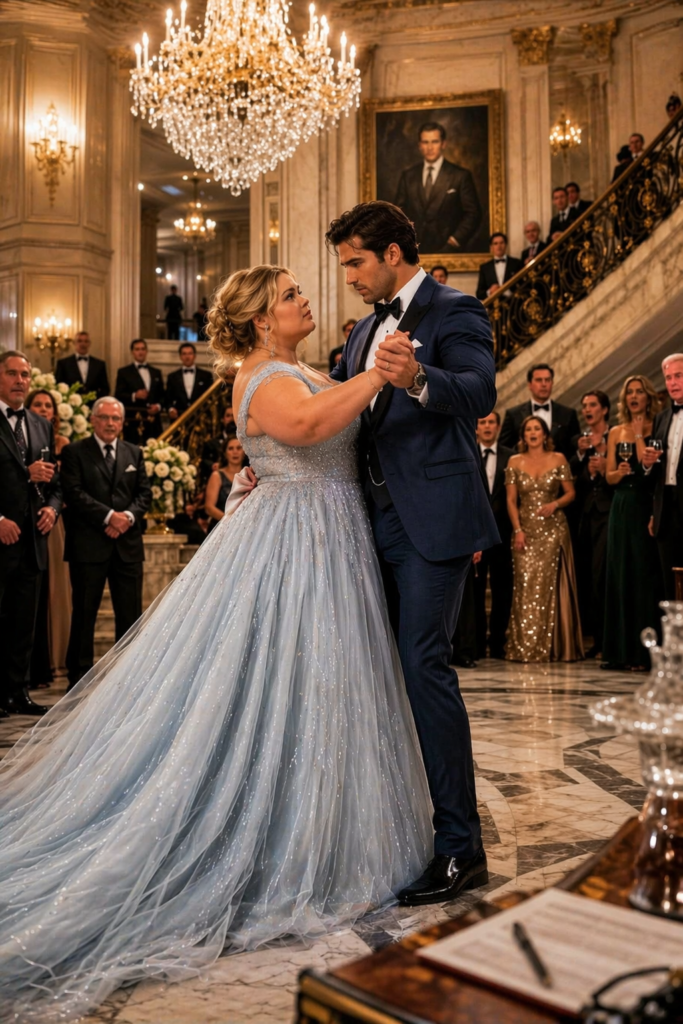
When Santiago Arriaga extended his hand to Lucía Barrera in the most elegant hall in Polanco, everyone understood it wasn’t an invitation.
It was a mockery.
The orchestra played a waltz, the glasses sparkled under the chandeliers, and the wealthy smiled with that educated cruelty that hurts without raising their voices.
Lucía stood by the dessert table, wearing a dark green dress she had altered three times to feel worthy.
She was a baker, plus-sized, with strong hands from kneading dough since four in the morning, and a gaze that demanded no forgiveness for taking up space.
Santiago Arriaga owned a powerful shipping company in Veracruz. A man used to buying silence, sealing deals with a glance, and making anyone tremble without staining his suit.
Beside him, Renata Salcedo let out a giggle.
“Let’s see if she tires before the song is halfway through,” she murmured.
Several women covered their mouths.
Lucía felt the blow, but she didn’t lower her gaze.
“Will you dance, Miss Barrera?” Santiago asked.
“I didn’t come to put on a circus.”
“Just one waltz.”
Lucía knew it was a trap. If she accepted, they would mock her body. If she refused, they would say she was common, resentful, incapable of being among them.
She also knew why she was there.
Her father had died, leaving a massive debt. The family bakery, “El Horno de Doña Meche,” in Santa María la Ribera, was about to be seized.
Her Aunt Olga had told her before she entered:
“Don’t be proud, dear. At your age, with your body and that debt, a man like that won’t cross your path again.”
That stung more than their laughter.
Lucía placed her hand on Santiago’s.
“Don’t step on me.”
“That’s what I should be saying.”
The music swelled.
At first, everyone waited to see her fail. But Lucía didn’t falter, didn’t trip, didn’t hide.
She had learned to move while carrying hot trays, dodging ovens, navigating crowded markets, and defending her place since she was a child.
Her body wasn’t clumsy.
It was hers.
And she carried it with such confidence that the laughter began to die.
Santiago noticed. His hand stopped pushing her as if testing merchandise. He began to follow her.
“You don’t dance like a baker,” he said softly.
“And you don’t command as well as you think.”
For one second, Santiago was left speechless.
When the song ended, no one applauded. No one knew if they had just witnessed a humiliation or a warning.
Lucía released his hand.
“You’ve had your show. Now let me go. My sourdough is better educated than these people.”
That night she thought she wouldn’t see him again.
But the next day, Santiago entered the bakery fifteen minutes before closing. He had two bodyguards at the door and a velvet box in his hand.
He opened it in front of her.
Inside was a massive ring.
“We’re getting married on Saturday,” he said. “And if you say no, your bakery disappears on Monday.”
PART 2
Lucía didn’t scream.
That was what unsettled Santiago the most.
He expected tears, insults, fear, or pleas. But she simply looked at the ring as if it were a cockroach on the counter.
“I have conchas in the oven,” she said. “You might buy half of Veracruz, Mr. Arriaga, but you won’t ruin my batch.”
Santiago let out a short laugh.
“Then Saturday it is.”
“You didn’t understand.”
“I understood perfectly. You need to save your bakery. I need a wife to calm partners, the press, and enemies.”
Lucía looked at him with disgust.
“You want a facade.”
“I want two years of marriage. Public appearances. Respect. Your debt canceled. Your business protected.”
“And after?”
“Clean divorce. Enough money to open another bakery.”
Lucía thought of her father, the overdue bills, her employees waiting for their paychecks, her Aunt Olga rummaging through drawers like a vulture.
She also thought of Renata laughing at her.
“I’m not your shield,” she said.
Santiago closed the box.
“No. She’s more dangerous than that.”
They married six days later in a private chapel in Las Lomas.
Magazines called it a fairy tale: “The most feared businessman of the port falls in love with a neighborhood baker.”
Lucía smiled in every photo.
Santiago did too, though his tenderness seemed rehearsed by lawyers.
At the party, Renata arrived dressed in red and leaned in to kiss the air next to Lucía’s cheek.
“How brave to wear white,” she murmured. “You don’t forgive anything.”
Before Lucía could respond, Santiago placed a hand on her waist.
“Renata,” he said calmly, “Congratulations to my wife or leave before the cake.”
Renata froze.
“You look beautiful, Lucía.”
“I already knew that,” she replied.
Santiago’s hand tightened slightly on her waist. Lucía suspected he was holding back laughter.
During the first three months, the marriage was a well-rehearsed act.
By day, Lucía continued at “El Horno de Doña Meche,” rising before dawn, checking dough, scolding suppliers, and attending to her long-time customers.
The only difference was the armored truck parked outside and Mateo, the silent bodyguard who drank coffee from a pot as if watching over bolillos was a matter of national security.
At night, she returned to Santiago’s residence in Bosques de las Lomas, a massive, cold house with expensive paintings and a kitchen too clean to be happy.
She slept in the north wing.
Santiago in the south wing.
They met at dinners, events, and meetings where he would touch her back with such convincing delicacy that sometimes Lucía forgot it was a lie.
Then the car door would close.
And the warmth would disappear.
Lucía repeated the contract to herself.
Two years.
The bakery safe.
The debt erased.
She could survive.
The problem was that Santiago wasn’t so easy to hate.
He noticed when she didn’t eat and sent caldo tlalpeño without asking. He noticed when photographers sought cruel angles and stood in front of her. He noticed when Renata got too close and ordered that she not be allowed to touch her.
One rainy afternoon, Lucía was decorating a cake when a man in a gray jacket and official badge entered.
“Mrs. Arriaga. Prosecutor Adrián Montalvo, FGR.”
Lucía wiped her hands on her apron.
“If you want bread, there are still ears. If you’re here to intimidate me, that costs more.”
The prosecutor didn’t smile.
“Santiago Arriaga doesn’t marry for love. He marries for strategy, for shielding, or for guilt.”
Lucía stood still.
“Tell me where he keeps the false cargo manifests, and I can protect you before your husband decides you’re no longer useful.”
The words hit hard.
Because they could be true.
“You have ten seconds to buy something or leave.”
“Men like him don’t love women like you, Lucía. They use them.”
The door swung open violently.
Santiago entered soaked, without a tie, his eyes filled with icy fury.
“Prosecutor Montalvo.”
The man straightened.
Santiago crossed behind the counter and put an arm around Lucía.
“If you came for bread, pay. If you came to bother my wife, speak with my lawyers.”
“We were just talking.”
“I don’t talk to those who scare my family.”
Lucía felt that word shift something in her chest.
Family.
When the prosecutor left, the bakery became too quiet.
“He called you used,” Santiago said.
“I am.”
“No.”
The word came out hoarse.
“The marriage is fake. You’re not.”
That night he canceled a dinner with businessmen and took her to a hidden eatery in Roma. He rented the whole place because he didn’t know how to do anything simply.
There Lucía discovered that Santiago hated cilantro, loved old boleros, and hadn’t celebrated his birthday since his mother died when he was sixteen.
“Why didn’t you open it?” he asked.
“Money.”
Santiago feigned offense.
“No,” she warned. “Don’t resolve my dream with a check.”
“I resolve almost everything with checks.”
“How sad.”
“How efficient.”
“Sadly efficient, dude.”
Santiago laughed against his glass.
After that night, the contract began to blur.
Santiago arrived earlier. At first, he said there was no traffic. Then that the meetings were boring. Eventually, he stopped making excuses and sat in the kitchen while Lucía baked.
By the sixth month, the separate rooms were a lie neither dared to break.
Then the losses began.
Three port contracts fell in one week. An inspection in Veracruz found hidden weapons in a container meant to carry auto parts. A loyal union crossed over to the Salcedos.
Money was leaking away.
Santiago’s men walked in fear.
Lucía did not.
One morning, she found him in his office, surrounded by account statements, manifests, and cold coffee.
“You’re going to make a foolish decision if you keep looking at the numbers with anger.”
“I don’t make foolish decisions.”
“You married me after humiliating me with a waltz.”
Santiago looked up.
“Point for you.”
She circled the desk.
“Show me.”
“It’s not your business.”
“It was the moment the FGR came to sniff my campechanas.”
Santiago almost smiled. Then he handed her a folder.
Lucía didn’t have an MBA, but she had kept a bakery afloat amidst debts, abusive suppliers, inflation, and customers wanting to pay with “Instagram exposure.”
The numbers told stories.
And she knew how to listen.
After twenty minutes, she pointed to a line.
“This diesel expense is inflated.”
Santiago leaned in.
“And this container weight doesn’t match the insurance,” she added, “unless you’re importing quarry elephants, something heavy is traveling hidden.”
Another page turned.
“The same phantom company appears here, here, and here. It also appears in my dad’s old debt records.”
The air changed.
Her father’s debt.
The bakery almost lost.
“Who kept your records before I arrived?” she asked.
Santiago took time to respond.
“Héctor Cárdenas.”
His right-hand man. The calm man who opened doors, signed documents, and spoke softly while others shouted.
Then Santiago’s phone rang.
He listened for a few seconds, and his face closed.
“I have to go to the fiscal yard. Héctor arranged a meeting with Bruno Salcedo. He says there’s a truce.”
Lucía felt fear.
“Don’t go.”
“I have no choice.”
“Yes, you do. You always do. You just hate admitting it.”
He took his jacket.
Lucía grabbed his arm.
“The numbers point to Héctor.”
“Héctor has been with my family for 30 years.”
“That doesn’t make him loyal. It makes him close enough to destroy you.”
Santiago hesitated.
Then the mask of the man who didn’t listen to anyone returned.
“Stay here.”
“Santiago…”
“Stay, Lucía.”
He left.
Lucía looked at the papers again and understood everything.
Héctor had used Santiago’s routes to move weapons with the Salcedos. He had hidden costs in old debts. And her father hadn’t been irresponsible.
He had seen too much.
They sank him to silence him.
Lucía took photos, tucked the folder under her arm, and left.
Mateo was at the entrance.
“Ma’am, the boss said…”
“The boss is walking straight into a trap organized by the man who destroyed my dad,” she cut him off. “Get the truck or move aside.”
Mateo looked at her for one second.
Then he searched for the keys.
The rain poured hard over the fiscal yard when Lucía arrived.
Santiago stood in front of a warehouse, with Héctor beside him and several Salcedo men waiting under a metal roof.
“Santiago!”
He turned furious.
“What are you doing here?”
“Saving your life, even if you’re a stubborn fool.”
Héctor paled.
She pointed at him.
“He works with the Salcedos.”
Everything froze.
“Watch what you say,” Héctor warned.
“I’m tired of being careful.”
She pressed the folder against Santiago’s chest.
“Inflated diesel, false weights, altered insurances, phantom companies. The same legal entity appears in your losses and in my dad’s debt. Héctor moved weapons through your routes. When my dad discovered him, he cornered him until he took everything.”
Héctor took a step toward her.
“You don’t understand what you have.”
“I understand enough.”
His hand lowered toward his jacket.
Santiago was faster.
He pulled out his gun and aimed at Héctor’s chest.
“No.”
The men on both sides drew weapons too. Mateo stepped in front of Lucía, but she pushed him aside and stood next to Santiago.
He wanted to hide her behind him.
But upon seeing her wet, scared, and firm, he understood something he should have understood since the waltz: Lucía had never needed to be hidden behind anyone.
“He’s lying,” Héctor said. “She’s a baker. She doesn’t know about this world.”
Santiago spoke low.
“She’s my wife.”
The words fell like a sentence.
“And she has more courage than all the men who surrounded me while you were robbing me.”
From the warehouse, Bruno Salcedo emerged. Renata followed him, wrapped in a white coat and a smile that faded upon seeing Héctor aimed at.
Santiago didn’t lower his gun.
“Mateo.”
“Yes, boss.”
“Call Prosecutor Montalvo. Tell him there are illegal weapons in this warehouse. Give him ten minutes to make his case.”
Bruno turned red.
“Are you going to bring the FGR down on all of us?”
Santiago finally looked at him.
“No. You did.”
The sirens arrived sooner than expected.
The raid shattered the night.
Federal agents, white lights, screams, guns falling to the ground. They found two cell phones with shipping messages on Renata.
Bruno was arrested.
Héctor didn’t run.
He looked at Santiago with a rotten sadness.
“I made your family strong.”
“No,” Santiago said. “You made it miserable.”
Three days later, all of Mexico was talking about the operation.
The Salcedos were investigated for arms trafficking, bribery, and money laundering. Héctor agreed to testify in exchange for protection. Santiago’s company was placed under external audit.
And Santiago did something no one expected.
He began shutting doors.
He sold warehouses, cut violent unions, removed men who only understood threats, and allowed independent accountants to review every contract.
Many called him weak.
Lucía did not.
She saw him become quieter, not because he lost power, but because he was deciding what kind of man he could be without hiding behind fear.
One week later, Santiago arrived at the bakery before opening.
Lucía was arranging cinnamon rolls in the display case.
He placed a thick envelope on the glass.
“What is that?” she asked.
“Divorce papers. And eight million pesos.”
The bakery seemed to run out of air.
“This isn’t payment for silence,” he said. “It’s compensation for saving my life, my company, and the little decency that remained of me.”
Lucía looked at the envelope.
“Then it’s done. I got too close to the truth, and you’re letting me go.”
“No.”
“Don’t lie to me now.”
Santiago slowly circled the counter.
“I’m ending the contract because I can’t stand hiding behind it any longer. I forced you to stay because of debt. I used you as a shield. I was cruel because it was easier than admitting that from the first waltz, you scared me.”
Lucía’s eyes filled with tears.
“I scared you?”
“Yes. Because you didn’t want my money. You didn’t want my surname. You didn’t want my world. You looked at me as a man, not an empire. And that I didn’t know how to buy.”
He set the envelope aside.
“I want you to be free to choose. Even if you choose to leave.”
Lucía cried silently.
“I hate you a little.”
“I know.”
“You blackmailed me.”
“Yes.”
“You were a jerk.”
“Also.”
“And your mansion has the saddest kitchen I’ve ever seen.”
Santiago smiled faintly.
“That is unforgivable.”
Lucía laughed through her tears, and that laughter shattered what remained of the contract.
He raised his hands toward her face, slowly, waiting for permission.
She gave it to him.
“I’m not easy,” Lucía said.
“No.”
“I’m stubborn.”
“Very much.”
“I take up space.”
Santiago looked at her tenderly.
“Then take all of mine.”
Lucía kissed him first.
Not for cameras. Not for debt. Not for fear.
She kissed him because she wanted to.
Six months later, “El Horno de Doña Meche” opened the space next door as a baking school for girls from shelters and tough neighborhoods.
The sign read: “Mercedes Barrera School,” in honor of Lucía’s mother.
Santiago attended the inauguration in a blue suit, standing at the back, more nervous in front of fourteen teenagers with rolling pins than before any prosecutor.
A girl asked:
“Is that man your husband?”
Lucía looked at Santiago. He watched her with silent pride.
“Yes,” she said. “That is my husband.”
“Is he scary?”
Lucía smiled.
“Only when he forgets who runs the kitchen.”
Later, at another gala, the orchestra began a waltz.
Santiago found Lucía by the dessert table, arranging a tower of profiteroles because some habits never die.
He offered her his hand.
There were no laughs.
There was no cruel challenge.
There was no hall waiting to see her fall.
“Mrs. Arriaga,” he said, “will you dance with me?”
Lucía looked at his hand, then at the hall.
Renata was no longer there. Héctor was no longer there. Her father’s debt no longer existed. And the old shame had no seat at that table.
She placed her hand in Santiago’s.
“Lead.”
He leaned in close.
“I think we both know that here, you lead.”
The music swelled.
They danced under the chandeliers, not as mockery, not as a contract, but as two people who found each other amid pride, debt, danger, and an uncomfortable truth.
Years later, people continued to tell the story of the millionaire who danced with a plus-sized baker to humiliate her.
But they told it wrong.
They said he chose her.
They said he made her powerful.
They said he saved her.
Lucía knew the truth.
She was already powerful when she took his hand.
She was already powerful when everyone laughed at her.
She was already powerful before Santiago Arriaga learned her name.
He just had to become brave enough to dance by her side.





