PART 1
—Stop that man.
Damián Luján's voice sliced through the mariachi music like a knife.
The wedding had barely begun, just ten minutes into the festivities. In the hall of an old estate in Tlalpan, waiters were serving corn cream, aunts were adjusting their phones to record the first toast, and Doña Rebeca, the bride's mother, was quietly crying with pride.
Renata Medina, dressed in white, still had rice in her veil.
Less than an hour ago, she had sworn to love Damián in front of everyone.
But Damián wasn’t looking at her.
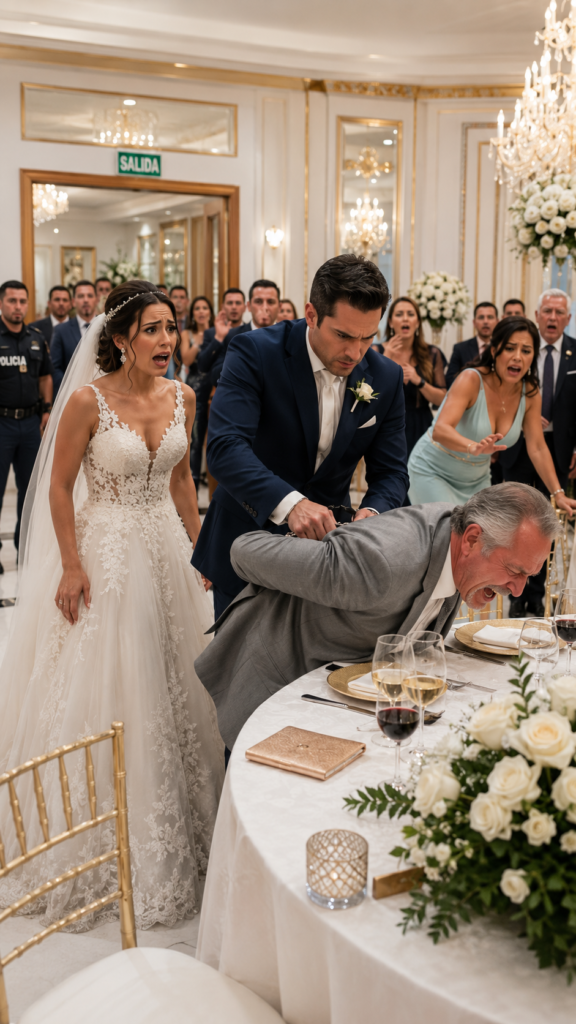
He stood up from the head table, adjusted his black suit, and strode directly toward Don Héctor Medina, his father-in-law, a retired rural teacher of 64 who had taught for 38 years in a small school lost among the hills of Puebla.
Don Héctor was sick, thin, with yellowed skin and a tired smile. Yet, he had worn his best gray suit, the one Renata had lovingly bought for him so he wouldn’t feel out of place among businessmen and officials.
—Damián, son, is something wrong? —the teacher asked.
The answer was a metallic click.
Handcuffs snapping shut around his wrist.
The entire hall froze.
Suddenly, 14 agents disguised as guests rose from various tables. One blocked the door to the garden. Another called for the music to stop. Two more positioned themselves by the bar, as if the party had been a lie from the start.
Doña Rebeca dropped her glass.
Renata felt the floor shift beneath her.
—Let him go! —she screamed, rushing toward her father.
An agent grabbed her arm.
—Do not interfere with an official proceeding.
Renata turned to her husband.
—What are you doing, Damián?
He didn’t answer.
He simply took Don Héctor by the neck and forced him to bend over the table. The white mole spilled onto his jacket. Some guests covered their mouths. Others recorded, because in Mexico, even pain becomes content in seconds.
Damián pulled a bank card from the inside pocket of Don Héctor's jacket and held it up for everyone to see.
—Héctor Medina is detained for his probable involvement in illicit resource operations. This account holds 46 million pesos.
The murmur was brutal.
—46 million? —whispered a cousin.
—That man seemed so humble —someone else said.
Don Héctor barely raised his face, his eyes filled with shame.
—I don’t know anything about that...
Renata broke free from the agent’s grip.
Three months earlier, Damián had asked her to move the wedding date forward. He said that after so many operations, after witnessing so much death, he wanted to start a clean life with her. He had scars on his body, medals from the Prosecutor's Office, and a reputation for being incorruptible.
Renata had believed she was marrying a just man.
Now, she faced a stranger using her wedding as a trap.
—Since when did you plan this? —she asked, her voice breaking—. Since before you proposed?
Damián clenched his jaw.
He said nothing.
Doña Rebeca fell to her knees, pleading:
—My husband doesn’t steal, please. He doesn’t even know how to use the bank app properly.
No one helped her up.
Renata looked at her father, his face pressed against the stained tablecloth, surrounded by cameras, whispers, and pity.
Then something inside her broke.
—Let him go —she said loudly.
Everyone turned.
Damián frowned.
Renata took a deep breath, pulled her phone from her bouquet, and looked at the agents one by one.
—Call my lawyer. That 46 million doesn’t belong to my dad... it’s mine.
PART 2
The silence was so heavy that even the ice in the glasses seemed to stop clinking.
Damián slowly lowered the card.
—Renata, think carefully about what you’re saying.
—I’m thinking more clearly than you are —she replied.
The white dress trailed petals across the floor as she approached Don Héctor. She wiped the mole from his face with a napkin embroidered with their initials.
That detail made her nauseous.
Everything about this wedding had been designed for a lie.
—Dad, look at me —Renata whispered—. You didn’t do anything wrong.
Don Héctor trembled.
—Sweetheart, I don’t know about that card. I swear on your grandmother.
—I know.
Damián signaled for them to remove the handcuffs, but the red mark was already etched on the teacher's wrist.
And in everyone’s memory.
A woman in a suit and black heels appeared beside Renata. She had her hair pulled back, a firm smile, and a gaze that was far too satisfied.
—Mrs. Luján, it’s best you come with us.
Renata looked at her with disdain.
—My last name is still Medina.
—I’m Sofía Aranda, an investigative agent. I work with Commander Luján.
The way she said “commander” didn’t sound professional. It sounded intimate.
Renata understood something she didn’t want to accept yet.
They escorted her from the hall as guests parted ways. Some avoided looking at her. Others kept recording. On social media, the video had already started circulating with miserable headlines:
“The millionaire bride and the humble father arrested at the wedding.”
“Luxury wedding ends in arrest for money laundering.”
“What a shame, the whole family caught in the mess.”
At the southern Prosecutor’s Office, Renata remained dressed as a bride. The pearls of her dress glimmered under a cold light that made everything feel crueler.
Sofía placed a folder on the table.
—Let’s be clear. Your husband has been investigating this network for 19 months.
Renata lifted her gaze.
—19 months?
Sofía opened the folder.
There were photos.
Renata in a café in Coyoacán, handing Damián an umbrella on the day they supposedly met by chance.
Renata leaving her office in Santa María la Ribera.
Renata with her father at a medical appointment.
Renata at the dinner where Damián asked her to be his girlfriend.
All the photos had dates, times, and codes.
—The investigation started 20 months ago —Sofía said—. Before he approached you.
Renata felt the air leave her.
All her love had fit inside a folder.
The flowers, the good morning messages, the Sunday barbecues with her dad, the ring hidden in a sunflower, the promises of family.
All surveilled.
All used.
—Give me my phone —Renata demanded.
—First, we need your statement.
—I won’t make a statement without my lawyer.
Sofía smiled.
—Look, between women, it’s in your best interest to cooperate. Your dad is old, sick. A night detained could cost him dearly.
Renata slammed her palm on the table.
—That’s exactly why you’re going to give me my phone.
For the first time, Sofía lost her smile.
A nervous agent entered.
—The video already has over 2 million views.
Renata closed her eyes.
She imagined her students, her father’s former colleagues, her neighbors from Puebla watching Don Héctor humiliated over a wedding table.
Then she took the cell phone they handed her and called.
—Attorney Herrera, this is Renata Medina. I’m at the Prosecutor’s Office. Room 3. Bring everything: records, audits, account statements, tax payments, contracts with schools, and my dad's card report.
On the other end, the lawyer’s voice sounded calm.
—Don’t say another word. I’m on my way.
Forty-two minutes later, the door opened.
Ernesto Herrera, a 60-year-old lawyer in a blue suit with a stone-cold gaze, entered. Behind him were two assistants carrying boxes, an accountant, and a doctor in a white coat.
—Director Medina —the accountant said, placing a folder on the table—. It’s all here.
Damián, who had just entered, froze.
—Director?
Herrera didn’t give him time to settle.
—Before turning a wedding into a police spectacle, Commander Luján, you should have read the complete documents.
He opened the first folder.
Incorporation deed of Semilla Digital, S.A.P.I.
Founder and majority shareholder: Renata Medina Torres.
Initial capital: 50 million pesos.
Date of incorporation: 4 years prior.
—Semilla Digital —Herrera explained— is an educational platform that provides classes, digital books, and tutoring to children in rural communities. It works with 2,100 schools and serves over 8 million students in Mexico. The 46 million come from declared, audited dividends, and paid taxes.
Sofía crossed her arms.
—The card was in Héctor Medina’s name.
—No —Herrera corrected—. It’s linked to a medical account where Don Héctor is listed as an authorized beneficiary. The fiscal ownership and origin of the money are perfectly accredited.
Renata looked at Damián.
—My dad has liver cancer.
His face changed.
—What?
—He was diagnosed three months ago. He doesn’t know. My mom doesn’t either. I wanted to get through the wedding, sit with them, and explain that I already had doctors, a hospital, and treatment covered.
The doctor placed another folder on the table.
—Here are the studies, the surgical appointment, and the budget. Everything was scheduled legally.
Renata continued, her voice trembling but firm:
—I put the card in his suit this morning because I planned to tell him after the party that he wouldn’t have to worry about anything anymore. But my dad is so dignified that if he knew the money came from me, he would refuse it. You treated him like a criminal.
Damián looked down.
—I didn’t know...
—You didn’t know because you never asked.
Herrera pulled out a thinner sheet.
—And now comes the serious part.
The sheet was 17 months old.
It was an internal report signed by Sofía Aranda.
The document indicated that the investigated movements had a legitimate business origin, with tax receipts and consistent audits. The recommendation was to close the criminal investigation and maintain only administrative review.
Damián picked up the report with tense hands.
—Sofía... why didn’t you ever show me this?
She lifted her chin.
—It was preliminary.
—It says “conclusive” here.
—Then more movements appeared.
—Because the company continued to grow —Herrera interjected—. Not because there was a crime.
Damián looked at Sofía as if he finally understood the complete trap.
—You suggested detaining him at the wedding.
Sofía didn’t answer.
—You said it was perfect because everyone would be gathered. You said that if we waited, they would move the money. You said Renata could be an accomplice.
Renata stepped closer to her.
—You didn’t want justice. You wanted to expose me.
Sofía let out a dry laugh.
—Don’t feel so important.
—But he was important to you, wasn’t he?
The room froze.
Damián turned to Sofía.
She didn’t look at him.
That silence was louder than a confession.
Herrera closed the folder.
—Internal Affairs has already received copies of the hidden report, the hall cameras, and the records of authorization for the operation. If there was abuse of authority, manipulation of evidence, or personal interest, it will be investigated.
Sofía paled.
Hours later, Don Héctor woke up in the hospital.
The first thing he did was touch his wrist.
—Renatita... I didn’t steal anything.
She took his hand.
—I know, Dad. And all of Mexico will know it.
—People saw me like this...
His voice broke.
Renata felt that sentence hurt more than any romantic betrayal. Because an honest man is not only killed by an illness; he is also killed when his name is tarnished.
She explained to him about Semilla Digital. She told him that the company had sprung from his classes, his old notebooks, his stories walking in the rain to teach 12 kids in a roofless classroom.
Don Héctor cried in silence.
—And the money is clean?
Renata swallowed hard.
—Very clean, Dad. With taxes, audits, and everything.
He closed his eyes.
—How sad that my daughter has to swear that to me because of others.
The next day, the story flipped.
Those who had mocked began to delete comments. Former students of Don Héctor posted pictures with him.
“That teacher taught me to read when my dad went north.”
“Don Héctor bought pencils with his pension.”
“That man deserves apologies, not handcuffs.”
The country traded gossip for indignation.
But Renata knew that a viral apology didn’t clean a tablecloth nor erase a look of shame.
Damián arrived at the hospital with flowers.
Renata stopped him in the hallway.
—You’re not going in.
—I need to apologize.
—You don’t need it. He would need it if he wanted to hear you. And he doesn’t.
Damián breathed heavily.
—Renata, I was used. Sofía hid the report.
—And you used me from the first coffee.
He couldn’t deny it.
—At first, I approached because of the investigation. But then I truly fell in love.
Renata smiled sadly.
—How convenient. The lie was professional, and the love personal, right? That’s how anyone can wash their hands.
—I made a mistake.
—No. A mistake is getting the song wrong at the waltz. You planned to handcuff my dad in front of 300 guests.
Damián lowered his head.
—I had a duty.
—And I had a family.
That afternoon, Renata returned to the house where they would live together. There were unwashed glasses, dried flowers, and a box with their names engraved in gold.
Damián was sitting in the living room.
—I don’t want a divorce.
She left the papers on the table.
—Then a judge will explain to you what it means to lose trust.
He knelt, just like on the day of the sunflower.
—I love you.
For 19 months, that phrase would have been her refuge.
Now it was a closed door.
—Maybe —she said—. But loving also means asking before condemning.
She took her books, a small suitcase, and the old watch her dad had given her for the wedding.
Before leaving, she turned one last time.
—Sign, Damián. It’s the only decent thing you can do after confusing justice with spectacle.
Weeks later, Don Héctor went into surgery.
Before they took him, he pulled out a folded sheet.
—For your rural teachers —he said.
Renata opened it.
In shaky handwriting, he had written:
“A child who learns owes nothing to anyone; Mexico owes everything to him.”
The operation went well.
Damián was suspended. Sofía faced administrative and criminal charges for hiding information and manipulating the operation. Renata didn’t celebrate. There were victories that tasted of hospitals, divorce, and a humiliated father.
Months later, Semilla Digital published Don Héctor’s phrase.
It was shared thousands of times.
Some debated whether Renata should forgive Damián. Others said that a man who uses love as an investigation doesn’t deserve a second chance.
Renata never responded.
She only accompanied her father to a rural school in the Sierra de Puebla, where 30 children welcomed him with applause.
Don Héctor, still weak, stood before the blackboard and smiled.
—Alright, kids, who wants to read first?
And then Renata understood something.
The wedding had taken away a husband.
But it had also shown her that the dignity of a good man can be trampled before everyone... and still rise greater than those who tried to destroy it.





