PART 1
For six months, Doña Elena lived as a prisoner inside the house she had paid for, peso by peso.
She wasn’t locked up with visible padlocks or chains on her hands. It was worse. She was trapped by her own son, by the shame of asking for help, and by that phrase Tomás repeated every time she tried to defend herself:
—Mom, you’re not right in the head anymore.
It all started after a heart scare. One afternoon, in her little house in the Jardines de la Cruz neighborhood of Guadalajara, Elena fainted while watering her bougainvilleas. It wasn’t serious, but Tomás arrived at the hospital with the face of a concerned son, hugging her in front of the nurses as if he were the noblest man in the world.
—I’m going to move in with you for a few days, Mom. Just to take care of you —he said.
His wife, Brenda, smiled with a sweetness that felt like a commercial.
—Yes, dear mother-in-law. You’ve done so much for everyone. Now let yourself be spoiled.
But the “spoiling” lasted less than a fortnight.
First, they changed the lock on the front door “for security.” Then Tomás kept the bank cards “so they wouldn’t get lost.” After that, her cellphone disappeared three times until he bought her an old one, without contacts, without internet, and with just one app to make calls.
Elena began to notice strange withdrawals in her account. 12,000 pesos one Monday. 18,500 on Friday. 40,000 the following month.
Every time she asked, Tomás sighed as if he were talking to a stubborn child.
—Oh, Mom, I already explained it to you. It’s for medicines, consultations, food. Everything is so expensive. Honestly, sometimes I feel like you don’t understand anymore.
Brenda was always nearby, with long nails, a cold coffee in hand, and a thin laugh that chilled Elena’s blood.
—Don’t be suspicious, dear mother-in-law. At your age, one can get confused really easily.
The house that once smelled of cinnamon, olla coffee, and clean clothes began to smell of fear.
Tomás installed cameras in the living room, but not to protect her. He used them to monitor that Elena didn’t talk to the neighbors. He canceled the visit from his comadre Lupita, saying that his mom “got agitated with people.” He told the baker not to give her anything on credit because “the lady was already making up stories.”
And the worst part was that everyone believed him.
One morning, Elena woke up with pain in her knees and found a mop next to her bed.
—Today you’re going to clean the kitchen —Tomás ordered from the door—. Brenda says it smells old.
Elena wanted to get up slowly, but he threw a pair of flip-flops at her.
—Come on, don’t pretend. If you can gossip by the window, you can mop.
From then on, cleaning became punishment. If the floor didn’t shine, Tomás took away her breakfast. If Elena took too long, Brenda took pictures and said she would send them to the doctor to prove she was “losing her abilities.”
That afternoon, the heat of Guadalajara poured in heavily through the windows. Elena was on her knees, scrubbing the kitchen floor with an old sponge. Her fingers trembled in the dirty water.
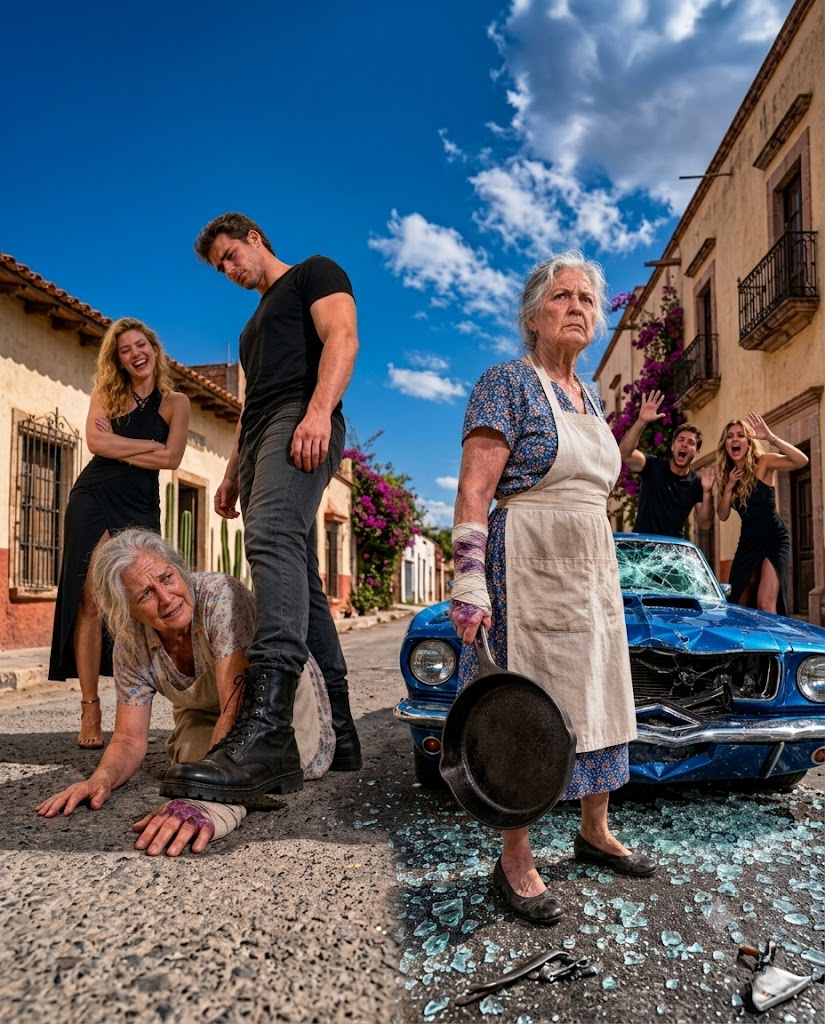
Tomás walked by her in brand-new industrial boots. He planted them on the wet floor.
—You missed a spot here, Mom.
Before Elena could respond, he stepped on her fingers.
The pain shot up her arm like fire. Elena let out a moan but clenched her teeth.
Brenda, sitting on the counter, burst into laughter.
—Oh, Tomás, don’t be stupid. Remember that later she will forget and say we mistreated her.
Tomás pressed harder.
—Clean it well, Elena.
He didn’t call her Mom.
He called her Elena.
As if he wanted to rip away the last shred of dignity.
Then something inside her went dark... and another thing ignited.
Elena yanked her hand away with force. Her knuckles were scraped, blood mixed with soap. She stood up slowly, staggering, but without looking down.
Tomás smiled.
—What’s wrong, crazy old woman?
Elena didn’t answer.
She walked toward the stove. She took the iron pan that had belonged to her mother, heavy, black, one of those that last longer than any marriage and any lie.
Brenda put down her glass on the counter.
—What is that woman going to do?
Elena walked out to the patio without saying a word. Tomás followed her laughing until he saw where she was headed.
In the garage shone his pride: a pristine classic 1969 Mustang, red, bought with the money he swore was for medicines.
Elena lifted the pan with both hands.
And just before bringing it down on the windshield, Tomás shouted something that made even Brenda stop laughing.
PART 2
—Don’t hit her! The papers are in there!
The phrase spilled from Tomás’s mouth like vomit.
Elena froze, pan held high. Not out of fear, but because she had just confirmed what she had suspected.
Brenda’s eyes widened.
—Shut up, idiot! —she yelled at her husband.
But it was too late.
Elena brought the pan down with all the strength she had left. The blow shattered the Mustang’s windshield with a dry, brutal crack. The glass spider-webbed. An alarm shrieked down the street, and several neighbors popped out of their windows.
Tomás ran toward her, furious.
—I’m sending you to the asylum today, you damn old woman!
He snatched the pan from her hands, but Elena didn’t back down. For the first time in six months, she didn’t tremble.
—Open it —she said.
—What?
—The glove compartment, Tomás. Open it.
He turned pale.
Brenda descended the steps from the entrance, trying to act calm.
—Mother-in-law, that’s enough. She’s agitated. Let’s get her inside before the neighbors make a scene.
But the scene had already begun.
Doña Lupita, Elena’s comadre, was standing at the gate with her apron on and her cellphone recording.
—What did you do to Elena? —she shouted—. Because I heard everything, Tomás. Everything.
Tomás tried to smile.
—Doña Lupita, don’t get involved. My mom is sick.
—She doesn’t look sick —the neighbor replied—. She looks beaten.
In less than ten minutes, there were eight people watching from the sidewalk. Someone called a patrol. Someone else called an ambulance.
Tomás began to sweat. Brenda whispered furiously in his ear, but Elena continued to stare at the glove compartment of the car.
When two municipal police officers arrived, Tomás changed his tone. He became the worried son of the hospital.
—Officer, my mom had a crisis. She has dementia. She attacked us with a pan and destroyed my car.
One of the officers glanced at Elena’s bloodied fingers.
—And those injuries?
Brenda quickly answered.
—She fell. She falls often.
Elena let out a dry, joyless laugh.
—I didn’t fall. He stepped on me.
Tomás put his hands on his head.
—See? Just lies. Poor thing, she doesn’t even know what she’s saying anymore.
Then Elena looked at Doña Lupita.
—Comadre, did you bring what I asked for?
The entire street fell silent.
Lupita reached into her apron pocket and pulled out a yellow envelope, folded and worn. She handed it to a police officer.
—Three weeks ago, Elena managed to throw this to me through the bathroom window. She asked me not to open it until she made some noise. Well, she made noise.
Tomás froze.
Brenda murmured:
—It can’t be…
Inside the envelope were copies of bank statements, receipts, pictures of bruises, names of doctors, and a letter written in shaky handwriting. But what made Tomás lose his color was a USB drive wrapped in aluminum foil.
Elena pointed toward the kitchen.
—He put the living room camera to watch me. But he forgot the microwave reflection records the kitchen. I learned to copy the videos when he went to shower.
Tomás took a step back.
—that’s a lie.
—I also learned to send files from the internet café down the street —Elena said—. I’m not crazy, kid. I’m old. And old doesn’t mean stupid.
Brenda attempted to snatch the envelope from the police officer.
—That doesn’t prove anything. She hates us. She’s always hated us.
The police officer stopped her.
—Ma’am, don’t touch evidence.
Tomás became frantic. He ran to the Mustang, opened the door, and tried to pull something from the glove compartment, but an officer grabbed him by the arm.
—Wait a minute.
—It’s my car!
—Then you won’t have any problem opening it in front of us.
When the glove compartment opened, the silence hung heavier than the heat.
There they were.
Elena’s bank ID. Her pension card. A power of attorney with a shaky signature that didn’t match hers. Papers for a request to declare her incapacitated. And a sales contract for the house, ready to be signed, with Brenda as the future owner.
But the real blow was underneath: a folder with invoices for the Mustang, restoration payments, imported parts, and transfers made from Elena’s account.
More than 700,000 pesos.
Doña Lupita crossed herself.
—Oh, Holy Virgin…
Tomás stopped acting.
—She doesn’t need that money! —he yelled—. What does she want it for? She doesn’t go out, doesn’t live, doesn’t do anything! I’m her son. All that was sooner or later going to be mine.
Elena looked at him as if he had just buried her alive.
—No, Tomás. You didn’t want to inherit. You wanted me to disappear.
Brenda, cornered, let slip the phrase that would doom them:
—Well, yes, but you said the asylum doctor was already arranged. You said that after the signing, no one would ask us anything!
Tomás turned to her with hatred.
—Shut up!
Too late again.
The police called for backup. The ambulance checked on Elena. She had two fractured fingers, bruises on her arms, and signs of malnutrition. While they bandaged her hand, she didn’t take her eyes off her son.
She didn’t cry.
Not because it didn’t hurt, but because she had already cried as much as possible over six months, locked in her own house, listening to how her son and daughter-in-law planned to sell her life as if it were old furniture.
That night, Tomás and Brenda were arrested. He yelled that his mother was manipulated by the neighbor. Brenda cried, saying she only obeyed her husband.
But on the USB drive were videos.
Tomás stepping on her hand.
Brenda mocking.
Tomás signing documents with Elena’s ID on the table.
Brenda saying that when the “old woman” was interned, they would rent the house on Airbnb and run off to Puerto Vallarta.
The news spread on Facebook like dry fire.
“Elderly Woman Destroys Classic Mustang and Uncovers Abuse by Own Son,” the posts said.
Some commented that Elena exaggerated, that destroying a car was wrong, that violence couldn’t be justified. Others responded that the real crime wasn’t the broken glass but the six months of humiliation that no one wanted to see.
A judge ordered Tomás’s accounts frozen. The power of attorney was declared false. The house was protected. And the Mustang, by legal order, was sold to cover part of the stolen money and Elena’s medical expenses.
On the day of the hearing, Tomás didn’t look like the tough guy in steel-toed boots. He was hunched over, without gel in his hair, without a fancy watch, without that world-dominating smile.
When he saw his mother enter with a cane, he tried to cry.
—Mom, forgive me. I got carried away. Brenda pressured me.
Elena stopped in front of him.
For a second, everyone thought she would embrace him. That a mother’s heart would break again. That she would say “son” and rescue him from the mud he himself had dug.
But Elena only raised her bandaged hand.
—The day you called me Elena, you made it clear you no longer wanted a mother.
Tomás lowered his gaze.
—Mom...
—And the day you stepped on my fingers, I understood that staying silent was also a way of dying.
There were no screams. There were no insults. Just an old woman speaking the truth with a calm that hurt more than any sentence.
Months later, Elena opened the windows of her house again. She changed the locks. Reclaimed her pots. She resumed making olla coffee for Doña Lupita on Sundays.
On the kitchen wall, she hung her mother’s old iron pan. Not as a weapon. As a reminder.
Because sometimes people think that an elderly person no longer hears, no longer understands, no longer feels.
But there are silences that are not weakness.
There are silences that are gathering evidence.
And there are mothers who do not stop loving their children, but one day learn something harder: that loving does not mean allowing oneself to be destroyed.





