PART 1
—If you’re so eager to be Mrs. Armenta, why not marry my Uncle Julián… the one in the wheelchair? —Emiliano slurred through the phone, his words dragging under the weight of alcohol.
On the other end, laughter erupted, club music pulsed, and Brenda, his personal assistant, cackled sharply.
Marina Luján stood frozen in the family room of the Armenta house in Lomas de Chapultepec, cell phone pressed to her ear, wedding invitations spread open on the table before her.
The paper was expensive, thick, embossed with gold, and faintly scented of gardenias. Everything had been chosen by Emiliano’s grandmother, Doña Rosario, to ensure the wedding appeared perfect.
But in the space where the groom’s name should have been, it read: Bride: Marina Luján. Groom: Julián Armenta.
Marina read it three times, hoping her eyes were just tired. They weren’t.
Julián was Emiliano’s uncle, the man the family had kept nearly hidden in a house at the back of the garden for four years since a highway collision on the Mexico-Puebla road left him in a wheelchair.
At family dinners, he was referenced as if he were an inconvenience. Emiliano called his uncle “an expensive piece of furniture with a name.” The cousins laughed. No one defended him.
Marina, however, had always greeted him with respect. She brought him coffee when she saw him alone on the terrace. He spoke little, but his eyes seemed to grasp everything.
—Was this your idea? —she asked, her voice trembling.
—It was a bet, babe —Emiliano replied—. Brenda said you’d endure any humiliation to marry me. And look, it really got to you.
Marina felt eight years shatter inside her chest.
She had left a position in Querétaro to move to Mexico City for him. She had cared for Doña Rosario when she broke her hip. She had endured comments about her clothes, her humble origins, and her “lack of sophistication.”
All because she believed Emiliano, behind his rich kid arrogance, truly loved her.
That night, she understood he had only used her to feel powerful.
An hour later, Emiliano stumbled into the house. Brenda hung off his arm, dressed for a party, her makeup bright, looking at Marina with a venomous smile.
—Oh, Mari, you’re overreacting —Brenda said—. It was just a little joke.
Emiliano tossed his keys onto the table.
—Take off the ring. Brenda wants to see how it looks on her.
The ring was an antique emerald from the Armenta family. Doña Rosario had handed it to her with tears in her eyes, saying there would finally be a decent woman in the house.
Marina slowly removed it and set it next to the invitations.
—You’re right. It doesn’t belong to me.
Brenda slipped the ring on, raising her hand toward the chandelier.
—On me, it looks like it belongs to a fine lady.
Marina didn’t respond. She simply extended her hand.
—Give me my medal back.
It was a medal of the Virgin of Guadalupe, chipped at one corner, the only thing she had left from her mother. She had given it to Emiliano years ago when he promised to wear it always “to take care of it.”
Emiliano laughed.
—That old thing. Brenda said it looked like it came from a flea market. I threw it away.
Marina dashed to the trash bin near the bar. She thrust her hands among dirty napkins, empty bottles, and shards of glass until she found the chain tangled.
As she tried to pull it out, Brenda stepped on her fingers with her heel.
—Sorry, girl. How clumsy of me.
Marina gritted her teeth. She lifted the broken medal, filthy and littered, and closed it in her fist.
Then she looked at Emiliano without crying.
—Tomorrow, there will be a wedding —she said—. Exactly as the invitation states.
Emiliano burst out laughing.
—You don’t have the guts.
Marina said nothing. She held the medal close to her chest and walked out to the garden, under the rain, toward the house where the man everyone believed to be finished lived.
PART 2
The guest house was nearly dark. Only a yellow lamp illuminated the window where Julián Armenta was reviewing some papers with a small magnifying glass, seated in his wheelchair.
He didn’t seem asleep. He seemed to be waiting.
Marina knocked twice.
—Come in —he said without looking up.
She entered, soaked, her dress stained with rain, her hands still smelling of trash.
Julián watched her in silence. He had graying hair, a well-groomed beard, and a calm that didn’t match the disdain his family held for him.
Marina set the invitation on the desk.
—Your nephew listed you as the groom.
Julián read the card. He wasn’t surprised.
—Emiliano has always confused cruelty with intelligence.
—Tomorrow, I want to walk in with you.
He lifted his gaze.
—To take revenge?
Marina swallowed hard.
—To not let them turn me into a joke.
Julián slowly turned his chair toward her.
—Getting married isn’t an elegant slap in the face, Marina. It’s a legal act. It has consequences.
—Humiliating someone has consequences too.
For the first time, Julián barely smiled.
—That’s true.
Marina thought he would refuse. But Julián opened a drawer and pulled out a black folder.
—If you do this tomorrow, you won’t just embarrass Emiliano. You’ll open a door this family has kept sealed for years.
—What’s behind it?
—Documents. Dead people who shouldn’t have died. Stolen houses. And maybe the reason you came into this family without knowing they had taken something from you before.
Marina felt a chill.
—What are you talking about?
Julián looked at the broken medal in her hand.
—Tomorrow you’ll find out. But decide now. If you cross that door with me, there’s no turning back.
Marina clenched the medal.
—Then let’s not go back.
The next morning, the hotel on Paseo de la Reforma was filled with businessmen, politicians, long-named influencers, and aunts with jewelry that seemed heavier than their conscience.
Doña Rosario walked nervously among the floral arrangements. Emiliano had not arrived. Neither had Brenda.
Guests murmured. Some checked the invitation and laughed quietly upon seeing Julián’s name.
—What bad taste —whispered a cousin—. It must have been a printing error.
Then the civil judge took the microphone.
—We begin the ceremony between Marina Luján and Julián Armenta.
The room froze.
The doors swung open.
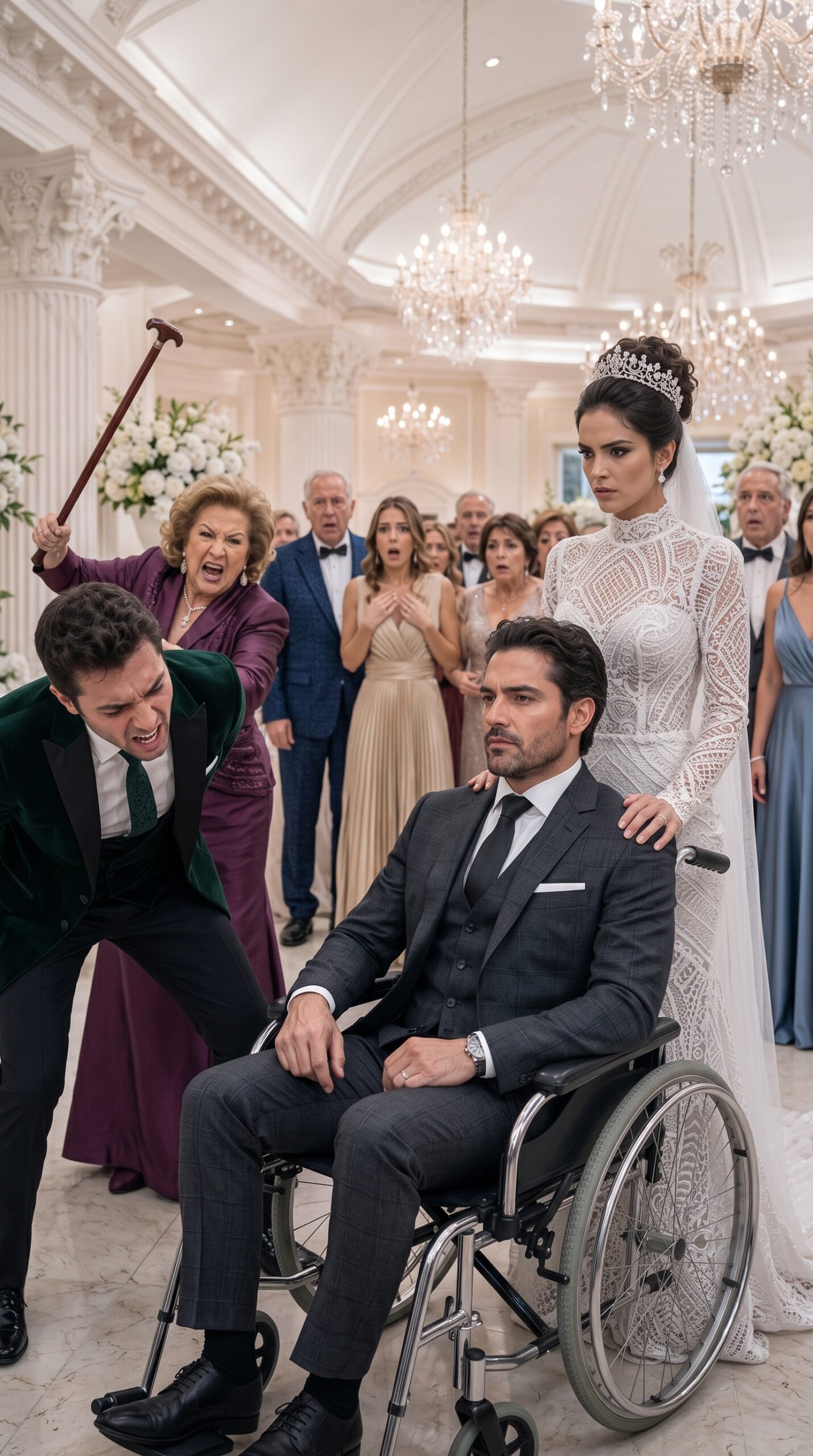
Marina appeared dressed in white, serene, pushing Julián’s wheelchair. He wore a pristine black suit, an antique watch, and a gaze so firm that no one dared to laugh.
Doña Rosario placed her hand over her chest.
—My God...
Marina moved forward without lowering her head. Each step seemed to split the Armenta pride in two.
In front of the judge, Julián took her hand.
—You can still stop —he whispered.
—I’ve already stopped too long —she replied.
The ceremony was brief, but every word rang like a hammer strike.
When the judge declared them husband and wife, the silence was louder than the applause.
Then the doors burst open.
Emiliano stormed in, furious, disheveled, his shirt untucked. Brenda trailed behind, pale, her smile gone from the night before.
—What did you do, you crazy bitch? —he shouted—. It was a joke!
Marina turned slowly.
—The invitation said Julián Armenta. I merely honored what you had printed.
Nervous laughter died out.
Emiliano pointed at his uncle.
—You married him? A disabled man? A man who can’t even stand?
Doña Rosario raised her cane and struck the floor.
—Shut up, Emiliano!
But he was already beside himself.
—Everyone, look at her! She married out of spite. Tomorrow she’ll be crying because that man can give her nothing.
Julián calmly took the microphone.
—You’re mistaken. I can give her something.
He gestured.
Two lawyers entered the hall with sealed folders. Behind them came three men in dark suits and a woman from the Prosecutor’s Office.
Panic rippled through the crowd.
Julián lifted the first folder.
—I can give Marina the truth.
Emiliano went pale.
—Uncle, don’t do this.
—Too late, nephew.
Julián opened the folder and displayed on the hall's screen documents, contracts, transfers, and photographs of a property in Puebla.
Marina recognized the facade before she read the title.
It was her childhood home.
The house that her family lost after a supposed illegal expropriation. The same house whose loss made her mother sick and left Marina working since she was 17 to survive.
Julián spoke without raising his voice.
—The Santa Clara Residential project was approved with false signatures. Families received crumbs. The rest of the money was diverted to accounts controlled by Rodrigo Armenta and his son Emiliano.
Marina felt the air leave her lungs.
Emiliano recoiled.
—That doesn’t prove anything.
Julián showed another page.
—There’s also the report of the accident where they tried to kill me on the Mexico-Puebla highway. My brakes were tampered with two days after I discovered the diversion.
Doña Rosario began to cry.
—Rodrigo...
Emiliano’s father, seated in the front row, stood as if he wanted to leave. The men in suits blocked his way.
The woman from the Prosecutor’s Office stepped forward.
—Rodrigo Armenta, you are under arrest for fraud, forgery, and attempted homicide.
The hall erupted.
Brenda tried to leave, but one of the lawyers raised a third folder.
—There are also transfers in the name of Brenda Cárdenas for concealing information and participating in ghost contracts.
Brenda glared at Emiliano with hatred.
—You said no one would review that!
Emiliano opened his mouth but couldn’t defend himself.
Marina looked at him as if seeing him for the first time. He was no longer the man she had loved. He was the son of a rotten system, raised to believe everything could be bought: houses, silences, women, disabilities, forgiveness.
—My mother died believing there was nothing to be done —Marina said, her voice breaking—. And you knew.
Emiliano tried to approach.
—Marina, I was young. My dad handled everything. I just signed what I was told.
Julián interrupted.
—You were 29. And you took an 18% commission.
The screen showed another transfer.
Emiliano’s face crumpled.
Guests, who minutes ago had gossiped for fun, now recorded with their phones. The scandal was too big for the hall.
Marina pulled the broken medal from her bouquet and raised it in front of Emiliano.
—Last night you called this trash. This medal was with my mom when they took us from our home. You threw away the only thing I had left of her, just as your family threw away our lives.
Emiliano lowered his gaze.
—Forgive me.
—No —she said—. That’s no longer yours to ask for. You need to pay.
Rodrigo was taken away in handcuffs. Brenda too. Emiliano wasn’t arrested that day, but he lost his job, his shares, and access to the family accounts. Doña Rosario, devastated, signed over control of the Armenta Group to Julián as all projects were investigated.
That afternoon, Marina returned to the guest house without a bouquet, without a party, and without a smile.
Julián was waiting for her by the window.
—You didn’t have to find out like this —he said.
—When did you know my house was in those papers?
—Six months ago. When I saw your name as Emiliano’s fiancée, I understood who you were. I wanted to warn you, but I didn’t have complete proof. Last night, when you came, I knew the family had grown too complacent.
Marina looked at him, pained.
—Did you use me?
Julián didn’t look away.
—At first, yes. I saw you as a witness, as a key, as someone who had also been harmed. But when I saw you searching for your medal in the trash without screaming, I understood you weren’t a pawn. You were the only person in this house who still knew how to have dignity.
Marina cried for the first time.
It wasn’t a cry of defeat. It was of exhaustion, of old rage, of years swallowed.
Julián didn’t try to touch her.
—You can ask for an annulment. I won’t hold you.
Marina looked at the wheelchair, the folders, the dark garden, and the main house where everyone had pretended grandeur while hiding rot.
—What if I don’t want to leave?
Julián took a deep breath.
—Then we will build something that doesn’t spring from revenge.
The following months were an earthquake.
Several families in Puebla recovered compensations. Investigations opened against notaries, officials, and construction companies. The Armenta name stopped appearing in social columns and began showing up in legal notes.
Doña Rosario publicly apologized to Marina in front of all the staff.
—I saw too many things and played dumb out of fear of losing the family —she confessed—. But a family that sustains itself on silence also rots.
Marina didn’t hug her right away. Forgiveness wasn’t a button.
But she agreed to sit down for coffee with her every Thursday.
Emiliano fell faster than anyone imagined. Without easy money, without a driver, and without Brenda, he began to drink. One night, he tried to enter the guest house drunk, wanting to confront Marina.
—You ruined me —he shouted from the garden.
Julián came out in his chair.
—No. You only met your consequences.
Emiliano let out a broken laugh.
—Look at you. Still in that chair, thinking you’re a king.
Julián tightened the brakes, placed his hands on the armrests, and, with an effort that made his whole body tremble, stood for a few seconds.
The garden fell silent.
Marina covered her mouth with her hands.
Julián fell back into the chair, sweating, but with fiery eyes.
—The chair was never my shame, Emiliano. The shame was that you needed to mock it to feel like a man.
Emiliano didn’t respond. For the first time, he left without shouting.
With therapy, patience, and a nearly miraculous stubbornness, Julián began to regain mobility. First one step between parallel bars. Then three. Then a cane.
Marina accompanied him without turning him into a hero or a pity case. She accompanied him like one accompanies someone fighting against themselves.
A year later, Julián took Marina to the outskirts of Cholula.
Among trees, bougainvilleas, and the smell of wet earth was a new house with a blue gate, a clay patio, and windows resembling those of the house they had lost.
Marina was left speechless.
—I couldn’t give you back the original —Julián said—. But this one is in your name. No one in my family can touch it. No one can evict you. No one can decide for you.
She touched the blue door as if touching a healing wound.
—My mom would have loved this patio.
—Then let what they couldn’t destroy begin here.
Some time later, Marina and Julián celebrated a second ceremony, small, without businessmen or politicians. Just Doña Rosario, some employees, neighbors from Puebla, and several families who had recovered part of what they lost.
This time, there were no fake invitations.
The card read: Marina Luján and Julián Armenta.
And below, a phrase that no one understood until they saw them enter together: “What started as a joke ended up being justice.”
Julián walked with a cane. Marina didn’t push him. She walked beside him.
In the distance, Emiliano watched from a bench, thinner, older, without a surname to protect him. He wasn’t expelled. He also wasn’t celebrated.
Marina approached him before leaving.
He lowered his head.
—I thought you were nothing special.
—No —she replied—. You needed to believe that to avoid seeing how little you truly were.
Emiliano cried in silence.
Marina didn’t feel triumph. She felt peace.
That night, upon arriving at the house with the blue gate, she hung the broken medal over the entrance. Julián looked at her.
—Don’t you want to fix it?
Marina smiled.
—No. It reminds me that something broken can also open a door.
Because there are jokes that reveal monsters, humiliations that awaken truths, and women who don’t need to take revenge by shouting.
Sometimes it’s enough to walk to the altar with the “wrong groom” for an entire family to discover who the real mistake was.





