PART 1
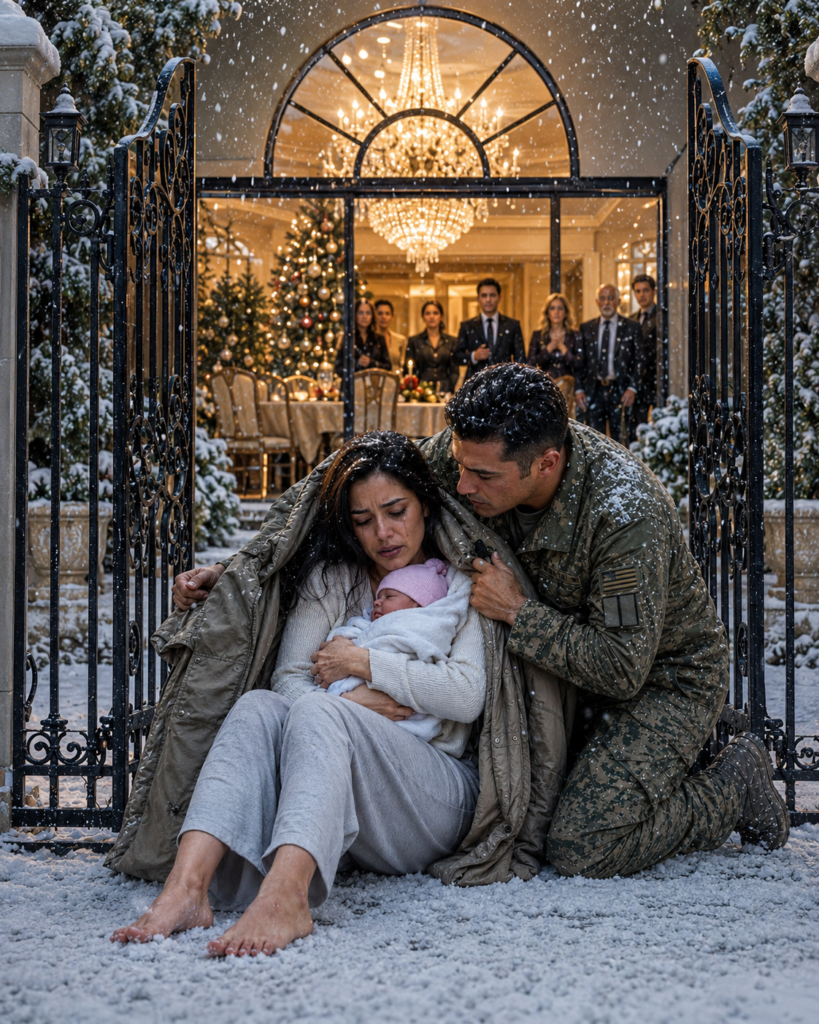
The first thing Emiliano saw when he got out of the truck wasn’t the iron gate of the family home, or the Christmas lights hung up as if everything inside was perfect.
It was Mariana’s bare feet, sinking into the dirty snow by the roadside.
The second thing was his newborn daughter, Lupita, pressed against her mother’s chest under a wet blanket. Mariana was shivering so violently that she could barely stand.
Her lips were no longer purple.
They were blue.
—Mariana! —Emiliano shouted, leaving the truck parked haphazardly in front of the gate.
He had just returned from a military assignment in Chihuahua. He had driven for hours through a storm that blanketed the road to his family’s vacation home, near the Nevado de Toluca.
He never imagined he would find his wife like this.
Mariana struggled to lift her gaze. Snow clung to her eyelashes, her hair plastered to her face, and her arms were stiff from cradling the baby.
—Emiliano… —she whispered—. Your mom said the DNA test proved I cheated on you.
He felt the world close in on him.
—What test?
Mariana looked toward the large, warm, brightly lit house, where shadows moved around the dining room. They were probably toasting with punch, laughing, discussing the “shame” they had just thrown onto the street.
—Doña Carmen showed it in front of everyone —Mariana said, her voice cracking—. She said Lupita isn’t yours. That I’m a nobody. That this house belongs to the Rivas, not to a liar or a bastard.
Emiliano gritted his teeth.
His mother had always been harsh with Mariana. She considered her “small potatoes” because she came from a humble family in Puebla and worked selling food before studying nursing.
But to leave her outside with a newborn?
That wasn’t just cruelty.
It was monstrous.
—Who threw you out?
—Your brother Raúl took my suitcase down. Your mom took my cell phone. She said you already knew everything and didn’t want to see me again.
The baby let out a weak whimper.
Emiliano took off his military jacket and wrapped both of them in it. Then he lifted Mariana as if she weighed nothing and carried her to the truck.
He turned the heater up to maximum.
Then he looked at the security camera by the gate.
The little red light blinked.
It had all been recorded.
Without ringing the doorbell, without shouting, without going in to break anyone’s face, Emiliano called the Military Hospital in Mexico City.
Doctor Julián Ortega answered immediately.
—Captain Rivas, is everything alright?
—I need neonatal emergency services. My wife has hypothermia and my daughter is exposed to the cold. I also need to check if any civilian lab requested my prenatal genetic sample.
There was silence.
Then the doctor replied with a serious voice:
—Captain… there’s no civil request here. No one asked for your DNA. No one could compare anything.
Emiliano closed his eyes.
Then he knew.
The test was fake.
At the hospital, Mariana was treated for severe hypothermia. Lupita was placed under heat lamps, wrapped in little white blankets, barely moving her tiny fingers.
When Mariana regained some strength, she took Emiliano’s hand.
—Please… don’t become like them.
He kissed her frozen fingers.
—No.
But he wasn’t going to forgive them either.
That night, his mother called 14 times.
Raúl texted:
“Don’t bring that woman. We already changed the locks.”
Emiliano replied simply:
“Understood. Merry Christmas.”
Then he called Major Santiago Beltrán, of military investigations.
Before going on missions, Emiliano had legally protected his properties, medical documents, and military identification. Any misuse would trigger a federal investigation.
Doña Carmen thought her son would obey as he always did.
She thought silence was fear.
But she forgot something important.
Emiliano didn’t warn before attacking.
He secured evidence.
He protected the innocent.
And this time, the operation was just beginning.
PART 2
Christmas morning arrived cold, white, and far too quiet.
While many families opened gifts, Emiliano stood in front of the glass of the neonatal room, watching Lupita breathe under a warm lamp.
Mariana slept in a private room. Her lips were still chapped from the cold, and her hands were covered with light bandages.
Every time Emiliano saw his daughter moving her mouth searching for milk, he felt a different kind of rage.
It wasn’t the hot rage that pushes you to scream.
It was a cold rage.
Exact.
The kind that doesn’t get wasted.
At 10 in the morning, he received a call from Major Beltrán.
—Captain, we’ve reviewed the document your wife described. The supposed lab closed three years ago.
Emiliano didn’t respond.
—The chemist’s signature is forged. Moreover, someone used a copy of your military ID to give the process a legal appearance.
—Who paid?
—Your brother Raúl. A transfer of 25,000 pesos to a former lab technician in Naucalpan.
Emiliano felt a blow to his chest.
Raúl had been his childhood companion. The same one who cried when Emiliano left for his first mission.
And now he had helped throw a brand-new mother into the snow.
—My mother?
—She made five calls to the technician. There are also audio recordings. It seems she planned everything.
Emiliano looked toward the room where Mariana was sleeping.
—I need the order ready before the meeting.
—It’s already in process.
Doña Carmen didn’t take long to organize a delayed Christmas dinner. She did it with full intention, confident that Emiliano would return alone, ashamed and willing to listen to her.
She invited uncles, cousins, close neighbors, and even Father Ignacio, the family friend.
She wanted an audience.
She wanted to prove she had “saved” the Rivas name from a poor woman.
What she didn’t know was that Emiliano also wanted an audience.
He arrived two days later, at six in the evening.
He wore his formal uniform. He carried a black folder, a sealed envelope, and a small metal box.
Doña Carmen greeted him at the entrance with a fake smile, one of those seen a lot in Mexico when someone wants to humiliate without messing up their hair.
—Son, thank God you came to your senses. That woman wasn’t worth it.
Raúl lifted his glass from the dining room.
—It’s about time, bro. Seriously, you were letting them play you.
Emiliano didn’t respond.
He entered and saw the table full: cod, romeritos, turkey, apple salad, punch. It all smelled like family.
But there was no family there.
Only accomplices.
Some looked away when they saw him. Others pretended not to know anything. Everyone, absolutely everyone, had seen Mariana being kicked out with Lupita in her arms.
No one defended her.
Emiliano sat at the head of the table.
Doña Carmen frowned.
—That place was your father’s.
—I know —he said—. That’s why I’m sitting here.
Silence fell heavily.
He placed the sealed envelope on the table.
—Before we toast, I want to show you something.
Raúl let out a nervous laugh.
—Are you going to defend Mariana again? Get over it, dude. The test was clear.
Emiliano opened the envelope.
—Genetic test conducted at the Military Hospital in Mexico City. Chain of custody supervised by federal personnel.
No one breathed.
A cousin dropped her fork.
Father Ignacio silently crossed himself.
Raúl paled.
Doña Carmen tried to smile, but her mouth trembled.
—That doesn’t prove the other one was wrong.
—No —Emiliano replied—. This proves it.
He pulled out another file.
—The lab mentioned in your document closed three years ago. The signature was forged. The military ID used to create the supposed test belongs to my personal file. And using false military documentation isn’t family gossip. It’s a federal crime.
Doña Carmen set her glass down on the table.
—I just wanted to protect you.
—Protect me? —Emiliano asked, with a calm that was scarier than a shout—. By leaving my wife barefoot in subzero temperatures? By taking away her phone while she asked for help? By calling my 12-day-old daughter a bastard?
Raúl slammed his fist on the table.
—Enough! Mom did what any mother would do.
Emiliano turned to him.
—No, Raúl. Any mother would have opened the door.
His brother swallowed hard.
—Mariana always wanted to keep what’s ours.
Then Emiliano landed the first real blow.
—What’s ours?
He pulled out notarized papers.
—The house was never “ours.” Dad left it to me because he knew Mom was secretly gambling and that you had debts.
The dining room exploded with murmurs.
Doña Carmen jumped up.
—Shut up!
But Emiliano continued.
—For years, I paid your credit cards, your loans, and even the truck Raúl crashed drunk in Metepec. Mariana knew and never said anything. On the contrary, she asked me not to humiliate you.
Raúl stepped back.
—That has nothing to do with it.
—Yes, it does. Because I found out why they forged the test.
Emiliano pulled out a copy of a contract.
—Raúl owed 800,000 pesos. And Mom promised to sell this house to rescue him. But there was a problem: I was never going to sell the place where my wife and daughter lived. So they needed to get them out first.
Doña Carmen started to cry.
They weren’t tears of regret.
They were tears from someone who had been discovered.
—You are my son —she said—. I gave you life.
Emiliano looked down for a second.
It hurt.
Of course, it hurt.
Because a part of him still remembered that woman making him hot chocolate when he was a child. He remembered her hands fixing his uniform the day he graduated.
But that mother was no longer there.
Or maybe she had never existed like he wanted to believe.
—You gave me life —he replied—. But you almost took my daughter’s.
Then he placed the small metal box in the center of the table.
Raúl looked at it suspiciously.
—What is that?
—The deeds.
Doña Carmen’s eyes widened.
—No.
—Yes.
Emiliano pulled out the last sheet.
—I sold the house 48 hours ago.
The guests froze.
—What did you do? —Raúl shouted.
—I sold it.
—You can’t! We live here!
—You lived here —Emiliano corrected—. The new owner takes possession in 15 days.
Doña Carmen clutched her chest.
—This house belonged to your father.
—And Dad would have never allowed a newborn to be left outside in a storm.
The door rang before anyone could respond.
Three men entered.
Two wore dark suits. The third showed an official ID.
Major Santiago Beltrán spoke firmly:
—Good afternoon. We come to execute a search warrant for document forgery, misuse of military identification, fraud, and domestic violence against a minor.
Raúl backed away until he bumped into a chair.
—Emiliano, please. We’re brothers.
Doña Carmen began shaking her head.
—Son, don’t do this to me. Don’t turn me in in front of everyone.
Emiliano stood up.
He looked at her one last time.
—In front of everyone, you threw out Mariana. In front of everyone, you called my daughter a bastard. In front of everyone, you concocted a lie to save money and pride.
He took his military cap and walked toward the door.
Raúl, now desperate, shouted:
—You’ll regret it! Blood is thicker than a woman!
Emiliano stopped.
He turned slowly.
—No, Raúl. Blood is not thicker than the truth.
No one said anything.
Not even those who thought they were judges before.
That night, Emiliano returned to the Military Hospital. Mariana was awake, with Lupita sleeping on her chest.
When she saw him enter, she asked fearfully:
—What happened?
He approached, kissed his wife’s forehead, and then his daughter’s.
—You don’t have to go back to that house.
Mariana cried silently.
Not for the house.
Not for the lost family.
But because for the first time since that night, she felt real warmth.
Days later, several relatives called to apologize. Some said they didn’t know what to do. Others swore they stayed silent “out of respect.”
Emiliano didn’t respond.
Because he understood something many prefer to ignore:
those who remain silent while an innocent is humiliated also choose a side.
And that Christmas, amidst a fake test, a sold house, and a baby who nearly didn’t survive the cold, everyone in the Rivas family learned too late that a last name is worthless when used to justify cruelty.





