PART 1
The receptionist guard smiled when Rosa Elena Mendoza said she wanted to surprise her husband.
It wasn’t a heavy smile.
Nor mocking.
It was the calm smile of someone who believes a lady has confused the address.
—Excuse me—she said, adjusting her bag on her shoulder—. I’m here to see Tomás Luján.
The guard checked the screen and then looked at her kindly.
—Yes, of course. But Mrs. Luján has already gone up to the executive floor.
Rosa Elena felt as if the air had been turned off.
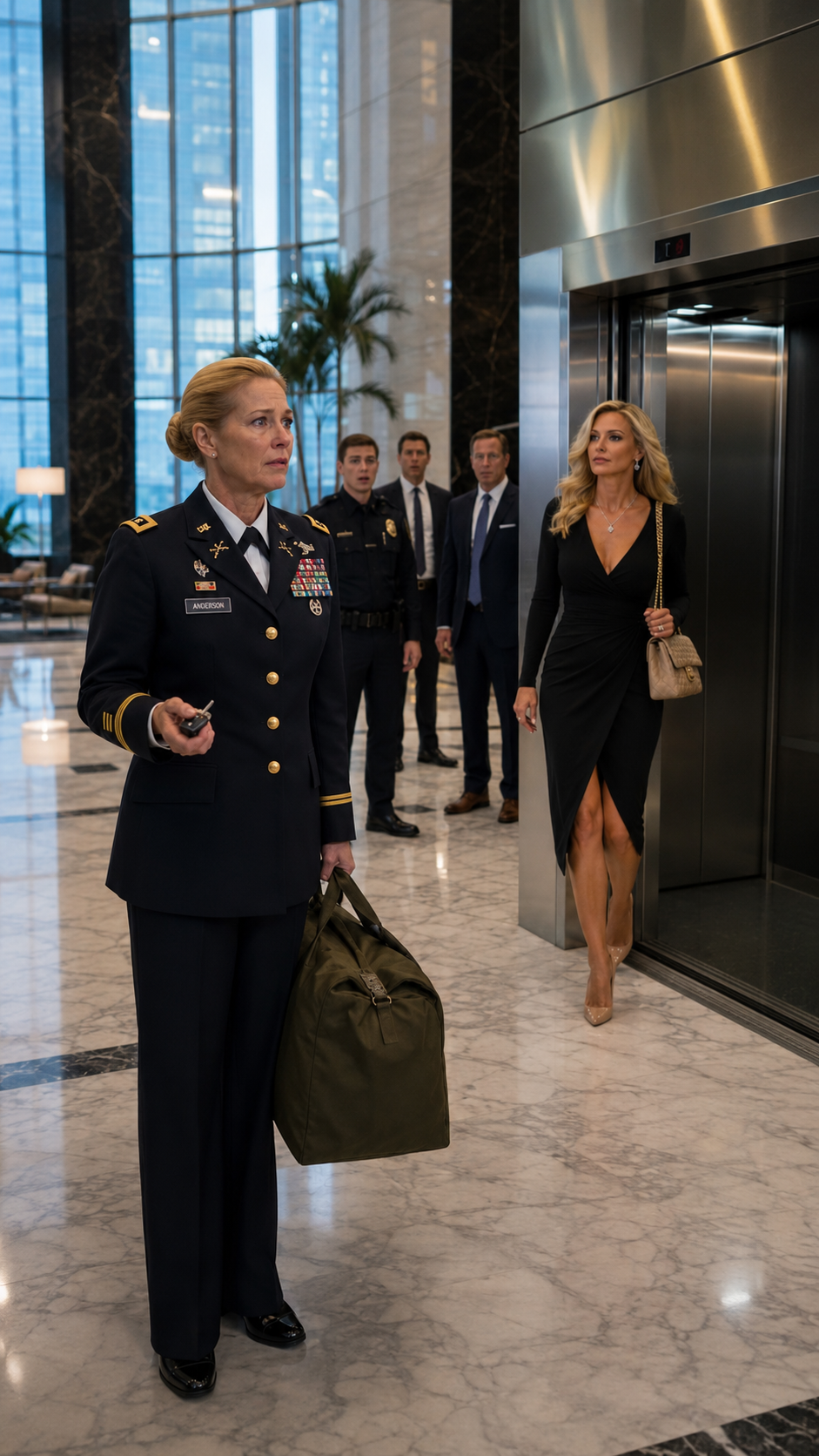
The Transportes Luján building shone on an elegant avenue in Monterrey.
Light marble.
Huge glass windows.
Receptionists in black suits.
A picture of the Virgin of Guadalupe next to a Mexican flag.
Everything seemed normal.
Except someone had just taken her place.
—Sorry—she replied with a calm learned through hardship—. I am Tomás Luján's wife.
The guard blinked.
—Oh... I didn’t know. She comes almost every morning.
“Every morning.”
That word scraped her chest.
Rosa Elena had driven over 800 kilometers from Chiapas, where she was stationed at a military base.
She hadn’t announced her return.
She wanted to show up as a surprise after so many months apart.
After anniversaries over video calls.
After birthdays sent by mail.
After 29 years of marriage, saved letters, repeated promises, and nights when the uniform weighed heavier than exhaustion.
She only wanted to see Tomás smile.
But the guard raised his gaze toward the elevators.
—Here she comes.
Rosa Elena turned slowly.
A light brown-haired woman stepped out of the private elevator.
She wore white pants, a silk blouse, and nude heels.
She walked with the confidence of someone who doesn’t ask for permission because she believes everything belongs to her.
The employees greeted her.
—Good morning, Mrs. Luján.
Mrs. Luján.
Rosa’s surname.
Her home.
Her story.
The woman smiled as if nothing were amiss.
Then their eyes met.
There was no surprise.
No shame.
No fear.
Just a cold, almost weary gaze, as if to say, “It’s about time you showed up.”
Rosa Elena lowered her eyes for a second.
And then she saw it.
Hanging from that woman’s neck was a silver military badge.
Her badge.
The one Tomás had given her when he was promoted to Colonel.
The same one engraved with the initials R.E.M. and a date: 09/17/1997.
Many women would have screamed.
Would have pulled the other’s hair.
Would have demanded an explanation from everyone.
But Rosa Elena was not just any woman.
She had learned in the Mexican Army that when the ground becomes dangerous, you first observe.
Then you breathe.
Afterward, you decide where to strike.
She returned to the counter with a rigid smile.
—There must be a mistake.
The guard, uncomfortable, nodded.
—Yes, ma’am. It happens sometimes.
No.
That didn’t happen.
Rosa Elena left the building and sat on a bench in front of the parking lot.
The city continued to roar.
Trucks passing.
People with coffee.
Executives talking on cellphones.
The world didn’t stop just because a life was breaking apart.
Her phone vibrated.
It was Tomás.
“My love, I miss you. I can’t wait for you to return. This house isn’t a home without you.”
Rosa Elena stared at the message for a long time.
He still believed she was far away.
He didn’t know his wife had just seen another woman using her surname, her place, and her medal.
She booked a room at a downtown hotel under her maiden name.
Rosa Elena Mendoza.
Not out of fear.
But strategy.
That night she opened her laptop.
Searched for Transportes Luján.
Founder.
General Director.
Supportive businessman.
Benefactor of military families.
Photos appeared one after another.
DIF events.
Gala dinners.
Fundraisers for widows of soldiers.
Breakfasts with businessmen.
And in almost all of them, there she was.
The description always said the same thing:
“Tomás and Valeria Luján, a couple committed to Mexico.”
Valeria.
His “wife.”
In a Christmas photo, Rosa Elena stopped breathing.
It was her living room.
Her fireplace.
The nativity set she had bought in Tonalá.
Valeria held a glass of wine while wearing her pearl earrings.
She kept scrolling.
Another image.
A gala for military families.
Tomás smiled proudly.
Valeria was at his side.
And around her neck hung Rosa Elena's badge.
The description read:
“Tomás and Valeria Luján honor the sacrifice of those who serve far from home.”
Rosa Elena slammed her laptop shut.
The room turned cold.
Then her cellphone rang.
It was her daughter, Daniela.
—Mom... are you in Monterrey yet?
Rosa Elena froze.
—Why do you ask that?
There was silence.
Then Daniela spoke almost in a whisper.
—Dad called me all upset. He asked that if you looked for me... I should let him know immediately.
Rosa Elena looked at the city lights.
And understood that betrayal was not the worst part.
What Tomás feared was not that she had discovered Valeria.
What truly terrified him was everything else still waiting to come out.
PART 2
Rosa Elena asked Daniela not to call her father.
It was one of the most painful decisions of her life.
She never wanted to involve her daughter in adult problems.
Daniela was 31, living in San Pedro with her husband, raising two small children.
She had already endured enough as a child, waiting for a mother who often didn’t arrive because duty sent her to another state.
But that night, the past caught up with the whole family.
—Mom, you’re really scaring me—said Daniela—. What did my dad do?
Rosa Elena saw her uniform hanging next to the hotel bed.
The medals shone under a yellow lamp.
They looked like they belonged to another woman.
A strong woman.
A respected woman.
Not a trembling wife because another wore her earrings.
—I still don’t know everything—she replied—. But if Tomás asks about me, tell him you don’t know anything.
Daniela took a while to answer.
—You called him Tomás. Not Dad.
Rosa Elena closed her eyes.
Children always hear what one tries to hide.
—I’ll explain when I can. For now, trust me.
After hanging up, she called the only person she knew could navigate the shadows without losing her head.
Marta Salgado.
Former military investigator.
A friend of over 20 years.
Retired, widowed, stubborn as a mule, and with a memory capable of sinking anyone.
She answered on the first ring.
—You were supposed to be in Chiapas.
—I was.
Marta fell silent.
—You speak like a woman whose life has just been shattered.
—Maybe.
Rosa Elena told her everything.
The guard.
Valeria.
The photos.
The military badge.
The earrings.
Tomás’s call to Daniela.
Marta didn’t interrupt.
When she finished, she said in a dry voice:
—Don’t confront him yet.
—I wasn’t planning to.
—Good. Cowards always want to talk first to arrange the lie. Don’t give him that advantage.
The next morning, Rosa Elena rented a discreet car and parked a block away from Transportes Luján.
She wore sunglasses, a cap, and simple clothes.
At 9:08, Valeria arrived in a white truck.
An employee opened the door for her.
Another handed her a coffee.
A secretary came down to greet her with a folder.
She wasn’t a hidden mistress.
She was a queen in the palace.
At noon, Tomás came out with her.
They walked together.
He placed his hand on her lower back.
A small gesture.
Almost invisible.
But Rosa Elena felt that gesture hurt more than a kiss.
Because kisses can be faked.
The habit cannot.
For four days, she watched them.
Valeria entered meetings.
Received clients.
Gave orders.
Smiled at lunches with directors' wives.
She even signed documents as a representative of a foundation called Manos de Honor.
A foundation to support military families.
The audacity was so great it felt like a joke.
On the fifth day, Marta arrived at the hotel with coffee, sweet bread, two prepaid cellphones, and a sour expression.
—Now we’re going to dig up the dirt.
Marta started with the public records.
Actas.
Documents.
Contracts.
Social notes.
Old photographs.
In less than six hours, she found something strange.
Valeria wasn’t Luján.
Her name was Valeria Castañeda.
She had been the events coordinator at a business chamber.
She appeared in Tomás's life 11 years ago, just when Rosa Elena spent 14 months away on a security mission at the southern border.
First, she was “an advisor.”
Then “public relations director.”
Afterward “foundation president.”
And finally, for the world, “Mrs. Luján.”
But there was no marriage certificate.
Not legal.
Not real.
—So, it’s all a facade—Rosa Elena murmured.
Marta shook her head.
—I wish it were that simple.
She showed her another document.
A power of attorney.
Supposedly signed by Rosa Elena.
It authorized Tomás to manage assets, accounts, and properties during “prolonged absences.”
Rosa Elena read her name.
Her CURP.
Her signature.
But she had never signed that.
Her stomach twisted.
—This is fake.
—There’s more—Marta said.
They uncovered movements from a joint account.
Withdrawals.
Transfers.
Donations to the foundation.
Payments to ghost vendors.
A house in Valle Alto bought in Valeria's name.
And worst of all:
A request to sell Rosa Elena and Tomás's family home using the forged power of attorney.
The house where Daniela took her first steps.
The house where Rosa Elena had saved letters, photographs, and boots filled with dirt from so many farewells.
Tomás hadn’t just brought another woman into his life.
He had tried to erase the real wife while she served far away.
Rosa Elena wanted to vomit.
Marta placed a hand on her shoulder.
—The ugliest blow is still to come.
She opened a digital folder.
Inside were photos from foundation events.
Valeria handing out supplies to soldiers' wives.
Tomás giving speeches.
Businessmen donating huge checks.
And at the center of it all, a repeated story:
“Colonel Rosa Elena Mendoza, wife of Tomás Luján, emotionally died for her family by serving Mexico.”
Rosa Elena furrowed her brow.
—What does that phrase mean?
Marta swallowed hard.
—It means Tomás sold your absence as abandonment.
There were interviews where Tomás said, with a broken voice, that his wife had “chosen the uniform over the family.”
He never said they were separated.
He never said they were still married.
He only allowed a poisonous idea to drop:
that he and his daughter had been victims of a cold woman.
And then he presented Valeria as “the person who rebuilt the home.”
Rosa Elena felt a rage so pure it no longer hurt.
What hurt more was something else.
Daniela.
Had they also made her believe that?
That night she went to see her.
She didn’t notify Tomás.
Daniela opened the door and froze.
Then she hugged her mother like when she was a child.
Crying without saying anything.
In the living room, while the children slept, Rosa Elena told part of the truth.
Daniela listened with her hands clenched.
Then she said something that broke everything.
—I met her, Mom.
Rosa Elena looked up.
—Valeria?
Daniela nodded.
—Dad introduced her to me years ago as a friend. Then he said you knew. That you didn’t care. That your marriage with him only existed on paper now.
Rosa Elena couldn’t speak.
Daniela cried with guilt.
—I believed him, Mom. I was angry with you. You were my mom, but you were hardly ever there. Dad said not to look for you because it made you uncomfortable to feel guilty.
The lie had been perfect.
They didn’t just take her place.
They had gradually stolen her daughter’s love, bit by bit.
Rosa Elena took Daniela’s hands.
—I wrote to you every week.
Daniela turned pale.
—I never received anything.
There was the twist that changed everything.
Tomás hadn’t just lied outwardly.
He had intercepted letters, messages, packages, and calls for years.
Daniela went upstairs and came back down with a box.
—I found this in Dad’s study when he moved offices. I thought they were old papers.
Inside were sealed envelopes.
Letters from Rosa Elena.
Postcards.
Photos.
Small gifts.
All addressed to Daniela.
Never delivered.
Daniela covered her mouth with her hand.
—No... it can’t be.
Rosa Elena opened a birthday letter from when Daniela was 15.
The ink was still intact.
“My girl, forgive me for not being there. There is no mission more important than you, even though sometimes the country demands me first.”
Daniela broke down.
—He made me hate you, Mom.
Rosa Elena hugged her.
And for the first time in many years, they both cried not for the distance, but for the theft.
The next day, the war began.
But it wasn’t with shouts.
It was with evidence.
Marta contacted a lawyer.
Rosa Elena gathered military documents showing her dates of service.
Daniela delivered the hidden letters.
An expert confirmed the signature on the power of attorney was forged.
An accountant traced transfers from the foundation to companies linked to Valeria.
And Rosa Elena saved the final blow for a gala of Manos de Honor, where Tomás would receive recognition for “his support to military families.”
The hall was full.
Businessmen.
Local politicians.
Wives in expensive dresses.
Facebook cameras broadcasting live.
Tomás went up on stage with Valeria.
She wore Rosa Elena’s military badge again.
Tomás took the microphone.
—My family knows what it costs to serve Mexico...
Then Rosa Elena entered.
Gala uniform.
Hair tied up.
Medals on her chest.
Steady step.
The hall fell silent.
Someone whispered a “no way.”
Valeria turned pale.
Tomás stopped smiling.
Rosa Elena walked to the stage.
She didn’t snatch the microphone.
She just extended her hand.
—My badge, please.
Valeria didn’t move.
Rosa Elena looked her straight in the eye.
—That badge has my name, my story, and my blood. It doesn’t belong to you.
The live broadcast captured everything.
Valeria took it off with trembling hands.
Tomás tried to speak.
—Rosa, this isn’t what it seems...
She held up a folder.
—No, Tomás. It’s worse.
The screens displayed the first piece of evidence.
The forged power of attorney.
Then the account statements.
Next, Daniela’s hidden letters.
Finally, the foundation transfers.
People began to murmur.
Some pulled out their phones.
Others were left stunned.
Daniela appeared at the back of the hall.
She said nothing.
Just looked at her father with a sadness that felt like a sentence.
Tomás stepped down from the stage trying to approach.
—Daughter, let me explain...
Daniela stepped back.
—Are you also going to say that my mom forged the letters?
That phrase destroyed him more than any accusation.
Valeria tried to sneak out through a side door, but a lawyer from the foundation and two police agents were already outside.
There was no soap opera scandal.
There was something worse.
Silence.
The silence of people watching a man who had built a saintly image fall with Judas’s lies.
Months later, Tomás lost the company.
The foundation was investigated.
Valeria faced charges for fraud and misuse of resources.
The power of attorney was annulled.
The family home was protected.
And Rosa Elena’s divorce came with a sentence many shared on social media:
“There is no abandonment when someone serves their country. Abandonment is using that absence to betray.”
Rosa Elena didn’t recover the stolen years.
No one returns a Christmas.
Nor a missed call.
Nor a daughter growing up with rage sown by another.
But she reclaimed her name.
Her badge.
Her home.
And above all, she regained Daniela.
One afternoon, they both opened all the letters Tomás had hidden.
Some made them laugh.
Others hurt.
Others came too late.
Daniela found one from when she was 18.
She read it aloud, crying:
“When you doubt me, daughter, remember this: I may be far away, but I never left your life.”
Rosa Elena hugged her.
Outside, Monterrey continued as usual.
Noisy.
Hot.
Unstoppable.
But inside that house, something finally rested.
Because sometimes the worst betrayal isn’t bringing another person into your place.
The worst betrayal is convincing everyone that you no longer deserved to occupy it.





