PART 1
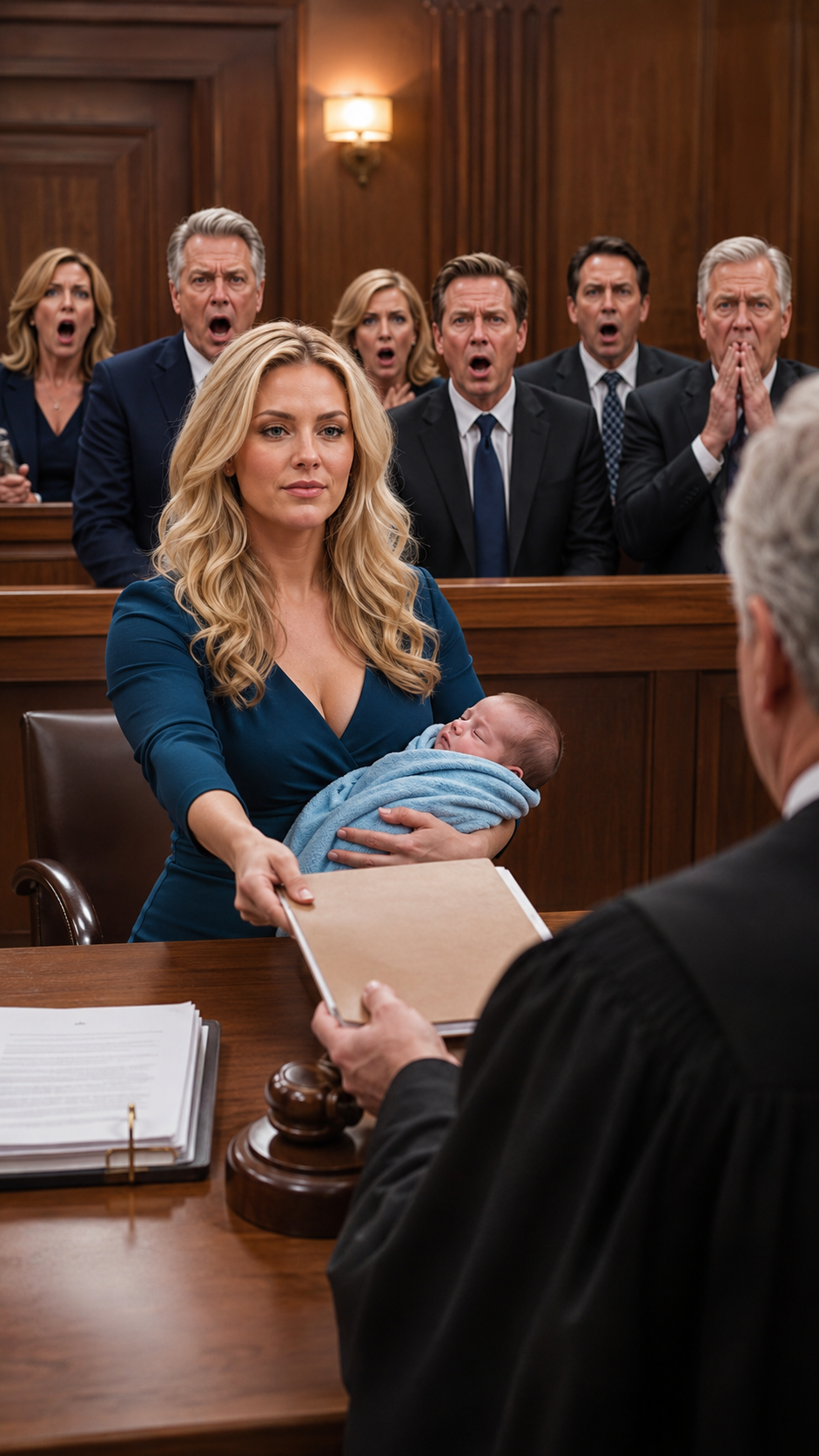
Mariana entered the Family Court of Mexico City, cradling her newborn son, wrapped in a blue blanket that still smelled of the hospital.
Only six days had passed since the birth.
She walked slowly, her body aching, her skin pale, with dark circles under her eyes that no makeup could hide. But she would not seek pity.
She was here to end a lie.
Across the room sat Andrés Villarreal, her husband, heir to a colossal construction company in Santa Fe. He wore a dark suit, an expensive watch, and that calm smile of someone who believes they’ve already bought the world.
Beside him was Teresa, his mother, an elegant woman adorned with pearls and a sharp gaze.
And next to him, as if already part of the family, was Natalia, the woman Andrés had begun living with before Mariana had even finished her pregnancy.
On Natalia's wrist glimmered a white gold bracelet.
Mariana recognized it instantly.
It had been her anniversary gift.
No one in that row looked nervous.
The lead attorney, Eduardo Salas, rifled through papers with an air of superiority. Occasionally, he would whisper something to Andrés, and they would both smile.
To them, this hearing was just a formality.
A recently delivered woman, without a lawyer, without visible money, and holding a baby in her arms could not face a family like the Villarreal's.
That’s what they believed.
They thought Mariana had brought the child to tug at the judge's heartstrings.
They thought the red folder pressed against her chest was filled with pleas, tender photos, and desperate explanations.
They didn’t know that each page was a stone aimed at the castle of lies Andrés had built over the years.
Andrés hadn’t gone to the hospital.
He hadn’t called.
He hadn’t asked if his son had been born well.
Instead, he sent his lawyer with documents for Mariana to sign a temporary custody authorization.
They claimed she wasn’t emotionally stable.
They said she didn’t have sufficient income.
They said her “psychological background” made her a risk.
That background was four therapy sessions Mariana had attended after a beating that Andrés forced her to report as a fall down the stairs.
Now he used that against her.
The judge looked up.
“Mrs. Villarreal, do you have legal representation?”
Eduardo Salas smiled before she could answer.
Andrés settled back in his chair, satisfied.
“No, your honor,” Mariana said, her voice low but steady.
Teresa let out a nearly imperceptible chuckle.
Natalia looked at the baby as if he were already hers.
Then Eduardo stood up and began his speech.
He said that Mariana was confused.
He said she was manipulating the newborn to prevent Andrés from exercising his rights as a father.
He claimed the Villarreal family could provide the baby with a “stable, secure, and dignified” life.
As if Mariana were trash.
As if nine months of fear, vomiting, threats, and silence hadn’t mattered.
As if a mother could be erased with a signature.
Mariana lowered her gaze to her son. The child slept peacefully, mouth slightly open, unaware that several people were trying to wrench him from her arms.
The judge asked if she had anything to say.
Mariana took a deep breath.
She opened her bag.
She pulled out the red folder.
It was thick, heavy, marked with colorful dividers.
The room fell silent.
Eduardo raised an eyebrow.
“I see you came prepared, Mrs. Villarreal.”
His tone was mocking.
Mariana didn’t respond.
She carefully stood up, walked to the stand, and placed the folder in front of the judge.
For the first time, Andrés stopped smiling.
She adjusted the baby’s blanket and looked directly at the judge.
“Your Honor, I’m not asking for protection by using my son.”
Andrés frowned.
Mariana swallowed hard.
“My son isn’t the reason for this request.”
The room stood still.
Then she said the phrase that drained color from Andrés’s face.
“My son is the evidence.”
PART 2
The silence lasted mere seconds, but it felt like an eternity.
Andrés went rigid.
Teresa clutched her purse so tightly her knuckles turned white. Natalia stopped looking at the baby and turned to Andrés, searching for an explanation he couldn’t provide.
Eduardo Salas was the first to react.
“Your Honor, this is a blatant attempt to provoke drama. Mrs. Villarreal is exhausted, she just gave birth, and she clearly isn’t in a state to interpret complex documents.”
Mariana remained still.
She didn’t need to yell.
She didn’t need to cry.
She had spent too many months learning that when someone powerful feels untouchable, the best response isn’t to fight back with words.
It’s to let the evidence speak.
The judge opened the folder.
The first section contained certified medical records.
They weren’t just from the birth.
They were emergency reports from two different years.
Bruises.
Cracked rib.
Wrist injury.
Back injuries.
All recorded as domestic accidents.
But beside each report were messages from Andrés sent hours later.
“You know what to say.”
“Don’t make a scene.”
“If you speak, no one will believe you.”
“My family has more weight than you, Mariana.”
Eduardo tried to interrupt.
“Messages out of context can be misinterpreted.”
The judge raised his hand.
“Let me review.”
He moved to the next section.
There were transcribed audio recordings.
In one, Andrés demanded that Mariana renounce any claims to the house in Lomas de Chapultepec.
In another, Teresa told her that a woman “without a surname” couldn’t educate the Villarreal heir.
And in the third, Natalia spoke with terrifying confidence.
“When he’s born, we register him with Andrés, and she disappears. A well-managed postpartum depression explains everything.”
The entire room froze.
Natalia opened her mouth but said nothing.
Teresa leaned toward her son.
“Andrés, fix this.”
But Andrés no longer looked like the impeccable businessman who had walked in just minutes before.
He looked like a man trapped.
The judge turned to Mariana.
“Mrs. Villarreal, how did you obtain this material?”
She held her baby against her chest.
“For months, he recorded many conversations from the home security system. I had access as co-owner. When I discovered they were also using those cameras to surveil me, I had a notary back it up.”
Eduardo paled.
The judge continued reading.
The next part was financial.
That was where the real blow lay.
Andrés had declared that Mariana had no income, that she depended entirely on him, and that she couldn’t support a baby.
But the folder revealed another story.
Before marrying, Mariana had been a corporate fraud investigator at a private firm in Monterrey.
She had worked on cases of false billing, embezzlement, and shell companies.
When she married, Andrés asked her to quit everything.
He told her she didn’t need to work.
He said a Villarreal should dedicate herself to family.
But she never stopped observing.
And when she began to notice strange movements in accounts linked to her name, she did what she knew best: she followed the money.
There were large transfers to three new companies just after she announced her pregnancy.
There were invoices for nonexistent services.
There were loans signed with an altered copy of her identification.
And there was an account where Natalia appeared as an indirect beneficiary.
The judge placed the documents on the table.
“This exceeds a custody hearing.”
Andrés exploded.
He pushed his chair back, and it fell to the floor with a loud thud.
“This is a trap! She’s always been resentful!”
The baby stirred restlessly.
Mariana held him tighter.
The judge banged the gavel firmly.
“Mr. Villarreal, sit down immediately.”
But Andrés had already lost his facade.
“That child shouldn’t have even been born!” he shouted.
No one breathed.
Not even Eduardo could save him from that phrase.
Mariana closed her eyes for a second. Not in surprise. She had heard that same phrase before, one night when Andrés demanded she terminate the pregnancy because Natalia was already settled in his life.
The judge called for them to continue.
Mariana pointed to the last divider in the folder.
It was the thinnest.
And the most dangerous.
There were prenatal genetic test results.
Not to prove that Andrés was the father.
That was already clear.
The study revealed something much graver.
The baby had a rare hereditary condition linked to a genetic line that Andrés had denied for years because it could affect the “perfect” image of his family before investors and partners.
But that wasn’t all.
The same study revealed compatibility with a previously registered sample from a private laboratory in Guadalajara.
A sample from another minor.
A five-year-old boy.
Biological son of Andrés.
Registered in the name of a housekeeper who had disappeared after signing a nondisclosure agreement.
Teresa placed a hand on her chest.
Natalia turned to Andrés as if she were seeing him for the first time.
“Do you have another child?” she murmured.
Andrés didn’t answer.
Mariana did.
“He has another child. And the mother of that child reported threats before withdrawing the lawsuit. After that, she received 800,000 pesos from a Villarreal family company.”
The judge looked at Eduardo Salas.
“Did your client have knowledge of this information?”
Eduardo didn’t reply immediately.
That silence spoke louder than any confession.
Then Mariana pulled out a small envelope from her bag.
“There’s also a formal request filed with the DIF and the Prosecutor’s Office. I didn’t come just for my custody. I came because there’s another child who was silenced before my son was born.”
Teresa stood up in fury.
“You’re ungrateful! We gave you a surname, a house, a driver!”
Mariana looked at her for the first time without fear.
“I was given nothing. I was locked in a pretty cage and they thought that having marble meant it wasn’t a prison.”
The phrase fell like a stone.
Natalia began to cry, but no one knew if it was out of guilt, fear, or rage.
The judge called for a brief recess and requested certified copies to refer part of the file to the Public Ministry.
When everyone exited into the hallway, Andrés tried to approach Mariana.
Two officers stepped in between them.
“Mariana, listen to me,” he said, now with a gentle voice. “We can fix this. Think of the child.”
She looked down at her son.
The baby was still asleep.
So small.
So innocent.
So used by everyone as if he were a prize, a threat, or property.
“I’ve thought of him since the beginning,” she replied.
Andrés reached for the blanket.
Mariana took a step back.
“Don’t ever use the word father again to hide what you are.”
The hearing resumed 40 minutes later.
The provisional decision was clear.
Full custody for Mariana.
Immediate protection order.
Suspension of visits until psychological and criminal evaluations were complete.
Prohibition for Andrés, Teresa, and Natalia from approaching Mariana’s home, hospital, or family.
And referral of the financial documents and audios to the Prosecutor’s Office.
Eduardo Salas no longer smiled.
Teresa exited, escorted, shouting that it was all an exaggeration.
Natalia removed her anniversary bracelet in the hallway and left it on a bench as if the gold burned.
Andrés stood frozen in front of the courthouse door, surrounded by lawyers who no longer seemed so confident.
Mariana walked slowly, her baby in her arms and the red folder lighter than when she entered.
Outside, there were no cameras.
No applause.
No movie ending.
Just a weary mother, her body broken, walking under the sun of Mexico City.
But that afternoon, for the first time in a long time, no one decided for her.
Weeks later, the case became national news when it leaked that the Villarreal family had used private agreements to silence women for years.
The other child was located with his mother in Querétaro.
Mariana didn’t know him but requested that he also receive protection.
Because justice shouldn’t only serve to save her son.
It should reach all children born under the secrets of cowardly adults.
Andrés lost contracts, partners, and provisional freedom when more false transfers surfaced.
Teresa continued to say that Mariana had destroyed the family.
But online, thousands responded with the same sentiment: a family isn’t destroyed when the truth is told; it’s destroyed when everyone agrees to bury it.
Mariana never used the Villarreal surname again.
She registered her son with her two surnames.
And every time someone asked her if she wasn’t afraid to raise a baby alone against such a powerful family, she would just look at her child and smile sadly.
Because she had been alone when she cried during her pregnancy.
She had been alone in the hospital.
She had been alone when they tried to declare her insane.
But in the courthouse, she understood something that many women take years to accept: sometimes a mother doesn’t need permission to save her child.
She just needs to stop being afraid of those who made her believe she was worth nothing.





