PART 1
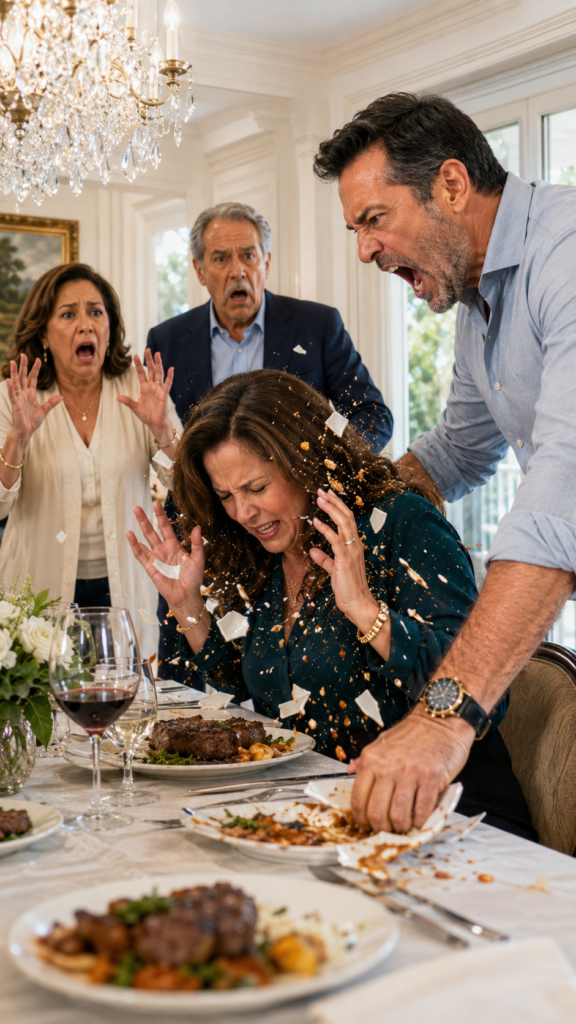
At the long table of the family home in Las Lomas, no one dared to breathe as Mauricio smashed a ceramic plate against Valeria's head.
The sound was dry, brutal, like something in the room had shattered forever.
Mole sauce mixed with blood on her ivory blouse. A red line trickled down her left temple, crossed her cheek, and fell onto the white tablecloth that Teresa, her mother-in-law, had insisted on bringing in “for a decent dinner.”
Eighteen people sat around the table.
Uncles, cousins, sisters-in-law, partners from the family construction company, and even the trusted notary of the Aranda family. Everyone had witnessed the hit.
And yet, no one stood up.
Valeria Salgado was 34 years old, an independent architect, and had been paying for her apartment in Del Valle, Mexico City, alone for six years.
It wasn’t a mansion. It wasn’t a magazine penthouse. But it was hers.
She had bought it through sleepless nights, careful budgeting, and entire weekends spent reviewing plans while her friends went out to live.
For Mauricio Aranda’s family, however, that apartment ceased to be home the moment Teresa decided she “needed it more.”
Dinner had started with false smiles, expensive glasses, and poisonous comments disguised as concern.
Teresa, with her gold bracelets jingling like church bells, announced that she could no longer live in her home in Jardines del Pedregal.
“There are too many stairs,” she said, clutching her chest. “My blood pressure is horrible. The doctor told me I need to be in a more practical place.”
Then she looked at Valeria as if asking for a glass of water.
“Your apartment is perfect for me, dear. Central, comfortable, without so many complications.”
Valeria set her fork down.
Mauricio didn’t look at her.
Her father-in-law, Ernesto, spoke in that calm tone of a man used to having everyone obey him.
“Besides, Valeria can rent something small. You’re young. An intelligent wife knows when to support the family.”
The word “support” fell like a stone.
Because they weren’t asking for support. They were demanding a surrender.
For twenty-five minutes, they talked about her property as if she weren’t there. They decided where Teresa's furniture would go, what room would be for her nurse, and even how much Valeria should contribute monthly for “basic expenses”: 42,000 pesos.
Then Valeria took a deep breath.
“No.”
The table went silent.
Teresa blinked, offended to her core.
“What do you mean no?”
“I’m not giving up my apartment. I won’t lend it, I won’t give it away, and I’m not going to pay 42,000 pesos a month for a decision made without consulting me.”
Mauricio stood up so quickly that his chair scraped the floor like a scream.
“Are you humiliating me in front of my family?”
“No, Mauricio. You’re humiliating yourself.”
It was that phrase that broke him.
With his face flushed, he took the heavy ceramic plate and hurled it straight at her.
The impact made her stagger. The ceramic shattered against her temple. Pieces fell onto the tablecloth, her hair, the shiny floor.
Mauricio breathed like a bull.
Teresa turned her face, not in horror, but out of shame for seeing blood on her elegant dinner.
Valeria placed a hand on the table to steady herself. The buzzing in her ear was unbearable.
But she understood something cold and crystal clear.
That dinner hadn’t been a family conversation. It had been a trap.
They wanted to break her in front of everyone. If she cried, they would say she was unstable. If she screamed, they would call her crazy. If she yielded, they would take her home.
Valeria took a napkin, wiped the blood from her cheek, and pulled a piece of plate from her hair.
Then she looked Mauricio directly in the eyes.
“You have no idea who you’re dealing with.”
She pulled out her phone, the screen stained with blood, and dialed 911.
When the operator answered, she spoke with a calm that froze everyone.
“Good evening. I need an ambulance and a patrol in Las Lomas. My husband just physically assaulted me in front of his entire family. There are 18 witnesses in the room.”
Teresa jumped up.
“Valeria, don’t be ridiculous! It was a family accident.”
Valeria kept her gaze on Mauricio.
“It wasn’t an accident. It was assault.”
Mauricio took one step toward her.
“Hang up that call.”
Valeria raised her phone.
“Take another step, and I’ll tell the operator exactly where you’re standing.”
At that moment, Ana, the younger sister-in-law, stepped between them, her face pale.
“Mauricio, don’t move.”
For the first time in his life, he hesitated.
And when the doorbell of the mansion rang seven minutes later, everyone understood that the bleeding woman before them wasn’t asking for permission to save herself.
PART 2
The police entered the house as if they were splitting the rotten air of that family in two.
Behind them came two paramedics with a stretcher and a first aid kit. The smell of expensive wine, roasted meat, and imported perfumes was buried under something stronger: fear.
Valeria remained seated, back straight, while blood soaked her neck.
One paramedic cleaned her wound. He told her she needed stitches and a CT scan to rule out major damage.
She nodded but didn’t let go of her phone.
The lead officer separated Mauricio from the table. Another asked for identification from everyone present and inquired who had witnessed the blow.
Again, silence.
That cowardly silence that weighs more than a lie.
Teresa approached with her Sunday mass voice.
“Officer, please. My son would never do something like this intentionally. It was just a marital argument, nothing more. My daughter-in-law is very sensitive, honestly.”
The officer didn’t even smile at her.
“Ma’am, return to your seat. You’re also a witness.”
Mauricio tried to talk to Valeria with a false smile.
“Baby, come on. Tell them you’re not going to press charges. We’re married.”
Valeria looked at him with a coldness that drained the color from his face.
“We were also married when you broke a plate over my head.”
The officer asked her to recount everything from the beginning.
Valeria didn’t limit herself to the blow.
She spoke of the apartment in Del Valle, the 42,000 pesos they wanted to extract from her each month, the pressures to sign a transfer, the family loans Mauricio had asked for “in an emergency.”
Then she opened the messages.
Three days earlier, Mauricio had written to her:
“If you make my mom look bad at that dinner, I can’t promise what will happen when things get ugly.”
The officer read the screen. His expression changed.
“Do you wish to press charges?”
Mauricio turned pale.
“Valeria, don’t do this.”
“Yes,” she said. “I want to proceed.”
Teresa let out a theatrical scream.
“You’re going to ruin my son’s life!”
Valeria touched the bandage the paramedic had just put on her.
“No, Teresa. He ruined it when he thought he could hit me and that you all would cover it up.”
They lifted her onto the ambulance.
Ana, her sister-in-law, asked for permission to accompany her. During the ride, she didn’t speak. She just held Valeria’s bag with trembling hands.
Until they arrived at the hospital.
“Forgive me,” Ana murmured. “I should have spoken up earlier.”
Valeria didn’t understand the weight of that phrase until the next morning.
After five stitches, tests, and zero hours of sleep, Valeria arrived at the office of Claudia Ríos, her best friend from college and a criminal lawyer.
She carried a black folder.
Inside were old photos of bruises, screenshots of messages, proof of transfers, loan receipts, and the original title of her apartment.
Claudia reviewed everything without interruption.
When she finished, she took off her glasses.
“Valeria, this didn’t start last night. Last night, they just dropped the mask.”
That same day, they requested a protection order, froze shared accounts, and went to the Del Valle apartment to change the locks.
Everything seemed intact.
Her books, her models, her plants on the balcony, her work table full of plans.
But Claudia insisted on checking the storage.
Downstairs, among old boxes and suitcases, they found a blue folder with Mauricio's name on it.
Inside were false promissory notes, copies of identifications, appraisals of the apartment, and a handwritten plan by Teresa.
“If Valeria resists, pressure with marital guilt. The property must enter the family trust before the audit in October.”
Valeria felt the floor give way beneath her.
They didn’t want to care for a sick woman.
They wanted to use her apartment to cover the debts of the Aranda construction company, which had been teetering on the brink of collapse for months.
Teresa’s illness was the theater. The dinner was the stage. The blow, the final tool.
Claudia stored the sheet in an evidence bag.
“This is no longer just domestic violence. This is fraud, coercion, and attempted dispossession.”
When they thought nothing could get worse, Ana arrived at the office with a USB drive in hand.
Her eyes were swollen.
“There’s something else.”
Claudia closed the door.
Ana explained that Ernesto, the patriarch, secretly recorded all the important dinners. He said it was “for asset security,” but in reality, he did it to have control over partners, children, and daughters-in-law.
That night, he had recorded as well.
Not to help Valeria.
But to document the moment when she, according to them, would “voluntarily” agree to give up her apartment.
Claudia connected the USB.
The screen showed the entire table. Teresa's voice came through clear and venomous.
“A good wife knows when her assets should serve her husband’s family.”
Then Ernesto:
“The apartment is in your name, yes, but you now belong to this family. Everything centralizes here.”
Then Mauricio:
“Don’t you dare make me look like a coward in front of everyone.”
The video continued.
Valeria's firm “no” was heard.
They saw the plate fly from Mauricio’s hand.
They saw the blow.
They saw the blood.
Ana began to cry.
“I also live in fear in that house,” she confessed. “They don’t hit me, but they control the money, the phone, everything. When I saw you call 911, I understood that if I kept quiet, one day it would be my turn.”
Valeria took her hand.
The complaint changed in size.
It was no longer just a wife defending her home. It was an open crack in a family that had been buying silence for years.
In the months that followed, the Aranda family crumbled.
Mauricio was linked to a process for domestic violence, injuries, threats, and fraud. The protection order prohibited him from coming within 500 meters of Valeria, her apartment, and her office.
He tried to send emails from fake accounts.
“You ruined my mother.”
“You destroyed my name for a plate.”
“You’re going to regret this.”
Claudia kept each message and added it to the folder.
The family tried their last trick: tarnishing Valeria’s name.
They said she was ambitious, that she never loved Mauricio, that she exaggerated an argument to keep the assets.
In groups of “Well, she too, why did she provoke him?”
But Valeria didn’t respond.
Claudia told her something that stuck with her:
“Don’t step into the mud they prepared. Let the documents speak.”
And the documents spoke.
The video, the messages, the blue folder, the appraisals, Teresa's handwriting, and Ana's testimony were enough.
In the hearing, Mauricio tried to cry.
He said he was stressed, that his business was failing, that his mother was unwell, that Valeria was cold, and that he “lost control for one second.”
The judge listened without changing her expression.
Then she requested the video to be played.
In the room, his voice was heard:
“How dare you say no to my mother?”
Then, the blow.
Then, Valeria's calm voice calling 911.
Teresa lowered her head for the first time.
Not out of regret. Out of public shame.
When Valeria spoke, she didn’t shout.
“For years, I confused enduring with loving. I believed that protecting the image of my marriage was my duty. But that night, seeing my blood on the tablecloth, I understood something: saying ‘no’ doesn’t destroy a family. What destroys a family is believing that a woman was born to obey, finance, and remain silent.”
Mauricio couldn’t look at her.
He was sentenced. Economic compensation was also ordered for medical expenses, therapy, and damages. The judge made it clear that neither Mauricio nor the Aranda family had any rights over Valeria's apartment.
But the fall didn’t end there.
The financial investigation revealed loans made with Valeria’s forged signature. Ernesto was also investigated. Teresa was named an accomplice in the attempted dispossession.
The dynasty that thought itself untouchable began to fight among themselves.
Ana separated three months later.
One day she called Valeria.
“I don’t want my daughter to learn that being a good woman means carrying trauma in silence.”
Valeria cried when she hung up.
Not out of pain, but because her wound had opened a door for someone else.
One year later, Valeria hosted a dinner in her Del Valle apartment.
She invited Claudia, Ana, and two architect friends. There were no inherited crystal glasses or expensive tablecloths. There was pasta, sweet bread, yellow flowers, and laughter with the windows open.
Ana raised her glass.
“To Valeria. Because that night she bled, but she didn’t kneel.”
Valeria smiled, her throat tight.
Sometimes she still heard in dreams the sound of the plate breaking.
But she no longer woke up feeling guilty.
She woke in her bed, in her home, with her keys on the table and her plans under the morning light.
And when someone dared to say she had destroyed a family for not giving up an apartment, she replied the same:
“I didn’t destroy a family. I just stopped living inside a cage they called home.”
Because there are blows that don’t just break the skin.
They also shatter the lie.
And when a woman understands that her “no” is worth more than the surname of an entire family, there is no husband, mother-in-law, or fortune that can drag her back into darkness.





