PART 1
—If you’re going to bury my son without letting me see his face, you’re going to bury me first.
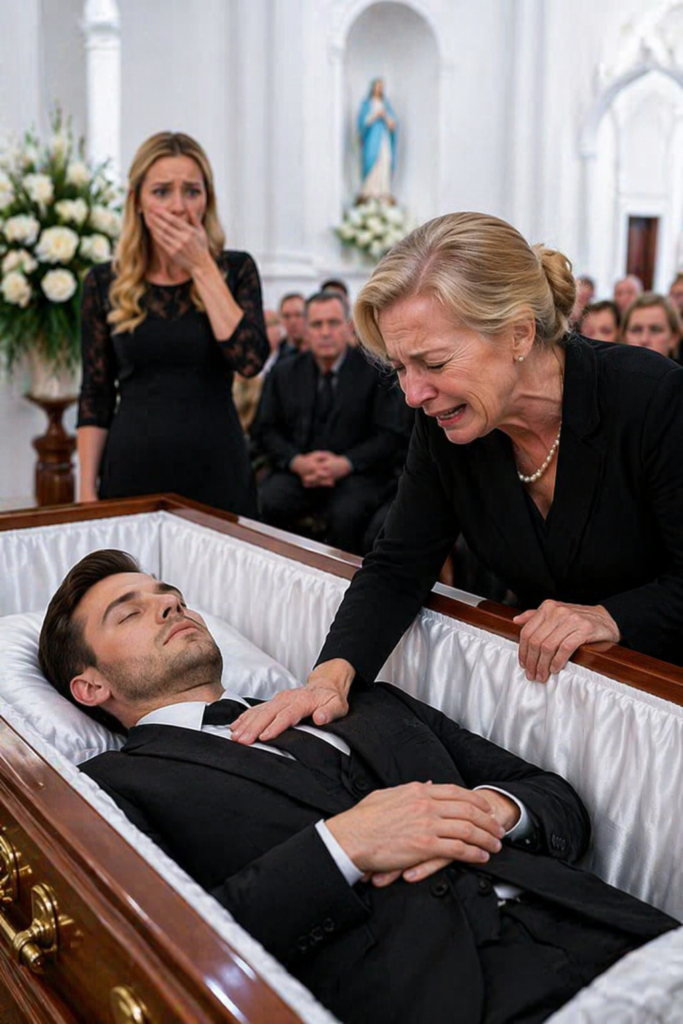
Doña Amalia's scream shattered the silence of the funeral home in Guadalajara.
She arrived with her shawl askew, sandals caked in dust, and eyes red from crying on the bus. She was 67 years old and had come from Tepatitlán after learning from a neighbor that Mauricio, her only son, had died.
No one had told her.
Not a call.
Not a message.
Nothing.
In front of her stood the closed coffin, covered with white roses, expensive candles, and crowns with golden ribbons. Beside it, dressed in impeccable black, stood Renata, her daughter-in-law, rigid as a statue.
—Please don’t make this harder, Mrs. Amalia —Renata said, her lips pressed tight—. Mauricio asked not to be seen like this.
Doña Amalia looked at her with a weary rage.
—My son called me even to ask how much garlic was in the soup. Don’t come here telling me what Mauricio wanted.
The attendees lowered their gaze.
There were employees of the firm, two partners with frightened faces, a lawyer sweating profusely, and elegantly dressed people who seemed more concerned about the time than the deceased.
Doña Amalia immediately understood something terrible: everyone knew about the funeral except her.
The night before, she had received a terse message from Doña Lupita, a neighbor:
“Amalia, I’m sorry. I just found out about Mauricio. How sad that they’re burying him today.”
The coffee cup slipped from her hands.
She dialed Mauricio's cell phone 12 times.
Nothing.
She called Renata.
Nothing.
She asked, begged, insisted until an acquaintance confirmed that the funeral had been hastily organized, with a closed coffin and immediate burial.
On the way, she clutched an old photograph of young Mauricio in a blue uniform with a school medal to her chest. She had raised him alone, selling tamales, washing other people's clothes, and cleaning houses. His father had left before knowing him, but she vowed her son would never lack a mother.
That’s why, when Renata stepped in front of the coffin, Doña Amalia didn’t see a widow.
She saw a closed door between her and her son.
—Open it.
—No.
—I’m telling you to open it.
Renata took a step back, lowering her voice.
—You and Mauricio had been fighting for months. Don’t come here now to play the perfect mother.
The phrase hurt because it was true.
Mauricio had distanced himself since marrying Renata, a refined, ambitious woman, a partner in a tech company that grew too fast. Doña Amalia never trusted her. She had seen how Renata answered for him, how she took his cell phone away, how she isolated him little by little.
—That woman doesn’t see you as a husband, son —she once told him—. She sees you as a signature.
Mauricio got angry.
He stopped calling her on Sundays.
But pride can’t erase 38 years of love.
Doña Amalia pushed Renata with a force no one expected. Two employees tried to stop her, but she broke free like a wounded beast.
She placed her trembling hands on the lid.
And she opened it.
Mauricio was there.
Pale.
Cold.
With purple lips.
Doña Amalia let out a moan that made even an employee cry. She leaned down to kiss his forehead.
Then she saw it.
A tiny movement in his eyelid.
Almost nothing.
Then Mauricio’s chest barely rose, as if air fought to stay inside.
Doña Amalia froze.
—He’s alive —she whispered.
No one responded.
She raised her tear-streaked face.
—My son is alive! He’s breathing!
Renata recoiled, white as a sheet.
—That can’t be… —she gasped.
And in that second, everyone understood they weren’t witnessing a miracle, but something much darker.
PART 2
—Call an ambulance, damn it! —screamed Doña Amalia, holding Mauricio inside the coffin—. What are you waiting for? For him to really die?
A young man from the firm pulled out his cell phone and dialed 911 with trembling hands. The others remained frozen.
Renata didn’t cry.
She didn’t scream.
She just stared at the open coffin with a terror that didn’t seem like pain, but rather fear that a lie might fall on her.
Doña Amalia held her son’s cold face.
—You knew —she said, never taking her eyes off Mauricio—. You knew my son wasn’t dead.
Renata clenched her jaw.
—Don’t say nonsense. I followed medical instructions.
—Which doctor’s?
Renata didn’t answer.
Paramedics arrived within minutes. They examined Mauricio and confirmed the impossible: he was still alive, but his pulse was so weak it was barely detectable.
—He’s in critical condition. We need to move him now.
Doña Amalia climbed into the ambulance without asking for permission. She took Mauricio’s hand and whispered in his ear as she had when he was a child with a fever.
—I’m here, son. Don’t leave me. You still owe me a dinner, and you’re not going to stand me up.
At the hospital, doctors fought for hours to stabilize him.
Meanwhile, Doña Amalia walked through the waiting room with a rosary between her fingers. Next to her was Javier, an old friend of Mauricio’s, the only one who hadn’t left.
Soon after, Commander Ernesto Salazar arrived, an old university friend of Mauricio and now an investigator for the prosecutor's office.
—Doña Amalia —he said seriously—, this is no longer a funeral mistake. No one ends up breathing inside a coffin by accident.
She looked down the hall, where Renata was speaking with an expensive lawyer.
—Then start with the one who was in such a hurry to bury him.
The first pieces of evidence emerged before dawn.
The death certificate had a forged signature.
The supposed doctor denied having personally examined Mauricio.
The funeral home admitted that Renata paid in cash for an urgent service, with a closed coffin and immediate burial without a long wake.
But the worst was revealed at the company.
Forty-eight hours before the supposed death, someone modified legal powers so that Renata would take absolute control of accounts, shares, and contracts if Mauricio died.
Doña Amalia felt the world spinning around her.
—It was never love —she murmured—. It was money.
Then Javier handed the commander a message Mauricio had sent him three days earlier:
“I found some strange transfers. Renata doesn’t know I’ve checked everything. If something happens to me, tell my mom. Don’t let her sign anything.”
Doña Amalia covered her mouth.
—My son wanted to find me… and I wasn’t there.
The commander shook his head.
—You arrived when he needed you most. That’s why he’s still alive.
Renata was taken to testify that same morning.
At first, she denied everything. She said Mauricio was stressed, that a private doctor confirmed the death, that she was just respecting his wishes.
But when they showed her videos, forged papers, transfers, and the final message, she stopped pretending to be sad.
—Mauricio was weak —she finally let slip—. Always thinking about employees, about his mom, about doing “the right thing.” I built that company too. I wasn’t going to let him ruin it out of sentimentality.
—What did you give him? —Salazar asked.
Renata fell silent.
—What did you give him? —he repeated.
She lowered her gaze, not out of guilt, but out of anger.
—A sedative. Something that looked like death for a few hours. I just needed to finish the transfer.
—They were going to bury him alive.
Renata took a deep breath.
—I never thought that old woman would dare to open the coffin.
When the commander left, Doña Amalia was standing, waiting for him.
—She confessed —he said.
Before she could respond, a doctor appeared from intensive care.
—Mrs. Amalia… your son has woken up.
Her legs almost gave way.
She entered the room and saw Mauricio surrounded by cables, his face ashen and lips cracked. But his eyes were open.
They were the same eyes of the baby she had held 38 years ago when everyone told her that raising a child alone would ruin her life.
—Mom… —he whispered.
Doña Amalia approached and kissed his hand over and over again.
—I’m here, son. I’m not going anywhere.
Mauricio started to cry like a child.
—I’m sorry. I pushed you out of my life.
—A fight doesn’t erase blood —she said—. And no pride can outweigh a mother’s love.
He closed his eyes.
—You were right about Renata.
The next day, he asked to testify. The commander turned on a recorder, and Doña Amalia wanted to leave, but Mauricio squeezed her hand.
—Stay. I don’t want to hide anything from you anymore.
He told how for two months he had detected strange movements: fake consultancies, deposits to unknown accounts, altered contracts, and documents with his forged signature.
When he confronted Renata, she told him he was too naive to run an empire.
The night before the funeral, they argued. Mauricio warned her he would report her. She suddenly calmed down, apologized, and made him tea.
After that, everything went dark.
—I could hear voices at times —he said with effort—. I felt cold. I couldn't move. Then I heard Renata say that the next day it would all be over. I woke up locked up, unable to scream. And then I heard your voice, mom.
Doña Amalia broke down.
—My boy…
Mauricio looked at her.
—you saved me again.
The news exploded throughout Mexico.
“Mother opens coffin and discovers her son was still alive.”
“Businessman from Guadalajara almost buried by his own wife.”
But Doña Amalia didn’t care about the cameras. She only wanted Mauricio to breathe without fear.
The weeks were tough. He woke up screaming that he couldn’t move. He couldn’t stand closed doors. Darkness terrified him.
Doña Amalia slept in a chair next to his bed, bringing him chicken broth in a thermos and telling him stories from when he was a child.
—Do you remember when you sold your toys to buy dog food for a stray?
Mauricio smiled weakly.
—You scolded me.
—Because you didn’t tell me, silly. But I also bought two more sacks.
A month later, the trial began.
The courtroom was filled with journalists, employees, and onlookers. Renata arrived in handcuffs, wearing a gray suit and a cold face. She didn’t seem remorseful. She seemed annoyed to have lost.
The prosecutor presented everything: medical reports, forged documents, videos from the funeral home, millions in transfers, and messages from the corrupt doctor.
Then Mauricio took the stand, still weak but firm.
—I trusted Renata with my life. I gave her my love, my work, and my dreams. But she didn’t want to walk with me. She wanted to keep it all. When she realized I had discovered her, she decided to erase me.
Then he looked at his mother.
—For years, I thought growing up meant not needing my mom. I was wrong. Growing up is recognizing who was with you when you had nothing.
Doña Amalia cried silently.
When it was her turn to testify, everyone expected to see her broken. But she sat up straight, approached the microphone, and spoke clearly.
She recounted how Mauricio’s father abandoned her while pregnant. She recounted the tamales sold at five in the morning, the uniforms washed by hand, the nights without dinner so he could eat.
Then she looked at Renata.
—You thought I was an ignorant old woman. You believed that expensive flowers and a closed coffin could silence me. But a mother recognizes her son even in the dark. I just needed to see him breathe once.
The courtroom fell silent.
Renata only said:
—I also deserved that company.
The judge looked at her harshly.
—Thinking you deserve something doesn’t give you the right to take a life.
She was sentenced to 15 years in prison for attempted murder, fraud, forgery, and conspiracy. She lost all rights to the assets, and her accounts were frozen to repair the damage.
As she left the courthouse, reporters surrounded Doña Amalia.
—What would you say to mothers whose children drift away?
She took Mauricio’s arm.
—That distance isn’t always forgetfulness. Sometimes children get lost trying to prove they can do it alone. But a mother who truly loves never gives up. And if something smells wrong, don’t stay silent.
Mauricio lowered his head.
—And what did you learn? —they asked him.
He looked at his mother.
—That no success is worth it if to achieve it you let go of the hand of the one who held you when you were nobody.
Months later, Mauricio rebuilt his company. He audited contracts, fired corrupt individuals, and created a scholarship program for poor youth wanting to study technology.
He named it Roots.
At the inauguration, he asked Doña Amalia to cut the ribbon.
—This is yours too, mom.
She felt embarrassed.
—I did nothing.
Mauricio took her hand.
—You did everything.
Every Friday, they had dinner together. Sometimes at a small eatery, sometimes at home, with beans, rice, and warm tortillas. It no longer mattered where they were, but that they wouldn’t let each other go again.
A year later, they returned to Tepatitlán. They visited the small room where Mauricio grew up. At the door were still the pencil marks where his mother measured his height.
He ran his fingers over those marks.
—I once wanted to go so far that I swore I wouldn’t look back.
Doña Amalia hugged him.
—Leaving wasn’t wrong, son. The wrong part was believing that looking back made you less.
The story didn’t go viral just because a mother opened a coffin and found her son alive.
It went viral because many understood something painful: sometimes we ignore the voice that loves us the most until life forces us to listen.
Renata lost her freedom for turning love into business.
Mauricio lost his innocence but regained his roots.
And Doña Amalia proved that true love doesn’t always whisper.
Sometimes it arrives late at a funeral home, pushes whoever needs pushing, and opens a coffin even when everyone says no.
Because a mother can be wrong about many things.
But when she feels her child still breathing, even death dares not contradict her.





