PART 1
Mariana Valdés was kneeling in the kitchen, one hand clutching her abdomen, the other gripping the cabinet to keep from collapsing completely.
The floor was cold.
A glass had shattered beside her knees, and several shards of glass had cut into her palm.
But that wasn’t what hurt the most.
—Raúl… please… take me to the hospital.
Raúl Castañeda was adjusting his watch in front of the dining room mirror, as if his wife wasn’t doubled over in pain just two meters away from him.
He wore a white shirt, a gray blazer, and that expensive cologne he always used when he wanted to impress his mother, Doña Elvira.
—Don’t start, Mariana —he said without looking at her—. My mom is turning 60. You know how she gets if we’re late.
Mariana closed her eyes as another contraction hit her.
This wasn’t normal pain.
It was a fierce, deep pressure, like something inside her was screaming that time was running out.
—I’m 39 weeks, Raúl. The doctor said if there’s blood…
Her voice broke.
She felt a warm wetness between her legs.
She looked down.
There was blood.
—Raúl… I’m bleeding.
Finally, he turned.
But not with fear.
Not with tenderness.
With exasperation.
—Seriously, you always find a way to ruin something for my mom.
Mariana stared at him as if she couldn’t understand.
She had spent four years enduring Doña Elvira’s comments, the family dinners where she was treated like an awkward guest, the times Raúl would say, “My mom is like that, don’t take it personally.”
But that night was not about pride.
It was about her life.
And her daughter’s life.
—I can’t walk —she whispered—. Please, help me.
Raúl grabbed the car keys.
—If it were really an emergency, you’d be screaming louder.
Mariana felt those words freeze her blood.
—Our baby might be in danger.
He let out a dry laugh.
—Our baby isn’t going to be born today just because you’re jealous of my mom.
Mariana tried to stand, but her legs wouldn’t respond.
She fell sideways, hitting her shoulder against the refrigerator door.
—Don’t leave me alone.
Raúl opened the door.
—When you’re done with the show, text me. And please, don’t ruin my night.
The door closed.
The slam echoed throughout the house.
Mariana was left there, breathing in fragments, with blood spreading across the beige tile.
She called Raúl seven times.
Nothing.
She called Doña Elvira.
No answer.
She dialed 911 with trembling fingers.
—I’m pregnant… I’m bleeding… my husband left… I think my baby isn’t moving like before…
The operator told her to breathe.
She said the ambulance was on the way.
Mariana crawled to the entrance, leaving a red trail behind her. The glass shards pierced her hand, but she didn’t stop.
—Hold on, my girl —she murmured—. Don’t leave me yet.
When the paramedics arrived, they found her nearly unconscious by the door.
One shouted:
—Possible placental abruption! Notify the hospital, operating room ready!
Mariana managed to hear sirens.
Then voices.
Then nothing.
What Raúl never knew was that Mariana Valdés was not just the quiet wife he presented as “the one who works from home.”
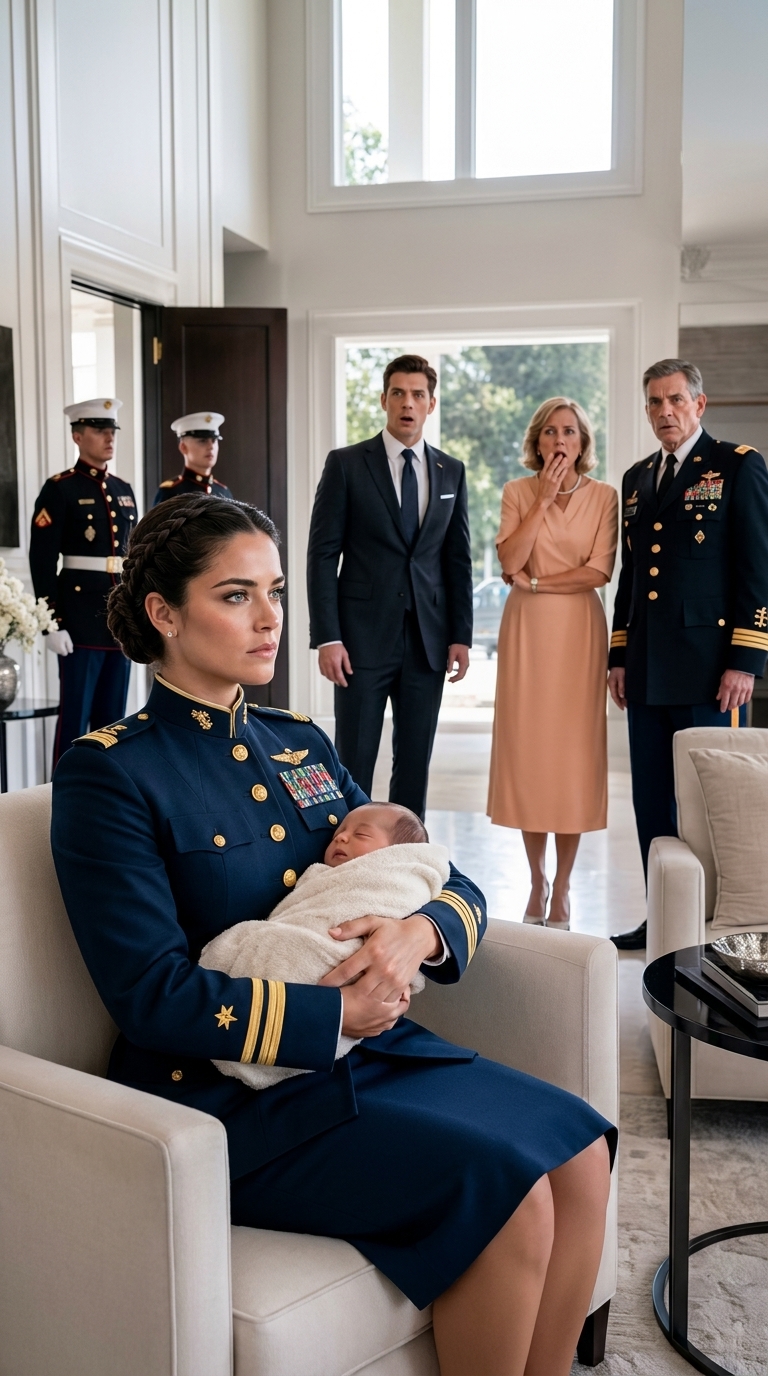
Mariana was Captain Mariana Valdés Rivas, a military intelligence analyst in a reserved unit.
For security, her professional identity had been protected.
Neither neighbors, nor friends, nor the Castañeda family knew the truth.
Raúl didn’t know that Mariana’s father was General Ernesto Valdés, a respected and feared man within the National Defense Secretariat.
Mariana had requested to keep it hidden.
She wanted Raúl to love her for who she was, not for her last name or her father’s connections.
Two days later, Raúl returned home with a box of chocolates, a cheap bouquet, and a calm smile.
He thought he would find Mariana angry, maybe with the baby in her arms, ready to hear his apology.
But as he got out of the car, he froze.
The street was blocked by black trucks.
Armed soldiers lined the sidewalk.
Agents from the Prosecutor’s Office guarded the door.
And in the middle of the yard, in an impeccable uniform and a stony gaze, stood a gray-haired man who seemed to need no voice to destroy him.
—What’s going on? —Raúl asked.
The man turned slowly.
—Raúl Castañeda.
Raúl swallowed hard.
—This is my house. Who are you?
The man stepped towards him.
—I am General Ernesto Valdés.
Raúl frowned.
—And what does that have to do with me?
The answer wiped the smile off his face.
—I am Mariana’s father.
PART 2
Raúl felt the bouquet slacken in his fingers.
He had never seen Mariana as someone with power.
To him, she was his calm wife, the woman preparing the nursery for their baby, the one who avoided arguing with his mother, the one who looked down when Doña Elvira said that “modern wives can’t handle anything.”
But in front of him stood a general.
And behind the general were armed men coming in and out of his house.
—Where is Mariana? —Raúl asked, trying to sound firm—. Where is my daughter?
The general didn’t blink.
—My daughter nearly died.
Raúl opened his mouth.
Nothing came out.
—No… when I left, she was exaggerating.
One of the agents looked at him with contempt.
The general spoke quieter, which made it even scarier.
—When you left, Mariana was bleeding on the floor. She crawled over broken glass to get to the door. She called 911 by herself while you celebrated your mother’s birthday.
Raúl felt the air clogging in his throat.
—I didn’t know it was that serious.
—Yes, you did.
The general pulled a sheet from a folder.
—The doctor explained the risk. High blood pressure. Bleeding. Danger to mother and child. You signed as the accompanying person.
Raúl looked at the sheet.
His signature was there.
He couldn’t deny it.
—I need to see them —he said—. I’m her husband.
—No.
—What do you mean no?
—You will not approach Mariana or the baby until she wakes up and decides whether she wants to see you.
Raúl took a step.
Two soldiers barely moved.
He stopped.
—This is abuse of power.
The general looked at him as if he had just heard a miserable joke.
—The Prosecutor’s Office opened a case for failure to assist, domestic violence, and possible serious negligence. The 911 call is recorded. So are the messages Mariana sent you.
Raúl went cold.
The messages.
“Don’t leave me.”
“There’s blood.”
“The baby isn’t moving.”
He had seen them as he left the party, early in the morning.
Doña Elvira took the phone from him and said:
—Don’t answer, my love. If you run every time she makes drama, you’ll never be a real man.
And he believed her.
Because it was easier to be an obedient son than a decent husband.
—My mom didn’t know —he murmured.
The general opened another page.
—Your mother received four calls from the hospital.
Raúl lifted his head.
—What?
—She answered the last one. She said Mariana was making up crises to manipulate you. She asked not to be bothered again.
Raúl felt nauseous.
—No… she wouldn’t do that.
A woman in dark suit came out of the house with a tablet.
—General, we’ve confirmed the documents.
The general nodded.
Then he looked at Raúl.
—Captain Mariana Valdés Rivas. 11 years of service. Financial intelligence operations.
Raúl let out a nervous laugh.
—Mariana isn’t military.
—Mariana has served the country since before marrying you.
—That’s impossible.
—Many things seem impossible when you never truly know the woman sleeping beside you.
The phrase hit him.
Raúl remembered the nights Mariana woke up sweating.
The small scars she hid.
The way she always sat watching the entrance of restaurants.
He called her intense.
Weird.
Dramatic.
He never asked what story she carried.
The woman in the suit opened another folder.
—The captain was investigating a network of shell companies linked to private security contracts, money laundering, and misappropriation of resources.
Raúl went rigid.
His family owned Castañeda Consultores, a company that grew too fast thanks to contracts with municipalities, foundations, and charity events held by Doña Elvira.
—I have nothing to do with that.
—Then you won’t have a problem testifying —the woman said.
Raúl looked at the general.
—This is revenge for Mariana.
—No —he replied—. What happened to Mariana forced us to reopen an investigation she had paused due to her pregnancy.
Raúl felt the ground shift beneath him.
—She was investigating me?
The general looked at him with hard sadness.
—At first, yes.
—At first?
The woman pulled out a sheet.
There was his name.
RAÚL CASTAÑEDA LUNA.
Below it, a red stamp:
UNDER OBSERVATION, NO DIRECT EVIDENCE.
Raúl shook his head.
—She loved me.
—She loved you —the general said—. That was the mistake that almost cost her life.
The woman explained that Mariana had requested to separate Raúl from the main accusation because she believed he was a weak man, controlled by his mother, but not necessarily corrupt.
Raúl covered his mouth.
Mariana had protected him.
Even while he left her alone.
Then a captain emerged from a truck.
—General. They called from the Military Hospital.
Ernesto Valdés’s expression changed.
—What happened?
The captain hesitated for one second.
That second almost killed Raúl.
—The captain has woken up.
The general closed his eyes.
—And the baby?
—She’s still in neonatal therapy. Stable, but delicate.
Raúl took a step forward.
—Did Mariana ask for me?
The captain looked at him.
—She asked to be taken to you.
Raúl felt relief.
He thought that meant forgiveness.
But the look from the general told him otherwise.
Mariana wasn’t calling him back to embrace him.
The drive to the hospital was silent.
Raúl sat between two officers, unhandcuffed, but without freedom.
Each street brought back a scene.
Mariana folding blankets.
Mariana asking him to go to the appointments.
Mariana silent while her mother said a decent woman doesn’t separate a child from her mother.
Mariana on the floor, pleading.
And him closing the door.
In the hospital, the hallways were guarded.
This wasn’t a family visit.
It was a scene of consequences.
Mariana lay in a bed, pale, with tubes in her arm and a thick bandage on her hand.
Her lips were dry.
Her face looked tired, but her eyes were open.
When she saw Raúl, she didn’t cry.
She didn’t scream.
She just looked at him with a calm that left him without excuses.
—Mariana… forgive me.
She breathed slowly.
—Did you ask about our daughter before asking about me?
Raúl was left speechless.
—I was told she’s alive.
A tear escaped Mariana’s eye.
—She’s alive because strangers did what you refused to do.
—I made a mistake.
She fixed her gaze on him.
—A mistake is forgetting an appointment. You left me to die in the kitchen.
Raúl lowered his head.
—I love you.
—No. You loved the woman who made you look good. The one who didn’t answer. The one who put up with your mom. The one who never forced you to be a man.
The general remained by the wall, motionless.
Mariana lifted her bandaged hand.
—I crawled, Raúl. I felt the glass cutting into me. I thought our daughter was going to die inside me. And still, I moved forward because I realized that if I waited for you, we both would have stayed there.
Raúl cried.
But his tears no longer mattered.
Mariana looked at her father.
The general placed a folder on the bed.
—There’s something else —she said.
Raúl trembled.
—What?
—Your mother didn’t just hate me. She needed me out.
The general opened the folder.
There were copies of medical records, legal requests, and false reports.
Mariana spoke with difficulty.
—Doña Elvira had access to my consultations. She knew about the pressure. She knew that any bleeding could be fatal.
Raúl shook his head.
—It can’t be.
—She was also preparing a custody request —the general said—. Claiming that Mariana was unstable, dangerous, and unable to care for the baby.
Raúl felt his stomach churn.
—Why would she want that?
Mariana closed her eyes.
—Because your grandfather left a trust. The first biological grandchild would inherit shares of the company. Until turning 21, their legal guardian would control everything.
Raúl sank into the chair.
The truth entered slowly.
Doña Elvira needed the baby alive.
But she needed Mariana destroyed.
The door opened.
An agent entered.
—General, Elvira Luna has arrived with a lawyer. She demands to see the newborn.
Mariana tightened the sheet.
Raúl stood up.
—Don’t let her in.
The general looked at him.
—Funny. Now you want to protect them.
Raúl didn’t respond.
Because it hurt.
And it was true.
Minutes later, Doña Elvira entered the room in a blue dress, pearls around her neck, and a false expression of concern.
—Marianita, thank God you’re okay. This is all a misunderstanding.
Mariana didn’t look away.
—Was it also a misunderstanding to tell the hospital I was crazy?
Doña Elvira tightened her purse.
—You were always so sensitive. Raúl couldn’t leave my birthday for every little pain of yours.
Raúl closed his eyes.
The prosecutor turned on a recording.
Doña Elvira’s voice filled the room.
“My daughter-in-law manipulates my son. Don’t bother her. If the girl is born, let me know.”
Then another.
“Mariana isn’t right in the head. I will take care of the baby and what’s due.”
Doña Elvira went pale.
Her lawyer lowered the papers.
Raúl looked at her as if he finally saw the real woman behind the perfect mother.
—Mom… what did you do?
She straightened her back.
—What you never had the character to do. Protect our name.
The silence was brutal.
Mariana didn’t shout.
She just said:
—Prosecutor, proceed.
Two agents approached.
Doña Elvira recoiled.
—Ernesto, you can’t allow this. I’m a respectable woman.
The general replied without moving.
—My daughter was also respectable when she was left bleeding on the floor.
Doña Elvira looked at Raúl, waiting for defense.
He didn’t move.
They took her away in handcuffs for document forgery, obstruction of assistance, attempted abduction of a minor, and financial crimes linked to the family business.
Her pearls trembled as she screamed that everyone would regret it.
But no one followed her.
Raúl stood staring at the door.
—I lost everything —he murmured.
Mariana heard him.
—No. Not everything. Our daughter is alive. I am alive. That is more than you deserved after that night.
He cried silently.
—Can I see her?
Mariana took a moment to respond.
—Through the glass. Not as a proud father. As a reminder.
An hour later, Raúl stood in front of the neonatal unit.
His daughter slept inside an incubator, surrounded by tiny wires.
She was so small that he felt ashamed for ever thinking a party was worth more than a life.
Mariana arrived in a wheelchair.
She placed her bandaged hand on the glass.
—Her name is Renata —she said.
Raúl broke down.
Renata.
The one who was reborn.
Weeks later, Elvira was charged.
The accounts of Castañeda Consultores were frozen.
Raúl testified before the Prosecutor’s Office and handed over documents he found in his mother’s office, although none of it erased the image of Mariana crawling alone.
Mariana filed for divorce from the hospital.
She didn’t do it out of revenge.
She did it because a woman who survives being left bleeding no longer asks for permission to save herself.
When she left the hospital with Renata in her arms, there were cameras outside.
They asked if she wanted to give a message.
Mariana didn’t talk about ranks, or generals, or punishments.
She simply said:
—When a woman asks for help, she’s not being dramatic. She’s trying to stay alive.
That phrase was shared thousands of times.
Because many understood something Mariana learned on the cold floor of her kitchen:
sometimes danger doesn’t enter screaming.
Sometimes it puts on perfume, adjusts its blazer, calls you dramatic… and closes the door while you beg it not to leave.





