PART 1
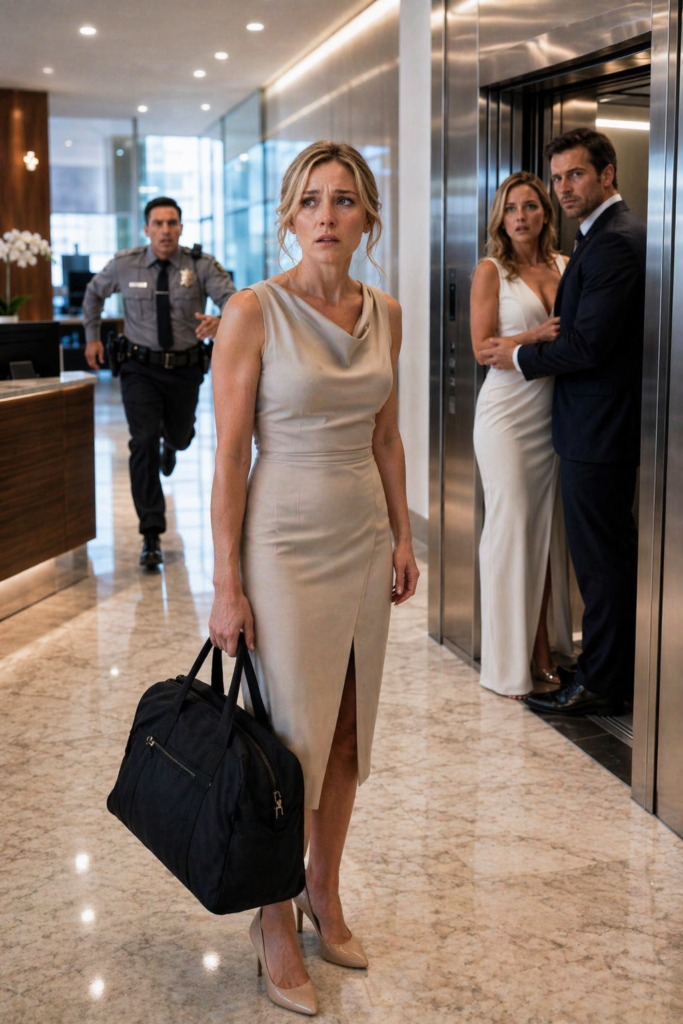
—Ma'am, Engineer Cárdenas is in a meeting with his wife on the 21st floor.
The words left Valeria Duarte frozen in front of the security module, as if the entire lobby had run out of air.
She was impeccably dressed in the Air Force gala uniform, insignias aligned, hair pulled back with discipline, and a small suitcase beside her polished boots.
She had driven nearly three hours from Querétaro to Santa Fe to surprise her husband, Rodrigo Cárdenas, the founder of an executive transport company boasting contracts with the government, hotels, and corporations.
She hadn’t notified him.
She hadn’t sent her location.
She hadn’t wanted to make noise.
She only wanted to see him lift his gaze, smile like before, and tell her he had missed her.
After 29 years of marriage, endless shifts, commissions far away, calls cut off by bad signals, and anniversaries celebrated with dry messages, Valeria believed she still deserved a simple scene.
But the guard, a kid in his twenties with a crooked badge, looked at her as if she were causing a scandal.
—I’m Valeria Duarte de Cárdenas—she said in a firm voice—. I’m Rodrigo’s wife.
The guard paled.
—Yes, ma’am… but Mrs. Cárdenas went up a while ago. She comes almost every day.
Valeria didn’t raise her voice.
She didn’t ask for the manager.
She didn’t do what anyone else would have done in her place.
She had learned to breathe under pressure in places where a mistake cost lives. An expensive building, smelling of fine perfume and machine coffee, wasn’t going to break her in front of strangers.
Then the private elevator opened.
A woman stepped out in a beige dress, designer bag in hand, and her black hair falling perfectly over her shoulders. She walked like she owned the building, the air, and the people who parted to let her pass.
—Good morning, Mrs. Cárdenas—greeted a receptionist.
The woman smiled without stopping.
Valeria felt a dry blow to her chest.
It wasn’t her confidence.
It wasn’t that everyone recognized her.
It was what hung around her neck.
A small, golden medal shaped like an ancient wing. It had a barely visible scratch on one tip, made the day Rodrigo gave it to her after his promotion, crying like a child while telling her he was proud to be her husband.
This woman wore her medal.
Her symbol.
Her story.
Her place in a life someone else had been occupying.
The woman locked eyes with Valeria for just one second. She wasn’t surprised. She didn’t ask who she was. She didn’t hesitate.
She recognized her.
And still, she kept walking.
Valeria left the building with her throat tight. She sat on a bench facing the avenue, watching black trucks and hurried executives pass as if the world hadn’t just split in two.
Her phone vibrated.
It was Rodrigo.
“My love, I can’t wait for you to come back. The house feels empty without you.”
Valeria stared at the screen until the words blurred.
Rodrigo thought she was still on a commission in Baja California for another month. Or at least that’s what she had told everyone.
That afternoon, she checked into a hotel under her maiden name. She went up to the room, locked the door, and opened her laptop.
She searched for the company’s website.
Cárdenas Premium Mobility.
Rodrigo appeared in photos with businessmen, mayors, foundations, and chambers of commerce. In almost every one, the same woman was by his side.
Marisol Cárdenas.
Honorary president.
In one picture, Marisol smiled inside Valeria’s kitchen, next to the Puebla tile she had chosen with her mother.
In another, she wore Valeria’s silver earrings.
In the last one, during a fundraising dinner for military families, Marisol wore the golden medal over her chest.
Valeria slowly closed the laptop.
Then her phone rang.
It was Natalia, her daughter.
—Mom… are you in Mexico City?
Valeria froze.
—Why are you asking me that?
Natalia swallowed hard.
—Dad just called me. He said if you showed up, to let him know right away.
Valeria gazed out the dark hotel window.
Rodrigo already knew she had returned.
And in that instant, she understood this wasn’t just a mistress wearing her jewelry, but a trap set long before.
PART 2
Valeria told Natalia not to answer any more calls from Rodrigo.
She didn’t want to drag her daughter into a war she didn’t even fully understand yet. Natalia was 31, had a 6-year-old son, a baby daughter, and a quiet life in San Juan del Río.
For years, she had grown up thinking her mother was strong, yes, but also distant. Rodrigo had filled the gaps with soft phrases, half-truths, and tailored silences.
—Mom, tell me what’s going on—Natalia pleaded, her voice breaking—. Dad is acting really strange.
Valeria squeezed her eyes shut.
—I don’t know everything yet. But I know he lied to me. And I need you not to tell him where I am.
Then she called Inés Roldán, her friend from the academy, a former military intelligence officer, and a woman who never sugarcoated a tragedy.
Inés listened without interrupting.
When Valeria finished, she simply said:
—Don’t go looking for him.
—I wasn’t planning to give him that satisfaction.
—Perfect. If he’s already been told you’re back, he’ll want to get ahead of things, make you look crazy or unstable. Men like him don’t improvise, Vale. Manage it.
The word weighed heavily.
Manage.
That’s what Rodrigo did. He managed routes, employees, contracts, reputations. Maybe he had also managed her disappearance.
The next day, Valeria rented a gray car, put on dark glasses, a cap, and simple clothes. She parked in front of the Santa Fe building early in the morning.
For five days, she observed.
Marisol arrived at 10:15 in a white SUV with a chauffeur.
An assistant carried her bag.
The receptionist handed her flowers.
Rodrigo picked her up at noon, placed his hand on her waist, and guided her to the private elevator like someone repeating an old routine.
Because it was old.
Inés arrived in the city with two new phones, an empty folder, and a bag of tamales.
—You haven’t eaten—she said.
—I’m not hungry.
—Well, tough. Nobody brings down a theater on an empty stomach.
Together, they built a timeline.
Public photos. Company posts. Charity events. Property records. Donations. Visible contracts. Social magazine notes.
Marisol Vega had entered four years earlier as a public relations consultant. Then she appeared as the coordinator of a foundation for military wives. Soon she began to travel with Rodrigo to dinners, inaugurations, and award ceremonies.
Within two years, the media already called her Mrs. Cárdenas.
Valeria called her younger brother, Samuel.
—Do you know Marisol Vega?
The silence on the other end was worse than an answer.
—Vale… Rodrigo said you two were separated.
Valeria felt the ground shift beneath her.
—Since when?
—About three years ago. He said you didn’t want to make it public because of your rank. That you were under a lot of pressure, that you wouldn’t accept help, that Marisol was supporting him with the foundation.
—And you believed him?
Samuel took a deep breath.
—He cried in front of Mom. He said we should protect you from yourself.
Valeria hung up without saying goodbye.
Not out of lack of love.
Because if she heard another phrase of false compassion, she would break.
Rodrigo had used her discipline as proof of coldness, her absence as abandonment, and her silence as illness. He had turned her into a rumor so no one would ask him too many questions.
The next call was to Doña Elvira, a neighbor from the house in Lomas de Angelópolis where Valeria and Rodrigo had lived for nearly 20 years.
—Oh, my girl—whispered the old woman—. I thought you no longer went in there.
Valeria felt a burning in her throat.
—Since when does Marisol live in my house?
Doña Elvira took time to respond.
—Almost two years. I’m sorry. We all thought you knew.
That night, Valeria drove to Puebla with Inés.
The house was lit up.
The bougainvillea garden she had planted was still alive. Through the large window, she could see her wooden table, her blue dishes, her curtains, the painting Natalia had made when she was twelve.
At 8:40, Rodrigo arrived.
Marisol opened the door before he could knock.
She kissed him.
Then she adjusted his jacket with a domestic tenderness that hurt more than a slap.
Inés, sitting next to her in the car, murmured:
—This wasn’t an affair.
Valeria didn’t look away.
—No. It was a substitution.
Then Marisol stepped out onto the porch, talking on the phone. She waved her hand, and the light glinted off a ring.
Valeria recognized it.
It was her 25th-anniversary ring.
The same one Rodrigo swore he had stored in a safe so it wouldn’t get lost during the commission.
Valeria opened the car door.
Inés stopped her by the arm.
—No, comadre. If you go in now, he wins. He’ll record you, provoke you, call you crazy, and tomorrow the story won’t be about theft, it will be a scandal.
Valeria looked at the house where another woman slept in her bed.
—Then I’ll bring him down with evidence.
The next morning, they sought out Clara Mendieta, a lawyer from Polanco known for dismantling wealthy marriages without raising her voice.
Clara listened for 35 minutes.
Then she didn’t ask if Valeria wanted a divorce.
She asked something colder.
—Who manages your properties, your joint accounts, and your shares in the company?
Valeria looked down.
—Rodrigo.
Clara closed her notebook.
—Then we’re not facing infidelity. We’re facing a possible dispossession.
They found a forensic accountant named Julián Mena. He was thin, quiet, and had the eyes of someone who found corpses among invoices.
In four days, he came back with three folders.
The first contained consulting payments to companies linked to Marisol.
The second, deposits from the foundation for military families to nonexistent suppliers.
The third, account movements showing properties transferred with powers of attorney signed by Valeria.
Valeria frowned.
—I didn’t sign this.
Julián adjusted his glasses.
—Some signatures appear to be scanned. Others could have come from documents you left before traveling.
Clara took a slow breath.
—Preliminary amount?
Julián looked at Valeria with professional pity.
—Between 60 and 80 million pesos.
The number didn’t make her cry.
What broke her was thinking of all the times Rodrigo would say over the phone, “You just focus, I’ll take care of everything.”
He did take care of it.
To empty her.
That afternoon, Natalia arrived at the hotel unannounced. She walked in with red eyes, carrying a backpack and a rage she didn’t know how to place.
—Dad told me you chose the uniform before us.
Valeria went speechless.
—What?
—When Leo was born and you couldn’t make it, he said I shouldn’t expect anything from you. That you loved your career more than your grandson.
Valeria felt something break inside her.
She remembered that night. She remembered crying in a base room, begging Rodrigo to put the phone to Natalia’s ear, to tell her he loved her, that he was devastated for not being able to travel.
Rodrigo replied: “I’ll explain it to her, my love.”
But he never explained.
He poisoned.
Natalia covered her face.
—I thought you didn’t care.
Valeria hugged her desperately.
—I cared every day. Every single day. Even if I wasn’t there, even if I didn’t know how to say it, even if he told you otherwise.
Mother and daughter cried for a long time, unguarded, without pretending.
Then Valeria showed her photos, contracts, transfers, posts, and screenshots.
Natalia wiped her tears.
—There’s something you need to know.
—Tell me.
—On Friday, Dad is throwing a gala on Reforma. 30 years of Cárdenas Mobility. He invited partners, press, politicians, and the whole family.
Clara raised her gaze.
Natalia bit her lips.
—Marisol appears as the official host.
Inés let out a dry laugh.
—What a detail. He gathered us on stage.
Clara proposed to act legally without public exposure. Freeze accounts. Request audits. File complaints. Protect Valeria first.
Valeria listened to everything.
Then she looked at a photo of Marisol wearing her golden medal in front of a Mexican flag.
—Rodrigo wanted to make my absence public—she said—. Then the truth will be public.
The gala was held in a hotel on Paseo de la Reforma, with chandeliers, arrangements of white flowers, and over 300 guests dressed as if shame couldn’t enter through the front door.
Rodrigo took the stage in a black tuxedo and a world-owner smile.
Marisol was by his side, in a dark green dress.
Around her neck hung the golden medal.
Valeria waited in the hallway with Natalia, Inés, Clara, and Julián.
She wore her gala uniform.
Every insignia was in its place.
Every wound too.
—You can still stop—Clara whispered.
Valeria took a deep breath.
—I stopped for 4 years. It’s enough.
The doors opened.
At first, nobody understood.
Then the hall began to quiet down. Some retired military stood up in respect. Several cameras turned toward her. A murmur spread among the tables like a dry fire.
Valeria walked until she was in front of the stage.
Rodrigo saw her.
His smile vanished.
Marisol touched the medal, as if she could hide what wasn’t hers.
—Valeria—Rodrigo said, stepping down a step—. This isn’t the moment.
She looked at him unblinking.
—For years you said I no longer had a moment.
The hall fell silent.
Valeria turned to the guests.
—My name is Valeria Duarte de Cárdenas. I am a colonel in the Mexican Air Force, and I have been legally married to Rodrigo Cárdenas for 29 years.
A glass fell on some table.
Marisol turned pale.
Samuel, from the back, covered his mouth with a hand.
A partner stood up.
—Rodrigo, what’s going on?
Clara stepped forward with a folder.
—What’s happening is that the board, the partners, and the tax authorities need to know relevant information about the management of this company and its foundation.
Rodrigo tried to take Valeria by the arm.
Natalia intervened.
—You can’t silence her by touching her.
That gesture broke the last wall.
Clara distributed copies. Julián explained dates, accounts, payments, ghost companies, image contracts, diverted donations, and documents with dubious signatures.
At first, there were no shouts.
Just papers.
And each paper weighed more than an insult.
Twelve minutes in, Marisol tried to sneak out the side.
Inés appeared in front of her.
—Leaving so soon, Mrs. Cárdenas?
Marisol looked to Rodrigo for help.
Rodrigo didn’t defend her.
Valeria understood something terrible: it hadn’t even been true love. It had been ambition with expensive perfume, a convenient alliance where they both dressed in what she had earned through hard work.
A reporter raised his voice:
—Colonel, do you accuse your husband of presenting another woman as his wife while you served the country?
Valeria held Rodrigo’s gaze.
—I accuse him of giving away my house, my name, my medals, and the love of my daughter to a lie. The rest will be proven by the documents.
The board president closed a folder with a stern face.
—Rodrigo, we need an extraordinary session right now.
That night, he was suspended from his position. Days later, Marisol was removed from all positions. The foundation was placed under investigation. Several accounts were frozen. Lawyers initiated civil, commercial, and tax lawsuits.
Rodrigo called 64 times.
Valeria didn’t answer.
Months later, the house in Puebla was sold. Valeria went alone on the last day. She walked through the empty rooms, touched the wall where a photo of Natalia in elementary school once hung, and stopped in front of the bedroom mirror.
For a long time, she thought Marisol had taken her life.
But there she understood the truth.
Marisol had only put on borrowed pieces.
The last name.
The bed.
The jewels.
The table.
The medal.
But she could never be Valeria.
Before leaving, she uprooted a small bougainvillea from the garden and planted it in a simple house in Querétaro, near Natalia and her grandchildren.
The divorce took almost a year. Rodrigo lost control of the company, part of his assets, and almost all his reputation. Marisol disappeared when the money stopped covering her. Samuel apologized so many times that Valeria one day told him something harsh but necessary:
—Forgiveness doesn’t work if it only calms the one who stayed silent.
With Natalia, it was different.
They had to learn to speak without Rodrigo’s voice stuck between them. Sundays became sacred. They ate pozole, watched the children run in the yard, and slowly, the stolen years stopped hurting like a knife and began to hurt like a scar.
One day, Leo found the golden medal in a box.
—Is this yours, grandma?
Valeria smiled.
—It was always mine.
—And why was another lady wearing it?
Natalia wanted to intervene, but Valeria gently shook her head.
—Because there are people who believe they can take what shines, even if they don’t know what it cost to earn it.
Leo looked at her very seriously.
—And did you take it back?
Valeria kissed his forehead.
—No, my love. I just remembered that it never stopped belonging to me.
That spring, the bougainvillea bloomed with a stubborn, almost insolent strength.
Valeria watched it every morning while drinking coffee. She no longer waited for messages from Rodrigo. She no longer explained her absences. She no longer needed to prove to the world that she existed.
The real justice wasn’t seeing him fall in front of everyone.
It was hearing Natalia laugh without guilt.
It was sleeping without feeling that someone was writing her story in secret.
It was understanding that a woman doesn’t disappear because a man betrays her, nor does she lose her value because a family prefers to believe a comfortable lie.
Rodrigo put another woman in her chair.
Her family kept silent.
Employees called “Mrs. Cárdenas” a stranger.
And a guard, unknowingly, opened the door to the truth.
Because the truth didn’t ask for permission.
It only needed Valeria to return early.