PART 1
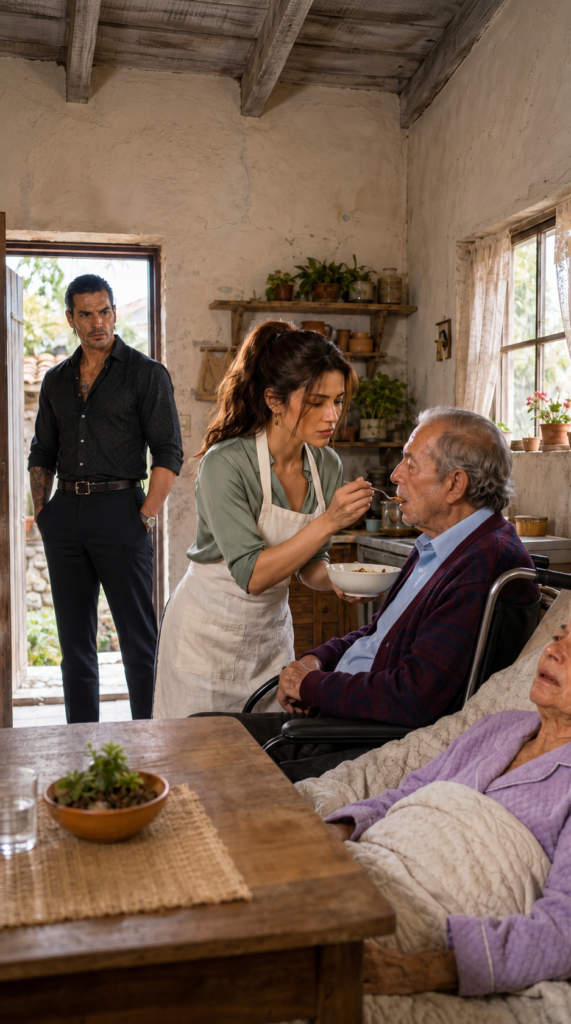
Julián Armenta felt his throat dry up when he opened the door to his parents' house and saw a stranger feeding soup to his father.
She wasn't a nurse.
She wasn't family.
And by the way his mother looked at her, she certainly wasn't just any visitor.
The old house, on a narrow street in the Santa María la Ribera neighborhood, smelled of chicken broth, dampness, and cheap medicine. Outside, the rain fell with the heavy sadness of Mexico City, pounding against the windows, the wires, and the closed stalls on the corner.
Julián hadn’t shown up for 8 months.
He claimed he was busy with business, drivers, warehouses, and meetings that no one asked too many questions about. He arrived in a black coat, expensive shoes, and the face of a man used to having everyone step aside.
But that woman didn’t move.
She was about 27 years old, with dark hair tied back with an old scrunchie, a faded blue sweatshirt, and wet sneakers. In one hand, she held the spoon. With the other, she patiently wiped the trembling chin of don Ernesto Armenta.
“Slowly, don Neto,” she said. “If you choke, you’ll give me the scare of my life.”
Doña Amparo, Julián's mother, sat in front of some overdue bills. Beside her, a 6-year-old boy colored an axolotl with a green crayon.
Julián glanced at the door.
It wasn’t locked.
That was what bothered him the most.
In this neighborhood, no one left a door open. Not if they wanted to keep the gas tank, the screen, or their peace of mind.
“Who are you?” Julián asked, his voice low.
The boy looked up and noticed the bulge under Julián's coat. The woman barely moved half a step, placing herself between him and the child.
She didn’t shout.
She didn’t ask for permission.
She just looked him in the eye.
“You must be the son,” she replied.
Julián clenched his jaw.
“Put the spoon down.”
“He hasn’t finished eating.”
“I said put it down.”
Don Ernesto let out a weary grunt.
“Shut up, Julián. You show up after 8 months, and the first thing you do is scare off the only person who didn’t let us die in here.”
Doña Amparo lowered her gaze, embarrassed.
“She’s Marisol. She lives in 32. She helps us when she can.”
Julián glanced at the boy.
“What’s your name?”
“Leo,” he whispered.
“Go to the living room, sweetheart,” Marisol said. “Take your drawing with you.”
The boy obeyed, his sneakers on the wrong feet, and disappeared down the hallway.
Julián sat down across from Marisol.
“What agency do you come from?”
“None.”
Doña Amparo swallowed hard.
“The agency stopped sending nurses since September. They said the area was complicated, that they didn’t have staff.”
Julián felt a cold jolt in his chest.
He paid 75,000 pesos a month for his parents' care.
Someone was collecting.
And no one was coming.
He opened the refrigerator. There was lactose-free milk, vegetables, tortillas, chicken, sugar-free gelatin, and medicine neatly organized in a plastic box.
“Who paid for all this?”
Doña Amparo didn’t answer.
Marisol did.
“I did. Don’t get confused. Your dad left the stove on for 3 hours. Your mom was trying to lift a water jug by herself. I came in because it smelled like gas.”
Julián pulled out several bills and threw them on the table.
“Take it. And don’t come back.”
Marisol looked at the money as if it were an insult.
She took only 1 bill.
“The chicken cost 96, the milk 38, and the vegetables 64. Give me 200 and keep your theater.”
“Take them all.”
“I don’t sell silence, sir.”
The kitchen went cold.
Marisol put the child’s green crayon in her bag and walked toward the door.
“The pills are next to the blue glass, Doña Amparo. 2 at 7. No grapefruit.”
When she left, Julián stared at the bills on the table.
He had millions hidden in accounts, warehouses, and fake names.
But that night, for the first time, he felt poorer than a woman who had only 200 pesos and her dignity.
And then, from the living room, Leo screamed with fear a phrase that left everyone breathless:
“Mom, the debt collector is downstairs again.”
PART 2
Julián didn’t get up right away.
First, he looked at his mother.
Doña Amparo clutched the receipts to her chest as if they were proof of an impossible shame.
Don Ernesto tried to stand, but his legs no longer obeyed like they used to. The old route leader, the man who for years had commanded respect in half of the bus terminal, could now barely hold a spoon.
“What debt?” Julián asked.
Doña Amparo closed her eyes.
“It’s not ours, son.”
“Then whose is it?”
No one answered.
Julián walked to the living room window. From above, he saw a man standing in the rain, wearing a black cap, a denim jacket, and holding a bag of seeds. He leaned against the entrance of the building across from where Marisol lived.
The guy didn’t knock.
He just waited.
That was worse.
“Leo,” Julián said without looking away, “does that man know your mom?”
The boy hugged his drawing.
“He tells her that if she doesn’t pay, he’s going to take our stuff. Sometimes he sits on the stairs and won’t let us pass.”
Doña Amparo covered her mouth.
“Marisol never wanted to tell us much. She just said it was a rent issue.”
Julián left without saying more.
His driver, Memo, was waiting in a gray Suburban with the engine running. When he saw Julián walking through the rain, he got out quickly.
“Everything okay, boss?”
“Investigate Marisol from 32. Work, family, debt, everything. And tell that guy in the cap to scram.”
Memo looked toward the building.
“With kindness or like always?”
Julián didn’t smile.
“Let him understand.”
At 11:50 PM, Memo handed him a folder in a café on Insurgentes that stayed open late because no one dared to kick Julián out.
Marisol Ríos, 27 years old.
Single mother.
Shift from 2 to 11 at an industrial laundry in Tlalnepantla, washing hospital sheets for 10,200 pesos a month.
One child, Leonardo, 6 years old.
An ex-husband: Iván Córdova.
Abandonment, abuse, hospital debt, and 4 years without paying alimony.
The landlord of the building, Gilberto Nájera, charged her interest for every week she was late. The actual debt was 14,800 pesos, but on paper, it already appeared as 31,000.
And the man in the cap was her collector.
They called him El Chueco.
Julián closed the folder.
“Where is she now?”
“Her car wouldn’t start outside the laundry. It’s still there.”
When the Suburban arrived, Marisol was sitting inside an old Tsuru, her forehead resting on the steering wheel. The rain poured down the windshield, and her shoulders trembled, though she was doing everything she could not to cry.
Julián rolled down the window.
“Get in.”
Marisol lifted her face.
“Now you’re watching me too?”
“Your alternator died.”
“It’s the terminal. I hit it with a wrench, and it holds.”
“You have to pick up Leo.”
She swallowed hard.
That detail defeated her more than the cold.
“I don’t need favors.”
“My dad asks if you’re bringing gelatin tomorrow. Get in before you get sick and it costs me more.”
Marisol looked at him with rage.
Then she climbed in.
Not out of trust.
But out of exhaustion.
They picked up Leo at a neighbor's house who was already charging double for watching him after 11. The boy came out asleep, wrapped in a Paw Patrol blanket, with one shoe in hand.
Marisol held him close.
“Don’t look at me like that,” she murmured.
“Like what?”
“Like you’ve already bought my problem.”
Julián didn’t answer.
Upon arriving at the building, he saw a pink notice taped to the door of 32.
Eviction notice.
31,000 pesos by Friday or change the lock.
Marisol ripped the notice away before he could read more, but it was too late.
“Stay out of it,” she said.
“They already got involved with my mother by scaring her adoptive grandson.”
“Leo is nothing to you.”
“My dad already saved him sweet bread. That in this family is almost a public deed.”
Marisol wanted to get angry, but she couldn’t.
She went upstairs with her son in her arms.
Julián waited until the light in the apartment turned on. Then he called Memo.
“Tomorrow, 8 AM sharp. We’re going to see Gilberto.”
Gilberto Nájera's shop was in Azcapotzalco, among stolen parts, fake invoices, and dust-covered saints. When Julián walked in, the mechanics lowered their gazes.
Gilberto, fat, sweaty, and with his shirt open, tried to smile.
“Don Julián, what an honor. I didn’t know the girl was yours.”
That phrase cost him dearly.
Julián approached slowly.
“Marisol is no one’s property.”
Gilberto lost his smile.
“It’s just a late rent.”
“It’s abuse. And very stupid, too, because you did it on a street where my parents live.”
Julián left 31,000 pesos on the desk.
“Here’s what you say she owes. Now you’re going to cancel the interest, repair the boiler, and give her a clean receipt. Without looking at her ugly, without sending collectors, and without knocking on her door after 8.”
Gilberto raised his hands.
“Of course, of course, as you say.”
Julián leaned in.
“And if you turn off their hot water again, I won’t send thugs. I’ll send Civil Protection, SAT, the municipality, and the Prosecutor’s Office. They’ll shut you down until the Virgin you have hanging.”
That afternoon, Marisol stormed into the Armenta household, receipt in hand.
She threw it on the table.
“What did you do?”
Doña Amparo stayed still.
Don Ernesto pretended not to hear but opened his eyes wider.
Julián was pouring himself coffee.
“I paid a debt.”
“No. You turned me into a pending favor. What’s next? Storing packages? Answering calls? Letting my son think you're good because you pay for things with dirty money?”
The word fell like a broken plate.
Doña Amparo lowered her gaze.
Julián didn’t defend himself.
“My father needed help. You didn’t ask for anything. That’s something hardly anyone knows how to do.”
“I did it because they’re old. Because no one should be left alone with the stove on and medicine to take.”
“That’s why I paid. Because you didn’t want anything.”
Marisol pressed her lips together.
A tear escaped her, but she wiped it away in anger.
“Leo will come tomorrow to finish his axolotl. But don’t decide for me again.”
In the following weeks, the Armenta home changed.
It no longer smelled of confinement.
It smelled of coffee, soup, sweet bread, and arnica ointment.
Don Ernesto remained sick. There were no soap opera miracles. His hands trembled, he got desperate, cursed his pills, and sometimes cried out of anger when no one was watching.
Doña Amparo started walking with more confidence.
Leo did homework at the dining table and explained to don Ernesto that axolotls weren’t dragons, even though they looked like them.
Julián hardly ever entered.
He left grocery bags at the door and left.
Marisol always complained.
“No one needs 3 kilos of ground beef.”
“My dad does.”
“Your father eats like a bird.”
“Then we make him little meatballs.”
She looked at him disapprovingly.
But she no longer slammed the door shut so quickly.
Everything seemed to find a fragile balance until one afternoon Leo arrived alone at the Armenta home.
He wasn’t wearing a jacket.
He had a wet sock, his sneakers on the wrong feet, and his hands over his ears.
“My mom is crying,” he sobbed. “The man broke the lamp and took her bag.”
Julián got up so quickly that the chair fell to the floor.
“What man?”
Leo could barely speak.
“My dad.”
Marisol’s face, proud and firm just days before, appeared in everyone’s mind like a blow.
Julián crossed the street without waiting for Memo.
The building door was open. He rushed up the stairs two at a time to apartment 32. The lock was broken, and inside he heard a raspy male voice, full of venom.
“Don’t lie to me, Marisol. They said a suit paid your rent. No one just drops 31,000 pesos for a laundress. Where’s the rest?”
Julián entered.
Marisol was against the sink, her hair down and a red mark on her cheek. In front of her, Iván Córdova held a screwdriver like a knife.
He was skinny, haggard, with poorly grown facial hair and a jacket that smelled of cheap alcohol.
Seeing Julián, he tried to puff himself up.
“It’s a family matter.”
Julián took a step.
“Put that down.”
“She’s my wife.”
“You abandoned her 4 years ago. You left her with debt, fear, and a child who covers his ears when he hears shouting. You have no family here.”
Iván swallowed hard.
“Who are you?”
“The son of Ernesto Armenta.”
The name drained the color from his face.
Everyone in the area knew who don Ernesto had been before he got sick. And everyone knew what Julián had turned into afterward.
The screwdriver fell to the ground.
“I didn’t know she was with you.”
“She’s not with us,” Julián said. “That’s why you’re still walking.”
Iván tried to grab Marisol's bag.
Julián stepped on his hand.
Not hard.
Just enough for him to understand.
“There’s a bus to Monterrey at 9:15. You’re leaving. If by 10 you’re still in the city, Memo will find your car and turn it into scrap metal. If you call, write, or even breathe near them again, I won’t kill you. That makes noise. I’ll leave you alive in a way that you’ll remember every time you want to raise your hand.”
Iván cried in fear.
Julián pulled out 2 500-peso bills and tossed them on the floor.
“For the ticket. It’s not a gift. It’s an exit fee.”
Iván left without looking back.
Marisol stood trembling next to the sink.
“He’ll come back when he runs out of money.”
“No. Cowards go back where it doesn’t hurt. Today it hurt him.”
She looked at him with a mixture of anger, fear, and relief.
“I don’t want Leo to grow up thinking men solve everything with threats.”
Julián lowered his gaze.
“I didn’t want to grow up thinking that either.”
For the first time, Marisol had no response.
Weeks later, Doña Amparo organized a Sunday meal. She made red rice, boiled beans, thin cutlets, and hibiscus water. Marisol arrived with Leo, thinking it was just another normal day.
On her plate was an envelope.
“No,” she said without touching it.
Don Ernesto banged the table with his spoon.
“Open it, girl. My son has a face of a delinquent, but sometimes something decent slips out.”
Marisol opened the envelope carefully.
It was a trust.
Apartment 32 was secured in the name of Leonardo Ríos until he turned 21. Marisol would be the administrator. No one could evict them, sell it, or use it as collateral.
She was left breathless.
“I can’t accept this.”
“It’s not for you,” Julián said. “It’s for Leo. And before you yell at me, I bought part of the building because Gilberto wanted to sell it cheap. My lawyer says it’s a clean investment. Technically, you did me a favor.”
Marisol let out a sad laugh.
“You don’t know how to receive affection without dressing it up as a business deal.”
Don Ernesto laughed with a cough.
“Finally, someone told him, damn it.”
After eating, Marisol went out to the patio. Julián followed her. The afternoon fell over the rooftops, the water tanks, and Doña Amparo’s old pots.
“I’m not going to work for you,” she said.
“I didn’t ask you to.”
“I’m not going to answer phones, store money, or involve my son in your world.”
Julián pulled something from his pocket and placed it on the wall.
It was Leo’s green crayon, worn down to half.
“I have people for my things. What I don’t have is someone to tell my dad to stop pretending to be macho and take his pills.”
Marisol picked up the crayon.
Inside, Leo was laughing because don Ernesto was trying to draw an axolotl and it looked like a squished lizard. Doña Amparo was crying silently, but this time it wasn’t out of fear.
Marisol then understood that family doesn’t always come clean, perfect, or with a shared last name.
Sometimes it comes with hot soup, an open door just in time, a debt paid without asking for anything, and a green crayon kept as a promise.
And although Julián could never erase all the darkness from his life, he learned something no business had ever taught him: there are debts that aren’t settled with money, but by taking care of those who once took care of yours.





