PART 1
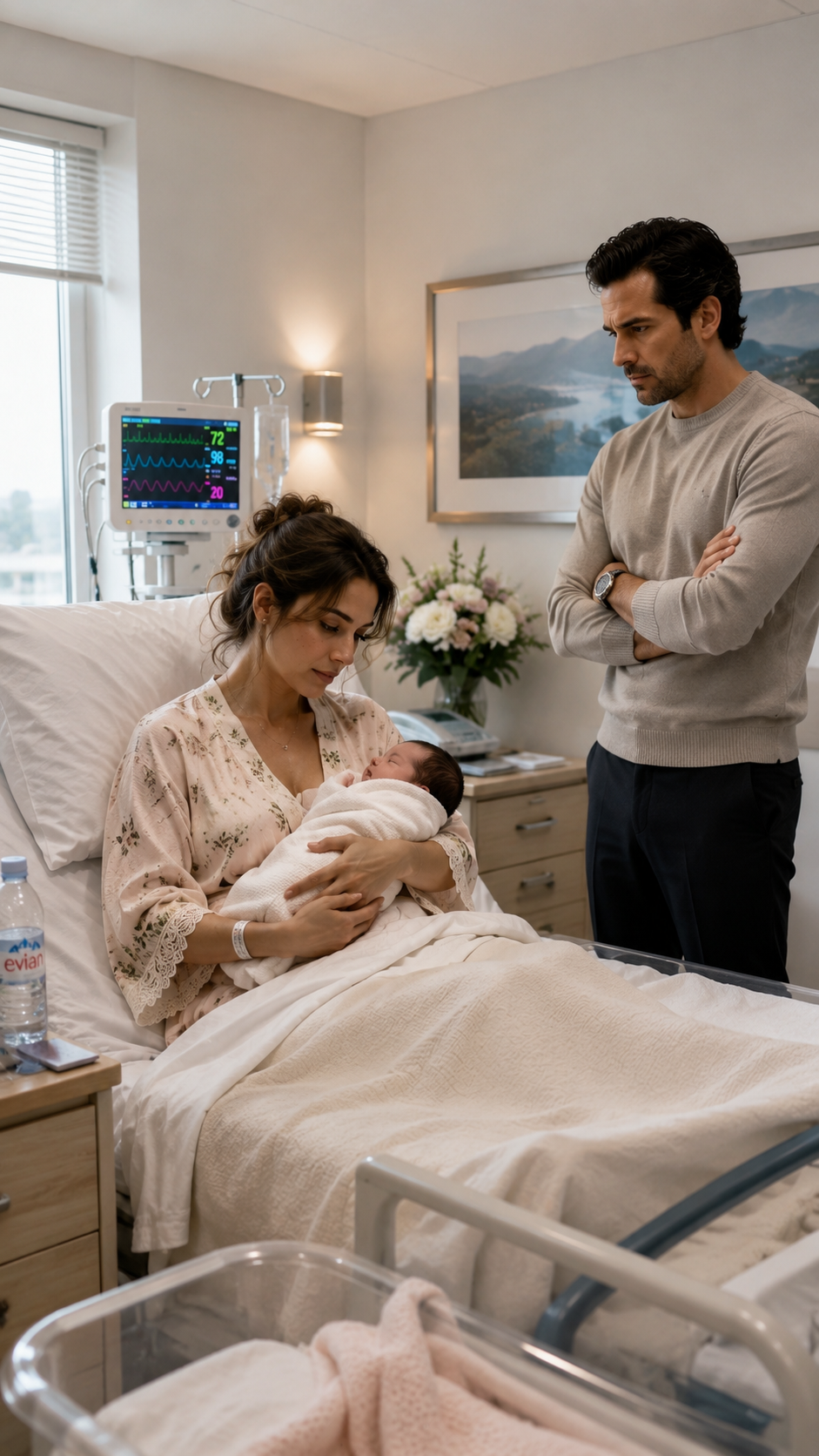
Only two hours had passed since the birth when Renata brought the newborn to the edge of the bed.
—Adrián, come here. Lucía needs to meet her dad.
He stood by the window of the private room, staring at the towers of Interlomas. He wore his suit jacket, held his phone in one hand, and wore an expression of annoyance, as if that early morning had interrupted an important meeting.
Renata called him again.
—Just hold her for a moment.
Adrián approached, looked at the baby wrapped in a pink blanket, and kept his arms glued to his body.
—I’m not going to acknowledge her—he said softly—. I already have a son.
Renata thought she must have heard wrong.
Then Adrián confessed that Paola Méndez, his executive coordinator, had given birth six months earlier. The boy was named Nicolás. His parents knew about the affair and believed he should be introduced as the future heir of Grupo Montiel.
—My grandfather built all this for the surname to continue—he explained—. We need a boy at the helm.
Renata pressed Lucía against her chest. The girl slept peacefully, unaware that her father had just determined her worth before even knowing her.
—And what does your daughter mean to you?
—Don't exaggerate. I'll pay for her school, medical care, and whatever she needs. But she won’t have my last name or rights in the trust.
Renata felt a stab more painful than the 14 hours of contractions. Still, she didn’t cry.
She smiled.
Adrián stepped back, bewildered.
—Remember this room very well—she said—. Here, you just lost much more than a wife.
He laughed.
—You’re medicated. Tomorrow you’ll come down from the drama.
Adrián left the hospital and didn’t return.
Renata had met him five years earlier when she audited the purchase of several resort complexes in Riviera Nayarit. He had been attentive, asked for her opinion, and claimed to admire how a woman could enter a boardroom and detect in minutes what no one wanted to see.
They married in a hacienda in San Miguel de Allende. For two years they faced treatments, tests, and losses they rarely mentioned.
When the ultrasound confirmed they were expecting a girl, Adrián hugged her and promised:
—She will be the owner of my heart.
Now Renata understood that even that phrase had been a calculated investment.
At 3:47 AM, she called her sister Sofía.
—Get me out of here before Adrián comes back.
—I’m on my way.
While she waited, Renata opened an email from attorney Eugenia Cárdenas, executor of her late godfather, Gabriel Soria. She hadn’t read it for three weeks, thinking it only discussed an old house in Cuernavaca.
The attached file contained 86 pages.
In the last one, Renata discovered that Gabriel had bequeathed her 16% of the real estate division of Grupo Montiel, along with a clause that allowed her to demand an audit and suspend any executive who compromised the estate.
Renata looked at Lucía, kissed her forehead, and whispered:
—Your dad wanted an heir.
Then she closed the document.
—What has just awakened is the shareholder who can take it all away from him.
PART 2
Sofía arrived from Toluca before dawn, her hair half up and a jacket over her pajamas. She didn’t ask where Adrián was.
She carefully took Lucía, kissed her forehead, and looked at her sister.
—Tell me who we need to face.
—Everyone—Renata replied—, but with proof.
The doctor wouldn’t allow her to leave until two days later. During that time, Adrián didn’t ask about the baby’s health.
His mother, Beatriz Montiel, sent white orchids and a card: “We trust you will regain your calm and accept what is convenient for both families.”
Renata gave the flowers to the nursing staff and ripped up the card.
On the day of her discharge, Sofía managed an exit through the doctors' parking lot. They settled in a borrowed apartment near the Nápoles neighborhood, with simple furniture, a small kitchen, and a balcony full of laundry.
Without bodyguards, drivers, or employees, Renata slept better there than in the residence where she had monitored every word.
Adrián took four days to discover she wouldn’t return. His first message read:
“You took confidential files. Return them before this gets ugly.”
Renata replied:
“Lucía and I are not property of the Montiels. The shares aren’t either.”
Eugenia arrived with three sealed boxes. Gabriel Soria had been a partner of Adrián’s grandfather and, upon selling his construction company to the group, retained shares, voting rights, and a clause to prevent family abuse.
—You didn’t inherit a decoration—clarified the lawyer—. With the 16%, you can force the board to review contracts, expenses, and conflicts of interest.
Renata had spent over 11 years tracing accounting trails. She didn’t need anyone to tell her where to start.
She worked through the night while Lucía slept next to the desk. She crossed invoices, transfers, rents, and payments authorized by the general management.
In less than two weeks, she found Paola’s apartment in Polanco, private medical consultations, trips to Houston, and a truck worth $1,650,000 paid for by a subsidiary.
Paola was listed as the “vice president of institutional relations,” with a monthly salary of $210,000, even while she still organized Adrián’s schedule.
But the most serious finding was in the refinancing folder of the group.
Adrián had declared before four banks that he had no personal relationships with subordinates and that no family disputes could affect the corporate succession.
He had lied to obtain credit.
This was no longer a marital betrayal. It was fraud, conflict of interest, and misuse of resources.
Eugenia called for an extraordinary board meeting.
Héctor Montiel, Adrián’s father and president of the group, called Renata that same night.
—Don’t destroy a company over a couple’s problem.
—His son paid for a second family with shareholders’ money.
—We can settle this. A house, a generous pension, and a fund for the girl.
—Lucía doesn’t need compensation for being born a girl.
Héctor fell silent.
The meeting was scheduled for Friday at the Paseo de la Reforma offices.
Adrián arrived smiling. He greeted the board members, ordered an espresso, and didn’t even look at Renata, who came in with Lucía asleep in a baby carrier.
—Did you have to bring her?—he asked, annoyed.
—You rejected her in front of me—she replied—. Today you’re going to lose power in front of her.
Eugenia projected the first transfers.
Adrián claimed they were labor benefits. Then came the hospital bill, the apartment contract, and the payments for Nicolás’s first month celebration.
An independent board member removed his glasses.
—Since when does a coordinator receive luxury housing, a truck, and family medical care?
—Paola was a key executive.
—Then why did she deny in writing any personal relationship with you?
Adrián glared at Renata with rage.
—Is this revenge because I stopped loving you?
She steadied Lucía’s back.
—You didn’t stop loving me. You never learned to love anyone who didn’t serve you.
Adrián slammed the table.
—Nicolás is the heir this family needs!
Héctor paled.
—Shut up.
—You taught me that the surname must pass to a man.
All eyes turned to the president. Beatriz lowered her gaze, aware that for months she had celebrated the boy as if Lucía were a disgrace.
Before the session could continue, the door opened.
Paola entered with a green folder and a flash drive.
Adrián jumped up.
—What are you doing here?
—Stopping being your lie.
Paola wore jeans, sneakers, and a simple blouse. Her eyes were swollen, but she walked to the table without lowering her head.
She explained that Adrián assured her he was separated from Renata. According to him, the marriage continued only to protect the group’s image while the refinancing was concluded.
She delivered messages where he promised to marry her after Lucía’s birth.
In one, he wrote:
“My mom will accept everything when I have the grandson who can preserve the surname.”
Renata felt anger, but Paola didn’t seem like a winner either. She was another woman trapped in a fabricated story.
Then Paola showed conversations between Adrián and his personal lawyer.
In them, he asked how to acknowledge Nicolás without giving him real rights over the shares.
“I need it to look like an heir for a few years,” said one of the messages. “Then I’ll send him to study abroad and keep Paola away from the board.”
Paola took a deep breath.
—You didn’t want my son. You wanted to use him to displace your daughter.
—You’re interpreting things you don’t understand—Adrián replied.
—Then listen to yourself.
She connected the flash drive.
In the first audio, Adrián said Renata would eventually accept the divorce when her accounts were blocked and she was deprived of access to the house.
In the second, he mocked Paola in front of a friend.
—The poor thing thinks she’ll be Mrs. Montiel. Seriously, she doesn’t understand that no one enters my family for love.
Paola closed her eyes.
Renata understood that Adrián hadn’t chosen either of them. He had used both and turned two babies into pawns of his ambition.
The board voted that very afternoon.
Adrián was suspended as CEO. An independent investigation was also approved for resource misappropriation, false statements, and contract manipulation.
Héctor tried to maintain dignity.
—All of this could have been handled without scandal.
Renata looked at him coldly.
—Yes. It could have been handled when your son looked at a newborn and you decided she was worth less.
The legal dispute lasted seven months.
Adrián tried to present Renata as a bitter wife, but the bank statements, emails, and audios were impossible to hide.
The banks demanded guarantees, two funds froze investments, and the board forced Adrián to resign definitively.
During the divorce, he offered a mansion in Bosques de las Lomas and $30,000,000 for her to drop the charges.
Renata refused. She didn’t want a mansion paid for with her silence.
She demanded custody of Lucía, legal recognition of the girl, protection within the trust, and restrictions to prevent Adrián from using her image in corporate campaigns.
She also requested that Nicolás receive support and an educational fund protected from any decision by his father.
Paola agreed to collaborate with the investigation. One afternoon, they met in Eugenia’s office.
—I thought you were the woman who wouldn’t let him be happy—admitted Paola.
—And I thought you wanted to take my family away—Renata replied.
Paola lowered her gaze.
—He told us different versions.
—Because as long as we competed, no one would review what he was doing.
The final agreement recognized Lucía as a legitimate daughter and beneficiary of the family estate. Nicolás received an independent fund that Adrián could not manage.
Adrián lost his position, his vote on several subsidiaries, and much of his privileges. But the harshest punishment didn’t come from a judge.
For nearly two years, he didn’t seek Lucía. He only called when Paola ended the relationship, when his old friends stopped inviting him, and when his surname no longer opened all doors.
—I want to meet my daughter—he said one night.
Renata watched Lucía, who was assembling a puzzle in the living room.
—you met her the day she was born.
—I was confused.
—No. You were sure she was worth less than a boy.
—I can change.
—Maybe. But changing doesn’t erase what you chose.
Adrián fell silent.
—I made a mistake.
—A mistake is forgetting an appointment. You looked at her, thought about your actions, and decided to reject her. That was a choice.
Renata hung up.
She felt no triumph. She felt peace.
Months later, Héctor asked to meet his granddaughter. He arrived alone at a café in Coyoacán.
—I raised Adrián believing that being a man and carrying this surname made him superior—he confessed—. I taught him privilege but never responsibility.
Renata allowed supervised visits: no inheritances, no comparisons with Nicolás, and no using Lucía as a symbol of the group.
Beatriz took longer to admit her guilt.
At first, she sent letters filled with explanations about family customs. Renata didn’t respond.
Then came a different note:
“Lucía didn’t have to be born a boy to deserve love. We were the ones who didn’t deserve her arrival.”
Renata kept the letter to give it to her daughter when she could understand.
Lucía and Nicolás met in a park when she was three years old. No photographers, no speeches, just two kids fighting over a ball and sharing popcorn.
Renata and Paola never became friends. However, they built a respect that Adrián could no longer break.
Sometimes, Renata remembered the hospital room, Adrián’s impeccable suit, and the way he spoke about the surname as if it were a crown.
He believed he was abandoning an exhausted woman and a powerless girl.
In reality, he had awakened the only shareholder capable of exposing him.
Lucía grew up in a home with drawings stuck to the refrigerator, plants on the balcony, and a mother who never asked anyone's permission to defend her.
Every night, Renata repeated to her:
—Your worth doesn’t depend on who decides to give you their last name.
Maybe Lucía was still too young to understand it.
Maybe Renata needed to hear it too.
Because Adrián didn’t lose his future when they expelled him from the board or when he signed the divorce.
He lost it two hours after his daughter was born when he decided a girl was worth less than his ambition.
Renata, on the other hand, looked at her as if she were everything.
And therein lay the difference between a man who received an empire and a mother who built a legacy.





