PART 1
The first sound was Valentina's laughter.
The second was the splash of water.
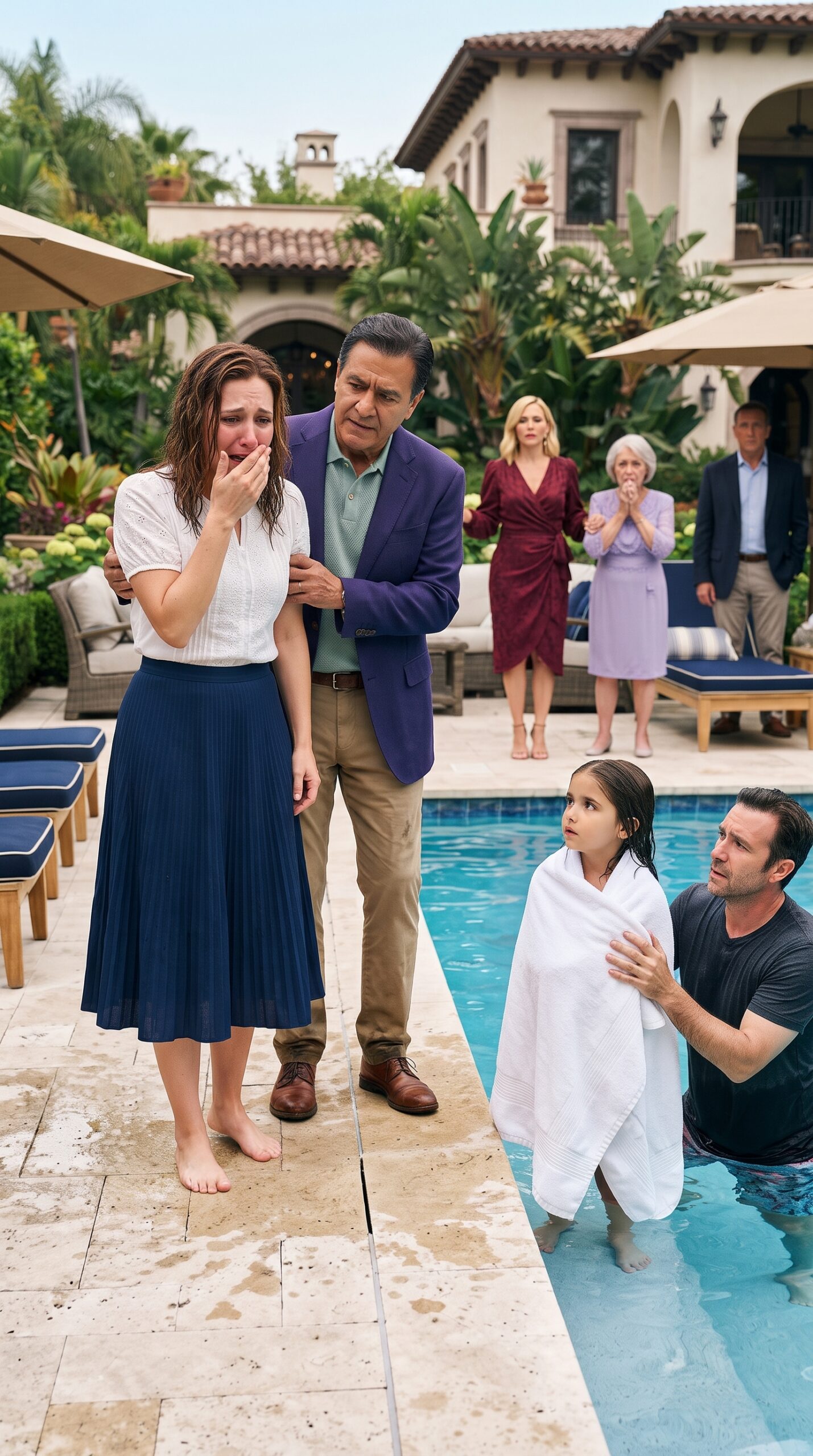
For one second, Mariana Robles couldn’t comprehend what her eyes had just witnessed. Her 5-year-old daughter stood by the hotel pool in Cuernavaca, wearing her Sunday yellow dress, a white sweater, and the shiny silver shoes she'd picked out that morning.
The Camacho family had organized a breakfast "to reconcile," as Don Arturo, Mariana's father, had put it. In reality, everyone knew it was one of those gatherings where smiles were forced for the camera while swallowing humiliation like bitter coffee.
Vanessa, Mariana's younger sister, approached the little girl with a crooked smile.
“Let’s see if your little princess stops feeling so special,” she murmured.
And she shoved her with both hands.
Valentina fell completely dressed into the pool.
The lemonade she held flew out of her hand. People screamed. A woman dropped her cup. Mariana tossed her bag aside, kicked off a heel, and ran toward the water, thinking of nothing but her daughter.
But a hand grabbed her by the back of her neck.
Don Arturo yanked her back with such force that her knees slammed against the hot floor.
“Let me go, Dad!” Mariana screamed.
He tightened his grip.
Vanessa stood with her arms crossed, watching the bubbles rise from where Valentina had vanished.
Doña Patricia, their mother, covered her mouth but didn’t lift a finger. Diego, their older brother, looked down as if this were just another family squabble best ignored.
Mariana clawed at her father’s wrist.
Valentina’s little hand broke the surface once.
“She can’t swim! She’s 5!” Mariana shouted, desperation clawing at her throat.
Don Arturo leaned in close. His breath reeked of expensive whiskey and mint gum.
“If she survives, she survives,” he said coldly. “If she can’t handle a little water, she doesn’t deserve pity.”
Something inside Mariana flickered out.
It wasn’t calm.
It was something colder.
She elbowed him in the ribs. Don Arturo grunted and barely loosened his grip. Mariana tore herself from his hands and dove into the pool.
The water hit her like ice. She opened her eyes against the sting of chlorine and saw Valentina sinking, her dress billowing around her, the shoes dragging her down.
Mariana grabbed her under the arms and kicked with every ounce of strength she had left.
When she finally pulled her out, the little girl’s lips were blue.
“Call an ambulance!” Mariana shrieked.
A guest began administering first aid. A woman held her by the shoulders while she trembled, soaked, broken, counting breaths that wouldn’t come.
Vanessa said barely a word:
“Oh, it was just a joke.”
Don Arturo raised his voice:
“Kids need character too.”
When the paramedics arrived, Valentina coughed up water onto the floor.
And Mariana, looking at her family surrounding her, understood something that chilled her blood: they weren’t afraid for the girl.
They were afraid someone had recorded it all.
PART 2
In the hospital, Mariana didn’t change out of her wet clothes.
The dress clung to her skin, her hair dripped down her back, and her knees were scraped, but she refused a single blanket. She sat beside the gurney where Valentina slept with oxygen, wrapped in thermal blankets, still trembling.
The private IMSS doctor who examined her was clear: mild aspiration, chlorine irritation, a shoulder bruise, and risk of emotional trauma.
“She was lucky,” the doctor said.
Mariana didn’t respond.
Because that hadn’t been luck.
It had been a miracle.
A municipal police officer approached with a notebook.
“Ma’am, we need to know exactly what happened.”
Mariana looked up. Behind the glass were Vanessa, Don Arturo, Doña Patricia, and Diego. They were all talking to a family lawyer, not the doctors.
There ended the doubt.
“My sister pushed my daughter,” Mariana said. “And my father stopped me when I tried to save her.”
Doña Patricia released a theatrical sob in the hallway.
“Don’t destroy your family, Mariana! It was an accident!”
Mariana stared at her without blinking.
“My family almost destroyed my daughter.”
That night, Vanessa was reported to the Public Ministry for assault and endangerment of a minor. Don Arturo was reported for obstructing assistance and domestic violence. The news hadn’t come out yet, but in the groups of
Diego sent Mariana 14 messages.
“Calm down.”
“Think about the business.”
“Dad didn’t mean that.”
“Valentina is alive, don’t exaggerate.”
“If this hits the press, you’ll sink us all.”
Mariana didn’t reply to any.
She called Rodrigo, her husband, who was in Monterrey for work. When he heard Valentina was alive, he cried. When he learned what Don Arturo had done, his voice changed.
“Don’t talk to them alone. Not one word. I’m on my way.”
But Mariana wasn’t thinking of talking.
She was thinking of acting.
The next day, she sought out Licenciada Teresa Galván, a lawyer known in Mexico City for taking on powerful families without raising her voice. Mariana arrived with the medical report, the complaint, and three videos sent by hotel guests.
In the first, Vanessa clearly pushed Valentina.
It wasn’t a trip.
It wasn’t a game.
It was a shove with both hands to the back.
In the second, Don Arturo held Mariana by the neck while the girl flailed in the water.
In the third, the complete phrase could be heard:
“If she can’t handle a little water, she doesn’t deserve pity.”
Licenciada Teresa paused the video and took a deep breath.
“Do you know what you have here?”
“Evidence,” Mariana said.
“Not just evidence. You have the truth without makeup.”
For years, Mariana had kept messages.
Not because she wanted revenge, but because in the Camacho family, everything was denied afterward. Don Arturo was the owner of Camacho Textiles, a Puebla company with contracts in hotels, school uniforms, and private hospitals. Publicly, he was a generous man, a sponsor of scholarships and campaigns against violence.
Privately, he crushed everyone with money, name, and fear.
Vanessa had hated Mariana since their maternal grandfather left her a house in Valle de Bravo. She said Mariana “played the victim” and that Valentina was “a spoiled child everyone had to endure.”
Mariana had screenshots of those messages.
She also had audio recordings where Don Arturo called the girl “weak,” “whiny,” and “an embarrassment to the Camacho blood.”
What she didn’t have was the piece that turned everything around.
That piece arrived four days later.
A hotel employee, nervous, asked to speak to Mariana outside the hospital. Her name was Maribel, and she worked in events. She handed over a USB drive wrapped in a crumpled napkin.
“I don’t want any trouble, ma’am,” she said, “but I overheard your mother before breakfast.”
Mariana felt her stomach tighten.
In the recording from an internal camera in the hall, Doña Patricia spoke with Vanessa near the dessert table.
“Give her a scare,” Patricia said. “Let’s see if Mariana understands that this girl isn’t the center of the world.”
Vanessa laughed.
“And if she gets intense?”
“Your dad controls her.”
Mariana watched the video once.
Then again.
By the third time, she no longer cried.
Licenciada Teresa requested restraining orders for all four: Vanessa, Don Arturo, Doña Patricia, and Diego, because Diego had gone to the hospital to pressure Rodrigo to “fix everything as a family.”
The judge granted the protection.
Doña Patricia screamed in court that she hadn’t touched the girl.
Teresa responded:
“She didn’t touch her. She only helped prepare the fear and then stood by watching her drown.”
The room fell silent.
Don Arturo tried to wield his name as always. He sent lawyers, offered money, asked for meetings with businessmen, called municipal government acquaintances. But this time, the video was already circulating among too many hands.
First, the board of Camacho Textiles watched it.
Then two big clients saw it.
Next, it reached a local journalist.
The article came out on a Tuesday morning:
“Pueblan businessman accused of obstructing the rescue of his granddaughter at a hotel in Cuernavaca.”
Within hours, the comments exploded.
“What kind of grandfather does that?”
“The aunt should go to prison.”
“The grandmother is guilty too.”
“All for protecting the image, disgusting.”
Don Arturo called Mariana from an unknown number.
She answered because Teresa had told her to record everything.
“Enough already,” he said, his voice low. “You’re costing me contracts.”
“You cost my daughter her peace.”
“That girl is alive.”
Mariana glanced toward the room. Valentina sat on the couch with Rodrigo, hugging a stuffed animal. Since the accident, she hadn’t wanted to bathe. She screamed when she heard running water. She couldn’t stand it when someone laughed loudly behind her.
“Alive doesn’t mean intact,” Mariana replied.
Don Arturo fell silent.
Then he released:
“You’ll regret it when you have nowhere to return.”
For the first time in her life, Mariana smiled without fear.
“I don’t want to return to a house where they almost let my daughter die.”
She hung up.
That audio also made it into the case files.
The internal investigation at Camacho Textiles began because of the scandal, but it didn’t end there. Upon reviewing expenses and transactions, they found personal payments from Vanessa charged to the company: trips to Cancún, jewelry, her children’s schools, even cosmetic surgeries disguised as “image consulting.”
Transfers also appeared to Diego’s account for services he never provided.
And contracts signed by Don Arturo with phantom suppliers.
The name they had so fiercely protected was rotten from within.
In less than two months, Don Arturo was forced to resign as CEO. The statement said “health reasons,” but no one believed it. Vanessa lost her place in the social club. Her friends stopped inviting her to lunches. Her husband left with their two children to his parents’ house.
Doña Patricia, who had always lived by pretending innocence, found herself alone in a house too big, with neighbors who no longer greeted her the same way.
Diego tried to defend himself, saying he “hadn’t pushed anyone.” But the new board removed him from the company due to the irregular transfers.
He sent Mariana one last message:
“I hope it was worth it to destroy us.”
She read it and deleted the conversation.
Because it wasn’t about destroying them.
It was about finally facing what they were.
Vanessa accepted a judicial agreement: a record, mandatory therapy, damage repair, and a prohibition from coming near Valentina. Don Arturo avoided prison with a settlement but couldn’t escape public shame or the civil lawsuit. The written admission was what hurt him the most.
He had to acknowledge that Vanessa pushed the girl.
He had to acknowledge that he prevented Mariana from rescuing her.
He had to acknowledge that his behavior endangered his own granddaughter’s life.
The compensation was deposited into a trust for Valentina. Mariana didn’t buy a car, throw a party, or boast about anything. She used part of her own money to create a psychological support fund for children who were victims of domestic violence.
She didn’t name it Camacho.
She named it “Yellow Ribbon,” after the bow Valentina wore in her hair that day.
Valentina’s recovery was slow.
For weeks, she slept between Mariana and Rodrigo. If she heard a pool, a shower, or a bucket filling, she covered her ears. A child therapist helped her with drawings, dolls, and breathing exercises.
One day, almost six months later, Valentina dipped a finger into a glass of water.
She looked at her mom as if she had crossed an ocean.
“I could do it,” she whispered.
Mariana didn’t applaud. She didn’t want to turn her courage into a spectacle.
She simply took her hand.
“Yes, my love. You decide at your own pace.”
Almost a year later, Valentina asked to go to the house in Valle de Bravo. Mariana hesitated because the house had a dock and the lake was nearby.
But the girl said something that shattered her heart:
“I don’t want them living in my head.”
She was six.
Too young to have learned such a phrase.
And too strong not to respect it.
They went for a weekend. Rodrigo carried the bags down while Mariana walked with Valentina toward the dock. The girl wore denim pants, pink sneakers, and a sweatshirt with a bunny.
They didn’t touch the water.
It wasn’t necessary.
Valentina simply stood in front of the lake, gripping her mom’s hand.
“My aunt Vanessa was mean,” she said.
“Yes.”
“My grandpa too.”
Mariana felt a knot in her throat.
“Yes, my love.”
Valentina gazed at the water for a few more seconds.
“But I’m not weak.”
Mariana crouched down and hugged her carefully, as if embracing something sacred.
“No. You were never weak.”
Months later, Mariana saw Don Arturo in a courthouse hallway. He no longer seemed the enormous man everyone obeyed. He walked slowly, his suit loose and his gaze tired. Vanessa stood beside him, without makeup, without arrogance.
Don Arturo looked at Mariana, expecting her to lower her eyes, as before.
She didn’t.
He was the one who looked away.
That was the last power he lost over her.
The Camacho family had valued the name, the company, the money, the reputation, and the silence.
Mariana took away only one thing: the silence.
Everything else fell apart on its own.
And Valentina remained alive.
That was the only thing that mattered.





