PART 1
"Tomorrow we’ll arrive with the suitcases, Mariana. And I don’t want your sad faces. That house is too big for you and a baby."
That’s what her mother, Doña Teresa, said over the phone, four weeks after Mariana Robles left the hospital with an open cesarean, deep dark circles under her eyes, and a newborn baby clinging to her breast.
Mariana had bought the house on her own.
No husband, no inheritance, no family support.
She had worked double shifts as a nurse in a private hospital in Tlalpan, caring for terminal patients, saving every peso while everyone in her family repeated that she "wasn’t ambitious," that she was only good for taking care of the sick and enduring sleepless nights.
"Your sister Paola is coming too," Teresa continued. "She, Mauricio, and the kids need the master bedroom. You can stay in the back room with the baby. After all, a single mother doesn’t need that much space."
Mariana stared at the boxes piled in the living room.
One said: "Sofía, diapers."
Another: "Sofía, blankets."
The house still smelled of fresh paint. It had a big window overlooking a small patio where she already imagined a stroller, a bougainvillea, and her daughter taking her first steps.
But her mother spoke as if all of that belonged to her.
"Are you listening to me?" Teresa asked. "We’re arriving tomorrow at noon. I don’t want any drama."
Mariana closed her eyes.
Her whole life, she had been the obedient daughter. The one who brought medicine. The one who cared for grandparents. The one who washed dishes while Paola received applause for merely existing.
Teresa always said at family meals:
"Mariana has a good heart, but she wasn’t born for great things."
And Mauricio, her brother-in-law, smiled with that confidence of an expensive man.
"Well, everyone has their talent. Leave the numbers to me."
Mauricio Salgado was a financial advisor. He wore shiny watches, tailored suits, and used words that confused everyone. In the family, they treated him like a genius because he spoke of funds, returns, and dollars.
He was also the man who had been managing Doña Inés’s money, Mariana’s grandmother, for almost a year.
Doña Inés was 90 years old.
According to Teresa, she no longer recognized anyone. She said the poor woman fell asleep mid-meal, repeated the same question ten times, and it was best not to take her seriously.
But that night, while Teresa planned to invade her daughter’s house, there was something she didn’t know.
Doña Inés was in the back room.
And she wasn’t lost.
She was awake, dressed, with her glasses on and a notebook on her lap.
Next to her sat Ms. Graciela Paredes, a lawyer specialized in elder care and family estate.
Mariana glanced at her sleeping baby in the cradle.
Then she took a breath.
"Alright, Mom," she said with a calm she didn’t even recognize. "Come tomorrow at noon."
Teresa let out a satisfied chuckle.
"That’s more like it. No martyr act."
When she hung up, Mariana dialed the lawyer.
"They’re all coming," she whispered. "My mom wants to invade my house."
On the other end, Graciela didn’t sound surprised.
"Good," she replied. "That way, no one can say she wasn’t present."
That night, Mariana hardly slept. Not out of fear, but because she knew the moment she had been preparing for months had finally arrived.
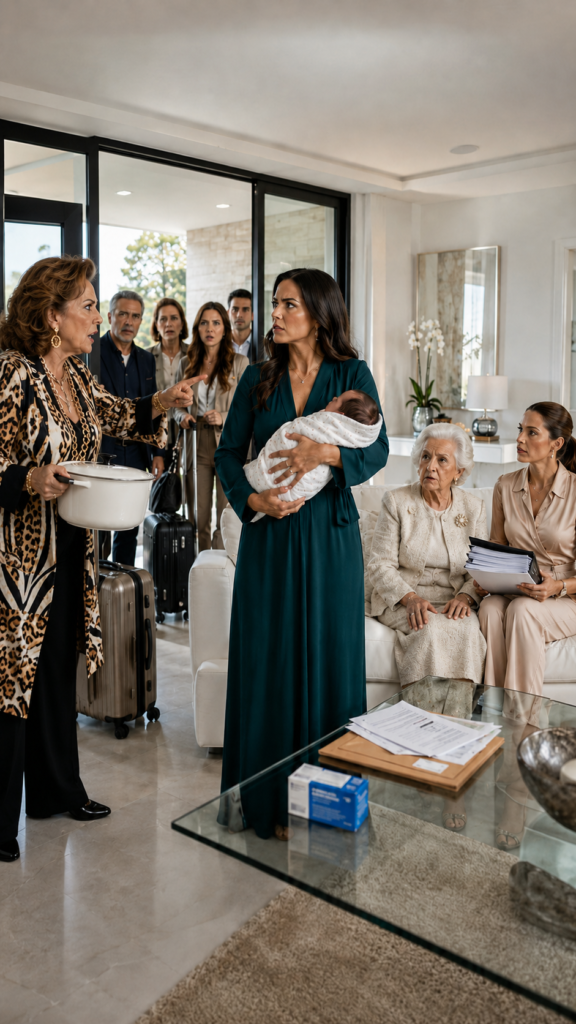
The next day, at precisely noon, Teresa opened the door without knocking, carrying a pot of pozole as if it were an offering and permission at the same time.
Behind her came Mariana’s father, Don Ernesto, her sister Paola, Mauricio, two restless kids, and six suitcases.
"Alright," said Teresa, entering the hallway. "First, let’s arrange the big room, and then we’ll talk about your rules."
But she froze.
Everyone froze.
In the living room, by the window, Doña Inés was sitting upright, wearing a navy blue dress, her lips painted, and her gaze completely clear.
Beside her was Ms. Graciela with a thick folder.
Near the bookshelf stood a social worker.
And by the door, a court clerk held a sealed envelope.
Doña Inés raised her chin and looked directly at her daughter.
"Sit down, Teresa," she said in a firm voice. "Today, you’re going to listen to me."
PART 2
Teresa clutched the pot to her chest as if she could still pretend she had come to help.
"Mom, you’re confused," she said with a trembling smile. "Mariana upset you. I’m sure you didn’t take your pills."
Doña Inés didn’t blink.
Ms. Graciela placed a sheet on the table.
"Geriatric evaluation conducted three weeks ago and reaffirmed five days ago. Doña Inés Robles is fully capable."
Mauricio stepped forward.
"This is nonsense. I have a signed power of attorney from her to manage her assets."
"Had," Graciela corrected. "It’s been revoked."
Mauricio’s face barely changed, but Mariana noticed. Nurses observe details. The dry throat. The restless hand. The foot seeking an exit.
Mariana held Sofía against her chest. The baby slept, unaware that a lie that had been breathing within the family for months was collapsing in that room.
It all started with a purple pill organizer.
Doña Inés lived in an old house in the Narvarte neighborhood, purchased with fifty years of selling clothes at a market stall and saving like an ant. She had small investments, a dollar account, and perfectly organized papers.
When Teresa said their mother "was already fading away," everyone accepted it.
That she fell asleep.
That she confused things.
That she signed without understanding.
That she could no longer decide.
But Mariana, as a nurse, knew something that the others didn’t want to see.
A person doesn’t just switch off suddenly when it suits others.
One night, while helping change her grandmother after a fall, she checked her pill organizer. She found a strong sedative combined with another medication that, in a 90-year-old woman, could cause confusion, deep sleep, weakness, and delirium.
It wasn’t old age.
It was induced fog.
She called a trusted geriatrician. The doctor reviewed doses, dates, and symptoms. Then he said a phrase that left her heart cold:
"Your grandmother isn’t losing her mind. They are shutting it down."
With medical supervision, they gradually lowered the doses.
In two weeks, Doña Inés returned.
First, she asked for coffee without too much sugar. Then she remembered the name of her deceased neighbor. After that, she looked at Mariana’s belly, which was still pregnant, and asked:
"Sweetheart, why didn’t anyone tell me you were having a girl?"
Mariana cried in the bathroom.
Then Lidia appeared, the caregiver Teresa had fired for being "nosy." Lidia brought a notebook with dates, doses, and written instructions.
"Give it to her before the notary arrives."
"Make sure she’s calm to sign."
"Don’t let her talk to Mariana."
Then came the documents.
Strange transfers.
Invented commissions.
Withdrawals in dollars.
Transactions to accounts linked to Mauricio.
A rushed sale of the house in Narvarte.
The total was staggering: $412,000 siphoned off little by little.
And the worst was still to come.
Mariana had found a cheap cellphone in Paola’s house, under a jacket of Mauricio’s. On the screen were hotel receipts, photos with another woman, expensive gifts, and deposits.
Mauricio wasn’t just stealing from his grandmother.
He was also funding a double life with that money.
Graciela had told Mariana:
"Don’t blow up yet. Let the papers speak."
And the papers spoke that noon.
The lawyer opened the folder.
"We have medical evaluations, a medication log, testimony from the caregiver, bank reports, revocation of the power of attorney, a request for nullification of operations, and a complaint for possible abuse of an elderly person’s assets."
The court clerk lifted the envelope.
"Notice is given of the preventive suspension of the sale of the property located in the Narvarte neighborhood."
Teresa turned pale.
Mauricio tried to smile.
"All transactions were in the best interest of Mrs. Inés."
Paola looked at him with eyes full of terror.
"In the best interest of my grandmother? Were the hotels also for her?"
Mauricio froze.
Teresa turned to her younger daughter.
"Paola, don’t be foolish. Your husband knows business."
"No, Mom," Paola replied, her voice broken. "My husband knows how to lie."
Mariana didn’t know that Graciela had already shown Paola the records. For the first time, her perfect sister didn’t seem perfect. She seemed like a woman waking up within someone else’s life.
Teresa exploded.
"I took care of my mother for years! You don’t know what it’s like to carry an old woman who doesn’t even know who she is anymore!"
Doña Inés stood up slowly.
No one helped her because she raised a hand.
"I did know some things, Teresa," she said. "I knew your perfume would enter before you did. I knew Mauricio would put papers in front of me when I couldn’t hold the pen properly. I knew you gave me pills before important people arrived. I didn’t understand everything, but I felt fear."
Teresa started to cry.
"Mom, I just wanted to make things easier."
"No," Doña Inés said. "You wanted my house."
Silence fell like a stone.
Then Teresa stopped acting.
"And what did you want it for?" she spat. "You hardly went out. You didn’t enjoy anything. That house would have gone to ruin with you inside."
No one breathed.
The social worker wrote something in her notebook.
Don Ernesto lowered his gaze.
Paola covered her mouth.
Mariana felt Sofía stir against her chest.
Doña Inés didn’t cry. That was the hardest part. She looked at her daughter with a dry, tired sadness, as if she no longer expected love from those who had only given her hunger.
"I sold my gold chain to pay for your operation when you were a girl," she said. "I fed you before I fed myself. And you decided that because one day you saw me weak, my life no longer mattered."
Teresa trembled.
"Mom…"
"Don’t call me Mom to save yourself."
The phrase shattered the room.
Then Doña Inés walked toward Mariana. Each step cost her, but she made it. She took her free hand and squeezed it three times.
One.
Two.
Three.
It was the code they used when Mariana was a child. It meant: I see you, I’m here, you’re not alone.
"Mariana was the only one who read the labels," the grandmother said. "The only one who asked. The only one who didn’t accept that I disappeared because it suited you."
Teresa glared at Mariana with rage.
"Are you happy? Is that what you wanted? To destroy your family?"
Mariana took a deep breath.
She was no longer the girl sitting in the kitchen while everyone celebrated Paola.
She was no longer the useful daughter, the one who didn’t respond, the one who swallowed tears to avoid discomfort.
She was a mother.
She was the owner of her house.
She was the granddaughter of a woman who had returned from the fog.
"You don’t own this house, Teresa," she said. "And here, you won’t call family what you did."
"I’m your mother."
"Not at this door. Here, you’re the woman who drugged her own mother to take her assets."
Mauricio raised the cellphone.
"I’m going to call my lawyer."
Graciela closed the folder.
"Call him. He can also call your company, the bank, and the Public Ministry. They all received copies."
Mauricio lost his color.
Paola took off her ring and left it on the table.
"You’ll also talk to my lawyer," she said.
Don Ernesto finally moved.
"Teresa, let’s go."
She looked at him as if he were betraying her.
"Is that all?"
He looked at Doña Inés.
"I’m sorry," he murmured.
The grandmother didn’t respond. Some apologies come so late that they can’t find a chair to sit on.
Mariana opened the door.
The same door she had paid for with night shifts.
The same one her mother thought she could cross like a queen.
"Out."
Teresa wanted to speak, but Mariana repeated:
"Out."
Mauricio left first. Don Ernesto next. Teresa was last. Before crossing, she said:
"One day, you’re going to need me."
Mariana looked at Sofía sleeping, her grandmother standing, and Paola broken next to the table.
"No," she responded. "One day, I’m going to need peace. And that starts today."
She closed the door.
After that, justice advanced without shouting.
The sale of the Narvarte house was frozen. The power of attorney was annulled. The bank investigated the transactions. Mauricio lost clients, prestige, and his job. Teresa lost something that hurt her more: the audience that always applauded her tears.
Paola returned two weeks later with sweet bread and swollen eyes.
"I called you bitter many times," she said. "And you were just seeing what no one wanted to see."
Mariana didn’t hug her right away.
But she made coffee.
Sometimes a family isn’t repaired with grand apologies, but with two women sitting at a table, learning to not repeat the cruelty they inherited.
Doña Inés returned to her house when everything was secure, but she spent seasons with Mariana because she said the patio had better light.
One afternoon, while Sofía slept and the bougainvillea began to bloom, Doña Inés took Mariana’s hand and squeezed it three times.
"You brought me back, sweetheart."
Mariana looked at her daughter.
"You brought me back first, Grandma."
Doña Inés smiled.
"Then it’s our turn to bring that little girl into a world where no one teaches her that being good means allowing yourself to be stepped on."
And Mariana finally understood:
She hadn’t destroyed her family.
She had simply stopped holding up the lie that had kept her standing.





