PART 1
—You should have died that night, filthy girl.
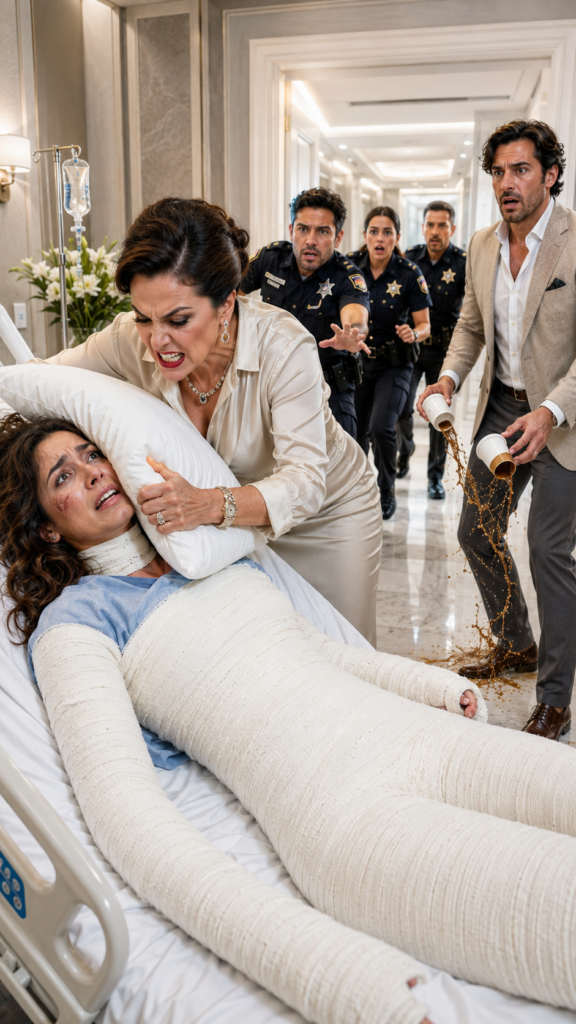
Doña Graciela Aranda closed the hospital room door with the same delicacy she used to greet guests at society dinners: a firm smile, straight back, expensive perfume, and a malice so well disguised it could be mistaken for elegance.
Valeria Montes lay motionless in a bed at Hospital Ángeles in Mexico City. A cast encased her from chest to legs. Two broken ribs, three damaged vertebrae, one immobilized arm, and bruises that changed colors as if her body were silently recounting everything that had been done to her.
The Aranda family claimed it was an accident.
That Valeria slipped from the balcony of their third-floor house in Lomas de Chapultepec.
That she was lucky.
That God had protected her.
But Valeria remembered differently.
She remembered her husband, Mauricio Aranda, with a pale face when she asked about a life insurance policy signed without her consent.
She remembered the strange sound of the railing.
She remembered Mauricio's hand tightening around her wrist.
And she remembered Graciela's voice behind her, cold as a razor:
—Now our problem is over.
Then came the emptiness.
The impact.
The darkness.
And upon waking, the same woman who hated her was crying in front of the nurses, holding her hand as if she were Mexico's most loving mother-in-law.
—My girl, thank God you’re alive —Graciela said, wiping false tears with an embroidered handkerchief.
But now there were no nurses.
No doctors.
No Mauricio.
Only Graciela, standing by the bed, looking at her like someone would look at trash that had been forgotten.
—A neighborhood accountant thought she could sit at our table —she whispered—. I told you from the beginning, Valeria. You didn't belong to this family.
Valeria couldn't move. Every attempt to breathe hurt as if stones were lodged in her chest. Her throat was dry. Her body was a prison of bandages, cast, and fear.
But her mind remained awake.
And that was what Graciela didn't know.
For two years, Valeria had silently endured humiliations. At Polanco dinners, Graciela introduced her as “the little number girl.” At Christmas, she gifted her used clothes “so she could learn to dress better.” At family gatherings, she would laugh and say that some women were born to inherit silverware and others to wash it.
Mauricio never defended her.
—My mom is intense, love. Don’t mind her.
But Valeria did mind.
Especially when she began uncovering false invoices, transfers to nonexistent construction companies, hidden accounts, and documents where her signature appeared copied with too much suspicious accuracy.
Graciela picked up a white pillow from the armchair.
Valeria felt the air in the room grow heavier.
—This time you won’t wake up —the mother-in-law said.
Then she placed the pillow over Valeria's face.
Valeria didn’t scream.
Didn’t panic.
Beneath the sheet, between her weak fingers, she had a black button that Nurse Teresa had left her an hour earlier.
The pillow pressed down hard.
Air vanished.
Valeria counted silently.
1.
2.
3.
After ten seconds, she pressed the button.
The door burst open.
But the ones who entered were not doctors.
PART 2
Three private investigators, one lawyer, and two plainclothes officers stepped in.
Doña Graciela stepped back, the pillow still in her hands. For the first time since Valeria met her, she didn’t look like a society queen. She looked like what she was: a woman caught in the middle of a crime scene.
—What are you doing here? —she shouted, attempting to regain her composure—. She was choking! I was just trying to help her!
The lead investigator, Julián Rivas, raised a small recorder.
—We heard you completely, Mrs. Aranda. From the moment you entered until you said she wouldn’t wake up this time.
Graciela’s face went rigid.
Valeria’s lawyer, Daniela Salmerón, approached the bed and carefully removed the pillow. Valeria gasped for breath. Her eyes were watery, but not from defeat.
Graciela scanned the corners of the room.
There, she understood.
There were cameras.
Not one.
Several.
And they had recorded everything.
At that moment, Mauricio appeared with two cups of coffee. He stopped at the door upon seeing his mother, the agents, and the pillow in a transparent evidence bag.
—Mom… what did you do?
The phrase sounded weak, almost childish.
Graciela shot him a glare.
—Don’t say a word.
And that order was enough for everyone to understand this wasn’t a spur-of-the-moment act by a crazy mother-in-law. It was a family operation.
Daniela opened a blue folder on the table.
—We have the insurance policy signed three weeks before the fall. We have messages about the railing. We have transfers of 850,000 pesos to a ghost construction company. And we have the forensic report showing that the screws were loosened from the inside.
Mauricio dropped the coffees.
The liquid spilled on the white floor like a clumsy, ridiculous, almost domestic stain, in the middle of an attempted homicide.
—No… that doesn’t prove anything —he stammered.
Valeria turned her eyes just slightly toward him.
The man who had promised to protect her now trembled not from guilt, but from the fear of being discovered.
Before marrying Mauricio, Valeria wasn’t “a neighborhood accountant,” as Graciela said. She had worked as a forensic auditor in financial investigations. She knew how to spot ghost companies, forged signatures, fraudulent trusts, and money that traveled through clean accounts to hide dirty crimes.
Mauricio thought he had married a woman grateful to enter his world.
But he had married someone capable of dismantling his world invoice by invoice.
The plan began twelve hours after Valeria woke up.
She couldn’t get up. Couldn’t walk. Couldn’t even scratch her face. But she could listen. And she heard Graciela talking on the phone next to her bed, believing she was asleep.
—If she dies in the hospital, it’s easier. Santiago collects, sorry, Mauricio collects, we sell the house and close the foundation before the old District Attorney pokes their nose in.
Valeria wasn’t asleep.
She was recording.
Nurse Teresa, a serious woman from Oaxaca who wasn’t impressed by fancy last names, noticed the terror in Valeria’s eyes every time her mother-in-law entered.
—Licensed, blink twice if you’re in danger —she whispered as she adjusted the sheets.
Valeria blinked.
Twice.
Teresa didn’t make a scene. Didn’t cry. Didn’t ask too many questions. She simply called Daniela, Valeria’s lawyer, and after that, the case moved quickly.
In less than six hours, the room had authorized hidden cameras, discreet microphones, and an emergency button concealed under Valeria’s hand.
They didn’t want rumors.
They wanted proof.
And Graciela, with that arrogance of someone who believes money can buy even God’s silence, gave them everything.
—You don’t know who you’re messing with —she said, raising her chin—. My family has judges, deputies, businessmen. This isn’t going to go anywhere.
Julián smiled without joy.
—That was recorded too.
Mauricio took a step toward Valeria.
—Love, listen to me. I didn’t know my mom was coming today. I swear I didn’t want this.
Valeria summoned the little strength she had left.
Her voice came out broken, dry, but clear.
—But you did want my money.
Mauricio froze.
Daniela pulled out another folder, this one red.
—We also have the bank statements. The “Light for Childhood” foundation received donations for four years, but over 70% ended up in accounts linked to the Aranda family. Valeria discovered it. That’s why they wanted her quiet.
Graciela pressed her lips together.
—That woman was going to destroy us.
—No —Valeria replied—. You destroyed yourselves.
Then came the twist no one expected.
Daniela revealed one more document.
Not only had they forged Valeria’s signature.
They had also forged Mauricio’s on several transactions of the foundation.
Graciela had used her own son as a legal shield. If the fraud exploded, he would bear much of the blame while she protected her personal accounts abroad.
Mauricio looked at his mother, mouth agape.
—Did you also drag me into this?
Graciela let out a short, cruel laugh.
—Oh, my dear. Without me, you can’t even choose a tie. Someone had to think for you.
That insult broke him completely.
Not because he regretted Valeria.
But because he understood that his mother had used him just as he had used his wife.
The agents approached Graciela.
—Mrs. Graciela Aranda, you are under arrest for attempted homicide, criminal association, and fraud.
She tried to break free.
—Don’t touch me! You don’t know who I am!
—We do know —Teresa said from the door.
No one had seen her come in.
The nurse stood with her arms crossed, looking at Graciela with tremendous calm.
—She’s the woman who tried to kill a defenseless patient thinking no one would say anything.
Graciela looked at her with contempt.
—You shut up, cat.
Teresa didn’t move.
—No, ma’am. Not today.
That phrase, so simple, weighed more than any scream.
Graciela was handcuffed. Mauricio was also asked to accompany them. He began to speak quickly, desperately.
—I can cooperate. I have messages. I can explain what my mom did. She planned everything. I just… I was just scared.
Valeria looked at him.
For years, she thought Mauricio's silence was weakness.
Now she understood it was complicity.
He had left her alone at every dinner, every humiliation, every suspicious document. And when the moment came to choose between his living wife and his intact inheritance, he chose the inheritance.
—Valeria, please —he pleaded—. I love you.
She closed her eyes.
Not because it hurt to hear him.
But because nothing moved her anymore.
—You don’t know how to love —she said—. You only know how to need.
The news exploded the next day.
“Aranda Family Investigated for Attempted Homicide and Million-Dollar Fraud.”
Social media ignited. On Facebook, people commented on everything. Some defended Graciela because “a lady of that class wouldn’t do something like that.” Others said money couldn’t buy a soul. Many women shared the story with phrases like:
“That’s why you shouldn’t ignore when a mother-in-law hates you too much.”
“Seriously, the enemy can have dinner with you every Sunday.”
“How terrifying to sleep next to someone who has already calculated how much your death is worth.”
But while the country was opining, Valeria was learning to truly survive.
Because surviving wasn’t just about not dying.
It was waking up in pain.
It was crying because she couldn’t walk.
It was asking for help to drink water.
It was feeling panic when someone approached with a pillow.
It was hearing high heels in the hallway and believing, for one second, that Graciela had returned.
Teresa continued visiting her even off duty. She brought her gelatin, sweet bread, homemade broth, and a patience no medication could replace.
—Come on, licensed —she said—. You still have a lot of fight left in you.
The first time Valeria moved her toes, she cried.
The first time they sat her in a special chair, she vomited from the pain.
The first time she took three steps with a walker, Teresa clapped softly, as if they were in a church.
—Look at her —she said—. She’s going to walk all over those scoundrels.
Valeria laughed.
It hurt to laugh.
But she laughed.
The trial began eight months later.
By then, Valeria could walk with a cane. She wore an orthopedic corset under a navy blue dress and had her hair tied up. She didn’t wear jewelry. She didn’t need to shine for anyone to see her.
When she entered the courtroom on her own, many fell silent.
Graciela arrived dressed in black, with small pearls and red lips. She looked more offended than repentant. As if the real crime had been forcing her to sit in front of people who could judge her.
Mauricio arrived separated from her. Thinner. Older. The rich kid's face had dimmed.
The experts showed pictures of the railing. Explained how the screws had been loosened from the inside, how the fracture didn’t match an accident, and how Valeria’s fall was premeditated.
Then came the accounts.
The false invoices.
The insurances.
The messages.
And finally, the video from the hospital.
On the screen, Graciela appeared entering the room. Her hand pinching Valeria’s bruised cheek. Her mouth coming close with poison.
—You should have died that night, filthy girl.
Then the pillow came down.
In the courtroom, no one breathed.
Even those who wanted to defend her looked down.
Mauricio agreed to testify against his mother to reduce his sentence. He cried on the stand. Said he had been manipulated, that he grew up in fear, that Graciela controlled every part of his life.
Daniela listened without interrupting.
Then she asked him:
—If you loved Valeria so much, why did you increase her life insurance before the fall?
Mauricio didn’t answer.
Daniela persisted:
—If you didn’t want to kill her, why did you write “make it look like an accident” in a message sent one night before?
The silence was brutal.
Mauricio collapsed.
—I didn’t think she would survive —he murmured.
There it all became clear.
It wasn’t an accident.
It wasn’t fear.
It wasn’t family pressure.
It was calculation.
Cold, cowardly, and miserable.
The sentence came weeks later. Graciela received more years than her son. Mauricio was also convicted of fraud, forgery, and participation in attempted homicide. The foundation was intervened. The accounts were frozen. The house in Lomas was secured.
But true justice for Valeria didn’t arrive with the judge’s gavel.
It came months later, when she could walk one whole block by herself.
It arrived when she signed the divorce without crying.
It arrived when she sold the little that still tied her to Mauricio.
It arrived when she bought a small apartment in the Del Valle neighborhood, without marble, without private security, without false dinners, but with a door that only she could open.
She had a small balcony.
Safe.
Sturdy.
With bougainvillea pots and a simple view of the street.
The first time she stepped out there, she rested her hand on the railing and breathed.
There was no expensive perfume.
No pillow.
No mother-in-law calling her trash.
No husband calculating how much money was worth her death.
Below, a woman sold tamales. A child ran in a school uniform. A man carried bags of sweet bread. Life continued with that strange normality that sometimes feels like a miracle.
Teresa sent her a message:
“Don’t act too brave, licensed. Walk ten minutes and rest.”
Valeria smiled.
For a long time, she thought survival meant staying alive.
Now she understood that surviving also meant reclaiming her name, her voice, and her peace.
Graciela called her filthy because she thought money decided who was worth what.
Mauricio told her he loved her while signing papers to collect on her death.
The two forgot something very simple: a woman who knows how to read lies in documents can also learn to read them in the eyes of a family.
Valeria gazed at the city, lifted her face to the wind, and whispered:
—You got the wrong woman.
And this time, no one could silence her.





