PART 1
"Girls learn this way, Mariana. If you don't correct them when they're little, they'll think they own everything."
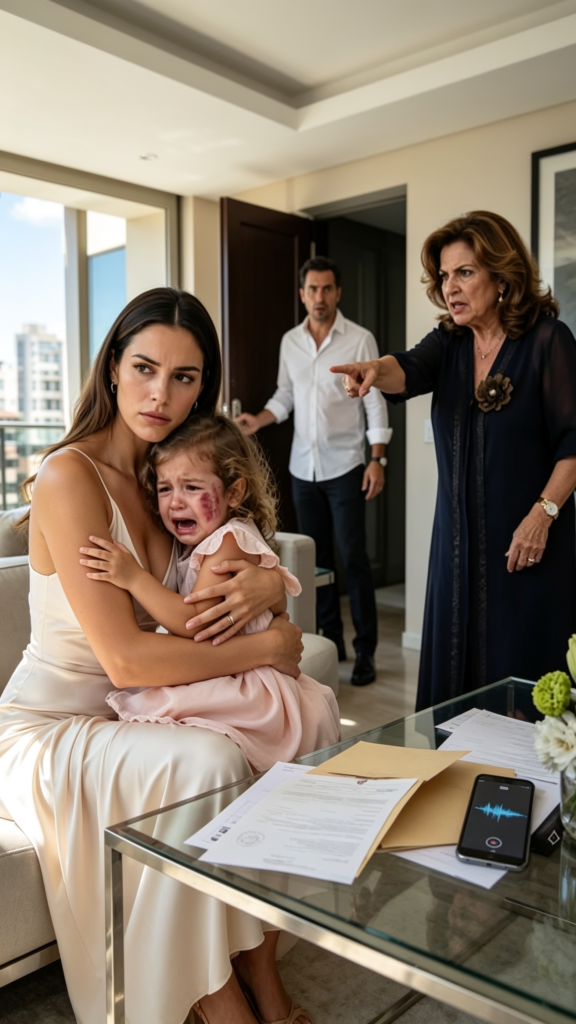
That’s what Doña Teresa said while Sofia, just 2 years old, cried on the living room floor with blood streaming from her nose and a red handprint marking her cheek.
Mariana didn’t scream.
Not because she didn’t want to.
But because for a second, her body felt completely shut down.
All she could see was the blood on her daughter’s pink shirt. She saw it on her fingers as she tried to wipe her nose. She saw it on the beige carpet of the apartment she paid for each month with the natural cosmetics business she had built from scratch.
It all happened in less than 5 minutes.
It was Sunday in the Narvarte neighborhood of Mexico City. Mariana was preparing noodle soup, red rice, and steamed vegetables because Doña Teresa had been complaining for days about her blood pressure, her aches, and that "no one cared for mothers like before."
Andrés, her husband, was supposedly in Querétaro closing an important deal.
At home, it was just Mariana, Sofia, Doña Teresa, and Emiliano, a 9-year-old boy who had been living with them for almost a year.
According to the family, Emiliano was the son of Andrés's older brother. A nephew who needed support, a good school, and a stable roof.
Mariana had paid for everything.
Enrollment.
Uniforms.
Sneakers.
Tablet.
Remedial classes.
Even his medical consultations.
And still, Doña Teresa treated Emiliano like a prince and Sofia like an inconvenience.
"He’s a boy," she always said. "He doesn’t have his food taken away."
That phrase twisted something inside Mariana, but for months she swallowed her anger to avoid an argument. She thought of her mother-in-law as difficult, old-fashioned, one of those women who confused respect with obedience.
Until that Sunday.
Sofia had taken a hot dog from Emiliano’s plate.
She didn’t even eat it.
She just grabbed it with her clumsy little hand, smiling, like children do when they still don’t understand "yours" and "mine."
Doña Teresa got up from the couch and slapped her hard enough that the girl fell sideways against the coffee table.
Sofia's cry was a sound that Mariana would never forget.
"What did you do to her?" she asked, picking up her daughter.
"I gave her a lesson," Doña Teresa replied, without a shred of guilt. "That girl has to learn that not everything is hers."
"She’s 2 years old."
"Better. Girls learn this way. Emiliano is a boy. He doesn’t have his food taken away."
Mariana felt something old break inside her.
She remembered all the times her mother-in-law hid fruit for Emiliano.
All the times she served meat to him first.
All the times she said that Sofia was "just another old woman in the house."
She sat her daughter down at the dining table, wiped the blood away, and kissed her forehead.
"Mommy is here, my love. No one will touch you again."
Doña Teresa let out a dry laugh.
"When Andrés gets here, he’ll put you in your place."
Mariana raised her gaze.
She walked toward her.
And without raising her voice, she slapped her once.
Then again.
Doña Teresa fell back onto the carpet, stunned.
"You hit me! Me! The mother of your husband!"
"The first was for touching my daughter," Mariana said. "The second was for believing a girl is worth less than a boy."
Then she took out her phone and called the bank.
She put it on speaker.
"I need to cancel the medical card in the name of Teresa Aguilar. Yes, the ending is 4318. Block it from this moment."
Doña Teresa stopped crying.
Her face changed.
"You can’t do that. I have scheduled procedures. You know I’m sick."
"My daughter is also hurt because of you."
The mother-in-law grabbed her phone with trembling hands and called Andrés.
"Your wife is crazy! She hit me! She took away my hospital! She wants to kick me out of the house over a bratty girl who stole Emiliano’s food!"
Mariana carried Sofia and locked herself in her bedroom.
Outside, Doña Teresa cried, screamed, and threatened to sue her.
Until her voice changed.
"I told you this woman would explode sooner or later… Now you’ll have to tell her the truth about Emiliano."
Mariana froze.
She didn’t know what that truth was.
She only understood that the slap on her daughter hadn’t uncovered a family fight.
It had uncovered a lie.
And Andrés was on his way to bury it again.
PART 2
Mariana stood behind the door with Sofia sleeping against her chest and the phone recording in her hand.
She didn’t know what she was about to hear.
But Doña Teresa’s voice no longer sounded like a victim. It sounded like someone nervous because something had slipped out that shouldn’t have.
"Yes, I know you’re coming," she said on the phone, "but if she starts looking for papers, everything falls apart. Especially the thing with the boy."
The thing with the boy.
Emiliano.
The nephew who had arrived with an old suitcase and a sad story.
The boy for whom everyone had asked for patience.
The boy Mariana had supported for almost a year while her own daughter was treated like she didn’t belong.
The elevator rang 10 minutes later.
Andrés entered the apartment with his jaw clenched, but he didn’t ask about Sofia.
He didn’t ask if she was okay.
He didn’t ask if she had seen a doctor.
He only looked at his mother and said:
"What did you do now?"
Doña Teresa immediately started crying.
"Your wife has gone crazy. She hit me. She canceled my medical card. All because I corrected the girl."
Andrés sighed, annoyed.
"I told you not to provoke her when I wasn’t around."
Mariana opened the door.
Andrés turned to her and then to Sofia, who still had a swollen nose and a marked cheek.
Mariana waited to see horror on his face.
But all she saw was annoyance.
"Has a doctor checked her?" he asked.
"Not yet," she replied. "First, I want to know what truth you hid about Emiliano."
Doña Teresa stopped crying.
Andrés hardened his gaze.
"Don’t start with your attacks, Mariana. You hit my mom. That can get you into serious trouble."
"How quickly you talk about legal issues," she said. "As if you’ve rehearsed it."
Then she raised her phone.
"It’s been recording since before you walked in."
Fear crossed their faces simultaneously.
That’s when Mariana knew she wasn’t imagining anything.
Emiliano appeared in the hallway, barefoot, hugging his tablet.
"Uncle..." he said.
He stopped.
Looked at Andrés.
And corrected in a low voice:
"Dad, are you going to tell her?"
The entire apartment ran out of air.
Doña Teresa closed her eyes.
Andrés didn’t deny anything.
He didn’t say, "He’s confused."
He didn’t say, "You heard wrong."
He simply looked down.
And with that, he destroyed his marriage.
"Emiliano isn’t your nephew," Mariana said, almost voiceless. "He’s your son."
Andrés took a step toward her.
"It’s not what you think."
Mariana let out a bitter laugh.
That phrase always came from the mouths of cowards.
"Then explain to me how it is."
Doña Teresa stepped forward.
"He was an innocent child. We weren’t going to leave him abandoned."
"And that’s why you brought him into my house with a lie?"
"You had money," the mother-in-law spat. "You could help. Besides, you only gave my son a girl. Emiliano is a boy. He deserves support."
Mariana felt nauseous.
Not just because of the infidelity.
But because of Sofia.
For every breakfast when her daughter received leftovers.
For every time Doña Teresa said, "Leave it, it’s a boy" when Emiliano broke something.
For every look of disdain toward a 2-year-old girl who had done nothing but exist.
"Since when do you know?" Mariana asked Andrés.
He didn’t respond.
Emiliano did.
"Grandma said when you’ve been married for 3 years, you couldn’t kick me out anymore. And that then they would fix the house."
The house.
Another door opened.
Mariana walked to the cabinet where Doña Teresa kept recipes, little cards, and old papers. She had never checked it before.
That night, she did.
She found a beige folder.
Inside was Emiliano’s birth certificate.
Father: Andrés Aguilar Reyes.
There were also copies of transfers from an account linked to Mariana's business.
Tuition payments.
Deposits to a woman named Paola.
Medical receipts.
And a draft of a trust where Emiliano appeared as the preferred beneficiary in case of separation.
Below was a sheet with Mariana's name on top.
"Impulsive. Jealous. Aggressive with Teresa. Unstable with the boy. Possible risk for minors."
Mariana understood everything.
They didn’t just want to hide Emiliano.
They wanted to provoke her.
Make her react.
Paint her as the crazy one in the story.
And take what she had built working nights, packing orders while they talked about surname and blood.
"They hit her to provoke me," she said, looking at Andrés.
"Don’t say nonsense."
But Doña Teresa, nervous, made the mistake that changed everything.
"I didn’t want her to bleed so much."
Andrés looked at her furiously.
Mariana felt her body freeze.
It was no longer suspicion.
It was confession.
She called her pediatrician.
"My 2-year-old daughter received a strong blow to the face. I need her to be checked today and certify injuries."
Then she called her lawyer.
"My mother-in-law hit my daughter. My husband brought his son into my house posing as a nephew. I have recordings, papers, and a list to accuse me of being violent."
The lawyer didn’t hesitate.
"Don’t speak anymore. Keep recording. I’m on my way."
Andrés tried to take the folder from her.
Mariana stepped back.
"Don’t you dare."
His face changed.
He was no longer the offended husband.
He was a cornered man.
"You’re not going to destroy my family over a hot dog."
Mariana looked at the dried blood on Sofia’s shirt.
"No, Andrés. Your family was destroyed when they believed my daughter was worth less than your lie."
At that moment, Emiliano raised his voice.
"I have the video."
Everyone turned.
The boy trembled with the tablet in his hands.
"Grandma told me not to show it because Dad would get mad."
Mariana felt a chill.
The video lasted 47 seconds.
You could see Sofia walking toward the table. She took the hot dog, yes, but not to eat it. She offered it to Emiliano with a smile.
The girl wanted to share.
Then you could hear Doña Teresa’s voice:
"Let her be. Let’s see if she learns."
The hand raised.
The slap sounded dry.
Sofia fell to the floor.
And Doña Teresa said:
"Now cry so your mother comes."
The silence was brutal.
It hadn’t been an outburst.
It hadn’t been a "correction."
It had been a trap.
Sofia had been used as bait to manufacture proof against Mariana.
The lawyer arrived shortly after with a private doctor and 2 police officers.
Doña Teresa screamed it was her house.
The lawyer looked at her fixedly.
"No, ma’am. This house is paid for by Mariana."
The doctor examined Sofia and recorded the bruising, swelling, and nasal contusion consistent with an open-hand impact.
The police took statements.
The tablet was backed up.
The beige folder remained as evidence.
That night, Andrés and Doña Teresa left the apartment with one suitcase.
She still dared to say:
"I have a scheduled surgery. You can’t leave me without a hospital."
Mariana looked at her from the door.
"You left my daughter scared of something worse than an illness: hatred."
The next day she changed the locks.
Canceled all additional cards.
Blocked Andrés's access to her business accounts.
Emiliano's biological mother appeared 3 days later. Her name was Paola, and she wasn't the irresponsible woman Doña Teresa had painted. She was a nurse who thought Andrés was honestly helping her son.
When she learned that he had been introduced as a nephew and taught to feel superior for being a boy, she wept from shame.
Emiliano left with her a week later.
Before he left, he stood in front of Mariana.
"Sorry for not saying anything."
Mariana took a deep breath.
It wasn’t easy to look at him. On his face was Andrés’s lie. But there was also a boy used by broken adults.
"Don’t carry what they did to you," she told him. "But learn something: when someone hurts someone smaller, staying silent also hurts."
Months passed.
Andrés sent furious messages.
Then sad ones.
Then long ones, filled with words like family, fear, pressure, and mistake.
He never wrote the one thing he should have written.
"I cheated on you."
"I used your money."
"I allowed my mother to hit our daughter to manufacture proof against you."
Doña Teresa ended up living with a sister in Toluca. She had to have her surgery in a public hospital. Not because Mariana was cruel, but because for years, she confused help with obligation and silence with permission.
Some people said Mariana was too harsh.
That a mother-in-law was still family.
That Emiliano was innocent.
That Andrés was Sofia’s father.
She heard it all.
Then she looked at her daughter sleeping, hugging her stuffed giraffe, touching her nose some nights as if she were still checking it was there.
And she stopped justifying her limits.
Because a mother doesn’t have to please those who taught her daughter to be afraid.
With therapy, Sofia began to run through the living room again.
She began to ask for hot dogs without crying.
One day she took a piece of bread and offered it to Mariana.
"For you, Mommy."
Mariana cried.
Because her daughter remained generous in a world where someone wanted to punish her for sharing.
That Sunday, Doña Teresa didn’t just hit Sofia’s face.
She ripped the mask off an entire marriage.
Unveiled the deceit, the ambition, and that rotten idea that a girl is worth less than a surname.
And Mariana understood something many women learn too late: forgiving too much can also become a form of abandoning one’s children.
She was not going to abandon Sofia.
Not for a husband.
Not for a mother-in-law.
Not for a family accustomed to calling respect obedience.
That day, their time inside her house ran out.
And for Sofia, a life finally began where no one would ever make her feel less for being born a girl.