PART 1
The private chapel smelled of lilies, incense, and expensive perfume as Valeria Montes became the wife of Sebastián Alcázar.
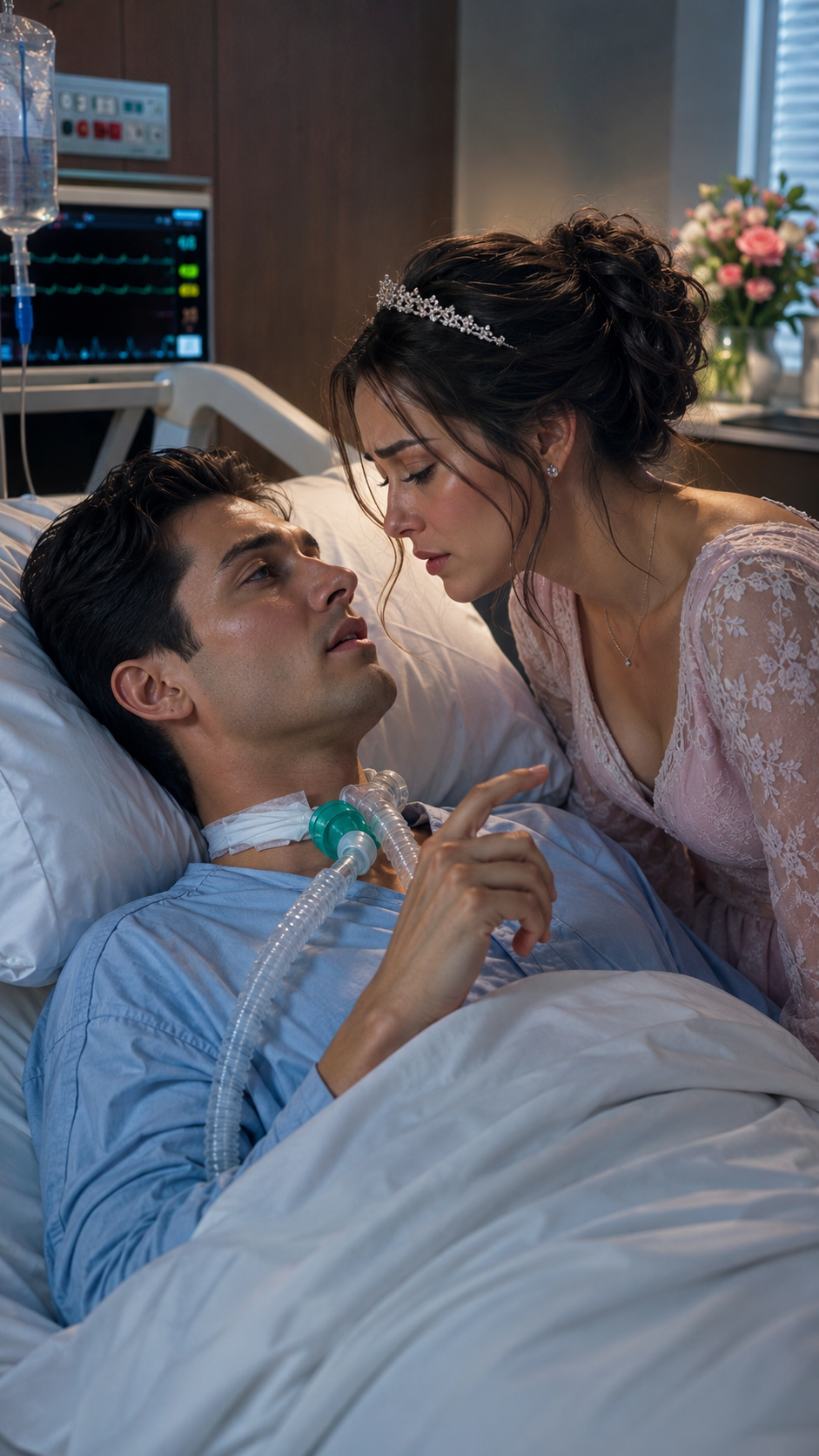
She wore a borrowed white dress. He sat motionless in a wheelchair, his hair slicked back, hands resting on his thighs, a nurse vigilantly monitoring the rhythm of his breathing.
Sebastián didn’t look at the bride.
He didn’t react when the priest pronounced their names.
He had been in a coma for 9 months.
“Say it,” Ernesto, Valeria’s father, murmured behind her.
The young woman felt her throat constrict.
“I accept.”
That word didn’t sound like a promise; it felt like a sentence.
The guests clapped politely. No one asked the groom to kiss the bride. No one could. Minutes later, Sebastián was taken back to his room, and Valeria was left under the stained glass, wondering when her life had turned into a financial operation draped in lace.
Outside, Ernesto hugged her with relief.
“You did the right thing, daughter. This saves us.”
“Us,” Valeria thought. Her father always said “us” when he needed her to pay for his mistakes.
Three weeks earlier, in the small house they rented in Naucalpan, Ernesto had explained the deal. The Alcázar trust required Sebastián to marry before turning 30. If he didn’t, control of his company would pass to Mauricio Alcázar, his cousin.
In exchange for the wedding, all of Ernesto’s debts would disappear.
Credits, promissory notes, threats, and months of overdue rent.
Everything.
Valeria wanted to believe her father was desperate, not that he was selling her.
But upon arriving at the Alcázar mansion, high in Valle de Bravo, she stopped trusting anyone.
Mauricio greeted her by a marble column. He was elegant, smiling, and too attentive.
“So you’re the makeshift wife.”
His gaze traveled over Valeria’s dress, making her feel dirty.
“That’s enough, Mauricio,” interjected a sharp voice.
Doña Elena Alcázar descended the stairs with her back straight and sharp eyes. She was Sebastián’s grandmother and the only person in that house whom Mauricio seemed to fear.
She studied Valeria for a few seconds.
“You will do.”
It wasn’t clear whether it was an approval or an insult.
Sebastián’s room was filled with sunlight, fresh flowers, and soft music. Everything seemed alive, except for him.
Doña Elena glanced at her grandson.
“You have a wife now. Don’t embarrass us.”
Then she left Valeria by the bed.
She sat down, exhausted.
“I don’t know if you can hear me,” she whispered. “I also don’t know why I’m talking to you.”
The monitor continued to register a steady rhythm.
“My mom died two years ago. She would have hated to see me here. I didn’t want to marry you either, but my dad said it was the only way to save you.”
Tears blurred her vision.
“Forgive me. Neither of us chose this.”
Then she felt something under her hand.
Sebastián’s finger moved.
Valeria froze.
His eyelids fluttered and began to open. Before she could scream, he parted his lips with great effort.
His voice was barely a whisper, but Valeria understood every word.
“Don’t trust Mauricio.”
PART 2
“Don’t trust Mauricio.”
Sebastián breathed heavily. When Valeria tried to reach for the emergency button, he shook his head.
“Not the doctor… either.”
His eyes closed again.
At that moment, Mónica, the private nurse, entered with a tray of medications. She checked the monitor and lifted a clear bag.
“It’s his nighttime sedative.”
Valeria felt a chill.
“Why does someone who’s been in a coma for 9 months need a sedative?”
Mónica’s smile grew rigid.
“It’s doctor Salgado’s orders.”
Valeria stepped in front of her and the IV.
“My husband opened his eyes.”
For less than a second, fear flickered across the nurse's face.
“It was a reflex.”
“He also spoke.”
Mónica gripped the bag tighter. Before she could connect it, doña Elena appeared in the doorway.
“Let it go,” she ordered.
Valeria explained what had happened. The elderly woman approached the bed and touched her grandson’s cheek.
“Sebastián, it’s me.”
His lips moved.
“Grandma… the car… it wasn’t an accident.”
Mónica bolted out of the room.
Valeria chased her down the hall to the main staircase. Below was Mauricio, pristine in a gray suit, as if he had been waiting for this moment.
“What’s going on, political cousin?” he asked. “Have you regretted the honeymoon yet?”
Doña Elena reached Valeria from behind.
“Sebastián spoke.”
Mauricio’s expression dulled before transforming into laughter.
“Seriously? Are you really going to turn a spasm into a miracle?”
“He said his accident was planned.”
Mónica glanced at Mauricio, seeking help.
That gesture betrayed her.
Doña Elena ordered the doors closed and called security. But before anyone could react, a rough cough echoed from the hallway.
Sebastián stood.
He held onto the frame, pale, trembling, the IV trailing behind him. Still, he fixed his gaze on his cousin.
“You look disappointed,” he murmured.
Mauricio lost color.
Valeria rushed to support Sebastián. When his knees buckled, he whispered in her ear:
“My study. Blue book. Don’t let them burn it.”
Then he collapsed in her arms.
Before dawn, doña Elena had expelled Mónica, seized the records, and called an independent neurologist from Mexico City. The blood analysis revealed sedative doses far exceeding the prescribed amounts.
Doctor Salgado insisted they were necessary to prevent neurological crises. No one believed him when Sebastián woke up again and thrashed at the sound of his voice.
Mauricio arrived with trust lawyers. He presented a document granting him temporary control of Grupo Alcázar while Sebastián was declared incapacitated.
“The company cannot be held up by family fantasies,” he said.
Doña Elena looked at him with disdain.
“Greed has made you foolish.”
Then she led Valeria to Sebastián’s private study.
It was the only room without ostentation: worn books, an old cup, an incomplete chessboard, and papers with notes. There were hundreds of blue volumes, but Valeria noticed the white queen was missing from the board.
She found it under a table. When she turned its base, a small key fell out.
Behind a painting was a safe.
Inside they found a blue leather diary.
Its pages contained transfers to shell companies, photographs of Mauricio meeting with doctor Salgado, and receipts from a workshop that had inspected Sebastián’s brakes the night before the crash.
There was also a letter for doña Elena.
Sebastián explained that someone was draining the company’s medical accounts. Mauricio coordinated the movements, Salgado forged reports, and Mónica maintained the sedation. However, the person with the most power was someone outside the family, capable of manipulating the marriage clause and choosing a wife after the accident.
The last line made Valeria feel nauseous:
“Don’t trust any arranged marriage while I’m incapacitated.”
“I didn’t know anything,” she said.
Doña Elena tucked the letter away.
“I believe you. But now we need to know why you were chosen.”
A knock shook the door.
Mauricio entered accompanied by doctor Salgado and two guards. He held a folder in his hand.
“How touching,” he mocked. “The old queen and the bought bride.”
He showed documents signed by Ernesto. In them, Valeria’s father declared that his daughter was aware of the legal purpose of the marriage and agreed to collaborate with the trust.
As a witness was Rubén Castañeda, the former partner whom Ernesto blamed for leading him to ruin.
“Your father was very helpful,” Mauricio said. “First, he delivered information. Then he delivered his daughter.”
Valeria slapped him.
The sound echoed in the study.
“Maybe that was a bad idea,” she said, shaking. “But I’ve been in this family for just one day, and I already understood that cowards must be looked in the eye.”
Then a scream sounded from Sebastián’s room.
Valeria ran.
The bed was empty, the window open, and there was blood on the frame. On the white paint, someone had scratched three letters:
FLEE.
Sebastián appeared behind a wardrobe, barefoot and holding a shard of glass. He was terrified.
“They tried to take me,” he said.
“Was it Mauricio?”
He shook his head.
“Mauricio wants the company. Salgado wants protection. But the one who ordered the crash and chose your name…”
The door swung open.
Ernesto stood there, his face gray and a gun in his hand.
“Valeria, stay away from him.”
She felt the floor drop out from under her.
“Dad?”
Ernesto aimed at Sebastián.
“They swore to me he’d never wake up.”
Doña Elena and Mauricio arrived in the hallway. The cousin looked as surprised as everyone else.
Sebastián held Valeria’s hand.
“I heard your voice for months,” he whispered. “I also heard his.”
Ernesto began to cry.
He confessed that Rubén had offered to clear his debts if he provided Sebastián’s schedules and paid the mechanic who tampered with the brakes. He thought they would only provoke a minor crash to force the heir to withdraw from a vote.
But the car went over a cliff.
When Sebastián survived, Mauricio used Ernesto’s guilt to blackmail him. He demanded that he convince Valeria to marry, because a wife without power or connections would be easy to control. They then planned to declare the marriage invalid, blame Ernesto for fraud, and keep the company.
“You sold me out,” Valeria said, her voice breaking. “Not once. Twice.”
“I wanted to save you from my mistakes.”
“No. You wanted to save yourself.”
Mauricio stepped back.
“He’s lying. That man is desperate.”
Ernesto turned the gun on him.
“You promised me my daughter would be safe.”
The lights went out.
A gunshot shook the mansion.
Valeria fell to the ground beside Sebastián. When the emergency lights came on, Mauricio was injured in the shoulder, and Ernesto lay bleeding in the chest.
Doctor Salgado held another gun.
He had shot Ernesto to prevent him from speaking further.
Doña Elena activated the alarm. The guards subdued the doctor while Mauricio tried to escape down the stairs. Valeria found messages, audios, and orders on Salgado’s phone from Mauricio to increase the sedatives and prepare Sebastián’s secret transfer.
The blue diary, the blood analyses, the security recordings, and Ernesto’s confession formed one undeniable story.
Mauricio, Salgado, Mónica, and Rubén were arrested. The mechanic agreed to testify in exchange for a reduced sentence. The stolen accounts were frozen, and the board returned provisional control of the group to doña Elena.
Ernesto survived the gunshot but lost his daughter’s trust forever. From the hospital, he asked to see her. Valeria went, not to forgive him, but to hear the whole truth.
“The hunger and debts didn’t force me to betray you,” he admitted. “I chose to do it.”
That phrase was the only honest act he had left.
Months later, Sebastián learned to walk again. The recovery was slow, painful, and filled with nights when he woke up believing he was still trapped inside his body.
Valeria stayed close, but made it clear she wouldn’t be his wife by obligation.
“When you can decide for yourself, we’ll ask for the annulment,” she told him.
Sebastián agreed.
The day he left the hospital, he signed the documents to free her. Then he handed her the wedding ring in a small box.
“The first time I couldn’t choose you,” he said. “You couldn’t choose me either. I don’t want anything good to start as a debt.”
Valeria closed the box and returned it to him.
“Then start over.”
There was no mansion, no lawyers, no guests. Just two people walking by the lake, with fear, scars, and the possibility of knowing each other without contracts.
A year later, they married again, this time before those who respected their freedom. Doña Elena cried in secret. Ernesto wasn’t invited, because regret doesn’t erase the consequences.
Valeria understood that helping family doesn’t mean obeying until you disappear. Sebastián understood that surviving wasn’t about reclaiming a company, but reclaiming the right to decide about his own life.
And many continued to argue the same thing: Does a father deserve forgiveness for betraying his daughter if he ultimately regrets it, or are there decisions that forever break even the most sacred bond?





