PART 1
—Whoever opens that door is out of this house too.
Octavio Vázquez's voice sliced through dinner like a knife on clay plate.
On the table lay red pozole, tostadas, cream, radishes, and a pitcher of hibiscus water. Outside, behind the blue gate of the neighborhood in Toluca, a thin man trembled under the icy December air.
It was Aurelio, Octavio's younger brother.
He had just come out of prison after 20 years.
Camila, 17, watched him through the kitchen window. She barely recognized him. His beard was grown, his hair almost white, and a bag of groceries hung from his shoulder. In his arms, he carried a rusty metal box, tied with an old string.
Doña Josefina, the grandmother, stood up first.
She didn’t ask if he was hungry.
She didn’t ask if he was sick.
She simply walked to the gate and put the latch in place.
Clack.
Then the chain.
Clack.
That sound left the house colder than the street.
—Just look at that —said Daniel, the other uncle, wiping his mouth with a napkin—. 20 years locked up, and he still dares to come back as if nothing happened.
His wife, Patricia, let out a low laugh.
—What audacity. After stealing from the factory and dragging the Vázquez name through the mud.
Octavio squeezed his tequila glass.
—That man is not my brother. He’s a disgrace. And whoever defends him is out with him.
Camila lowered her gaze to her plate.
Everyone continued eating.
The television played a gossip show with fake laughter. The cousins scrolled through their phones. The grandmother tore tostadas as if outside there wasn’t a man who once slept in that very house.
But Camila remembered.
When she was a child, her parents would leave her alone for hours while they tended to the store or went to neighborhood meetings. One afternoon, when she was 6, she cried from hunger in the yard. Aurelio came in through the rooftop, made her a soup with egg, squeezed lime into it, and handed her two amaranth candy.
—Eat it, little one —he had said—. As long as I have hands, you’ll never go hungry.
That phrase came back like a blow to the chest.
That night, when everyone finished, Camila pretended to clear the plates. Then she filled a pot with water, warmed rice, shredded chicken, and broth with dried chili.
Her mom, Lorena, observed her from the door.
—Are you going to have dinner twice or what?
—I’m still hungry.
—Then don’t make a mess.
Camila served everything in a large bowl, covered it with a plate, and took it to her room.
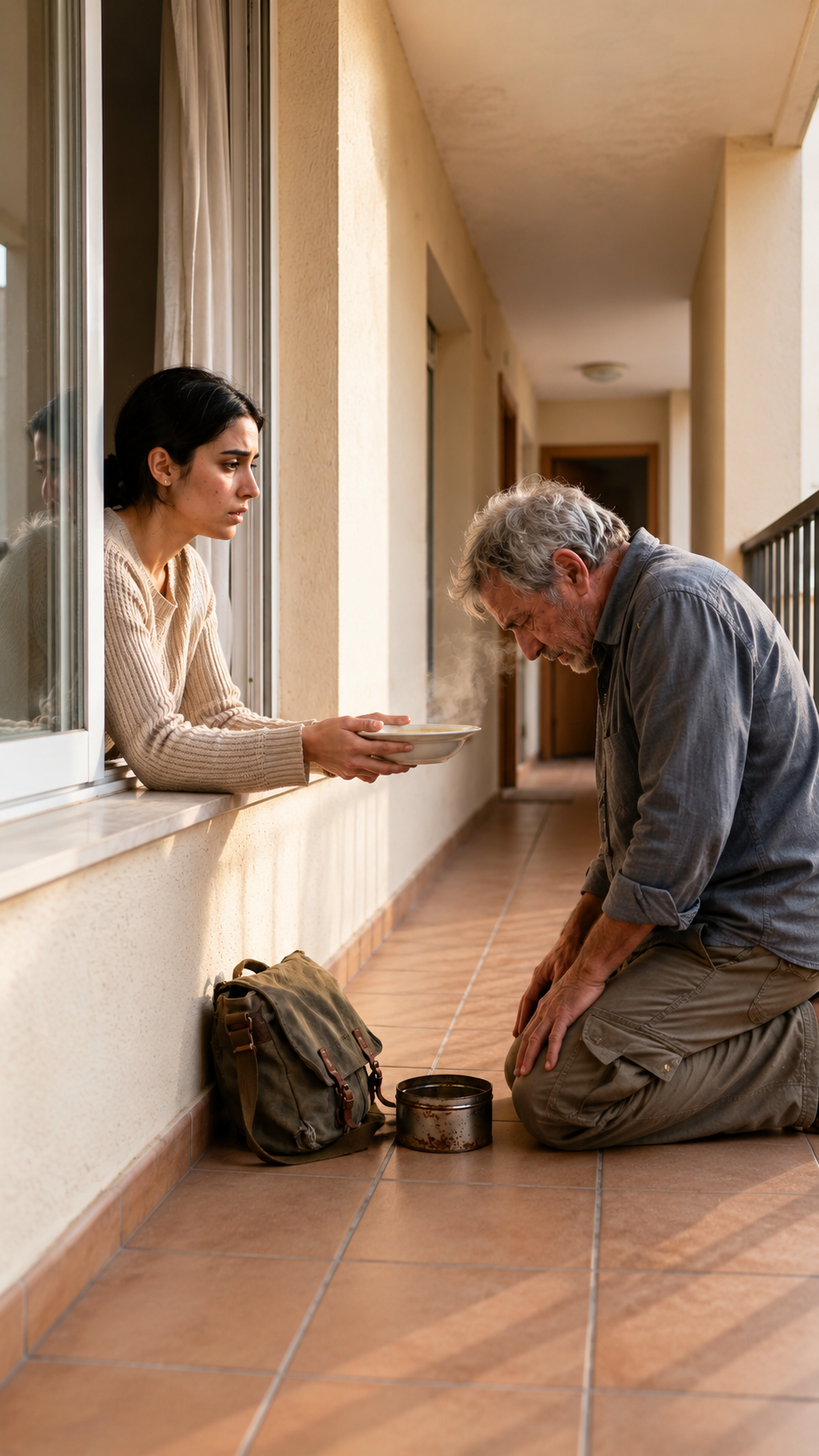
Her window opened to the outside hallway. She opened it slowly.
Aurelio was still there.
He was sitting on the floor, hugging the rusty box to his chest, with hunched shoulders and dusty, worn-out shoes.
—Uncle —Camila whispered.
He lifted his face, startled.
—Camila?
She passed him the bowl.
—Eat it before it gets cold.
Aurelio wanted to refuse, but his hands trembled too much. When he took the food, the steam hit his face, and his eyes filled with tears.
Then something happened that Camila would never forget.
Aurelio knelt on the cement.
—No, uncle, don’t do that.
But he lowered his forehead to touch the floor.
—Thank you, daughter.
Tap.
—Thank you.
Tap.
—God bless you.
Camila froze.
A man who had survived 20 years in prison was kneeling for a hot meal.
And while he cried, he kept clutching that rusty box as if it held the only truth left in him.
Camila understood something terrible: her family didn’t hate him for being a thief.
They feared him for what he could reveal.
And when days later she opened that box, she discovered that the true criminal had always dined at the main table.
PART 2
The next morning, Aurelio was no longer at the entrance.
Doña Josefina made coffee as if nothing had happened. Octavio opened the grocery store early. Daniel came by for some invoices and mockingly said:
—He probably went to find someone to pity him. Those people never change.
Camila didn’t respond.
She put on her high school uniform but didn’t walk to school. Instead, she took the old streets behind the market, where there were abandoned warehouses and roofless rooms that the scavengers used for sleeping.
She found him in a damp little room, lying on cardboard.
The rusty box was beside him, wrapped in a black bag.
—Uncle Aurelio.
He bolted upright.
—You shouldn’t have come, girl. If your dad finds out, you’re going to be in trouble.
—Did you eat yet?
Aurelio showed half a hard bread roll.
Camila took out of her backpack a bean torta with cheese, a juice, and some cough pills.
—Here.
—I can’t take what’s yours.
—you’re not taking anything. I’m sharing.
Aurelio bit into the torta with shame, as if each bite needed permission.
Camila looked at the box.
—Why do you always carry it?
He stopped chewing.
—Because inside is the only thing they couldn’t take from me.
—At home, they say you stole 80,000 pesos from the Textiles La Esperanza factory.
Aurelio looked down.
—That’s what they say.
—And is it true?
The man closed his eyes.
—There are truths that burn, Camila. It’s better not to touch them with your hands.
But Camila had already touched the fire.
That very afternoon, Doña Josefina fell in the bathroom. They took her to the General Hospital. She had a fractured hip and needed urgent surgery.
The doctor spoke of bills, deposits, and materials. The initial amount was almost the same as the curse everyone repeated: 80,000 pesos.
There, Camila watched how the supposed exemplary family crumbled.
Octavio said he had no cash because he had just stocked up on merchandise.
Daniel swore he was paying for his son’s university.
Patricia commented that “the elderly should also foresee their expenses.”
Lorena remained silent, staring at the floor.
In the end, Octavio borrowed money with interest from a market acquaintance. He signed papers with a tough face but nervous hands.
In the hospital corridor, Daniel complained:
—All of this stems from Aurelio. If he hadn’t stolen those 80,000, the Vázquez name wouldn’t be cursed.
Camila felt a chill.
80,000.
The grandmother's operation cost 80,000.
The factory theft was for 80,000.
It couldn’t be a coincidence.
For 5 days, Camila visited her grandmother in the hospital in the morning and Aurelio in the afternoon. She brought him broth, bandages, an old jacket, and cigarettes he never smoked but accepted to trade for coffee.
Aurelio only asked one thing:
—Is your grandmother okay?
He never asked about Octavio.
He never asked about Daniel.
He never asked about himself.
One afternoon, Camila found him with a fever. He was soaked in sweat, breathing poorly, holding the box like a scared child.
She took him to a small clinic. She paid with the money she had saved for a used cell phone.
When they returned to the little room, Aurelio fell asleep on the cardboard.
The box was next to him.
Camila stared at it for a long time.
She knew she shouldn’t open it.
But she thought of the closed gate. Of her father calling him trash. Of her grandmother putting on the chain. Of that man kneeling for a soup.
She found a stone and broke the lock.
Inside, there were no bills.
No jewelry.
There were letters, old receipts, a folded family photo, and a dried scapular.
The first letter had Doña Josefina’s trembling handwriting.
“Aurelio, your dad is very ill. The doctor says he will die without surgery. Your siblings can’t get any money. Do something, son. For the Virgin, do something.”
The second letter was signed by Daniel.
“You’re the only one who still has access to the warehouse at night. No one will suspect you if you do things right. Don’t be a coward. It’s for dad.”
Camila felt sick.
Then she found the receipt.
San Rafael Hospital.
Patient: Gregorio Vázquez.
Payment received: 80,000 pesos.
Name of the payer: Aurelio Vázquez.
Date: 3 days after the theft.
The money that the whole family said Aurelio had stolen out of greed had been used to save grandfather Gregorio.
But at the bottom of the box was something worse.
A folded sheet written in blue ink.
The signature was Octavio’s.
Camila read it while standing.
Then she had to sit down because her legs wouldn’t hold her.
The letter said:
“Aurelio:
I spoke with Daniel. Tomorrow they will leave the payroll cash in the small office. Just take 80,000. Don’t touch the rest.
I have a copy of the key.
If anything goes wrong, you say you did it alone. You’re the youngest, you have no family of your own, they’ll give you little time. We’ll take care of mom and pay for dad’s.
When you get out, I’ll set you up, buy you tools, and no one will disrespect you.
Don’t see it as theft. See it as sacrifice.
We are blood.
Your brother, Octavio.”
Camila stared at the signature.
Octavio, the man who shouted about honor at the table, had planned it all.
Aurelio hadn’t been the monster.
He had been the scapegoat.
A 22-year-old boy who believed in his brothers, stole to pay for a surgery, turned himself in to protect them, and received 20 years in prison because no one kept the promise.
Worse still: grandfather Gregorio lived 4 more years thanks to that money.
The family inherited his land, built the store, bought trucks, paid for schooling, and celebrated christenings on the sacrifice of the man they later left trembling outside.
Camila put the letter and receipt in a plastic bag. She closed the box as best she could.
That night she returned to the hospital.
Doña Josefina was awake, her face pale and hair tied up. Octavio was sitting beside her, going through accounts in a notebook.
—Where have you been? —he asked—. I called you 6 times.
Camila looked at him intently.
—I went to see Aurelio.
Octavio shot up.
—I told you to stay away from that criminal.
—Criminal? Or witness?
Doña Josefina dropped her spoon.
Octavio paled slightly, but Camila noticed.
—Don’t start with nonsense.
—Grandma, how much did grandfather Gregorio’s operation cost?
Silence filled the room.
Doña Josefina moved her lips, but no words came out.
Octavio stepped toward Camila.
—Shut up.
—80,000 pesos?
The grandmother closed her eyes.
That reaction was enough.
Camila understood that it wasn’t enough to know the truth. She had to expose it where it hurt the most: in front of the very family that had used shame as a tablecloth.
For 1 week, she skipped afternoon classes. She went to the industrial colony where Textiles La Esperanza used to be. She asked at tortilla shops, diners, and workshops about former workers.
That’s how she found don Hilario, the factory’s former night watchman.
When Camila mentioned Aurelio Vázquez, the old man stopped drinking coffee.
—That boy wasn’t a thief —he said—. He didn’t go in alone that night.
She also found doña Meche, who worked in accounting.
—The office was opened with a key —she recalled—. There was no forced lock. But the boss wanted to close the matter quickly. It suited him to blame the weakest.
Last was don Abel, the former driver of the manager.
He looked at Octavio’s letter and crossed himself.
—I saw your dad outside that night. He was wearing a brown jacket and smoking by the gate. When Aurelio came out, Octavio said something in his ear. The next day, everyone swore Aurelio acted alone.
Camila asked for help.
Not money.
Not fights.
Just presence.
The following Sunday, Doña Josefina turned 75. The family organized a big meal in the neighborhood: carnitas, rice, tres leches cake, recorded mariachi, and photos to appear united.
Octavio toasted in front of everyone.
—This family may be humble, but we’ve always had dignity. We don’t protect thieves here.
In that moment, Camila opened the gate.
She entered with Aurelio by the arm.
She had bought him a gray shirt, black pants, and simple shoes at the market. Still, he walked in fear, as if expecting someone to throw him out.
Behind them came don Hilario, doña Meche, and don Abel.
Laughter died.
Doña Josefina clutched her chest.
Daniel left his taco halfway.
Octavio lowered the glass.
—What’s this man doing here?
Camila replied without shouting:
—He’s here to hear the truth that you buried 20 years ago.
Patricia stood up indignantly.
—Girl, don’t make your scene. It’s your grandmother’s birthday.
—It’s not a scene. It’s a debt.
Daniel let out a nervous laugh.
—Debt? Now the thief comes to collect?
Aurelio lowered his head.
Camila stepped in front of him.
—Don’t call a thief someone who paid for your dad’s operation.
The patio fell silent.
Doña Josefina began to cry before Camila pulled out the receipt.
—Here’s the hospital proof. 80,000 pesos paid by Aurelio Vázquez to operate Gregorio Vázquez.
Octavio clenched his jaw.
—That doesn’t prove anything. He could have stolen and paid. He’s still a thief.
—Yes —Camila said—. But he didn’t plan it alone.
She pulled out the letter.
Octavio tried to move forward, but don Hilario blocked him.
—Don’t you dare, Octavio.
Camila read every word.
She read about the key.
She read about taking the blame alone.
She read about the promised job.
She read “we are blood.”
When she finished, no one was eating. No one moved. Even the children had fallen silent.
Aurelio slowly raised his gaze. He looked at Octavio, then at Daniel, then at his mother.
—So it was true? —he asked, his voice broken—. You did leave me alone?
Doña Josefina covered her face.
—I thought they’d give you less time, son. I thought when you got out everything would be fine.
—When I got out, you shut the door on me.
The grandmother cried louder.
—I was ashamed.
Aurelio took time to respond.
—Ashamed of me, mom? Or ashamed for using me?
Daniel raised his hands.
—Don’t involve me. I didn’t write that letter.
Doña Meche looked at him with disdain.
—but you did sign a statement saying you knew nothing about the money.
Daniel froze.
Don Abel added:
—and you, Octavio, were at the factory that night.
Octavio exploded.
—I did it for my father! Everyone wanted Gregorio to live! Everyone cried, everyone begged for money, but now I’m the bad guy!
Camila felt her blood rush to her face.
—No. The bad guy wasn’t the one who sought to save his father. The bad guy was the one who let his brother serve 20 years and then called him trash in front of his daughter.
The patio erupted.
Some uncles shouted. Patricia cried out of anger. Lorena, Camila’s mom, sat as if she had just discovered with whom she had slept for half her life.
Aurelio didn’t shout.
He didn’t insult.
He simply looked at Octavio and said:
—I would have endured prison if, when I got out, you had looked at me like a brother. But you took that away from me too.
That phrase hurt more than any blow.
That very afternoon, don Hilario accompanied Camila to the Public Ministry. They submitted copies of the letter, the receipt, and the testimonies. The case wasn’t easy. Twenty years had passed, many papers had been lost, and several responsible parties were no longer present.
But Octavio’s handwriting was confirmed. Old factory files appeared, and a altered declaration. Octavio ended up prosecuted for false testimony, concealment, and fraud related to the reopened case.
He didn’t receive 20 years.
That was the most unjust part.
But he did enter handcuffed into the same patio where he had boasted of dignity. And for a man who lived by appearances, seeing neighbors recording with their phones was a condemnation that tore his mask away.
Daniel gave money to “fix the damage.” No one believed in his goodness. He did it because he was afraid of falling too.
Doña Josefina apologized many times.
Aurelio listened to her one afternoon in the hospital. He didn’t insult her. He didn’t hug her.
He simply told her:
—I forgive you so I don’t carry it on my back. But I won’t sleep outside any door again.
After that, he left with Camila and Lorena to a small apartment near the terminal. Lorena had also left the house, not out of immediate bravery, but because the truth had given her enough shame to start late.
The place had 2 bedrooms, 1 used table, and a window through which a lot of sunlight came in.
Aurelio found work as a watchman at a private school. The kids liked him because he always opened the door with a smile and told them to walk carefully.
The rusty box stopped being hidden.
Camila cleaned it, took off the string, and placed it on a shelf in the living room.
Inside were the letters, the hospital receipt, and an old photo where Aurelio was 22 years old, in a white shirt, bright eyes, and a future that his own family stole from him.
One night, Camila returned from school and found the table set.
There was rice, beans, chicken in green sauce, and a bowl of soup with egg.
Aurelio set it in front of her.
—Eat it before it gets cold, little one.
Camila smiled with her eyes filled with tears.
—It’s just like when I was 6.
Aurelio sat down slowly.
He no longer looked like a defeated man. Yes, he had wrinkles. He walked slowly, too. But he no longer looked down when someone knocked at the door.
That night, as they dined, Camila understood that justice sometimes arrives late, tired, and with gaps that no one can fill.
It does not restore youth.
It does not erase bars.
It does not return 20 years.
But it can open a rusty box, lay a receipt on the table, and remind an entire family that the true thief isn’t always the one who goes to prison.
Sometimes the thief is the one who dines warm while another trembles outside.
And the shame wasn’t Aurelio.
The shame was all those who shut the door on him.





