PART 1
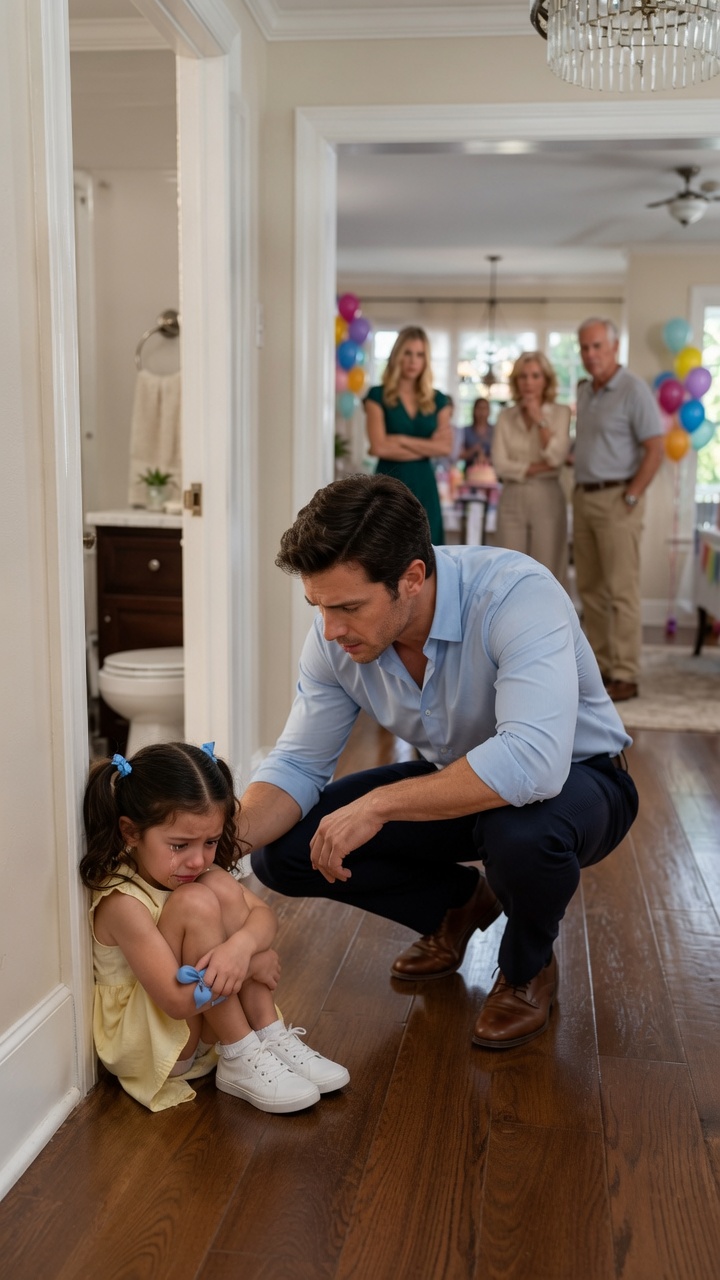
"Dad... do I have to apologize to Aunt Rebeca?" whispered Sofia, barely five years old, hiding behind the washing machine, pressing her wrist against her chest.
One cheek was red.
Not red from running.
Red from a slap.
Outside, the party continued as if nothing had happened.
In the backyard of their grandparents’ house, in a quiet neighborhood of Puebla, there were purple balloons, streamers, a table full of jellies, pambacitos, cups of horchata, and a huge mermaid piñata hanging from the tin roof.
It was Valentina’s sixth birthday, Rebeca’s daughter, Andrés’ older sister.
Children screamed around a bounce house.
Adults laughed with plates of cake in hand.
The music blared so loudly that it seemed to drown out any uncomfortable truths.
From the sidewalk, anyone would have said:
"What a beautiful family."
But Andrés had been searching for his daughter for fifteen minutes.
Sofia wasn’t a noisy child.
Ever since her mother, Elena, passed away two years ago from a medical complication, the little girl had grown quieter. She clung tightly to her dad. In large gatherings, she covered her ears. If someone spoke loudly, she looked down.
Andrés didn’t push her.
He knew a child doesn’t overcome the death of her mother just because adults say, "be strong."
He first looked by the birthday cake table.
Then in the kitchen.
Next in the bathroom.
He checked the TV room, the hallway, even under a table where the children had left toys.
Nothing.
Then he heard a small cry from the laundry room.
It wasn’t a tantrum.
It was fear.
When he opened the door, he felt something inside him shatter.
Sofia was sitting on the cold floor, between a bucket and a laundry basket. Her blue dress was wrinkled. Her cheeks were wet, her hair disheveled, and there were marks on her arms, as if someone had gripped her tightly.
Andrés crouched down slowly.
"My love, what happened?"
Sofia didn’t lift her gaze.
"Don’t get mad, Dad."
That phrase hurt more than the mark on her face.
Because no child should fear telling that they were hurt.
He tried to hug her, but she flinched slightly, as if expecting another yank.
Andrés swallowed hard.
"Who did this to you, Sofi?"
The little girl tightened her grip on her wrist.
"Aunt Rebeca said I ruined the party."
Andrés’ heart began to pound in his chest.
"And that’s why she hit you?"
Sofia closed her eyes.
"I just accidentally knocked over some cupcakes. Valentina pushed me a little and they fell. But Aunt said I was a spoiled child... that I always make drama."
Andrés carefully lifted her up.
The girl clung to his neck.
And in that moment, he remembered Elena in the hospital bed, pale, gasping for breath, squeezing his hand.
"Take care of Sofia, Andrés. Don’t let anyone make her feel alone."
He promised her.
And that day, he understood that sometimes danger doesn’t enter through the door.
Sometimes it’s already sitting at the family table, serving cake.
He stepped into the yard with Sofia in his arms.
The laughter faded slowly.
Rebeca was by the main table, arranging candles with a hard smile.
His mom, Doña Carmen, was carrying disposable plates.
His dad, Don Julián, had a beer in hand and that look of a man who prefers not to get involved in "women’s problems."
Everyone saw Sofia’s cheek.
Andrés asked in a low voice:
"Who touched my daughter?"
No one answered.
Rebeca let out a dry laugh.
"Oh, Andrés, don’t even start. Your daughter threw a terrible tantrum."
Andrés stared at her.
"What did you do to her?"
"I just took her inside to stop the show. She knocked over Valentina’s cupcakes and then started crying as if she were the victim."
Sofia buried her face in her dad’s neck.
Doña Carmen hurried over.
"Andrés, please. There are guests. Don’t make a scene."
He almost laughed.
His daughter was trembling and his mother was worried about appearances.
Don Julián lowered his voice.
"Kids exaggerate. They fall, they hit, they cry. Don’t turn a birthday party into a court."
Rebeca crossed her arms.
"You spoil her too much because you feel guilty about Elena."
The yard went silent.
Even the music seemed to sound farther away.
Andrés looked at his sister, then at his parents.
In that second, he understood he wouldn’t find justice there.
Just excuses.
"We’re leaving."
Doña Carmen grabbed his arm.
"Don’t humiliate us in front of the whole family."
Andrés shrugged her off.
"You’ve humiliated yourselves already."
He walked toward the exit with Sofia pressed against his chest.
As they passed the table, Valentina looked at her cousin fearfully, but said nothing. Rebeca pulled her toward her, as if the girl could also reveal something.
In the car, Andrés secured Sofia in her seat.
The little girl was still crying softly.
As he drove toward the emergency room, she asked again:
"Dad... do I really have to apologize to Aunt?"
Andrés tightened his grip on the wheel.
"No, my love. You never have to apologize for someone hurting you."
The light turned green.
At that moment, his phone started ringing.
It was his mom.
Andrés didn’t answer.
He still didn’t know that call wasn’t to ask about Sofia.
It was to start covering up a much bigger lie.
PART 2
At the emergency room, the doctor saw Sofia and her expression changed.
She didn’t say, "I’m sure it’s nothing."
She didn’t minimize.
She didn’t force her to talk.
She crouched down to her level, offered her a lollipop, and asked for permission before examining her arms.
Sofia barely nodded.
Andrés stood beside the gurney, feeling every mark was a direct accusation against him for trusting too much.
The doctor took pictures.
She documented the time.
She noted the injury on the cheek.
She examined the arms.
Then she looked at Andrés with a calmness that was frightening.
"We’re going to document everything. We’ll also alert authorities for follow-up."
He nodded.
Not because he wanted to destroy anyone.
But because the truth, if not written down, would be erased by family with phrases like "don’t exaggerate," "it was an accident," or "we’re blood."
Later, a worker from the DIF arrived.
Andrés recounted everything.
The party.
The laundry room.
The red cheek.
The marks.
Rebeca’s words.
His parents’ silence.
Sofia fell asleep clutching her wrist.
She looked exhausted, as if she had cried all a five-year-old could cry in one day.
The next morning, Andrés found a bag at the entrance of his house.
Inside were the shoes that Sofia had forgotten at the party and a note written by Doña Carmen.
"Andrés, think carefully about what you’re doing. Rebeca is under a lot of pressure. Sofia has always been delicate. In a family, we forgive before destroying our own."
He read it twice.
Not one question about Sofia.
Not one apology.
Not a single line asking: "How is my granddaughter?"
Before he could breathe, a message from Rebeca arrived.
"You’re making a drama."
Then another.
"Say she fell. Don’t be mean."
Then another.
"My parents are with me. Don’t ruin my life over your daughter’s tantrum."
Andrés took screenshots.
By noon, Don Julián called.
Andrés answered on speaker, but when he saw Sofia stop coloring as soon as she heard her grandfather's voice, he went to the hallway.
"We need to think calmly," his father said.
"Calmly for what?"
"Your sister works at a daycare. If this gets out, she could be fired. Do you want to carry that?"
Andrés closed his eyes.
"Are you more worried about her job than your granddaughter?"
"Don’t twist it. We want to keep the family together."
"No. You want to keep a little girl silent."
There was silence.
Then his father said:
"Your mom is devastated."
Andrés looked toward the living room.
Sofia was pretending to color, but the crayon wasn’t moving.
"My daughter is too."
That afternoon, he sent everything to the DIF worker: the note, the messages, the medical report, and the photos.
Two days later, an investigator sat in his kitchen.
He listened to everything without interrupting.
At the end, he reviewed the screenshots and said:
"Keep every message. Sometimes the truth doesn’t come screaming. Sometimes it leaves a trail."
Andrés couldn’t imagine how much trail Rebeca had left.
That night, Martín, a cousin who had set up some lights in the backyard for the party, called him.
"Andrés... I don’t know if I should get involved, but I checked a camera."
Andrés froze.
"What camera?"
"The one on the terrace. It doesn’t record the laundry room, but it does the entrance to the house. And it has audio."
His stomach twisted.
"What does it show?"
Martín took a deep breath.
"You can see Rebeca grabbing Sofia by the arm. Your girl isn’t running, she isn’t throwing herself on the floor, nothing. She’s crying, but walking. And before going in... Rebeca says something."
Andrés felt cold.
"Send it to me."
The video lasted barely 18 seconds.
But 18 seconds were enough to shatter years of Sunday dinners, false hugs, and that comfortable idea that family always protects.
On the screen, Rebeca walked quickly with Sofia taken by the arm.
The girl looked confused, scared.
She wasn’t throwing a tantrum.
She wasn’t kicking.
She wasn’t screaming.
She was just crying softly.
Before closing the door, Rebeca’s voice rang out clearly:
"Now you’re going to learn not to ruin my daughter’s party."
Then came a sharp thud.
Then Sofia’s crying.
Andrés stared at his phone without blinking.
There it was.
The proof.
You couldn’t see the hand striking.
But the words, the sound, the marks, the medical report, the messages asking to lie, and his mother’s note formed a chain no one could break.
The next day, he took the video to the Public Ministry and the DIF.
The attorney played the file three times.
Then took notes.
"This changes a lot."
Yes.
It changed everything.
Rebeca changed her story three times.
First, she said Sofia fell.
Then she said the girl threw herself on the floor by herself.
Then she said she only "corrected" her because Andrés didn’t know how to set limits.
Doña Carmen and Don Julián said they hadn’t seen anything.
That was what hurt Andrés the most.
Not because he expected too much.
But because a foolish part of him still believed that upon seeing the video, his parents would think first of Sofia.
It didn’t happen.
His mom called him crying.
"Andrés, please. Your sister could lose everything."
"My daughter lost her safety in her own family."
"It was a mistake."
"No. A mistake is knocking over a glass. This was hurting a child and then asking us to lie."
Don Julián took the phone.
"You’re being cruel."
The word disgusted him.
Cruel was Sofia hiding behind a washing machine asking if she should apologize.
Cruel was a grandmother defending her adult daughter’s image before the safety of her granddaughter.
Cruel was a grandfather worrying about a daycare, not about a five-year-old girl.
Andrés took a deep breath.
"Don’t ever contact Sofia again."
On the other end, there was silence.
Then his mother murmured:
"Are you going to take our granddaughter away?"
"No. You let her go when you chose to protect Rebeca."
He hung up.
It didn’t feel like a victory.
It felt like closing a door with hands full of glass.
Weeks later, Rebeca was temporarily removed from the daycare while the investigation progressed.
The DIF documented the family pressure.
The Public Ministry integrated the case.
His parents weren’t charged with hitting Sofia, but their messages, calls, and the note remained evidence that they tried to minimize and hide what happened.
For Andrés, that was enough.
One Saturday afternoon, Rebeca appeared in front of his house unannounced.
Andrés was on the porch.
Sofia was inside watching cartoons.
Rebeca got out of the car with red eyes but didn’t seem remorseful.
She looked furious.
"Are you happy?" she said. "You ruined me."
Andrés didn’t move.
"No. You did."
"It was a moment, Andrés. A damn moment. Are you going to destroy me for that?"
"My daughter is going to remember that moment for the rest of her life."
Rebeca clenched her jaw.
"Sofia was always strange. Always crying, always attached to you. You made her weak."
There Andrés understood the saddest truth.
Rebeca didn’t regret hurting a child.
She regretted being discovered.
He opened the door to his house.
"Leave."
"You’re going to be alone."
Andrés looked toward the living room.
Sofia was hugging her wrist and giggling softly at something she saw on TV.
"No. I’m staying with who matters."
Rebeca shouted from the sidewalk.
She said he was exaggerating.
That Elena had left him traumatized.
That Sofia was going to grow up "unbearable."
Andrés locked the door.
And for the first time in a long time, he didn’t feel guilty.
The following months were strange.
The house didn’t become empty.
It became peaceful.
Sofia started sleeping better.
At first, she woke up in the middle of the night asking if Aunt Rebeca was coming.
Andrés sat by her bed, stroked her hair, and repeated:
"No, my love. You’re safe here."
The first time Sofia laughed loudly again, Andrés cried in the kitchen without her seeing.
The first time she wanted to go to a classmate’s birthday, he felt fear, but he accompanied her.
Sofia clung to his hand for the first few minutes.
Then she let go to grab a slice of cake.
That simple gesture felt like a miracle.
One Sunday afternoon, when the sky was orange over the rooftops and it smelled of freshly baked sweet bread, Sofia sat with him in the yard.
She wore a blanket over her shoulders and her doll in her lap.
"Dad," she said.
"Yes, my angel?"
"Did my mom know you were going to take care of me?"
Andrés’ throat tightened.
He looked at the photo of Elena by the door: her holding newborn Sofia, with a tired but beautiful smile.
"Yes," he answered. "She knew."
"Because you promised her?"
He kissed her forehead.
"Because I promised her. And because you are the most important thing in my life."
That night, after tucking her in, Andrés stayed looking at the slightly open door of her room.
For a long time, he thought losing Elena had been the hardest thing in his life.
He was wrong.
The hardest thing was discovering that some people called family would ask you to protect their reputation before protecting a child.
He also learned something.
Family isn’t demonstrated with last names, old photos, or Sunday dinners.
Family is demonstrated when a vulnerable person is scared and everyone must choose which side to be on.
If defending Sofia meant distancing himself from his parents, his sister, and all that blood poisoned by excuses, Andrés would walk away without looking back.
Because no little girl should ever wonder if she has to apologize for being hurt.
Because the silence of adults can teach a child that their pain is a nuisance.
And because a promise made beside a hospital bed isn’t broken when the truth is uncomfortable.
Elena asked him to take care of Sofia.
And Andrés would do that.
Until his last day.





