PART 1
—If you throw another tantrum, Emiliano, I’ll take you to a clinic tomorrow, and no one will come to rescue you.
Rodrigo's voice echoed in the second-floor bedroom as the rain lashed against the windows of that big house in Del Valle, Mexico City.
Emiliano, ten years old, didn’t respond. He just pressed his cast against the corner of the wall again.
Knock. Knock. Knock.
The sound was dry, desperate, as if it wanted not to break the wall, but to escape from his own body.
Marta, the nanny who had worked for the family for eighteen years, froze at the door. She had seen tantrums, fevers, grief, couple fights. But this wasn’t mere stubbornness.
It was terror.
—Get it off me! —Emiliano screamed, his face drenched in sweat—. It’s moving! They’re biting me from the inside!
His eyes were wide, red from lack of sleep. With his healthy hand, he tried to push a pencil under the edge of the cast, scratching himself until the bandage was stained with blood.
He had broken his arm three weeks earlier when he fell at school during a soccer match. At first, everything seemed normal. Pain, cast, rest.
But for the past five days, the boy had cried in the early hours, saying something was crawling inside.
Rodrigo barged in, furious, his shirt wrinkled, his face drawn with exhaustion.
—Enough, Emiliano! —he shouted, gripping him by the shoulders—. Do you want to lose your arm for being stubborn?
—Dad, I swear, I’m not lying! —the boy sobbed—. It itches, it burns, it moves!
Rodrigo didn’t listen. He grabbed a tie from the closet and tied the healthy wrist to the headboard to keep him from hitting himself.
Renata appeared at the entrance, Rodrigo's new wife. Tall, perfumed, impeccable, in a beige robe that looked like it had just come from a magazine.
She didn’t approach the boy. She didn’t touch him. She just sighed.
—I told you, my love —she murmured—. This isn’t pain anymore. It’s emotional blackmail. Since I moved in here, he does everything to make you feel guilty.
Emiliano glared at her with rage and fear.
—You know what you did!
Renata opened her mouth, feigning surprise.
—See? Now he’s accusing me. This has crossed a line, Rodrigo. He needs professional help before he hurts himself worse.
Rodrigo closed his eyes. Since Laura, Emiliano's mother, died, he had tried to keep the house afloat as best he could. When Renata arrived, sweet and patient, he thought finally someone would bring peace.
But now his son screamed every night as if he were being tortured.
Marta approached slowly. She changed the sweaty pillow and then noticed it.
The smell.
It wasn’t just sweat. It wasn’t moisture from the cast. It was something sweet, heavy, rotten, like spoiled fruit mixed with an infected wound.
—Mr. Rodrigo —Marta said softly—. The boy is burning up.
—He’s hot because he won’t stop moving.
—No. This is fever.
Renata let out a dry laugh.
—Marta, with all due respect, you’re not a doctor. Don’t put more strange ideas in the boy’s head.
Emiliano twisted again.
—Nana, please… get them out.
Marta swallowed hard. While adjusting the sheet, she saw something small cross the white fabric.
A red ant.
It wasn’t heading to the floor. It walked straight to the boy’s arm and disappeared through a dark crack between the cast and his skin.
Marta felt her hands go cold.
—Sir… I just saw an ant get into the cast.
Rodrigo looked at her with annoyance.
—Then clean the room better. He’s probably hiding candy somewhere.
—Emiliano has hardly eaten in two days.
Renata crossed her arms.
—See how everyone coddles him? That’s why he’s like this. Tomorrow we’re calling the clinic. This can’t continue.
The boy stopped screaming for a moment. He looked at Marta with cracked lips.
—Nana… don’t let them lock me up. I’m not crazy.
Marta wanted to respond, but another ant crawled out from under the edge of the cast and vanished among the sheets before Rodrigo could see it.
That night, while Renata smiled from the hallway, Marta understood that something monstrous lived beneath that white shell.
And the worst part was that someone in that house was doing everything to ensure no one discovered it.
PART 2
The next morning, Rodrigo appeared in the living room with a yellow folder and his phone pressed to his ear. His beard was unkempt and his eyes were red.
—Yes, doctor, I understand —he said—. I’ll take him today. Yes, I authorize a psychiatric evaluation.
Emiliano listened from the stairs. He came down slowly, holding his arm against his chest as if carrying fire.
—Dad, no —he pleaded—. Don’t send me there.
Rodrigo hung up and took a deep breath.
—Son, it’s for your own good.
—I’m not crazy!
Renata appeared behind him and patted his shoulder.
—Don’t argue, my love. The more you explain, the more he acts up. You saw how he manipulates everyone.
Marta left a tray with coffee on the table. The cups clinked from how hard she set it down.
—Before you admit him, take him to the ER.
Rodrigo frowned.
—Marta, please, don’t start.
—Touch his forehead. Smell his arm. See how he trembles. That’s not madness, sir. It’s an infection.
Renata immediately stepped forward.
—What if a doctor sees his bruised arm? What do you think will happen? They’ll call social services. They’ll say Rodrigo neglected his child. Is that what you want? To get into trouble over an exaggeration?
The word “social services” dropped like a stone.
Rodrigo paled. And Renata noticed. That was her power: not to yell, but to plant fear right where it hurt the most.
Emiliano approached Marta and held her hand with his swollen fingers.
—Nana —he whispered so quietly only she could hear—. Go get the big bread knife.
Marta felt a knot in her stomach.
—What for, my child?
—Cut off my arm. I don’t want it anymore. I promise I won’t scream.
Marta’s eyes filled with tears.
A child who once cried over a vaccine now preferred to lose an arm rather than endure another minute.
—Don’t say that, sweetheart.
—Then help me —he begged—. She did something to me.
Marta looked up. Renata didn’t seem worried. She looked watchful.
That afternoon, while Rodrigo signed the admission papers for the clinic, Marta went upstairs to change the sheets. The smell was worse. Sweet, sour, sick.
Emiliano was no longer screaming. That scared her more.
He was pale, his lips dry, his breathing shallow. His eyes stared at the ceiling, but they didn’t focus.
—Nana… are they gone? —he mumbled.
—Who, my love?
—The ones who walk.
Marta checked the edge of the cast. The skin was red, humid, inflamed. Between the gauze and the edge, she saw dark dots moving.
She rushed to the kitchen with her heart racing. She didn’t search for the knife.
She searched for evidence.
In the trash can in the yard, she found sticky napkins, a nearly empty jar of honey, and a bottle of corn syrup, the kind used for desserts. Everything was wrapped in a black bag, hidden under food scraps.
Marta remembered perfectly that Emiliano hadn’t had any sweets.
Then she heard footsteps behind her.
—Did you lose something? —Renata asked.
Marta straightened up slowly.
—I’m taking out the trash.
Renata smiled, but her eyes turned hard.
—Don’t get involved where you’re not wanted. You’re old enough, Marta. It would be sad if you ended up on the street for defending a child who isn’t even yours.
Marta didn’t answer. She tucked a sticky napkin into her apron pocket and kept walking.
At midnight, the rain returned stronger. Rodrigo received a message from the clinic: they would pick up Emiliano at 8 a.m.
Renata packed a small bag with the boy’s clothes, as if sending him on a trip.
—You’ll see, in a few days, he’ll come back calmer —she said, arranging pajamas.
But Emiliano didn’t arrive in the morning.
At 2:17, Marta heard a dull thud.
She ran to the room. The boy was convulsing on the bed, arched, with his eyes rolled back and the cast trembling against his chest.
There was no time to convince anyone.
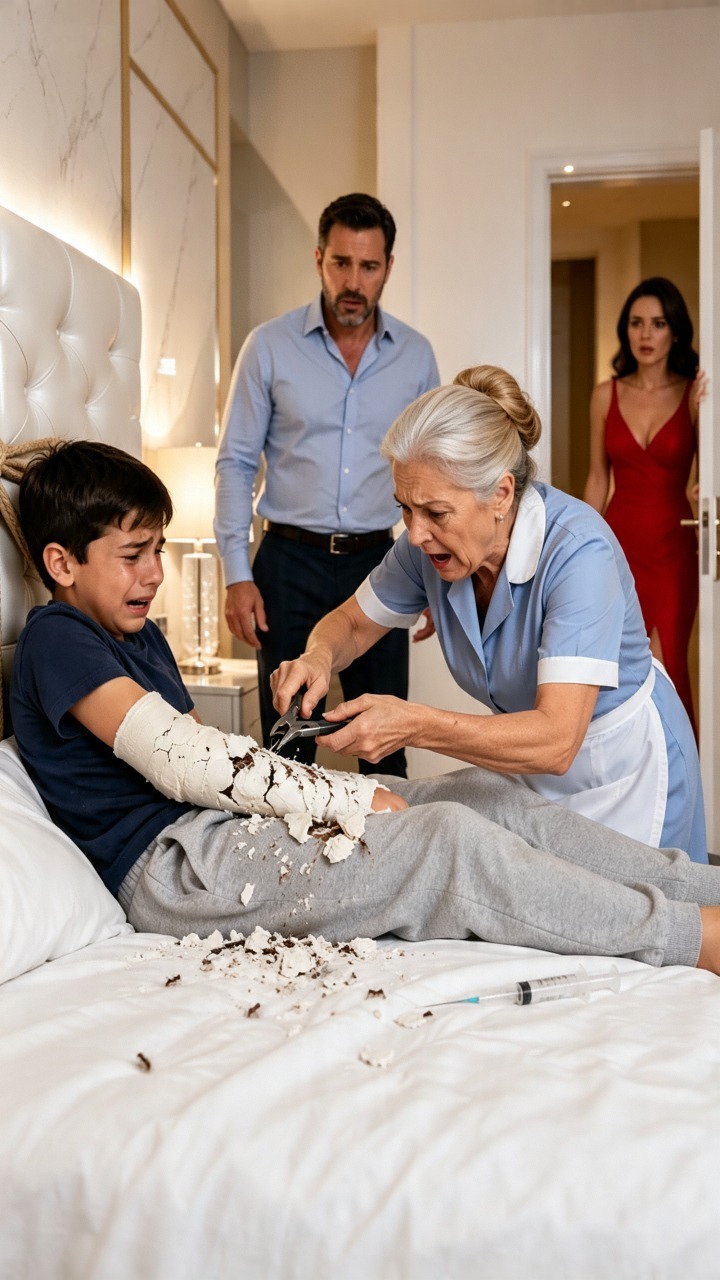
Marta dashed to the garage, opened Rodrigo’s toolbox, and grabbed heavy, rusty industrial pliers that were used for cutting thick wire.
She ran upstairs, entered the room, and locked the door.
On the other side, Rodrigo pounded the wood.
—Marta! What are you doing?
Renata screamed:
—She’s crazy! She’s going to kill the boy!
Marta knelt beside Emiliano. She stroked his soaked hair.
—Hold on, my life. The nanny is going to get that out of there.
She placed the pliers at the edge of the cast and squeezed with all her might.
Crack.
The first piece opened.
An unbearable stench burst out, so sweet and rotten that Rodrigo stopped pounding on the door for a second.
Marta squeezed again.
Crack.
The line opened up to the elbow. Emiliano groaned with purple lips.
—Do you see them, nana? —he whispered.
Marta looked inside and felt her soul shatter.
—Yes, my child. I see them.
And although it was horrific, that phrase brought peace to the boy. Finally, someone believed him.
Marta inserted her fingers into the opening and pulled. The cast broke like an old shell and fell to the floor.
What appeared beneath was not just an injury.
It was living cruelty.
Emiliano’s arm was swollen, red, full of open wounds. There were black, sticky areas, with dried blood and a shiny substance that smelled like fermented honey.
Among the internal gauze, red ants moved, desperate for the light. There were also small white larvae stuck to the sweet remains.
Marta screamed, not out of disgust, but out of rage.
In that moment, the door burst open. Rodrigo charged in furious, ready to take the pliers away from her.
But he stopped.
First, the smell hit him. Then he saw the broken cast. He saw the ants scattering on the carpet. He saw his son’s arm.
And everything collapsed around him.
—No… —he murmured.
Marta kicked a piece of cast toward him.
—Look closely, Mr. Rodrigo. Your son wasn’t crazy. He wasn’t making anything up. They were eating him alive beneath the cast while you tied him to the bed.
Rodrigo brought a hand to his mouth. He remembered every night he had called him exaggerated. Every time he had yelled at him. Every time he had believed Renata more than the terrified eyes of his son.
He doubled over and vomited on the floor.
Emiliano, half unconscious, cried softly.
—Dad… it was true.
Rodrigo fell to his knees.
—I’m sorry, son. I’m so sorry. Please forgive me.
Marta wouldn’t let him sink.
—To the bathroom! We need to clean him up and call an ambulance.
Rodrigo clumsily lifted Emiliano in his hands, as if he were made of glass. He turned on the shower with warm water and began to wash the arm. Every insect that fell down the drain was a stab to his heart.
—I’m sorry, my child —he repeated—. Dad was an idiot. Dad didn’t listen to you.
Marta called 911. While she spoke, she saw Renata at the entrance.
The woman was pale but not destroyed. Her eyes weren’t on Emiliano.
They were on the bedside drawer.
Marta followed that gaze.
Inside were bandages, pills, small scissors, and, at the back, a thick culinary syringe, the kind used for filling cakes. The tip was sticky. The plastic held crystallized golden residues.
Marta picked it up with a towel.
—Mr. Rodrigo.
He came out of the bathroom with Emiliano wrapped in a white towel. Seeing the syringe, he froze.
—What is that?
Renata stepped back.
—I don’t know. It must be from the kitchen.
—It was in the child's medicine drawer —Marta said.
Rodrigo walked toward her with heavy breathing.
—What did you do to him?
—Nothing. You’re exaggerating. The boy must have put candy in the cast. You know how he is.
Emiliano barely opened his eyes.
—She came in when you went to Puebla —he murmured—. She told me that if I spoke, you would send me far away. She held my arm. I felt cold. Then sticky. Then they came.
Rodrigo stopped breathing.
The trip to Puebla. Two weeks earlier. A work meeting. Marta had gone to the doctor. Renata had been alone with Emiliano.
Everything fit together with brutal precision.
—You put honey in the cast —Rodrigo said, his voice low—. You injected him with sugar.
Renata tried to maintain her mask, but it shattered.
—It wasn’t that serious.
Marta felt the urge to slap her.
—It wasn’t that serious?
Renata exploded.
—Since I married you, this house revolves around him! Always Emiliano, his therapy, his school, his dead mother, his memories! I’m family too, Rodrigo. I wanted a place too.
—Did you torture my son out of jealousy?
—He would have grown up hating me! —she shouted—. If they admitted him, maybe you and I could start anew. Without him in the middle every day.
The silence that followed was louder than any thunder.
Rodrigo raised his hand but stopped. He wasn’t going to become what she was.
He grabbed his phone.
—I need an ambulance and a police car —he said to 911—. My son was harmed by an adult in this house.
Renata tried to snatch the phone from him, but Marta stepped in front of her.
—Don’t you dare.
—You’re nobody —Renata spat.
Marta straightened up.
—I’m the woman who believed the boy.
The sirens arrived twelve minutes later. The paramedics rushed upstairs, and upon seeing Emiliano’s arm, their faces changed. They administered IV fluids, checked for fever, and covered the area with sterile gauze.
Rodrigo wanted to get on the ambulance, but Emiliano extended his healthy hand toward Marta.
—Let my nanny come.
Another wound opened inside Rodrigo, but he nodded.
—Of course, son. She’ll go with you. I’ll follow behind.
Marta climbed aboard. Emiliano rested his head on her lap.
—It’s over —she whispered—. No one will say you’re crazy anymore.
On the sidewalk, two police officers spoke with Renata. She cried, saying it was all a misunderstanding, that Marta hated her, that Emiliano was problematic.
But Rodrigo handed over the wrapped syringe, the sticky napkins, and the remnants of the cast.
—I also want to report threats and manipulation —he said—. And I will request a restraining order.
Renata glared at him with hatred.
—You’ll regret this. Without me, you can’t handle that child.
Rodrigo watched her in the rain, no longer seeing the perfect woman he thought he loved.
—Without you, I almost lost him.
In the pediatric hospital, the doctors confirmed the worst. Emiliano had a serious infection beneath the cast. The sweet mixture had kept moisture, attracted insects, and worsened the wounds.
—If you had waited 24 more hours —the doctor said—, we could have been talking about bone infection, amputation, or septic shock.
Rodrigo sat in the hallway and covered his face.
Marta stood in front of the operating room door, hands clasped. She didn’t cry. She had cried enough. Now she prayed.
The surgical cleaning lasted over two hours.
When the doctor came out, Rodrigo nearly collapsed as he stood up.
—Is my son okay?
—He’s stable. The arm is saved. He’s going to need antibiotics, dressings, and therapy, but we got to him in time.
Marta closed her eyes.
—Thank God.
When Emiliano woke up, the first thing he saw was Marta. Then he saw his father in the corner, his face shattered by guilt.
—Is she gone? —he asked.
Marta stroked his hair.
—Yes, my child. She’s gone.
Rodrigo approached slowly.
—Emiliano… I don’t know if you’ll ever be able to forgive me. But I’m going to spend the rest of my life listening to you. I should have believed you.
The boy looked at him for a long time. He didn’t say “I forgive you.” Not yet.
He only asked:
—Will she never come back?
—Never —Rodrigo replied—. I swear to you.
Emiliano closed his eyes.
—Then stay.
Rodrigo sat beside him and took his healthy hand. He cried in silence, not asking for absolution, not explaining his exhaustion, not making himself a victim.
For the first time, he understood that being a father wasn’t about paying for school, living in a nice neighborhood, or hiring help. Being a father was believing when a child said, “It hurts,” even if the truth shattered the perfect family.
Renata was arrested days later. The investigation gathered messages, purchases, honey residue in the syringe, Marta’s testimonies, and the medical report.
In the neighborhood, everyone talked. Some judged Rodrigo. Others defended Marta. Many wondered how many times a child can be telling the truth while adults call him exaggerated.
Weeks later, Emiliano returned home.
His room was completely cleaned. Rodrigo threw away the bed, the sheets, the carpet, and everything that reminded him of that night. But he couldn’t throw away the guilt. That he would have to learn to carry.
Emiliano had his arm bandaged, no longer in a cast, with marks that would take a long time to heal. He walked slowly, but alive.
Marta waited for him in the living room with chicken soup, lemon gelatin, and a soft blanket.
When the boy saw her, he smiled for the first time in weeks.
—Nana, can I sit with you?
—As long as you want.
Emiliano snuggled next to her. Rodrigo watched them from the entrance. Perhaps before it would have hurt him that his son sought Marta first. Now he understood.
Trust is not demanded. It’s earned.
And he had lost it when it mattered most.
Days later, Rodrigo asked Marta to stop calling him “sir.”
—You saved my son —he said—. This house is also yours as long as you want to be here. Not as an invisible employee. As family.
Marta looked at Emiliano, who was playing with some toy cars, carefully using the hand he nearly lost.
—I don’t need to be queen of any house —she replied—. I just need that when a child says it hurts, someone believes him.
Rodrigo lowered his gaze.
—I’m going to remember that every day.
Emiliano raised his eyes.
—Me too.
That night, the house was silent for the first time in a long while. But it was no longer a silence of fear. It was a clean silence, of open doors and calm breaths.
The marks on Emiliano’s arm didn’t disappear completely. But each one told a truth stronger than any lie.
Sometimes the monster doesn’t live in a child’s imagination.
Sometimes it lives in the comfort of adults who prefer not to look.
And that’s why, when a small person says, “Something is happening to me,” don’t silence them, don’t ridicule them, don’t send them to silence.
Because maybe their salvation depends on a single brave person willing to break the cast of appearances.





