PART 1
In the sand-colored house of a quiet neighborhood in Querétaro, everyone greeted Ernesto Aguilar as if he were a respectable man.
He drove a black truck, always wore a pressed shirt, and spoke loudly at neighborhood meetings, as if he owned the truth.
But inside that house, when the electric gate closed, Ernesto stopped pretending.
Mariana Ríos, 24 years old, could recognize the sound of his keys from the street.
It wasn’t ordinary fear.
It was the icy terror that grips the chest when someone learns that even breathing could be a reason for punishment.
Ernesto had been her stepfather for 9 years.
Her mother, Leticia, proudly referred to him as “my husband” in front of people, but at home, she called him “sir,” lowering her gaze as if asking for permission to exist was normal.
Every night, Ernesto found an excuse.
That the soup was cold.
That the television was too loud.
That Mariana had answered with a “bad tone.”
Sometimes he didn’t even bother to make something up.
He would sit in his chair, open a beer, and say:
—Mariana, come here. I’m bored.
Leticia was always nearby.
Washing a dish.
Folding clothes.
Arranging a potted plant.
Always doing something to avoid looking.
—Just do what he says, daughter —she murmured—. Don’t provoke him.
But Mariana had already understood something terrible: her silence didn’t calm Ernesto.
It only gave him more permission.
That Thursday afternoon, the argument started over a shirt.
Ernesto held it up in front of Mariana’s face and said it looked like it had been ironed by an idiot.
—You’re 24 and can’t even do this right —he spat.
Mariana, with a dry lip and her hands still, looked at him without crying.
That infuriated him more than any scream.
—What are you looking at? —he asked, stepping closer with the smell of alcohol on his breath.
—That you’re as predictable as always —she replied, barely raising her voice.
Leticia let out a groan.
—Mariana, please...
The first punch sent her crashing against the dining table.
The second cut off her air.
Leticia stood frozen next to the fridge, gripping her wedding ring as if that gold band could absolve her.
—Tell her to apologize —Ernesto ordered.
—Apologize, daughter —Leticia pleaded—. Don’t make this worse.
Mariana looked at her with eyes full of something worse than tears.
—Apologize for what? For staying alive?
Ernesto didn’t wait any longer.
The blow was so swift that Mariana couldn’t protect herself.
Her head struck the tiled floor.
The world turned black.
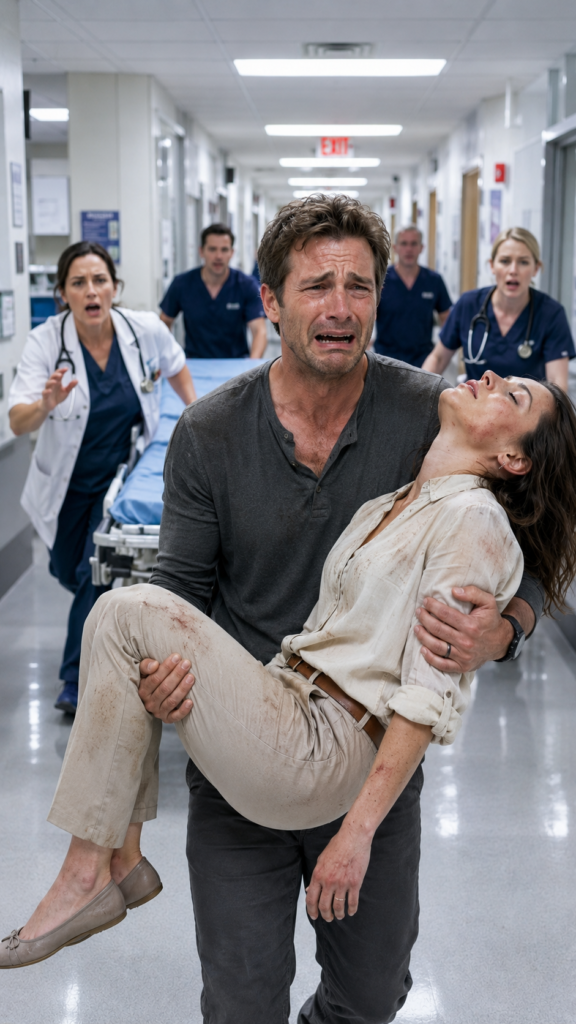
When she opened her eyes, she was in the emergency room of the General Hospital, with bright lights above and a metallic taste in her mouth.
Ernesto was next to the stretcher, pretending to be worried.
Leticia gripped her hand tightly, not to comfort her, but to warn her.
A young doctor entered, Dr. Ricardo Mireles.
—What happened here? —he asked.
Leticia immediately responded:
—She slipped in the bathroom. She’s always been very clumsy.
The doctor looked at Mariana’s face.
Then her arms.
Then the old marks that no one had wanted to see.
His expression changed.
He picked up the phone on the wall and said:
—I need the police in emergency, cubicle 3. Now.
For the first time that night, Ernesto stopped smiling.
And Mariana understood that what was coming wouldn’t be a mere report… it would be the beginning of something that no one in that family was prepared to face.
PART 2
Ernesto tried to laugh, but the sound came out dry.
—Doctor, don’t exaggerate. My stepdaughter is dramatic. She always makes things up to get attention.
Leticia nodded quickly.
—Yes, doctor. Mariana has always been very intense. She falls, she hurts herself, and then blames everyone.
Dr. Mireles didn’t reply.
He positioned himself between the stretcher and them, like a human wall.
—The patient will speak for herself —he said calmly—. No one else.
Ernesto clenched his jaw.
—She’s my family. I have the right to explain.
—No —the doctor replied—. You have the right to remain silent.
That phrase changed the air in the room.
Mariana breathed with difficulty. Her whole body hurt, but for the first time in years, she didn’t feel alone.
A nurse approached and handed her her cell phone.
—It was in your bag —she whispered—. Take your time.
Mariana unlocked the screen with trembling fingers.
Ernesto looked at her as if he could still control her with his eyes.
—Don’t do anything stupid, Mariana —he said through clenched teeth—. Remember what happens when we go home.
But Mariana wasn’t going back.
She opened a hidden folder behind an app called “Recipes.”
Inside were audios, photos, videos, screenshots, and documents.
Not from one week.
Not from one month.
From six years.
The first audio that the police officer who had just entered listened to was Ernesto’s voice saying:
—No one will believe you, brat. Your own mother will say you fell.
Leticia turned pale.
Mariana opened another file.
There, she heard her mother’s voice:
—Ernesto, don’t hit her in the face before my sister’s birthday. People ask too much.
The officer slowly lifted his gaze.
—Ma’am, is that your voice?
Leticia began to cry.
—It’s taken out of context...
Mariana let out a small, broken laugh, almost without strength.
—What context, Mom? The context where I was used as a punching bag to save your marriage?
Ernesto took a step toward the stretcher, but the officer stopped him.
—Back.
—This is false —Ernesto shouted—. She edited everything. She’s crazy.
Then Mariana opened the folder that scared her the most to show.
It didn’t just have evidence of beatings.
It had bank statements, contracts, photographs of receipts, and copies of deeds.
For years, while Ernesto thought she was crying locked in her room, Mariana had been working remotely for an auditing firm in Mexico City.
She reviewed invoices, bank movements, and shell companies.
And secretly, she had also looked into her stepfather's businesses.
Ernesto had a small construction company that he bragged about in the neighborhood.
He claimed to do honest renovations.
But Mariana had discovered something else: he took deposits from elderly people, abandoned projects, forged signatures, and moved money through acquaintances’ accounts.
Among those documents was the strongest blow.
A copy of the forged signature of Mariana’s biological father, who died when she was 15.
With that signature, Ernesto and Leticia had tried to move part of the inheritance that her father left for his daughter.
The officer looked at the papers.
—Did your mother sign as a witness?
Mariana nodded.
Leticia began to shake her head, but she no longer sounded convincing.
—I didn’t know what I was signing...
Mariana looked at her as if that phrase hurt more than any blow.
—You did know. What happened is that you thought I would never learn to read what you hid.
That morning, the Prosecutor’s Office opened two files: one for domestic violence and injuries, and another for fraud, forgery, and property abuse.
Dr. Mireles photographed each injury with medical precision.
He didn’t ask cruel questions.
He didn’t hesitate.
He didn’t treat her as exaggerated.
He just said one phrase that Mariana would never forget:
—What they did to you wasn’t an accident. And it wasn’t your fault.
At dawn, a social worker processed a protection order.
Ernesto left the hospital handcuffed, shouting that it was all a show.
—You’re going to destroy your mother! —he yelled at Mariana.
She barely lifted her head.
—No. She destroyed herself the day she chose your lies over my life.
Leticia tried to approach, crying with her hands clasped together.
—Daughter, please, think of the family.
Mariana looked at her without hatred but without tenderness.
—For nine years, I thought of the family. You never thought of me.
Three days later, agents raided the Querétaro house.
They found a small camera hidden inside a wall clock in the hallway.
Mariana had placed it there after Ernesto broke her cell phone for the first time.
They also found sealed diaries in plastic bags, hidden behind an old piece of furniture.
Each page had a date, time, description, and attached photograph.
Ernesto always said that Mariana was good for nothing.
But she had built the perfect case against him.
The twist that finally sank them came a week later.
The neighbor across the street, Doña Amalia, handed over a video from her security camera.
In the recording, Leticia could be seen leaving the patio after several shouts.
She wasn’t going to ask for help.
She wasn’t going to call 911.
She was going to close the window so that the neighbors wouldn’t hear.
That video made many people in the neighborhood stop defending her.
Because at first, several had said: —Poor lady, she must be scared too.
But the video showed something else.
Leticia wasn’t just a scared woman.
She was an accomplice who had learned to arrange silence to make it seem like peace.
Months later, the courtroom was packed.
Ernesto entered wearing a white shirt and the face of an offended man, as if the world owed him an apology.
Leticia arrived wearing dark glasses, trembling and clutching a rosary.
She wanted to appear as a victim.
But the evidence doesn’t cry.
The evidence speaks.
The Public Prosecutor played the audios.
Ernesto's voice filled the room: —If you speak, your mother will swear you’re crazy.
Then Leticia’s voice was heard: —Mariana has bruises because she falls a lot. That’s how we’re going to say it.
A woman in the audience covered her mouth.
The defense attorney tried to present Mariana as vengeful.
—You hate my client, don’t you?
Mariana, seated before the judge, calmly replied: —I hate what he did. But more than seeing him punished, I needed him to stop hurting others.
The attorney smiled. —So you admit you planned this.
Mariana moved closer to the microphone. —I planned to survive long enough so that the truth wouldn’t depend on my word anymore.
The courtroom fell silent.
Then the financial evidence arrived.
Fake contracts.
Divided deposits.
Altered signatures.
Elderly people defrauded.
And Leticia’s signature appearing over and over again as a witness.
The judge didn’t see a family broken by a rebellious daughter.
He saw a web of violence, money, and cover-up.
Dr. Mireles spoke in the end.
His voice was firm. —The injuries did not correspond to a fall in the bathroom. They were consistent with repeated assaults. Calling the police wasn’t a moral choice. It was a medical and human obligation.
The verdict came after less than two hours.
Ernesto was found guilty of domestic violence, aggravated injuries, forgery, fraud, and threats.
He received 21 years in prison.
Leticia received 7 years for concealment, false testimony, and participation in forged documents.
When they took Ernesto away, he still wanted to put on his last act.
—You destroyed this family! —he shouted.
Mariana didn’t cry.
She didn’t lower her gaze. —No. I was the only one who stopped pretending this was a family.
Leticia broke down when they put the handcuffs on her. —Mariana, I’m your mother...
She looked at her one last time. —A mother protects. You only protected the man who was destroying me.
A year later, Mariana lived in a small house near the beach in Veracruz.
It wasn’t luxurious, but it had big windows, white walls, and a silence that didn’t feel frightening.
With the money recovered from her inheritance, she opened an association to help victims of domestic violence document evidence safely and legally.
At the entrance was a simple phrase:
“Just because no one believes you at first doesn’t mean the truth doesn’t exist.”
Dr. Mireles collaborated with her, giving talks in hospitals.
Doña Amalia, the neighbor who delivered the video, donated security cameras to four women who needed protection.
And every time a girl arrived trembling, saying, “Honestly, no one will believe me,” Mariana would serve coffee and respond: —Then let’s make them believe the evidence.
Ernesto sent one letter from prison.
Mariana never opened it.
Leticia sent five.
Mariana didn’t read them either.
She kept them in a box for months until one afternoon she understood that she didn’t need to hear more excuses to close the wound.
She burned them in a brazier on the patio while the sea sounded in the distance.
She felt no joy.
She felt relief.
Because some families break when someone speaks.
But some lives begin just when someone dares to stop remaining silent.





