PART 1
“If my son comes home and dinner isn’t ready, I’ll teach you to obey with something that burns,” Lourdes said.
Mariana barely had time to turn.
The boiling oil fell on her shoulder, chest, and part of her back like a rain of fire. Her scream ricocheted off the white tiles of the kitchen in that enormous house in Lomas de Chapultepec.
Lourdes didn’t drop the pot.
She held it for a few more seconds, breathing hard, with hard eyes, as if she had just corrected a spoiled child and not burned her daughter-in-law alive.
“For you to learn,” she murmured. “My son doesn’t work his ass off all day to come home to a house without dinner.”
Mariana fell to the floor.
The pain was so brutal that she couldn’t even cry. The shirt clung to her skin. The smell of burnt oil mixed with that of her singed hair.
Seconds later, Diego walked in.
He had his jacket in hand, an expensive watch gleaming on his wrist, and that look of annoyance he always wore when things didn’t go his way.
He looked at his mother.
Then he looked at Mariana sprawled on the floor.
And the first thing he did was lift his foot to avoid getting his shoes dirty.
“Mom… what did you do?” he asked quietly.
Lourdes adjusted her shawl as if nothing had happened.
“What you don’t have the guts to do. Putting order in your house.”
Mariana tried to call for help, but only a broken moan escaped her. Diego crouched beside her, not to hug her, not to quickly call an ambulance, but to check her eyes.
“She’s conscious,” he said.
“Then hurry up,” Lourdes replied. “Say she fell. That she spilled a pot of broth. That she’s always been clumsy.”
Diego took out his cell phone, but before dialing, he scanned the entire kitchen with a calculating gaze.
Mariana caught a phrase before passing out.
“We have to tell the same version.”
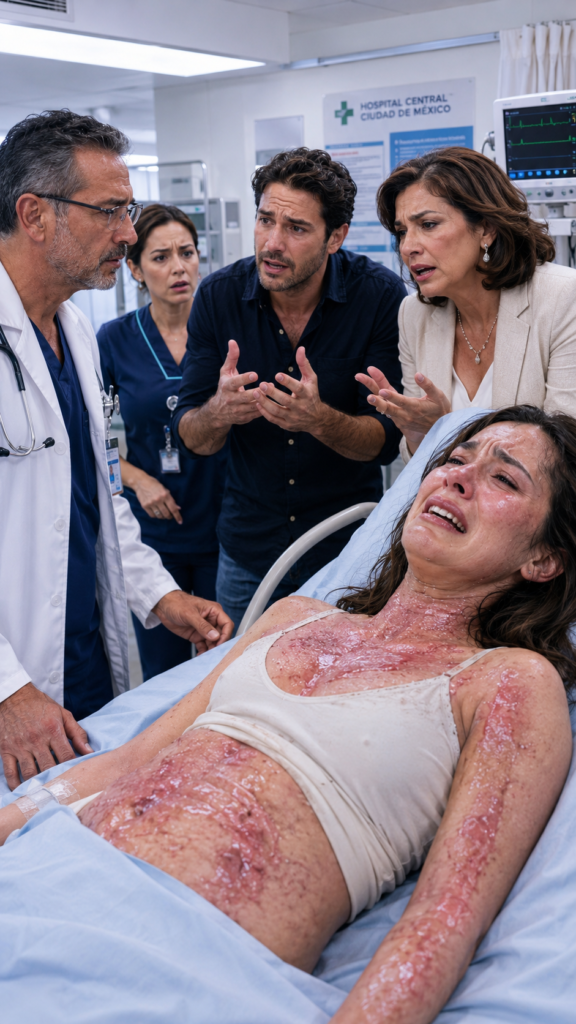
When she came to, she was in the hospital.
There was the smell of disinfectant, bright lights, and a constant beep next to her bed. Everything burned, even breathing. Behind a curtain, Diego spoke in a perfect voice.
“Doctor, my wife is very distracted. She spilled a pot on herself. She’s been acting strange for months.”
Lourdes sobbed with theatrical precision.
“Poor thing, we told her to rest, but she doesn’t listen.”
Mariana kept her eyes closed.
For three years, Diego and his mother had turned her into a shadow. They took her cards, checked her calls, claimed in front of everyone that she had anxiety, that she exaggerated, that she invented things.
But they forgot something.
Before marrying, Mariana Salvatierra was a tax attorney.
She knew how to detect a forged signature, a hidden account, and a well-rehearsed family lie.
The doctor approached her bed.
His voice dropped to almost a whisper.
“Mariana, don’t open your eyes if you can’t. These burns don’t look accidental. The police are already downstairs.”
Then the door to the room opened.
And two agents from the Prosecutor’s Office walked in.
PART 2
Diego stopped talking.
His worried husband face fell like a poorly placed mask. Lourdes tightened the rosary she held between her fingers and pretended to cry more intensely.
“This is disrespectful,” Diego said. “My wife is medicated. She doesn’t know what she’s saying.”
Doctor Camila Rivas looked at him without blinking.
“Curious. She hasn’t said anything yet.”
Mariana opened her eyes with effort.
The light hurt. Her skin burned. But seeing the hidden fear in Diego’s jaw gave her a cold strength.
“Blue folder,” she murmured.
Lourdes lunged toward the bed.
“Don’t listen to her! She’s delirious!”
One of the agents stepped in. He was a commander from the Investigation Police, in a white shirt and a tired face, like someone who had seen too many families rot behind elegant walls.
“Mrs. Mariana Salvatierra,” he said, “do you authorize the opening of the folder indicated in your medical directive?”
Mariana barely moved her head.
Camila took out a sealed envelope from a drawer in the hospital. Inside was a signed statement from two months before, where Mariana described threats, blows disguised as accidents, financial control, and medical manipulation.
There was also a very clear instruction.
If she entered the hospital unconscious due to a suspicious situation, her fiduciary had to turn everything over to the Prosecutor’s Office.
Diego leaned toward her, teeth clenched.
“You set a trap for me.”
Mariana swallowed hard. Her throat burned as if it had also been scorched inside.
“No, Diego. I let you act.”
That same afternoon, in a private hospital room, the agents played the video from the kitchen.
On the screen, Lourdes was seen at the stove, complaining that dinner was 19 minutes late. Mariana stood with her cellphone in hand, asking them to leave her house.
“This house belongs to my son,” Lourdes said.
“No,” Mariana replied. “And tomorrow you’ll receive a formal notification to vacate it.”
Then Diego appeared.
He didn’t shout. He didn’t defend anyone. He just poured himself a whiskey and said:
“See, mom. When she feels powerful, she becomes unbearable.”
Lourdes took the pot.
The video showed the oil pouring over Mariana.
It showed Diego crouching, checking her pulse, and saying:
“We need a better story.”
Then he dragged her out of frame.
But the audio continued recording.
“Unlock her phone with her face,” Lourdes ordered.
“I’m on it,” Diego replied.
Furniture moved, rapid breathing, and dull thuds against the floor were heard.
Then Diego made a call.
“She may not wake up. Move the trust stuff tonight. Use the foundations. If we declare her incompetent, no one will review anything.”
The commander paused the video.
He no longer looked at Diego as a nervous husband.
He looked at him as an accused.
Lourdes was arrested for aggravated injuries and attempted femicide. Diego was arrested for domestic violence, obstruction of justice, and attempted financial fraud.
As they took her away, Lourdes turned to Mariana.
“Ungrateful! We gave you family!”
Mariana, covered in bandages, replied without raising her voice:
“You gave me scars. The family was mine before you entered my house.”
But that was just the beginning.
Within 48 hours, Diego’s lawyer filed an urgent request to declare Mariana incapable of managing her assets. A private doctor delivered false notes claiming she was unstable, aggressive, and paranoid.
The press began to talk about “the heiress who recorded her family.”
Diego still had contacts.
From the burn unit, Mariana worked with her fiduciary, a forensic accountant, and the Prosecutor’s Office. Every account moved by Diego left a trace. Every shell company had a name. Every transfer to apartments, jewelry, and trips opened a new door.
Then came the twist Diego never imagined.
The man he called the night of the attack wasn’t his partner.
He was an undercover collaborator from the Specialized Prosecutor’s Office for Financial Crimes.
Mariana had contacted him three months earlier when she discovered that Diego was using charity foundations to launder money and back loans with assets that didn’t belong to him.
The aggression didn’t initiate the investigation.
It completed it.
A week later, Diego was released under precautionary measures and went straight to the house with his lawyer. He wanted to enter before the raid. He wanted to grab computers, hard drives, and documents.
He typed the door code.
The lock blinked red.
On the other side of the glass, he saw boxes with his clothes, agents reviewing papers, and Mariana standing, covered in bandages under a light coat.
Diego knocked on the door.
“Mariana! This is my house too!”
She pressed the intercom.
“No, Diego. It was just the place where you confessed everything.”
Behind him, a patrol turned on its lights.
The trial began seven months later.
Mariana arrived with an ivory blazer over her shoulders. She walked slowly, her skin marked by grafts she no longer tried to hide.
Every step was an answer to those who said she would never get back up.
Diego entered in a navy blue suit, rehearsed smile, and an expensive-sounding lawyer. Lourdes appeared dressed in white, with her rosary and tears ready for the cameras.
They looked like victims.
It lasted 38 minutes.
The Prosecutor’s Office played the kitchen video.
In the courtroom, no one moved when Diego’s voice was heard:
“We need a better story.”
Then came the expert testimonies. The oil had been thrown from an impossible angle to explain as an accident. The burns showed patterns of aggression. There were also previous injuries: fractured ribs, marks on the arms, and bruises Diego had reported as “falls.”
Then came the money.
Bank statements. Forged signatures. Loans with false guarantees. Payments to the doctor who tried to pass Mariana off as unstable.
And transfers to Fernanda, Diego’s mistress, who lived in a Santa Fe apartment paid for with Salvatierra company money.
Fernanda testified on the third day.
She arrived nervous, with bitten nails and a trembling voice.
“Diego told me Mariana was sick,” she confessed. “That soon she would be admitted to a private clinic. He said that afterward he would control the house, the shares, and the accounts. He promised we would go to Madrid.”
The prosecutor asked:
“Did he tell you how he would manage to admit her?”
Fernanda looked down.
“He said his mom could provoke crises at home. That he would record only the part that suited him.”
Diego clenched his fists.
His lawyer tried to turn it around.
“Mrs. Mariana, you installed cameras, prepared documents, and contacted investigators. Were you not planning to take revenge on my client?”
Mariana looked at Diego.
She remembered the nights in front of the mirror, searching for ways to explain marks no one should see. She remembered Lourdes counting the minutes of dinner as if they were crimes. She remembered the first time she thought: if I don’t leave evidence, they’ll erase me.
Then she responded:
“I wasn’t planning revenge. I was planning to survive.”
The prosecutor placed two documents on the table.
The first was the supposed agreement where Mariana ceded Diego control of the company and the trust.
The second was the real document, signed in front of a notary, with a protection clause: any attempt at coercion, violence, fraud, or medical manipulation by the spouse automatically expelled him from all positions and benefits.
Diego had signed as a witness without reading.
The man who thought he was stealing a fortune had triggered his own downfall.
But the most brutal moment came with Lourdes.
She took the stand with her rosary, looking at everyone as if she still had authority.
“I just wanted discipline,” she said.
The prosecutor watched her in silence.
“Discipline because dinner was served 19 minutes late?”
“She knew the rules of my house.”
“And the punishment was boiling oil?”
Lourdes turned to Diego, waiting for him to defend her.
Diego looked down.
That gesture broke her.
“You wanted it!” she screamed, pointing at him. “You told me we had to scare her! You said that if she kept thinking she owned everything, you would never be able to take the company from her!”
Diego jumped up furiously.
“Shut up, crazy old woman!”
The guards moved quickly. Mother and son tore into each other in front of everyone, each trying to save themselves by sinking the other.
The jury didn’t take long.
Lourdes was found guilty of aggravated injuries, domestic violence, and conspiracy. Diego was found guilty of fraud, asset exploitation, identity theft, obstruction of justice, domestic violence, and conspiracy.
When they put the handcuffs on him, Diego glared at Mariana with miserable rage.
“You ruined my life.”
Mariana touched the scar crossing her collarbone.
“No, Diego. I just kept evidence of what you did to yours.”
Lourdes received 15 years in prison.
Diego received 24.
The doctor lost his license. The accounts were frozen. Almost all the stolen money returned to the trust.
The house in Lomas stopped smelling of fear.
They painted the walls, changed the kitchen, and removed the stove.
But justice didn’t return Mariana to her previous skin. It didn’t erase the sound of the pot. It didn’t give her back the years she confused enduring with loving.
It returned something more difficult.
The certainty that her life belonged to her.
A year later, Mariana returned to the hospital with a blue folder under her arm.
With part of the recovered money, she founded Proyecto Brasa, a support network for women whose wounds had been disguised as domestic accidents.
They paid for expert opinions, shelters, lawyers, secure storage of evidence, and therapy.
In the first year, 36 hospitals in Mexico joined.
The first woman she attended arrived with a burn on her leg. Her husband claimed she had fallen against the stove.
She sat in front of Mariana, trembling.
“They’re going to say I’m crazy,” she whispered.
“I know,” Mariana replied.
“He has everything.”
“That’s what he wants you to believe.”
The young woman looked at the visible scars on Mariana’s neck.
“And how did you win?”
Mariana opened the blue folder and slid it across the table.
“I stopped asking for love from cruel people. I sought allies, kept evidence, and allowed the truth to speak where they could no longer silence it.”
Outside, the morning illuminated the hospital’s windows.
For years, Mariana thought peace was not provoking anger, not raising her voice, not contradicting.
Now she knew peace was something else.
Peace was a closed door that Diego would never cross again.
It was a recovered signature.
It was her clean name.
It was her body, marked but hers.
And every time someone asked her about her scars, Mariana answered the same:
“They are the places where the power they had over me ended.”





