PART 1
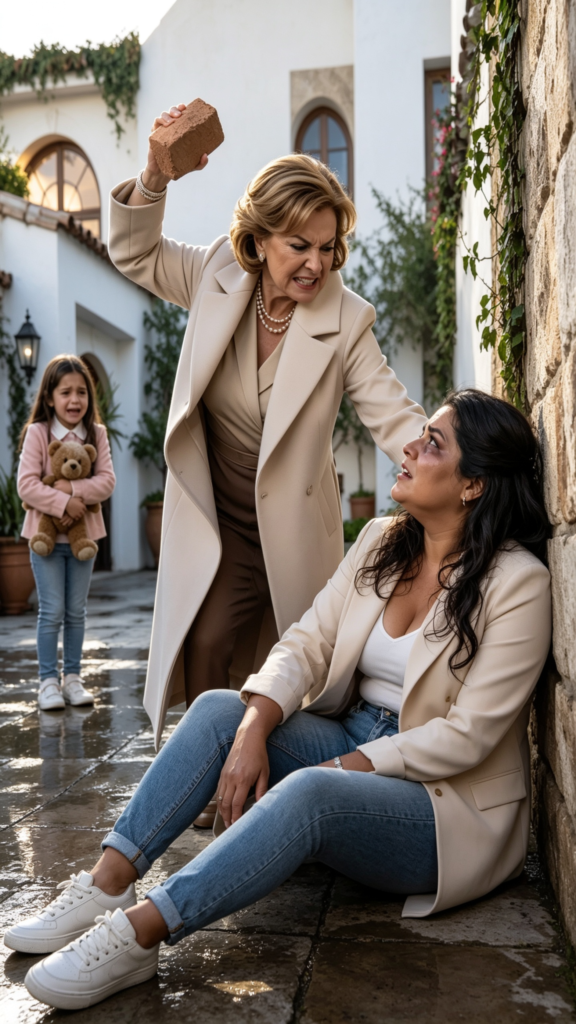
—Let’s see if you finally understand, Daniela! This house belongs to my son, not to a freeloader like you!
Teresa's scream ricocheted off the kitchen tiles as the rain pounded against the patio sheets in a neighborhood of Tlaquepaque, Jalisco.
Daniela Robles, 35 years old, squeezed the rag she had just used to clean the floor. Her hands were cracked from the bleach, her eyes red from lack of sleep, and her fonda uniform still smelled of grease.
Her 8-year-old daughter, Sofía, sat at the table with a blanket draped over her shoulders. She had been running a fever for days, had no appetite, and had strange bruises on her legs.
—Grandma, don’t shout —the girl murmured.
Teresa turned with disdain.
—You shut up, sickly brat. That’s why your mom can’t even keep you healthy.
Daniela felt blood rush to her face.
—Don’t talk to my daughter like that.
The mother-in-law let out a dry laugh.
—Feeling brave now? If it weren’t for Álvaro, you’d be selling quesadillas on the street.
Daniela fell silent.
The truth was different.
Álvaro had been unemployed for 7 months, yet every morning he left smelling of cologne, claiming he was going to “see clients.” The mortgage, the electricity, the water, the food, and even Sofía’s medicine came from Daniela, who worked in a fonda, did nails at home, and sold desserts on weekends.
But Teresa repeated to all the neighbors that her daughter-in-law was a freeloader.
That afternoon, when Daniela tried to take Sofía to the room, Teresa blocked her path.
—Don’t act like the owner. My son told me he bought this house.
—Your son lied to you.
Teresa froze.
—What did you say?
Daniela raised her gaze.
—The house is in my name. I’ve been paying for it alone for 7 years.
The silence lasted barely 2 seconds.
Then Teresa stormed out to the patio, grabbed a clay pot, and smashed it against the wall, inches away from Sofía. The girl screamed.
—You damn liar! —the mother-in-law roared—. Before I let you humiliate me, I’ll get you out of here, one way or another.
Daniela hugged her daughter and locked herself in the room.
As Sofía trembled in bed, Daniela opened a box hidden beneath the mattress. There were the deeds, the property tax receipts, the bank statements, and every mortgage payment.
Everything was in her name.
At 4:37 in the morning, while searching for paracetamol, she found Álvaro's phone vibrating in the living room.
She didn't want to check it.
But she did.
There were photos of him with another woman in Mazatlán, messages where he called her “my real wife,” and audios from Teresa saying:
—Get the papers before that fat woman suspects anything. If she gets difficult, we say she’s crazy and that she hits the girl.
Daniela felt the floor drop out beneath her.
Then Sofía began to cough.
Running to her, she saw bloodstains on the pillow.
And she understood that while they were planning to steal her house, her daughter might be fighting for her life.
What Daniela did next left everyone in the neighborhood speechless…
PART 2
Daniela left before dawn with Sofía in her arms, a small backpack, and a folder of documents hidden under her jacket.
She didn’t wake Álvaro.
She didn’t confront Teresa.
She didn’t scream.
For the first time in years, she understood that arguing with people who had already decided to destroy her was giving them an advantage.
She took a bus to the Civil Hospital of Guadalajara. Sofía was pressed against her chest, sweating cold, with pale lips and half-closed eyes.
—Mom, will they let us be at peace? —the girl asked.
Daniela kissed her forehead.
—Yes, my love. But first, we need to know what’s wrong with you.
After several hours, a young doctor called her into an office.
Her voice was careful, but she couldn’t hide the gravity.
—The girl has severe anemia, dangerously low platelets, and signs that require urgent tests. We need to rule out leukemia.
Daniela felt a buzzing in her ears.
—Leukemia?
—I can’t confirm it yet. But we can’t wait.
Sofía was coloring a picture in the waiting room, unaware that her mother had just heard the word that no mother wants to hear.
Daniela called Álvaro 9 times.
He answered on the tenth.
—I’m busy, what do you want?
—Sofía is seriously ill. They’re admitting her.
—You always exaggerate, Daniela.
—I need you to come to the hospital.
—I can’t. I have a meeting.
She looked at her phone screen.
On social media, Álvaro had just posted a story from a restaurant in Chapalita. He was with a woman named Brenda and two children. On the table, there were seafood, beer, and a cake.
The caption read:
“With my real family, the one that gives me peace.”
Daniela didn’t cry.
She simply took a screenshot.
That same afternoon, she sought a lawyer recommended by a nurse. Her name was Mónica Aguirre, specializing in domestic and property violence cases.
When she reviewed the papers, she was direct.
—The house is yours. If the deed and payments are in your name, your husband cannot sell it or take it from you. But these audios are delicate. They are planning to fabricate a complaint against you.
Daniela also showed her messages where Álvaro asked for photos of her ID, supposedly to “update the insurance.”
Mónica frowned.
—This could be fraud. We need to know if he has already used your data.
—What if I return to the house?
—Go back only to collect what you need, but record everything. Don’t tell them you already have a lawyer. Abusive people become more dangerous when they find out they’ve lost control.
Daniela obeyed.
For 5 days, while Sofía underwent tests, Daniela entered and exited the house silently. She recorded insults, threats, and conversations that left her frozen.
In one, Teresa said:
—When they put her in jail, I’ll keep an eye on the house. Then you sell it and go off with Brenda.
In another, Álvaro responded:
—I need the original deed first. Without that, the buyer won’t be encouraged.
The neighbor across the street, Doña Lupita, also began to talk.
She confessed that Teresa had lost her own house due to debts and underground gambling. Since then, she had pretended to everyone that Daniela’s house belonged to Álvaro to avoid accepting her shame.
—That woman hates you because you achieved what she lost —Doña Lupita told her—. And because it hurts her that her son lives off you.
The hardest blow didn’t come from Teresa.
It came from Brenda.
One afternoon, she showed up at the hospital wearing sunglasses, pregnant, and carrying a folder.
—Are you Daniela?
Daniela stood up.
—Yes.
Brenda swallowed hard.
—Álvaro told me you were divorced, that you abandoned your daughter, and that the house belonged to him.
Daniela felt anger, but didn’t attack.
—I’m still married. My daughter is hospitalized. And I pay for that house.
Brenda covered her mouth with a hand.
Then she pulled out the folder.
—He asked me to keep this because he said you were crazy and could lose it. But last night I heard him talking to his mother. He said that when they accused you, I had to declare that you were violent.
Inside was a loan contract in Daniela’s name.
The signature was fake.
There were also copies of her ID, proof of address, and a draft of the sale of the house.
Daniela felt nausea.
Brenda began to cry.
—I didn’t know. Honestly, I thought you were the bad one.
—That’s what cowards do —Daniela replied—. They divide women so that none can see the real enemy.
That same day, the diagnosis for Sofía arrived.
Acute lymphoblastic leukemia.
Daniela stood frozen in the hallway, holding a cup of coffee that had already gone cold. The doctor explained that there was treatment, that it wouldn’t be easy, that there would be chemotherapy, transfusions, low defenses, and months of fear.
Daniela listened to everything without blinking.
When she entered the room, Sofía was hugging an old stuffed animal.
—Am I going to die, Mom?
Daniela sat beside her and took her hand.
—I won’t lie to you. We’re going to fight hard. But you won’t fight alone.
That night, Mónica filed a complaint for domestic violence, threats, forgery, and fraud. She also requested protective measures.
But Daniela still had to return to the house for medication, Sofía’s clothes, and the original documents.
When she arrived, she found the door ajar.
Inside, Álvaro and Teresa were rummaging through the room.
The mattress was lifted.
The box of documents was on the bed.
Álvaro held the deed in his hand.
—Look at this —he said with a crooked smile—. The lady owner hiding things.
Teresa locked the door.
—You’re not leaving here until you sign over the house to my son.
Daniela activated the recorder on her phone inside her bag.
—That house isn’t yours.
Álvaro approached her.
—It’s not in your best interest to make this difficult. With everything we have, anyone will believe you’re crazy. A mother with a sick daughter, no money, hysterical… easy.
—What do you have?
Teresa smiled.
—Photos of bruises on my arm. I’ll say you hit me. Álvaro will declare that you neglect the girl. Brenda was also going to support, but that idiot has already chickened out.
Daniela felt a slow chill.
It wasn’t just about taking the house.
They wanted to take Sofía from her too.
Álvaro placed a sheet on the table.
—Sign. We’ll let you stay for a month. After that, you’re out.
Daniela looked at the pen.
Then she looked at Teresa.
—You know that Sofía is sick.
The mother-in-law looked away.
—Kids get sick. Don’t use that to play the victim.
Daniela was about to respond when there were three sharp knocks on the door.
Álvaro tensed.
—Were you expecting someone?
Daniela shook her head.
They knocked again.
—I’m Ramiro, from the finance company —a male voice said—. I need to talk to you, Álvaro. The contract went wrong.
Álvaro’s face lost color.
Teresa whispered:
—Don’t open.
But it was too late.
Ramiro pushed the door just as Álvaro turned the lock. He came in sweating, nervous, with an envelope in hand.
—The bank detected the fake signature. And the owner requested a certified copy.
Then he saw Daniela.
He froze.
—Is she the owner?
Daniela lifted her phone.
—Yes. And this is being recorded.
Álvaro tried to snatch the phone from her, but the door swung open.
Two police officers, Mónica Aguirre, and an agent from the Women’s Justice Center entered.
Teresa screamed:
—She’s robbing us! She’s a freeloader!
Mónica showed a certified copy of the deed.
—The only owner is Daniela Robles. Álvaro does not appear as the owner, co-owner, or guarantor.
Álvaro began to sweat.
—She’s my wife. What’s hers is mine too.
—Not when the property is acquired and documented in her name, and especially not when there’s a complaint for fraud and violence —the lawyer replied.
Ramiro raised his hands.
—I can testify. He asked me to copy the signature. I have messages.
Álvaro glared at him with hatred.
—Traitor.
Ramiro let out a nervous laugh.
—You’re the traitor, dude. I’m not going down alone.
The agent requested to review the documents. Inside the envelope were printed conversations, deposits, photos of Daniela’s ID, and a voice note where Álvaro said:
“When they declare her unstable, my mom will stay as a witness, and I’ll sell quickly. With that, I’ll pay off debts and leave with Brenda.”
Teresa began to cry.
—I just wanted to protect my son.
Daniela looked at her as if finally seeing the real woman behind so many screams.
—No. You wanted to save him from the consequences of being useless.
Álvaro tried to change his tone.
—Dany, think of Sofía. I’m her dad.
Daniela took a step towards him.
—A dad doesn’t abandon his daughter in the hospital to eat seafood with another family.
—We can work it out.
—You could have worked it out when I called you 9 times. You could have worked it out when your daughter was coughing up blood. You could have worked it out before forging my signature.
The police placed handcuffs on him.
Teresa clung to the door frame.
—Don’t take him! He’s my only son!
The agent replied emotionlessly:
—He’s also a suspect in fraud, threats, and domestic violence.
Brenda arrived minutes later. Her eyes were swollen, and she carried a bag with more documents.
—I’m going to testify —she said—. And I’m going to demand that he answer for my children. He’s not going to use me to hide his lies anymore.
Álvaro looked down.
For the first time, he had no woman covering his back.
Teresa asked to stay.
—I have no house. I have nowhere to go.
Daniela felt a pang of pity. For years, she had been taught that being a good woman meant enduring, forgiving, and rescuing everyone.
But that Daniela was no more.
—You have 1 hour to take your things —she said—. After that, any contact will be through the authorities.
—Are you going to throw me out on the street?
—You tried to throw me out of my own house with lies. I’m throwing you out with the law.
When she closed the door, the house fell into silence.
It wasn’t a silence of fear.
It was a new silence, as if the walls could finally breathe.
But the hardest battle was still at the hospital.
Sofía began chemotherapy. She lost her hair, her appetite, and many times her will to smile. Daniela sold desserts outside the hospital, slept in plastic chairs, and answered summons between tests and medications.
Doña Lupita organized a collection in the neighborhood. Some neighbors who had previously believed Teresa’s gossip came with soup, diapers, clean clothes, and awkward apologies.
—I’m sorry, mija —one said—. We thought you were a slacker.
Daniela didn’t respond with anger.
—Now you know how easy it is to believe the one who screams the loudest.
Months later, Sofía had a favorable response to treatment. It wasn’t a movie miracle. There were still check-ups, medications, and care needed. But for the first time, the doctor spoke of hope.
Daniela converted the room where Teresa had slept into a small kitchen. Every Sunday, she prepared food for mothers with hospitalized children.
She named it “Sofía’s House.”
On the wall, she wrote:
“A quiet woman can survive a night. A heard woman can save a life.”
Brenda brought rice one morning. They weren’t friends, but they weren’t enemies either.
—He lied to both of us —Brenda said.
Daniela nodded.
—Yes. But he’s not going to use us against each other anymore.
Álvaro tried to send messages from jail, asking her to withdraw the complaint.
Daniela handed them over to her lawyer.
Teresa sent a letter months later. She admitted that she had lost her house due to debts and that it angered her to see Daniela hold a life that she couldn’t sustain.
Daniela read it once.
Then she put it away.
Forgiveness didn’t mean opening the door again.
A year later, Sofía returned to school with short hair, a donated backpack, and her old stuffed animal hanging from the zipper.
—Mom —she said as she left—, when I grow up, I want to help sick girls.
—Why?
—Because when I was scared, you didn’t let them erase me.
That night, Daniela looked at the house.
It still had dampness on one wall, a leak in the bathroom, and old furniture. It wasn’t an elegant house. It wasn’t perfect.
But it was hers.
And for the first time, it was safe.
They called her a freeloader, crazy, useless, and a bad mother.
But it was Daniela who paid the mortgage, supported her daughter, gathered evidence, confronted the abusers, and turned a room full of hate into a kitchen for other women.
Those who tried to bury her forgot something very Mexican and very true:
when a woman takes root in her own land, no lie can tear her away.





