PART 1
Julián had been dead for 17 minutes when Valeria's mother decided that Ximena's birthday celebration couldn't be interrupted.
She didn't say it like that at first.
First, she just sighed, annoyed, as if Valeria had called to ask an uncomfortable favor. In the background, glasses clinked, laughter bubbled, and the sound of expensive restaurant music wafted from Polanco.
Valeria sat in a plastic chair outside the emergency room, her clothes soaked from the Guadalajara rain, her hands smelling of hand sanitizer and her husband's cologne.
—Mom… Julián died —she whispered.
There was a small silence.
For one second, Valeria thought her mother would finally react like a mother should.
But Marta Ríos just lowered her voice.
—Oh, Valeria… we're at your sister's birthday dinner. Can this wait until tomorrow?
Valeria felt the hospital corridor narrowing.
Beside her, Sofía, her 8-year-old daughter, clutched a math notebook to her chest. Minutes earlier, she had asked if her dad was going to wake up.
Valeria hadn’t known how to lie.
Julián had collapsed in the kitchen while helping Sofía with her multiplication. He had come home late from the construction supply warehouse, tired, his boots dusty, wearing that calm smile he used to keep everyone from worrying.
The cup fell from his hand first.
Then he did.
The paramedics tried to revive him on the cold floor, while Sofía cried on the stairs, and Valeria repeated his name as if voicing it could bring him back.
At San Javier Hospital, Doctor Morales walked out 43 minutes later.
Massive aortic rupture.
Sudden.
Catastrophic.
No chance.
Valeria still couldn’t comprehend how an entire life could end before the soup on the stove cooled.
That's why she called her parents.
Because that’s what a person does when the world collapses around them.
But on the other end of the line, her father asked who it was. Ximena's laughter echoed, light and joyful, celebrating her 35th birthday with cake, wine, and perfect photos.
—We can't leave right now —Marta said—. Your sister only turns 35 once.
And she hung up.
Valeria stared at the dark screen of her phone.
Sofía lifted her face.
—Are my grandparents coming?
Valeria swallowed her tears.
—Yes, my love. They're on their way.
But they didn’t come.
They didn’t go to the hospital.
They didn’t go to the wake.
They didn’t go to the burial.
That same night, Ximena posted photos in a golden dress, a glass in hand.
“35 and shining brighter than ever,” she wrote.
Valeria saw the post while sitting in front of Julián's lawyer, a woman named Mercedes Luján, who was explaining documents, policies, business accounts, and procedures that felt cruel when the body still hurt.
At the funeral, masons, suppliers, neighbors, warehouse workers, and even the man Julián helped fix his gate for free showed up.
Everyone cried.
Except Valeria's family.
Four days after the burial, Arturo and Marta showed up at her house in Zapopan.
They didn’t bring flowers.
They didn’t bring food.
They didn’t bring apologies.
They entered with solemn faces, as if they had rehearsed the gesture in front of a mirror. Valeria stood next to the armchair, her eyes sunken, her voice shattered.
Sofía was in her room, or so she thought.
Arturo slowly took off his glasses.
—We found out Julián had life insurance —he said—. Also the business, the warehouse, trucks, accounts…
Valeria blinked.
—What?
Marta sighed softly, as if speaking to a tantrum-throwing child.
—Honey, no one is taking anything from you. But the family shares burdens and blessings. Ximena is going through a rough patch with her bakery. We have expenses too.
Arturo settled into the armchair.
—We think it’s fair to receive half.
The house fell silent.
Valeria looked at Julián’s boots by the back door. She hadn’t been able to move them.
Then she looked at her parents.
—Half of what?
—Of what Julián left behind —her father replied—. Don’t be selfish. He was part of this family.
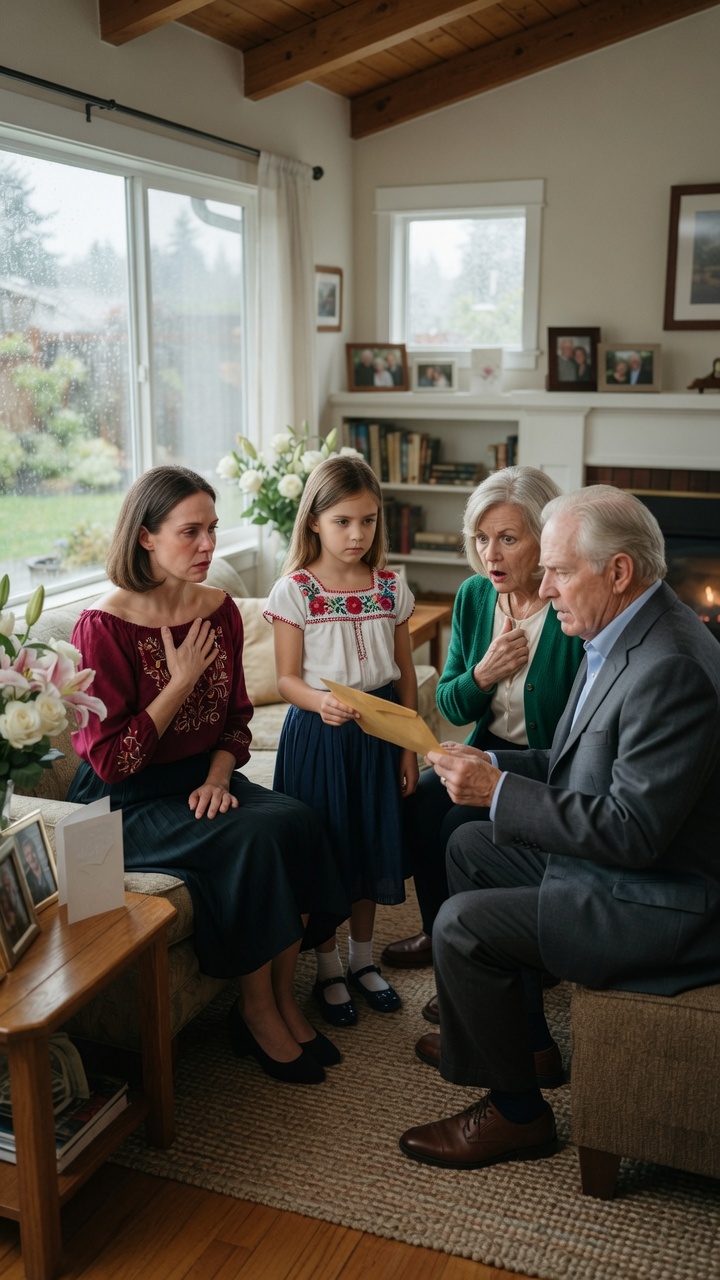
Before Valeria could respond, Sofía appeared in the hallway.
She wore a navy sweater, her hair messy on one side, and held a manila envelope in her hands.
No one moved.
The girl walked to the living room, stood between her mom and her grandparents, and extended the envelope.
Her voice was soft, yet firm.
—This is what you came to look for.
Marta tried to smile.
—Sofía, my dear…
But Sofía didn’t lower her gaze.
—You didn’t come when my dad died.
Valeria took the envelope with shaking hands and placed it on the coffee table.
Arturo frowned.
—What is that?
Valeria took a deep breath.
—The truth.
And when Marta opened the envelope, the first page wiped the color from her face.
PART 2
Inside the envelope were three documents.
The first was a notarized promissory note for 2,870,000 pesos, signed by Arturo and Marta Ríos 18 months prior.
Valeria felt her memory burning.
They had asked Julián for that money to “save” Ximena’s bakery in Providencia. Marta had cried in the kitchen, saying her youngest daughter would lose everything, that the employees depended on her, that they just needed a push.
Valeria had said no.
Julián, on the other hand, had listened in silence.
Later, when they were alone, Valeria warned him:
—They’re not going to pay you, Julián.
He leaned against the bar and rubbed his jaw.
—I know.
—So why accept?
—Because if I don’t, they’ll blame you for life.
Julián didn’t hand over the money blindly. He asked for a contract, signatures, interest, collateral, and Mercedes’s review.
Marta was offended.
Arturo said that family doesn’t do those things.
Julián simply replied:
—Precisely because it’s family, everything must be clear.
And they had spent 18 months paying almost nothing.
The second document was a legal letter. It stated that the debt had returned to Julián's estate and must be settled within 30 days. If they didn’t, there would be a civil lawsuit, interest, fees, and preventive seizure of the vacation home Arturo and Marta owned in Chapala.
Marta read that part twice.
The third was worse.
It was the certified transcript of the call Valeria made from the hospital the night Julián died.
Valeria’s voice:
“Mom… Julián died.”
Marta’s voice:
“We’re at your sister’s birthday dinner. Can this wait until tomorrow?”
Valeria’s voice:
“No. He’s gone.”
Marta’s voice:
“Your sister only turns 35 once.”
At the bottom was a note from Mercedes:
“Any attempt to financially pressure the widow or claim assets outside the will will be treated as bad faith harassment.”
Marta held the pages so tightly that the paper crumpled.
Arturo turned red.
—This is madness.
Sofía flinched at the sound.
Valeria stepped forward.
—Don’t yell at her.
—That loan was for Ximena —Arturo said—. Julián knew we were just helping her.
—That’s why you signed —Valeria replied—. Not her.
Marta raised her face, indignant.
—Would you really sue your own parents?
There it was.
The old trick.
When they asked for money, they were family.
When it was time to pay it back, they were wounded parents.
Valeria had spent 37 years trapped in that trap. Ximena was always the fragile one, the poor thing, the one who couldn’t handle pressure. Valeria was the strong one, the responsible one, the one who had to understand.
When Valeria earned a scholarship, Marta asked her not to boast so that Ximena wouldn’t feel less.
When Valeria got engaged, Ximena cried because she felt behind in life.
When Julián and Valeria bought their house, Arturo asked for money to “fix a pothole” for Ximena and took almost a year to pay back part of it.
Ximena’s pain was always a family emergency.
Valeria’s was always an exaggeration.
—You didn’t come as my parents —Valeria said—. You came as debtors.
Marta opened her mouth, wounded.
Then she looked at Sofía, searching for an escape.
—Sweetheart, we adults are having a misunderstanding.
Sofía squeezed her mom’s hand.
—My dad wasn’t a misunderstanding.
The phrase fell like a stone.
Arturo threw the envelope on the table.
—Ximena can’t pay this.
—That’s not my problem.
—You’re going to ruin her.
Valeria felt something cold settle inside her.
—Julián is dead. Sofía lost her dad. I buried my husband. You missed the funeral and came to collect. So listen to me well: it’s over living around Ximena’s crises.
Marta clenched her jaw.
—You’ve always been envious of your sister.
Valeria almost smiled.
That accusation no longer had any edge.
—No. What I’ve always had is exhaustion.
Arturo pointed at her.
—You’re going to regret this.
Valeria looked at Julián’s boots by the door.
—No. I think I’m finally stopping to regret things that were not mine.
Her parents left without saying goodbye.
That night, when Sofía fell asleep clutching Julián’s plaid shirt, Valeria called Mercedes.
The lawyer didn’t seem surprised.
—Julián left something else —she said—. A letter to be opened only if someone from your family tried to pressure you after his death.
Valeria sat at the same table where Julián had taught multiplication.
Mercedes read.
“Vale, if you’re listening to this, it means I’m not there to make people behave as they should. So I’ll tell you clearly what I’ve told you softly for years: you owe loyalty to no one who treats you like a backup daughter and then presents themselves as primary creditors.”
Valeria covered her mouth.
The letter explained that the life insurance, the business, and the accounts would go into a trust for her and Sofía. That money was for housing, school, therapy, health, and future.
Not a peso could be used to rescue Ximena, Arturo, or Marta without Valeria's and Mercedes’s approval.
Then came the phrase that broke her:
“If they ask for compassion that they didn’t give to Valeria when she needed it most, the answer is no.”
Valeria cried until she ran out of breath.
Not because Julián had been cruel.
But because he had been clear.
Even in death, he was protecting her from a family he understood before she did.
The next day, Ximena posted on Facebook.
“There are people who use money to punish their family during difficult times. Loss doesn’t justify becoming vengeful.”
She didn’t mention names.
It wasn’t necessary.
Marta posted a broken heart emoji. Arturo wrote to several cousins, saying that Valeria was “unstable” and wanted to take their house.
Then Ximena uploaded a photo from Julián’s funeral, stolen from a distant aunt.
She cropped it to show the coffin but not the empty row where her parents should have been.
The caption read:
“Grief shows who you are.”
Valeria wanted to respond.
She wanted to upload the call, the promissory note, the messages, everything.
But she remembered a phrase from Julián:
“Urgency is almost always someone else’s strategy.”
So she posted nothing.
She sent everything to Mercedes.
That same day, cease and desist letters went out. A notice was also filed with the family and civil court for harassment related to the estate.
For three days, Ximena called 17 times.
Valeria didn’t answer.
The messages came in alone.
“Are you really going to let lawyers attack mom and dad?”
“Julián would be disgusted.”
“You always hated me.”
“Hope you enjoy being alone.”
Valeria forwarded everything.
Mercedes replied:
“Keep saving.”
For the first time, Valeria understood that silence wasn’t weakness.
Sometimes it was gathering evidence.
A week later, the twist nobody expected arrived.
Mercedes discovered that of the 2,870,000 pesos loaned for the bakery, almost 900,000 hadn’t entered the business. They had been used to pay Arturo’s personal credit cards, overdue taxes, and a debt on the Chapala house.
Julián had suspected it months earlier.
He had asked for receipts.
They never gave them.
He had the file ready.
Valeria stared at Julián’s closet, where his shirts still hung.
—He knew…
—He suspected —Mercedes said—. He didn’t want to worry you without proof.
Of course.
Even in that, he wanted to protect her.
The mediation happened a month later in an office in downtown Guadalajara.
Arturo and Marta arrived with a lawyer. Marta looked smaller. Arturo no longer had his authoritative voice but a weary rage.
His lawyer started with nice phrases.
—We all recognize it has been an emotionally complicated period.
Mercedes didn’t blink.
—My client’s husband died. Four days later, her parents demanded half of the inheritance while owing 2,870,000 pesos to the estate. Let’s use precise language.
They tried to say there was confusion.
Mercedes showed the promissory note.
They tried to say they didn’t want to harm Valeria.
Mercedes showed the messages.
They tried to say seizing Chapala was excessive.
Mercedes showed the personal payments made with Julián’s money.
The room shifted.
Even their lawyer stopped pretending.
During a break, Marta followed Valeria into the hallway.
—You have to understand —she murmured—. Ximena needed us.
Valeria looked at her.
—I needed my mom too.
Marta didn’t respond.
—I called you from a hospital. Julián was dead. Sofía was in my lap asking if her dad was going to wake up. I needed my mom.
Marta’s eyes filled with tears.
Valeria no longer trusted tears without actions.
—You chose a dinner.
—I didn’t know what to say.
—You could have started with: “I’m on my way.”
That was all.
At the end of the day, they signed.
Arturo and Marta would pay an immediate portion by selling the truck and renting out the Chapala house. The rest would remain under judicial calendar with interest.
They also signed a written retraction regarding their posts and messages.
They wouldn’t be able to contact Valeria or Sofía for one year, except through lawyers. After that, any approach to Sofía would depend solely on Valeria.
Marta hesitated before signing.
Mercedes placed the call transcript on the table.
Marta signed.
The retraction was cold, dry, without affection.
But Valeria no longer needed fake affection.
She needed limits with signatures.
Ximena closed her second bakery before the month ended. The first remained open, smaller, without motivational phrases or luxury photos.
Some time later, she called from an unknown number.
Valeria answered by mistake.
—Are you happy? —Ximena asked.
—No.
—You ruined my life.
—No. I stopped financing the destruction you were already causing.
Ximena fell silent.
Then she said, quieter:
—I didn’t know about the hospital call.
Valeria tightened her grip on the phone.
—But you did know about the funeral.
Ximena didn’t respond.
—Mom and dad always said you thought you were better than me —she murmured.
Valeria looked at the rain hitting the kitchen window.
—No, Ximena. They told you that so you wouldn’t see that they were using both of us. You as the fragile one. Me as the useful one.
Ximena hung up.
Valeria didn’t forgive her.
But she understood something: Ximena hadn’t invented that family alone. She had benefited, yes. She had used her, too. But their parents had built the stage long before.
Understanding didn’t erase the guilt.
It only made the damage sadder.
Over time, Sofía began therapy. She drew houses, rain, and three people under a yellow sun. Then two. Then three again, but the third was light.
Valeria sold Julián’s business to Ramiro, his warehouse manager. He promised to keep the workers and painted Julián’s motto on the wall:
“Build right. Stand firm.”
One day, Ramiro handed Sofía her dad’s old helmet.
Inside, it was written with a marker:
“For Sofi's first skyscraper.”
The girl hugged it all the way home.
One year later, Valeria and Sofía went to the beach in Nayarit with a portion of Julián’s ashes. The wind was strong, clean, as if it could carry what they no longer could.
Valeria read a letter.
She told him that Sofía already knew how to divide, even though she still hated it.
She told him that her parents were paying what they owed.
She told him she had stopped chasing people who only wanted her when she was useful.
And in the end, she whispered:
—I’ll be okay. Not because this is okay. Because you loved us in a way that taught us to stand.
Sofía scattered a handful of ashes into the wind.
They disappeared quickly.
—Where did dad go?
Valeria hugged her.
—Everywhere.
Sofía thought for a moment.
—Dad would like to be everywhere.
That night, in the light blue kitchen, Sofía asked:
—Do you miss grandma?
Valeria looked at Julián’s photo on the shelf.
—Sometimes I miss the mom I wanted to have.
Sofía lowered her gaze.
—I miss dad as he was.
Valeria took her hand.
—That’s the best kind of missing.
Sometimes, Valeria still mentally replayed that call.
The broken voice.
The music in the background.
“Your sister only turns 35 once.”
It still hurt.
But then came something stronger.
For years, Valeria believed that being a good daughter meant staying silent. She believed that peace meant letting the most selfish person occupy the entire room.
Then Julián died.
Her parents came to collect.
And her 8-year-old daughter walked in with an envelope in her hands.
She didn’t shout.
She didn’t beg.
She simply handed them the truth.
And in the tremor of those hands, Valeria saw a lie that had lasted her whole life shatter.





