PART 1
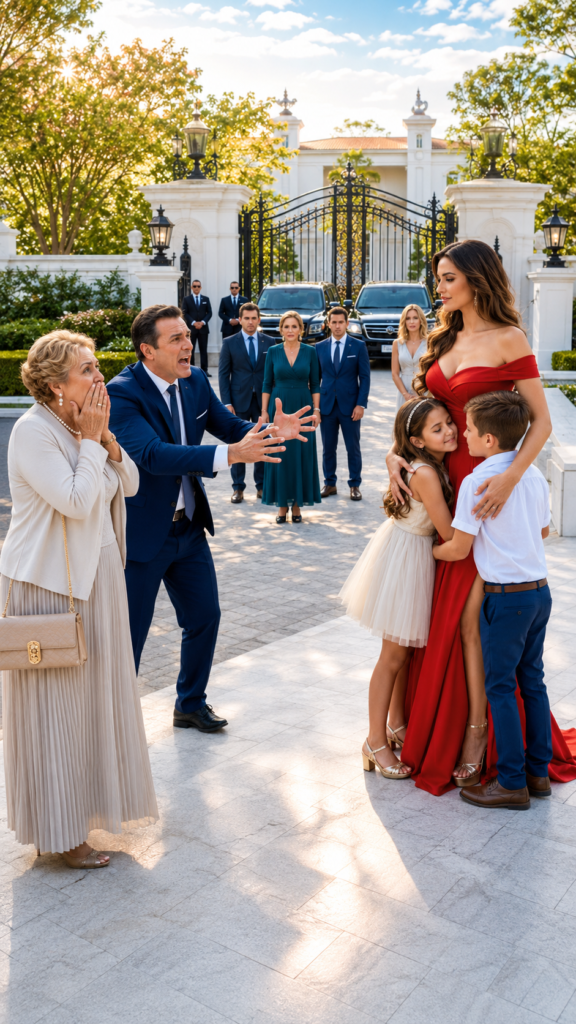
—The trash doesn’t enter my house, Mrs. Renata. And how curious… they all arrived together.
The Cárdenas family stood in stunned silence before the black gate of a private residence in Puerta de Hierro, Guadalajara.
Marina Robles was on the other side, dressed in white, serene, with her hair down and a gaze that no longer asked for permission.
But three weeks earlier, no one would have pictured her like this.
Outside the family court, Marina held a small bag and the divorce papers. She wore no jewelry. No expensive makeup. Just that weary dignity of someone who had cried too much in silence.
Mrs. Renata Cárdenas looked at her as if she were a stain on the floor.
—Let’s see how long your pride lasts without my son —she said, adjusting her dark sunglasses—. Because women like you, darling, end up coming back with their tails between their legs.
Sebastián, her ex-husband, let out a low laugh.
—My mom is right. I gave you a name, a house, trips, restaurants. Without me, you become nobody.
Behind them, the cousins laughed. Fernanda, Sebastián’s sister, recorded on her phone, waiting for Marina to crack.
For five years, Marina had heard the same thing at family meals, christenings, posadas, and birthdays.
That she didn’t fit in with them.
That she didn’t know how to dress.
That she spoke little because she probably had nothing to say.
That Sebastián had “lifted her up,” as if marrying her had been an act of charity.
What none of them knew was that Marina was not poor.
She was just hidden.
She had concealed her full surname, her inheritance, and her role in Grupo Robles Valcárcel because she wanted to know if Sebastián loved her, not her fortune.
And the answer had been brutal.
That day, outside the courthouse, Marina did not cry.
She simply looked at Mrs. Renata and then at Sebastián.
—You’re right about one thing —she said calmly—. In one month, it’ll be clear who really needs whom.
Sebastián burst into laughter.
—Oh, Marina, come on. Now you think you’re the protagonist of a novel?
—No —she replied—. Just the hostess.
Mrs. Renata frowned.
—Hostess of what?
—Easter dinner. Come one, come all. I want you to see how I live without you.
Fernanda stopped recording for a second.
—Everyone?
—Everyone who laughed —Marina said—. So that nobody is missing.
Mrs. Renata smiled cruelly.
—With pleasure. Let’s see if you rented a terrace with pretty tablecloths to pretend.
Marina did not respond.
She walked toward a black car waiting for her at the corner. An older driver stepped down and opened the door respectfully.
—Mrs. Marina, welcome back.
She took a deep breath.
—Let’s go home, Mr. Aurelio. The farce is over.
Three weeks later, 32 members of the Cárdenas family arrived in luxury SUVs at the address sent in an ivory envelope.
They came dressed as if for a magazine photo shoot. They came ready to laugh.
But when the GPS brought them in front of an immense residence, guarded by private security, the laughter faded.
A guard approached.
—Good afternoon. Welcome to the residence of Mrs. Marina Robles Valcárcel.
Mrs. Renata turned pale.
Sebastián rolled down the window.
—Robles… what?
Then the gate began to open slowly.
And no one was prepared for what lay behind.
PART 2
The SUVs advanced along a stone driveway surrounded by bougainvilleas, jacarandas, and high walls covered in vines.
In the distance, a huge, elegant house rose, with light-colored stone, wide windows, and a terrace from which half the city could be seen.
This was not a rented house.
This was not a borrowed terrace.
This was a real mansion.
Fernanda lowered her phone slowly.
—This is really weird, Sebastián.
Sebastián did not answer. He was staring at the fountains, the gardens, the uniformed staff, and the cars parked under a wooden pergola.
Mrs. Renata tightened her designer bag.
—It must belong to some friend. That woman can’t afford this.
When they got out, Mr. Aurelio welcomed them with a list in hand.
—Cárdenas family, 32 confirmed guests. Mrs. Robles is waiting for you in the central patio.
—Mendoza Cárdenas —Mrs. Renata corrected in a harsh voice—. She was a Cárdenas until three weeks ago.
Mr. Aurelio looked up.
—Here she has never stopped being Robles Valcárcel, ma'am.
The phrase landed like a slap.
They walked in silence to the central patio. There was an enormous table with linen tablecloths, fine china, white flowers, and Easter food: romeritos, salted cod, marinated leg, apple salad, freshly baked bread, and almond desserts.
But no one looked at the food.
Everyone looked at Marina.
She stood next to the table, calm, with two lawyers, a notary, and a man in a gray suit whom Sebastián recognized immediately.
It was Ernesto Salvatierra, the financial director of one of Jalisco’s strongest private funds.
Sebastián felt a pit in his stomach.
—Marina… what is all this?
She looked at him without anger, but without tenderness.
—My house.
Mrs. Renata let out a dry laugh.
—Don’t insult our intelligence. You came to my family with two dresses and a suitcase.
—I came this way because I wanted to —Marina replied—. Not because it was all I had.
Fernanda swallowed hard.
—Who are you?
The notary stepped forward.
—Mrs. Marina Robles Valcárcel is the majority shareholder of Grupo Robles Valcárcel, with stakes in real estate developments, transportation, agribusiness, and investment funds.
No one spoke.
Not even the cousins who always had a cruel joke.
Sebastián blinked several times.
—No. That can’t be.
—What’s impossible —Marina said— is that you lived with me for five years and never asked who I was. You only cared about what you thought you could control.
Mrs. Renata raised her chin.
—If that were true, you would have told us.
—For what? —Marina asked—. So I could be invited to the table for my money and not for respect?
The silence weighed more than any scream.
Ernesto Salvatierra opened a blue folder.
—Mr. Sebastián Cárdenas, Mrs. Renata Cárdenas, you are informed that as of today, the financial backup lines linked to Constructora Cárdenas del Bajío are suspended.
Sebastián took a step back.
—What backup?
Marina held his gaze.
—the one my company provided you for four years without you knowing. The one that sustained your projects in Zapopan, Chapala, and Puerto Vallarta.
Mrs. Renata brought a hand to her chest.
—That’s a lie.
—I wish it were —Marina said—. Because we also discovered that you used my marriage to justify credits, move guarantees, and forge authorizations.
A murmur spread across the table.
The uncles looked at each other. The cousins stopped pretending to be secure.
Sebastián approached nervously.
—Marina, we can talk in private.
—No —she replied—. You came as a family to see me fail. So you’re going to hear the truth as a family.
Mr. Aurelio turned on a screen at the back of the patio.
The first image showed Mrs. Renata entering Marina’s old room with a key.
She was seen rummaging through drawers, taking out envelopes, opening boxes, photographing documents.
Fernanda whispered:
—Mom…
Mrs. Renata pressed her lips together.
—It was my son’s house. I could enter.
—It wasn’t your house —Marina said—. It was a house paid for with money that came from accounts you couldn’t even read.
The screen changed.
A transcribed audio appeared.
Sebastián’s voice sounded clear:
—As long as Marina feels grateful, she’ll sign whatever. My mom says these women obey if you make them believe they’re worth nothing.
Then Mrs. Renata was heard:
—Tell her that without you, she doesn’t eat. That’s how they stay quiet.
The patio froze.
Sebastián lost color.
—That’s edited.
One of the lawyers replied:
—No. It’s validated by forensic analysis. And accompanied by emails, altered contracts, bank applications, and three forged signatures.
Marina took another folder.
—When I married you, Sebastián, you demanded a separation of assets because you didn’t want me to touch “yours.” What a damn irony, right? That document ended up protecting me from your debts.
Mrs. Renata slammed her palm on the table.
—You’re doing all this because you’re bitter! Because my son no longer wanted you.
For the first time, Marina smiled slightly.
—No, Mrs. Renata. I do this because you taught me something.
—What thing?
—That trash doesn’t get a place at the table just for the sake of education.
Some guests looked down.
Paola, a cousin who used to mock Marina in the family chat, began to cry.
—Marina, I didn’t know any of this.
Marina looked at her firmly.
—you didn’t know everything. But you knew enough to laugh.
Paola didn’t respond.
Sebastián tried to take her hand.
—Marina, please. I loved you.
She pulled her hand away.
—No. You loved the version of me you could humiliate without consequences.
He lowered his voice.
—We’re family.
Marina took a deep breath.
—we were family when you left me dining alone on Christmas because my dress “was embarrassing.” We were family when your mom said my abortion was an exaggeration to get attention. We were family when you sold my dad’s watch and told me I must have lost it.
Mrs. Renata quickly turned to Sebastián.
—You sold what?
Then came the twist no one expected.
Marina opened a small velvet box.
Inside was not the watch.
It held a pawn receipt, a copy of a transfer, and a photograph.
—you didn’t sell the watch to pay any debt —Marina said—. You sold it to buy your lover an apartment in Providencia.
Fernanda opened her mouth.
Sebastián stood still.
Mrs. Renata looked at him as if she had just discovered a stranger.
—What lover?
The lawyer placed another folder on the table.
—the property was purchased in the name of Laura Méndez, former assistant at Constructora Cárdenas. The payments came from accounts linked to guarantees backed by Varela Capital.
Marina calmly corrected:
—Robles Valcárcel Capital.
The silence shattered with furious murmurs.
Some uncles began to confront Sebastián. Mrs. Renata, who had come to humiliate Marina, now didn’t know whether to defend her son or pretend she didn’t understand.
Sebastián rubbed his hands over his face.
—I made mistakes, but you don’t have to destroy us.
—I’m not destroying you —Marina said—. I’m just stopping holding you up.
Ernesto Salvatierra closed the folder.
—the corporate properties are under review. The banks will initiate an audit. If the irregularities are confirmed, there will be a preventive embargo and criminal charges.
Mrs. Renata staggered.
—they’re going to leave us with nothing.
Marina looked directly at her.
—No, ma’am. They’re going to leave you without what was never yours.
The guards approached discreetly.
Mr. Aurelio stepped forward.
—Please, follow me to the exit.
Sebastián raised his voice.
—Did you invite us just to throw us out?
—No —Marina replied—. I invited you to see my failure, as you wanted. Just that you got the wrong story.
Mrs. Renata gritted her teeth.
—You’re ungrateful.
Marina approached her until they were two steps apart.
—you told me outside the courthouse that without your son, I couldn’t even pay for the light. You were right to worry about the bills. You just got the wrong house.
No one spoke again.
One by one, the Cárdenas family walked toward the SUVs. They no longer looked like a powerful family but a group of people surprised that arrogance also incurs interest.
Sebastián stopped before crossing the gate.
—Did you ever really love me?
Marina held his gaze.
—Yes. That’s why I gave you five years without a surname, without fortune, and without a shield. You chose to use that gift to trample me.
He lowered his head.
Mrs. Renata got into her SUV without looking back.
That night, as they returned to Guadalajara without tasting a single dish, the messages began to arrive.
A bank demanded an urgent meeting.
A partner canceled a contract.
A supplier requested immediate payment.
A notary notified the review of two properties.
And in the family chat, where they once shared mockeries about Marina, no one had the courage to write even an emoji.
At the Robles Valcárcel residence, no food was wasted.
Marina ordered everything to be taken to a community dining room in Tonalá, where several families had a hot dinner without knowing that those dishes had been prepared for people who never knew how to value anything.
Later, Marina stepped out onto the terrace with a cup of coffee.
Mr. Aurelio approached silently.
—Are you okay, ma’am?
Marina looked at the city lights.
—not yet. But I’m no longer ashamed to be alone.
The man nodded.
—Your father would be proud.
Marina swallowed hard.
For years she wanted to prove that she could be loved without money.
In the end, she understood something harsher: whoever needs to see you small to feel big, never deserved to sit at your table.
The next morning, the fall of the Cárdenas family spread through Guadalajara without cheap scandal, but with the same speed with which families who live off appearances crumble.
They didn’t lose everything because of Marina.
They lost everything because they confused her silence with weakness.
And she, for the first time in five years, had breakfast alone in front of the garden without feeling sadness for anyone’s absence.
Because sometimes justice doesn’t shout.
Sometimes it just opens a gate, reveals the truth… and lets the arrogant leave empty-handed.





