PART 1
After three years locked away in Barrientos prison for a crime he never committed, Mateo Salgado returned to the house of his childhood with a torn backpack, a borrowed jacket, and a heart knotted in despair.
He didn’t want money.
He didn’t want a fight.
He just wanted to embrace his father.
For 1,095 nights, Mateo imagined Don Ernesto waiting for him in the living room, with his pot of coffee and that hoarse voice always saying:
—The truth doesn’t die, son. It just takes time to arrive.
But when he reached the Narvarte neighborhood in Mexico City, he knew something was wrong.
The yellow façade of the house was gone.
Now it was gray, cold, modern, like something out of an expensive catalog. The geraniums his father had tended every Sunday had vanished. In the driveway, there was a brand-new black SUV and a sports bike Mateo had never seen.
Even the door seemed different.
Black, shiny, with a security camera.
Mateo knocked.
Not as a visitor.
He knocked like a son returning from war.
The door opened, revealing Renata, his stepmother, immaculate in a burgundy dress, perfect nails, and a gaze so barren it felt like she had been waiting only to destroy him.
—Look at you —she said—. I thought you’d take longer to get out.
Mateo swallowed hard.
—Where’s my dad?
Renata didn’t blink.
—Your dad died a year ago. And before you start your little show, this house is mine now.
Mateo's legs went weak.
The noise of the street became distant.
—Died? And no one told me?
Renata let out a low laugh, as if the question bored her.
—You were in prison, Mateo. In prison for stealing from your own father’s factory. Do you really think he wanted to see you at his funeral?
—I didn’t steal anything.
—That’s what you said at the trial. And look how that went for you.
Mateo tried to look inside.
Gone were the family photos. Gone was the image of his mother on the altar. Gone was Don Ernesto’s palm hat hanging by the entrance.
Everything smelled of expensive perfume and foreign living.
—Let me in. I just want to see his room.
Renata crossed her arms.
—His room doesn’t exist anymore. I turned it into a dressing room.
At that moment, Iván, Renata’s son, came down. His half-brother. The same one who years ago would come home drunk asking for money, the one who gambled online and always swore he’d “change this time.”
Iván smirked mockingly.
—Look who’s back, the martyr. You here for inheritance or pity?
Mateo clenched his fists.
—I’m here for my dad.
—Your dad left you out of everything —Renata said—. Signed will. House, accounts, factory, all legal. So get lost before I call the cops.
—I want to see his grave.
Renata shrugged.
—Panteón Jardines del Sur. Next to your mom, just like he wanted. You can go cry there.
The door closed softly, elegantly, humiliatingly in Mateo's face.
He didn’t scream.
He didn’t kick.
He didn’t give them the satisfaction.
He walked to the cemetery with burning eyes and an old key in his pocket. It was a key his father had given him as a teenager, telling him one day he would understand what it was for.
Mateo never knew.
Until that afternoon.
At the cemetery, he searched for the Salgado name among clean graves, marble crosses, and fresh flowers. He found his mother’s grave.
But next to it, Don Ernesto was not there.
Only empty earth.
An old gardener, with a worn hat and hands full of dirt, watched him from afar. Then he approached slowly.
—Are you Mateo Salgado?
Mateo froze.
—Who’s asking?
The man lowered his voice.
—My name is Don Aurelio. Your dad asked me to give you this if you ever came.
He pulled out a yellowed envelope, carefully folded. Inside was a letter, an old photo, and a card with an address in Naucalpan.
There was also a phrase written in Don Ernesto’s shaky handwriting:
“If Renata told you I’m dead and buried with your mother, she has already started her last lie.”
Mateo felt the air cut off.
He looked at the gardener, but the old man just pointed to the key he held in his hand.
—That key opens storage 47. Don’t go back to that house yet, boy. What your dad left there could save you… or sink them all for good.
PART 2
Mateo didn’t read the letter sitting on a bench.
He read it standing, next to his mother’s grave, with the sun setting over the cemetery and his hands so stiff he almost tore the paper.
Don Ernesto’s handwriting was still the same: large, slanted, the handwriting of a man used to signing blueprints, contracts, and payroll checks.
“Son, forgive me.
I didn’t abandon you because I believed you were guilty. At first, I was a coward. I let myself be deceived. Renata and Iván showed me reports, emails, and bank transactions where your user appeared. They told me you had emptied the factory accounts to pay debts.
I wanted to believe it was a lie, but I was sick, weak, and surrounded by people whispering in my ear every day.”
Mateo closed his eyes.
That hurt more than prison.
His father had doubted him.
Even if it was out of fear, even if it was due to illness, he had doubted.
He continued reading.
“When I began to review everything calmly, I found fake invoices, made-up suppliers, and transfers that ended in accounts linked to Iván. I also found your password written in Renata’s notebook.
You didn’t steal, son.
They used you.
And I arrived too late.”
The paper trembled in his fingers.
“In storage 47 is everything: copies, videos, account statements, medical reports, messages, and a recording of me. Don’t confront Renata without seeing it first. She isn’t alone. And she has no mercy.”
At the bottom, he wrote:
“If I couldn’t save you, at least I want to return your name.
Love, though late, your dad.”
Don Aurelio said nothing for a while. Then he pulled out 200 pesos from his old wallet.
—Take this. For the taxi or the subway. Your dad used to come here when he could. He would sit next to your mom and say you wouldn’t carry that cross forever.
Mateo wanted to refuse, but the old man closed his hand over his.
—Don’t be stubborn, young man. There are days even broken men need someone to pay their way.
Storage 47 was in an industrial area of Naucalpan, among mechanic shops, torta stands, and rusty sheet metal warehouses. The attendant eyed him suspiciously, but the key opened easily.
Inside, there were no old furniture.
There was a hidden life.
Boxes labeled with black marker:
“RENATA”.
“IVÁN”.
“FACTORY”.
“WILL”.
“EVIDENCE FOR MATEO”.
On a folding table sat an old laptop, a USB drive, and a note taped to it:
“Watch the video first.”
Mateo connected everything as best as he could. The laptop took a long time to boot, making a terrible noise, but finally, the file appeared.
The screen showed Don Ernesto.
He looked thinner, with ashen skin and a brown sweater Mateo remembered from chilly mornings. Behind him was the carpentry shop where his father repaired old chairs even though he had the money to buy new ones.
—Mateo —the tired voice said—, if you’re watching this, it means you’re out. I wish I could be there to hug you. I lacked courage, son. I lacked time. But I didn’t lack love.
Mateo brought his hand to his mouth.
—You didn’t steal. Iván used your user to move money from the factory to ghost companies. Renata got your passwords because she went through your things at the office. Then she entered your apartment with a duplicate key and left altered documents on your computer.
Don Ernesto breathed with difficulty.
—When I realized, they had already isolated me. Renata said the medication made me imagine things. She took my cell phone. Canceled visits. Told everyone I was delusional.
The recording paused.
Don Ernesto looked into the camera with a sadness that seemed to pierce the screen.
—They also forged my signature to change the will. There are papers where my signature appears on days when I was sedated. The notary who allowed it is bought. Everything is documented.
Mateo felt nauseous.
It wasn’t just the house.
It wasn’t just the factory.
It was a complete trap.
—And there’s one more thing —Don Ernesto said—. If Renata told you I’m buried next to your mother, it’s a lie. I bought that place to be with her. But if they discovered me before this got to you, they might have tried to erase even my grave.
The image froze for a few seconds.
Then Don Ernesto said the phrase that shattered Mateo inside:
—Forgive me for not saving you alive. Maybe I can help you dead.
The video ended.
Mateo spent the night reviewing folders. There were account statements, printed emails, photographs of Renata entering his old apartment, screenshots of messages between Iván and an accountant from Monterrey, receipts for gambling, and transfers totaling millions.
In a red folder, he found a handwritten confession.
It was from Iván.
He admitted he had used Mateo’s keys to divert money but claimed it was “all his mom’s idea” and that he had only obeyed because he owed money to dangerous people.
Underneath was a note from Don Ernesto:
“I got this from him drunk, crying, before he retracted. Keep it like gold.”
Mateo didn’t go to the house that night.
Before prison, he would have screamed, kicked down the door, demanded answers. But three years locked away taught him something cruel: the system loves to label as violent the man who finally defends himself.
So he breathed.
He tucked the USB into his sock.
He slept sitting among the boxes, hugging the backpack as if it were a lifeline.
The next morning he went to a legal support organization in Doctores. There he met Lucía Armenta, a petite, serious lawyer with a gaze that had seen too many injustices.
Lucía read for nearly three hours.
Finally, she took off her glasses.
—Mateo, this isn’t a family dispute. This is fraud, forgery, identity theft, evidence fabrication, and manipulation of a will. If this is handled properly, your conviction will be overturned.
—And my dad?
Lucía opened the folder of funeral documents.
Her face changed.
—There’s something very ugly here.
The documents showed that Don Ernesto had paid, years prior, for a double plot next to his wife. Everything was settled. He even left a letter asking to rest with her.
But Renata canceled the service after his death.
Requested a refund.
Collected a funeral insurance.
And sent the body to an individual grave in a municipal cemetery in Chimalhuacán, with a provisional plaque.
It didn’t say Ernesto Salgado.
It only said:
E. Salgado.
Mateo didn’t cry.
Not yet.
The rage left his throat dry.
—She punished him even in death —Lucía murmured.
Mateo looked at the photo of his father in the folder.
—No. She wanted to erase him.
The first notifications arrived at the Narvarte house 12 days later. Accounts were frozen, a review of the sentence was requested, the notary was summoned, and Don Ernesto’s medical records were demanded.
Renata called that same afternoon.
Her voice sounded sweet, almost maternal.
—Mateo, son, I received some horrible papers. Someone is filling your head with lies. We can fix this as a family.
Mateo held the phone without moving.
—A family doesn’t imprison an innocent man.
There was a brief silence.
Then Renata dropped the mask.
—People already know who you are. You were three years in prison. Who do you think will believe an ex-con?
Mateo looked at the USB drive on Lucía’s table.
—They don’t have to believe me. They will believe my dad.
The battle lasted nine months.
Iván was the first to crack. When the prosecution showed him transfers, bets, messages, and his own handwritten confession, he began to sweat like a child caught in a lie. At first, he said he didn’t remember. Then that he had been threatened. In the end, he understood his mom wouldn’t save him.
Then he spoke.
He said Renata had copied Mateo’s passwords. Said she used a duplicate key to enter the apartment and plant files. Said she convinced Don Ernesto not to visit his son, telling him Mateo hated him and only wanted money.
He also said something that froze the room:
Renata had changed the dose of some medications to keep Don Ernesto confused when he started to suspect.
Not to kill him, according to Iván.
But to silence him.
Renata arrived at the hearing dressed in white, with a rosary in hand and rehearsed tears. She spoke of love, sacrifice, and a confused widow who only tried to protect the factory.
But then Lucía projected the video.
The room went silent.
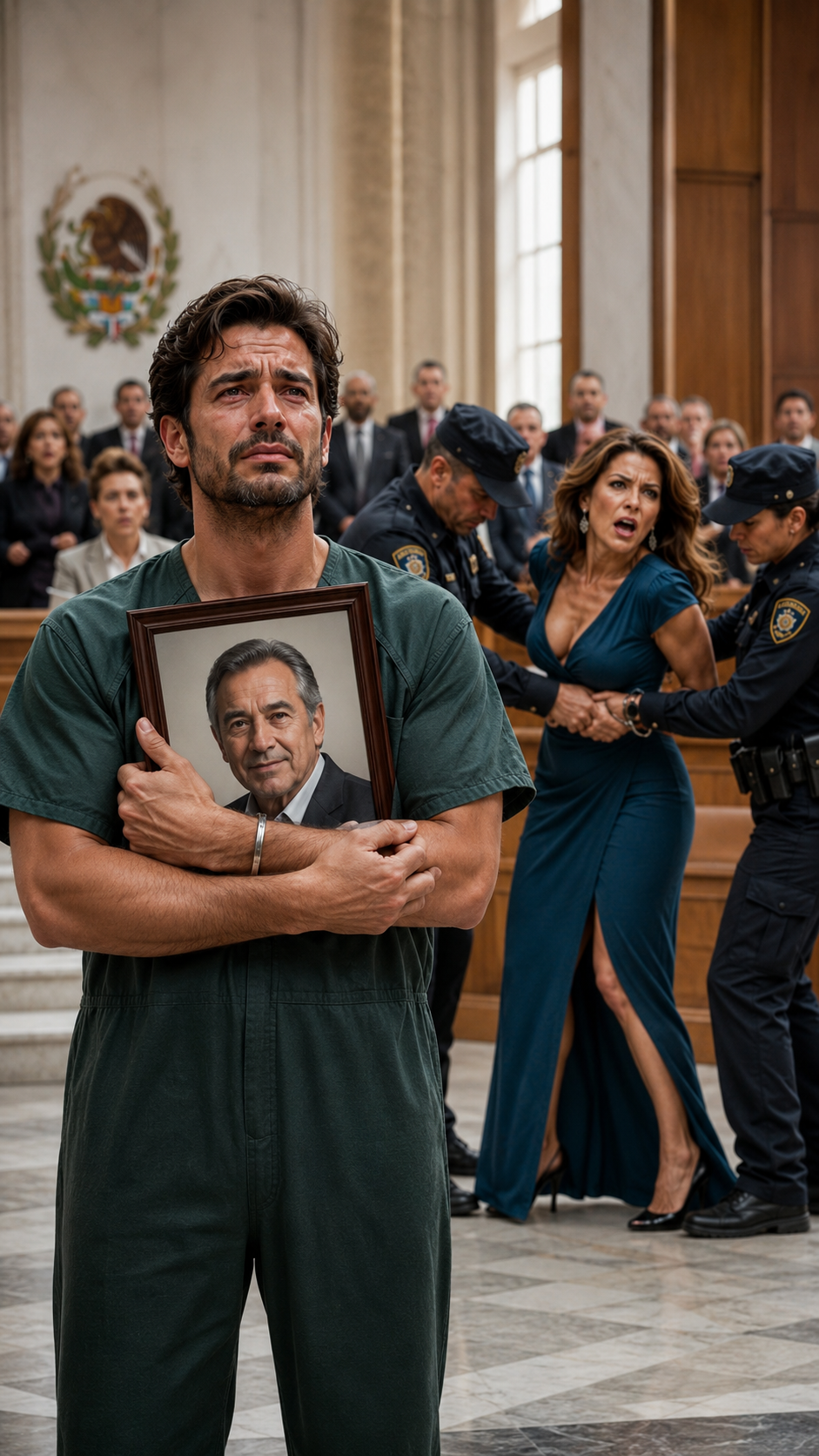
Don Ernesto appeared on the screen, thin, sickly, but with a dignity that not even death could take from him.
He recounted the trap.
He recounted his guilt.
He recounted the fear.
And when he said, “My son Mateo is innocent, and I was a coward for not screaming it sooner,” Mateo finally broke.
He didn’t make a scene.
He just bent over in his chair, covering his face, while everyone listened to a dead man return his life to him.
Weeks later, Mateo’s sentence was overturned. His name was cleared legally.
But no paper could return him three years.
Nor the nights of fear.
Nor the beatings.
Nor the Christmas he spent alone while his father was dying behind a guarded door.
Renata lost the house, the accounts, and the factory. She was charged with fraud, forgery, evidence manipulation, and abuse against a sick person. Iván accepted a plea deal and handed over more documents to reduce his sentence.
But the harshest punishment for Renata was not hearing the judge.
It was hearing, in a room full of strangers, the voice of the man she tried to erase defending the son she sent to prison.
Days later, Mateo went to the municipal cemetery in Chimalhuacán with Don Aurelio and Lucía. The place was dry, dusty, filled with crooked crosses and plastic flowers burned by the sun.
An attendant led them to the back.
—Here it is —he said, pointing to a rusty plaque.
E. Salgado.
Mateo knelt.
He ran his fingers over those two incomplete words and cried like he hadn’t cried since he was a child.
—I’m here now, Dad —he whispered—. I know everything. They couldn’t erase you.
Months later, with legal authorization, Don Ernesto was exhumed and taken alongside his wife, to the place he had bought himself. The new tombstone was simple:
Ernesto Salgado
Father, worker, and a true man.
Underneath, Mateo had inscribed the phrase that had sustained him in prison:
“The truth doesn’t die, it just takes time to arrive.”
The Narvarte house was returned to Mateo, but he sold it. Not out of lack of love, but because some walls hold too many screams.
With that money, he reopened his father’s workshop and hired people who had left prison without anyone giving them a job. No one knew better than him the weight of guilt stuck to the forehead, even if it wasn’t yours.
Some neighbors said Mateo should have forgiven Renata because “after all, she was family.”
Others said prison was too little for a woman capable of robbing three years from an innocent man and a dignified grave from a dead one.
Mateo never argued.
He only visited his parents every Sunday, left fresh flowers, and remained silent.
Because he understood that justice doesn’t always come with knocks on the door.
Sometimes it arrives in an old key, in a yellowed letter, and in the broken voice of a father who, even from a mismatched grave, found a way to bring his son back to the truth.





