PART 1
On the day of the divorce hearing, Javier Montiel walked into the family court in Mexico City, his mistress on his arm, as if they were arriving at a wedding instead of the place where he had shattered ten years of marriage.
Beside him was Mónica Salazar, impeccable, in an expensive white dress, nude heels, and that smile of a woman who already feels like the owner of a house where she’s never washed a dish.
Iris Vargas sat across from them in a simple gray coat, her hair pulled back, hands still on the table.
She wasn’t crying.
She wasn’t shouting.
And that seemed to bother Javier more than any insult.
He adjusted his silk tie, glanced at the reporters who had come for the divorce of the owner of Montiel Biotech, and smiled with a confidence that was disgusting.
—The company, the house in Las Lomas, the cars... it’s all mine now —he said, his voice steady—. In less than a month, you’ll be begging for help on the streets.
A few people turned away, uncomfortable.
His lawyer didn’t even try to silence him.
It wasn’t necessary.
On paper, Javier had already won.
Montiel Biotech was registered in his name. The mansion too. The bank accounts had been emptied three days before Iris filed for divorce.
The cars, the investments, the contracts with private hospitals, everything appeared beneath Javier’s signature.
Iris, under the law, seemed to have nothing left.
Mónica tightened her grip on Javier’s arm and let out a fake giggle.
—Poor thing —she murmured—. She looks so exhausted. Seriously, how tough it must be to lose everything.
Javier leaned toward Iris.
—Come on —he whispered—. Beg me. I can still leave you a monthly payment so you don’t embarrass yourself.
Iris didn’t respond.
Beside her, attorney Daniel Robles watched the judge without moving a muscle. He was a serious man, the kind who doesn’t promise revenge but prepares it with precision.
—Ready? —he asked quietly.
Iris took a deep breath.
For ten years, Javier had convinced her that no one would believe her. That he had money, friends, notaries, doctors, turned-off cameras, and bought employees.
For ten years, every mark on her skin had been hidden under long sleeves, makeup, and excuses.
—I fell.
—it was an accident.
—I’ve been clumsy lately.
But that day, there were no more excuses.
Iris looked directly at Javier.
—Now —she said.
She stood up.
The murmur in the courtroom gradually faded.
The photographers raised their cameras. The judge stopped reviewing documents. Even Mónica lost that cheap magazine smile for a second.
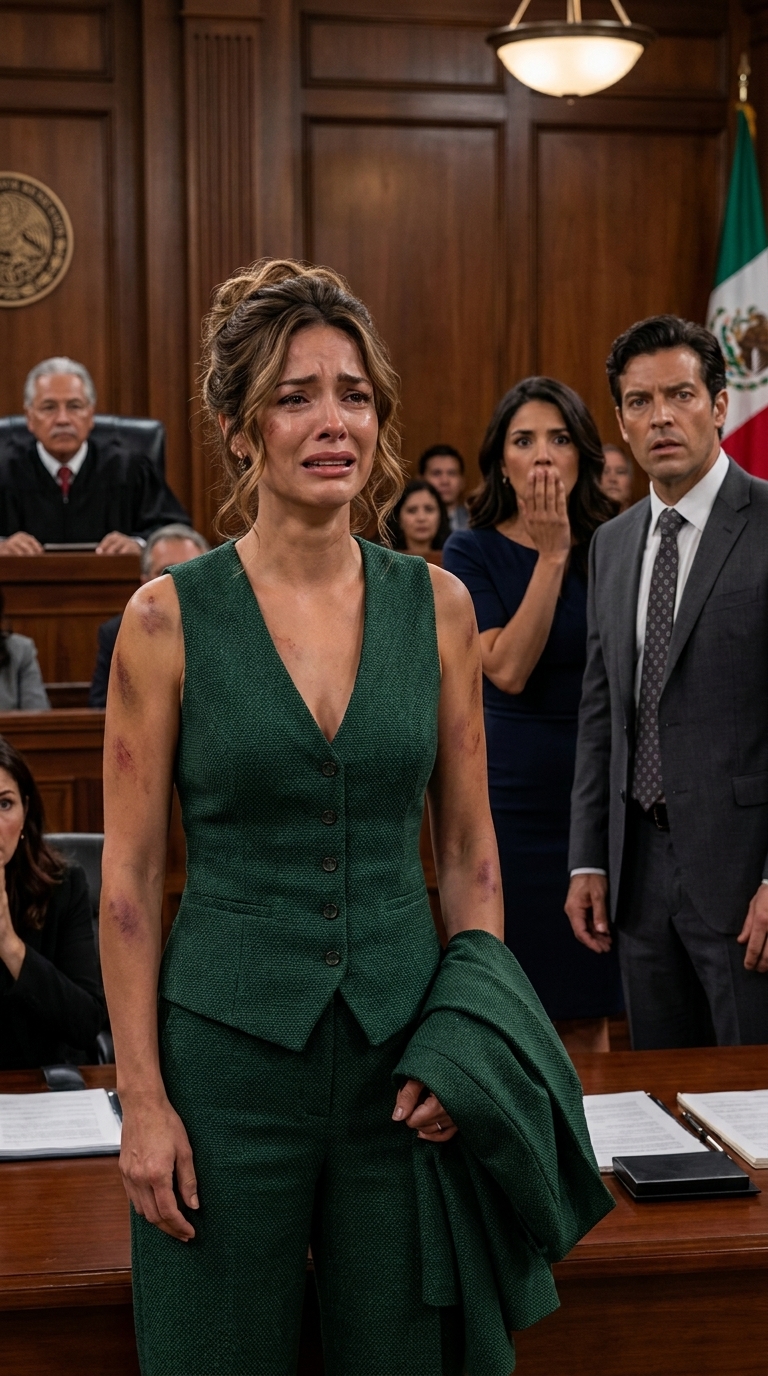
Iris moved her hands to the buttons of her coat.
Javier frowned.
—What are you doing?
She didn’t answer.
She slowly took off her coat.
And then the entire courtroom gasped for air.
Across her shoulders, arms, and ribs were long, clear, deep scars. They weren’t small marks. They weren’t accidents.
They were maps of pain.
They were living proof.
Mónica stepped back.
Javier turned pale.
The judge leaned forward.
—Ms. Vargas...
Iris placed both hands on the table and spoke with a calm that chilled more than any shout.
—This is no longer just a divorce, Your Honor. Today begins the trial for everything this man thought his money could bury.
Javier swallowed hard.
—Iris... no.
And for the first time in ten years, she smiled.
PART 2
Iris’s smile held no joy.
It held exhaustion.
It held repressed rage.
It held all the years she swallowed her fear to survive under the same roof as Javier Montiel.
The courtroom remained silent as Daniel Robles opened a black folder and placed a series of photographs, medical reports, and certified copies on the table.
—Your Honor —he said—, we request that this hearing be suspended as a mere divorce procedure and that immediate notice be given to the Public Prosecutor for domestic violence, fraud, forgery, asset abuse, and attempted concealment.
Javier let out a nervous laugh.
—This is ridiculous. They’re old scars. She’s always been unstable. She hurt herself to get attention.
Iris didn’t move.
She had expected that phrase.
She had heard it too many times.
Mónica looked at Javier anxiously.
—Javi, shut up —she whispered.
But he wasn’t listening to anyone.
—That woman didn’t build anything —he said, pointing at Iris—. I built the company. I secured the contracts. I put the Montiel name in this country’s medical industry.
Daniel passed another sheet to the judge.
—That’s also false.
The judge raised her gaze.
—Explain yourself, counselor.
Daniel connected a USB drive to the court’s system. An old video appeared on the screen, recorded twelve years earlier, in a small lab in the Narvarte neighborhood.
In the image, Iris, younger, in a white coat, explained a prototype for cardiac monitoring for rural hospitals.
Next to her was Javier, quiet, holding wires, looking as if he barely understood what she was saying.
Iris’s voice in the video sounded confident.
—The algorithm detects alterations before the patient goes into crisis. If we manage to bring it to public clinics, we could save many lives.
Javier’s face hardened.
The courtroom began to murmur.
Daniel showed notarized documents, emails, and patent records predating the creation of Montiel Biotech.
All in Iris Vargas’s name.
Not in Javier’s.
—The company was born from Ms. Vargas’s work —Daniel said—. Mr. Montiel registered the company using forged powers while she was hospitalized for an alleged domestic fall.
Iris lowered her gaze for a second.
She remembered that hospital in Tlalpan.
She remembered the cast.
She remembered Javier bringing her flowers in front of the nurses and squeezing her wrist when no one was watching.
—Smile, Iris. Don’t make a scene.
The judge reviewed the papers, her face growing more serious.
—Do you have proof of the forgery?
Daniel nodded.
—We have three handwriting expert analyses, testimonies from two employees, and a recording.
Javier slammed his hand on the table.
—That doesn’t prove anything!
The judge raised her voice.
—Mr. Montiel, if you interrupt again, I will order you removed from the courtroom.
Javier sat down, furious.
Mónica no longer smiled.
Her once-perfect white dress seemed out of place amid so much filth.
Daniel activated the audio.
First, there was the sound of glasses clinking, low music, and Javier’s voice.
—Iris will never dare. I have her under control. If she opens her mouth, I’ll say she’s crazy. And if she insists, I’ll take away even her last name.
Then Mónica’s voice appeared.
—And the marks?
Javier laughed.
—What marks? No one cares about a quiet woman in long sleeves.
Silence fell again like a slab.
Mónica covered her mouth.
Iris closed her eyes.
Not because it hurt to hear that.
It hurt to confirm that, even in his betrayal, Javier spoke of her as if she were a broken object.
The judge requested the audio to be stopped.
—Ms. Salazar —she said, looking at Mónica—, are you aware that you appear in a recording related to possible crimes?
Mónica began to tremble.
—I... I didn’t know everything.
Javier turned to her.
—Don’t say a word.
But Daniel pulled out another folder.
—In reality, Ms. Salazar knew quite a bit. And she also signed receipts from hotels, jewelry purchases, and bank transactions using company cards while Mr. Montiel diverted resources.
Mónica paled.
—He told me Iris had authorized everything.
—Did he also tell you that she authorized a life insurance policy in his name? —Daniel asked.
The courtroom trembled.
Javier stood frozen.
Iris lifted her gaze.
That was the part she didn’t even know completely.
Daniel spoke more slowly.
—Eight months ago, Mr. Montiel took out a million-dollar policy in Ms. Vargas’s name. The primary beneficiary was him. The secondary beneficiary, surprisingly, was Ms. Salazar.
Mónica let out a gasp.
—No... it can’t be.
Daniel showed a copy.
There was her signature.
Her name.
Her lie.
Javier tried to stand, but two judicial police officers in the room immediately approached.
—This is a trap —he said—. Iris has always been a manipulator. She always wanted to play the victim.
Iris finally spoke.
—I didn’t want to be a victim, Javier. I wanted to be your wife.
Her voice didn’t tremble.
But everyone felt the impact of those words.
—I helped you when you had nothing. I sold my mom’s apartment to pay for the first lab. I designed the equipment. I talked to doctors. I stayed up nights while you learned to pronounce words you didn’t understand to show off at conferences.
Javier gritted his teeth.
—Shut up.
—No —Iris said—. Not anymore.
The judge didn’t interrupt her.
No one did.
—When you hit me for the first time, you begged my forgiveness, crying. You said it was stress. The second time, you bought me flowers. The third time, you told me I provoked you. After that, I lost count.
Mónica was crying silently.
Not for Iris.
For herself.
Because she had just understood that she wasn’t the new queen.
She was the next.
Daniel presented the last piece of evidence: a recovered security video from the garage of the Las Lomas house.
In it, Javier was seen pushing Iris against a truck. Then it showed her falling, how he looked around, and how, noticing the camera, he ripped the device from the wall.
But he didn’t know the system kept a copy in the cloud.
The judge ordered an immediate recess.
The murmur exploded.
Reporters rushed out to make calls. Javier's lawyers huddled together, sweating, reviewing documents that were no longer worth anything.
Javier glared at Iris with hatred.
—You ruined me.
Iris put the coat over her shoulders, but didn’t button it.
She no longer had to hide.
—No, Javier. You ruined yourself. I just stopped protecting you.
When the hearing resumed, the judge was clear.
She ordered immediate protective measures for Iris, preventive freezing of accounts, an investigation into transferred assets, and referral of evidence to the Public Prosecutor.
She also ordered a review of the true ownership of Montiel Biotech.
Javier, the man who had entered like a king, left escorted amid cameras and reporters' shouts.
Mónica tried to approach Iris in the hallway.
—I didn’t know he did that to you —she said, crying—. I swear.
Iris looked at her with a cold sadness.
—Maybe you didn’t know everything. But you knew you were celebrating my fall.
Mónica had no response.
Because there were truths that didn’t need documents.
Days later, the story exploded on social media.
Some said Iris should have reported it sooner.
Others questioned why no one in her family noticed anything.
Many were outraged with Mónica.
Others, even worse, defended Javier because “a successful man doesn’t ruin his life for nothing.”
And that’s why Iris decided to hold a press conference.
Not in an elegant hotel.
Not in a private room.
She did it in front of the old lab in Narvarte where it all began.
She wore a sleeveless blouse.
Not to provoke pity.
But to make it clear that shame should never have been on her skin.
—For years I asked myself why I didn’t leave earlier —she said in front of the cameras—. Today I understand that question is wrong. The real question should be why so many saw signs and preferred to stay out of it.
Beside her were four former employees of Montiel Biotech.
All had testified.
All had been threatened.
All had stayed silent for fear of losing their jobs.
Until Iris spoke first.
Months later, justice began to move.
Not quickly.
Not perfectly.
But it moved.
The patents were recognized as Iris’s intellectual property. The house was under investigation for money laundering. Hidden accounts surfaced in Querétaro, Miami, and Monterrey.
Javier lost partners, contracts, and the image of a brilliant businessman he had cared for so much.
Mónica faced charges of financial complicity, although she tried to declare herself deceived.
And Montiel Biotech changed its name.
Iris renamed it Project Aurora.
Because, as she said, even after the longest night, something can rise again.
The first clinic to benefit was a public unit in Oaxaca, where monitoring equipment was installed for women victims of violence arriving without money, contacts, or anyone who would believe them.
Iris didn’t go back to Javier.
She didn’t send messages.
She didn’t visit.
She didn’t need to see him fall to his knees to feel free.
A year later, she received a letter from prison.
Javier’s handwriting was clumsy, desperate.
“Forgive me. I lost everything for not valuing the only woman who truly loved me.”
Iris read it completely.
Then folded it and put it in a box.
Not out of nostalgia.
But as a reminder.
That afternoon, in front of the mirror, she looked at her scars again.
For years she saw them as proof of defeat.
Now they were something else.
They were the exact lines of the path that had brought her out alive.
And although many on social media continued to argue, judging, opining as if someone else’s pain were mere table novel, Iris understood something she never negotiated again:
Justice doesn’t always start when a guilty person asks for forgiveness.
Sometimes it starts when a woman stops hiding the wounds that others should carry as shame.





