PART 1
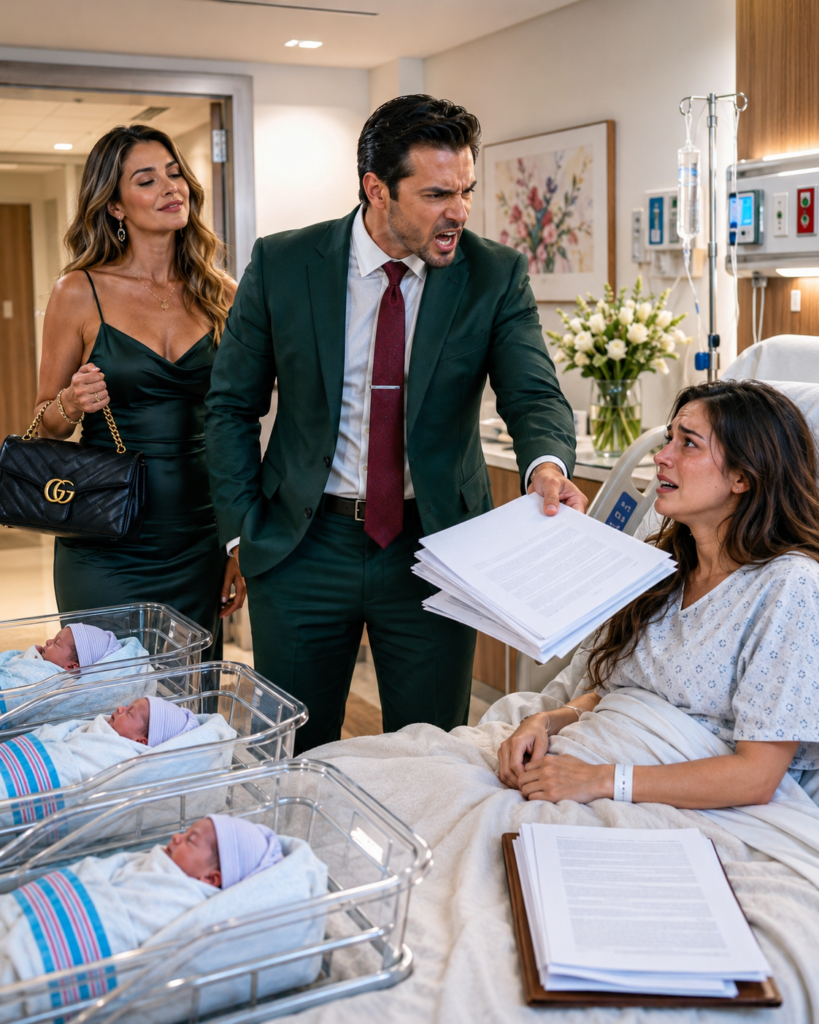
Mariana Rivas still wore the hospital gown stained when Ricardo Santillán entered her room like he was arriving at a private party.
He didn't come alone.
On his arm was Renata Alcocer, a woman in red heels, perfect lips, and a black Birkin bag dangling from her forearm like a crown. She lifted it just slightly, making sure everyone could see it.
Beside the bed, Mariana's three babies slept in transparent cribs. They were tiny, pink, swaddled in white blankets from the Hospital Ángeles de Pedregal.
Mariana hadn’t slept in 36 hours.
Her back ached, her scar burned, her hair clung to her forehead, and her hands trembled from exhaustion. But what hurt the most wasn’t her body.
It was Ricardo's smile.
“Look at her,” he said, letting out a low laugh. “I told you she didn’t look the same.”
Renata tilted her head, feigning pity.
“Oh, poor thing. She looks completely wrecked.”
Mariana stared at him, hoping to find even a crumb of guilt. But Ricardo simply adjusted his navy blue blazer, smelling of expensive perfume, immaculate, cold.
As if she hadn’t just brought their children into the world.
As if the three babies weren’t also his blood.
Ricardo pulled out a folder and tossed it onto the blanket.
“Sign the divorce.”
Mariana blinked.
“Here?”
“Where did you want it? In a fancy restaurant?” he replied. “You’re not in a position for those things anymore, Mariana. Look at you. No one’s going to want you now.”
A nurse passing by the door froze. Ricardo turned his face, smiling with that false politeness he used with partners.
“Family matter, miss.”
The nurse hesitated but continued walking.
Mariana opened the folder with trembling fingers. Divorce. Waiver of assets. Custody agreement. Transfer of rights to the house in Las Lomas.
All neatly organized.
All prepared.
“You want me to leave you the house,” she whispered.
Renata let out a giggle.
“Oh, don’t be dramatic. That house is better off in the hands of someone who knows how to live.”
Mariana felt the air leaving her.
“What did you do, Ricardo?”
He leaned closer, lowering his voice.
“I transferred it to Renata’s name a week ago. You were too busy puffing up like a balloon to notice anything.”
One of the babies whimpered softly. Mariana reached out to him, but Ricardo took the pen and placed it on top of the folder.
“Sign. You have no job, no money, and three mouths to feed. My lawyers will tear you to shreds.”
Mariana looked at the pen.
Then she glanced at Renata, at her bag, at her red nails glistening next to the black leather.
Then back at Ricardo.
“No.”
His smile vanished.
“Don’t play the brave one, Mariana.”
She breathed heavily but didn’t look down.
“I said no.”
Ricardo leaned over the bed.
“Then when you leave here, you won’t even have a place to sleep. Let’s see if your little-town parents can save you.”
Mariana didn’t respond.
That night, when they finally left, she took her phone with trembling hands and called her mother.
“Mom... I was wrong. You were right about Ricardo.”
There was silence on the other end.
Then her father’s firm voice came through.
“Are my grandchildren alright?”
“Yes.”
“Then cry today, daughter. Tomorrow we begin.”
Ricardo thought he had destroyed Mariana.
He had no idea he had just awakened the wrong family.
PART 2
Mariana left the hospital two days later with the three babies in baby carriers lent by a nurse who couldn’t stay silent.
The nurse’s name was Lupita and before saying goodbye, she squeezed Mariana’s hand.
“Ma’am, sorry to meddle, but what that man did was disgusting. I recorded a little bit when he threw the papers. You can’t see everything, but you can hear it loud and clear.”
Mariana felt her chest tighten.
“You recorded it?”
“For your benefit. You never know.”
Mariana received the video with tears in her eyes.
Outside, Ricardo wasn’t waiting for her.
A driver in a gray suit stood by a black armored truck.
“Mrs. Mariana Rivas, your father sent for you.”
Renata would have burst out laughing if she had seen that scene. She imagined Mariana begging for a taxi, loaded with diaper bags and crying on the sidewalk.
But Mariana got into the truck silently, clutching her children as if they were the only real things in the world.
When she arrived at the house in Las Lomas, she found the gate open.
Inside, there were boxes.
Her boxes.
Maternity clothes, family photos, shoes, books, even the crib she had chosen with excitement. Everything was piled at the entrance like trash.
Renata was in the living room, barefoot, wearing a silk robe.
“Oh, I’m so glad you’re here,” she said, sipping coffee from a porcelain cup. “Let me know what you want to keep because the rest is going to charity. I don’t want bad vibes in my house.”
Mariana tightened the blanket of one of the babies.
“That house isn’t yours.”
Renata smiled.
“Legally, it is. Just ask Ricardo. Or better not, he’s probably busy planning our honeymoon in Los Cabos right now.”
Then Ricardo appeared from the stairs.
“What are you doing here?”
“I came for my things and my children’s.”
He walked down slowly, enjoying seeing her weak.
“Your children can visit when a judge allows it. In the meantime, you’re not permitted to enter.”
Mariana looked at him with a calmness that annoyed Ricardo.
“Are you going to kick three newborns out into the street?”
“Don’t dramatize. Your parents have a little house somewhere, right? In Querétaro, in Puebla, who knows? They must have something humble.”
Renata let out a laugh.
“Send them pictures, love. So they can see what happens when a woman thinks too highly of herself.”
Mariana didn’t respond.
She simply pulled out her phone and recorded the boxes, the empty nursery, Ricardo refusing to hand over medical documents, Renata touching the blankets with disgust.
“Don’t record,” Ricardo grunted.
“Why?” Mariana asked. “Are you embarrassed for people to see who you are?”
Ricardo snatched the phone.
That was his second mistake.
Before he could delete it, the front door swung open.
Three men in dark suits entered. Behind them appeared an elegant woman, her gray hair tied up, fine glasses, and a steel gaze.
It was Elena Rivas, Mariana’s mother.
Renata looked her up and down, confused.
“And who are you?”
Elena didn’t answer.
She walked straight to Mariana and kissed each baby’s forehead.
“My beautiful children.”
Ricardo turned pale but tried to recover.
“Mrs. Elena, this is a private matter.”
“No, Ricardo,” she said. “When you kick a postpartum mother with three babies out of a property that wasn’t yours to transfer, it ceases to be private.”
Renata frowned.
“What do you mean it wasn’t hers?”
Then Mariana’s father entered.
Don Esteban Rivas didn’t raise his voice. He didn’t need to.
In Mexico, certain people don’t announce themselves.
They are felt.
He had always been discreet, but in Guadalajara, Monterrey, and Mexico City, his name appeared behind construction companies, hospitals, trusts, and foundations. Ricardo only half-knew this but always thought the Rivas lived off old appearances.
That was his third mistake.
“Ricardo,” Esteban said, “five years ago when you married my daughter, you signed a prenuptial agreement. You also signed a clause for asset protection over this house.”
Ricardo swallowed.
“That doesn’t apply. The house was in my name.”
“No,” Esteban replied. “The house was in a family trust. You only had the right to use it as long as you remained married to Mariana and as long as there was no fraud, abandonment, economic violence, or proven infidelity.”
Renata slammed her cup down on the table.
“What is he saying?”
Elena pulled out a wine-colored folder.
“That transfer to your name is null.”
Mariana couldn’t help but close her eyes. It wasn’t relief yet. It was exhaustion. It was accumulated rage.
Ricardo tried to laugh it off.
“This is absurd. My lawyer reviewed everything.”
“Your lawyer is being summoned,” Esteban said. “And so is the notary who accepted to move papers with a woman hospitalized, under medication, and without consent.”
Renata looked at Ricardo.
“You said everything was clean.”
Ricardo shot her a furious glare.
“Shut up.”
But Renata had already begun to understand.
The Birkin bag on her arm suddenly felt less like a trophy and more like evidence.
Elena pointed at it.
“That bag was also paid with money from a joint protected account. Just like the trip, the car, and the apartment in Polanco where you’ve been seeing each other for the past eight months.”
Renata turned red.
“I didn’t know that money was hers.”
Mariana looked at her for the first time without trembling.
“But you did know she was pregnant.”
Silence fell heavily.
Renata opened her mouth but couldn’t find a quick lie.
Then Lupita, the nurse, sent the video to Mariana’s phone.
The sound accidentally played when Mariana opened it.
“Sign. You have no job, no money, and three mouths to feed. My lawyers will tear you to shreds.”
Ricardo froze.
Renata looked down.
The men in suits were recording everything, with Esteban’s permission and a temporary protection order already in process.
“This isn’t going to stay a family drama,” Elena said. “This is going to court, to prosecutors, and to all the partners who still think you’re a decent man.”
Ricardo exploded.
“This is all because I fell in love with another woman!”
Mariana let out a broken laugh.
“No, Ricardo. This is because you waited until I was open from childbirth, bleeding, with our three newborn children beside me, to humiliate me and steal from me.”
The words pierced him, but not out of guilt.
Out of fear.
Because for the first time, he understood that Mariana was no longer begging for love.
She was demanding justice.
In less than 48 hours, Ricardo's perfect life began to unravel.
The notary confessed that Ricardo had pressured the signature with incomplete documents. The lawyer, seeing himself implicated, delivered emails where Ricardo wrote: “Do it before she gets out of the hospital. With three babies, she won’t be able to fight.”
That email was the blow that changed everything.
Renata also spoke.
Not out of pure regret, but to save herself.
She said that Ricardo had promised her that Mariana wouldn’t receive anything, that the babies would be “settled” with a minimal pension, and that later they could present themselves to society as a new, clean, elegant couple.
“He told me she was a gold digger,” Renata declared. “He told me her parents were nobody.”
When that phrase reached Esteban’s ears, he simply closed the folder.
“Then he didn’t investigate well.”
The provisional hearing took place a week later.
Mariana arrived dressed in black, with her hair tied up and her face still pale. She didn’t look like a destroyed woman.
She looked like a woman who had cried all she needed to and was now walking with her tears turned into a blade.
Ricardo arrived with dark circles under his eyes, without Renata.
His suit no longer looked powerful. It looked like a costume.
The judge listened to the hospital video. He read the emails. He reviewed the transfer of the house. He saw the medical report confirming that Mariana was under severe pain and postpartum recovery when Ricardo attempted to force her to sign.
Then he looked at Ricardo.
“Did you expect the lady to sign legal documents under those conditions?”
Ricardo tried to talk about love, marital crisis, freedom.
The judge interrupted him.
“I asked you about asset abuse, not romanticism.”
A murmur spread through the room.
Mariana lowered her gaze to avoid crying.
The provisional resolution was clear: the house returned to the family trust; Mariana and the three babies would have immediate possession; Ricardo had to leave the property; several accounts were frozen for possible resource diversion; and custody remained protected while the process advanced.
Ricardo shot up suddenly.
“This is a trap! She’s destroying me!”
Mariana looked at him from the opposite table.
“No, Ricardo. You only left behind evidence.”
That afternoon, when she returned home, she didn’t enter as a victim.
She entered with her children.
The new cribs were in the room that Renata had emptied. Elena had put clean sheets, soft lamps, and three bears with embroidered names: Mateo, Santiago, and Emiliano.
Mariana caressed each name with her fingers.
For the first time in days, she cried without feeling shame.
Don Esteban stayed at the door.
“Daughter, we managed to protect the house. But the rest is up to you. If you want to erase him from your life, we’ll do it legally. If you want him to see his children someday, he’ll have to earn the right to even knock on the door.”
Mariana looked at the sleeping babies.
“I don’t want dirty revenge, Dad. I want my children to know their mother didn’t let herself be stepped on.”
Elena hugged her.
“That’s worth more than any last name.”
Ricardo tried to reach her ten days later.
He arrived at the gate without a luxury car, without a driver, and without complete arrogance. He rang the intercom for 15 minutes.
Mariana didn’t come out.
It was Esteban who responded.
“You can’t come in.”
“I need to talk to my wife.”
“Ex-wife, soon.”
“They’re my kids.”
“Then you should have remembered that before bringing your mistress to the hospital.”
Ricardo breathed heavily.
“I lost everything.”
Esteban remained silent for a moment.
“No. You lost what wasn’t yours. What’s yours you’re just about to face.”
The final blow came from where Ricardo least expected it.
Renata sold the Birkin.
Not to escape with him.
But to pay a lawyer and deliver screenshots, audios, and receipts. In one of those audios, Ricardo was heard laughing, saying that Mariana “was going to sign sooner or later because a woman with three babies has no dignity, only needs.”
That audio became public when a journalist friend of Elena covered the case, without revealing details about the minors.
The story exploded on social media.
Thousands of women commented with rage. Men too. Some said Mariana was lucky to have a powerful family. Others replied that no woman should need rich parents for justice to be heard.
And there was the debate that hurt the most.
Because it was true.
Mariana knew it.
That’s why, months later, when the divorce was finalized, she didn’t settle for just recovering her house. With her mother’s help, she created a foundation for postpartum women victims of abandonment, economic violence, and legal pressure.
She named it “Tomorrow We Begin.”
The same phrase her father had told her when she believed she couldn’t get up.
Ricardo ended up without a partner, with lawsuits, without free access to his children, and forced to pay a pension he couldn’t manipulate. Every visit had to be supervised.
The first day he saw the triplets, behind a glass family area, Ricardo cried.
Not out of pure love.
He cried because Mateo, Santiago, and Emiliano looked at him the way babies look at a stranger.
Mariana watched from a chair, her heart tight but firm.
She didn’t celebrate his fall.
She didn’t take pleasure in seeing him broken.
She only understood something many women learn too late: sometimes justice doesn’t come like a bolt from the sky, but like a tired mother who one day decides to say “no” even if her whole body trembles.
Renata disappeared from Las Lomas and Polanco. The black bag she flaunted in the hospital ended up as evidence, then as a symbol of mockery online.
But Mariana never spoke of her in public.
When asked if she hated the mistress, she replied:
“The one who came in with a bag thinking she was a queen wasn’t the one who owed me respect in front of my children. The one who owed me respect was the man who promised a family and wanted to use my pain as a stepping stone.”
That phrase was shared thousands of times.
In the end, Mariana didn’t need to shout for everyone to hear.
She just had to survive the worst day of her life and get up the next.
Because Ricardo thought a postpartum woman, with three babies in her arms, was a defeated woman.
And he never imagined that sometimes a mother, when she has nothing left to lose, becomes the most dangerous person in the house.





