PART 1
Santiago Ríos bought the house without telling anyone.
No photos, no speeches, no boasting on social media. Just a sand-colored mansion facing the sea in Progreso, Yucatán, with blue windows, a spacious terrace, and a view so beautiful it felt straight out of a movie.
It cost $425,000.
The deed was in Santiago's name, but the house was for his parents, Doña Elvira and Don Manuel, for their 50 years of marriage.
They had worked their entire lives. She sold tamales and sewed for others. He repaired engines, carried goods, and left before dawn.
They never asked for luxury.
So when Santiago handed them the keys, Doña Elvira covered her mouth and began to cry.
Don Manuel stood on the terrace, gazing at the sea, clutching the railing as if afraid to wake up.
“Son, this is too much,” she said.
“No, Mom,” Santiago replied. “Too much was everything you did for me.”
For three weeks, everything was perfect.
Doña Elvira sent photos of coffee on the terrace. Don Manuel strolled along the beach in his old hat. They said they finally slept without noise, debts, or worries.
Then Renata, Santiago's older sister, appeared.
She arrived with her husband Braulio and their two teenage children. According to her, they were only going to stay a few days.
“The kids want to see the beach,” Renata said over the phone. “Besides, Mom is happy to have us here.”
Santiago suspected nothing at first.
But days turned into two weeks.
Then Doña Elvira stopped calling.
When Santiago dialed, she answered softly.
“Santi… I think you should come,” she managed to say one afternoon.
The call cut off.
Santiago drove from Mérida without stopping.
As he entered the gravel road, he saw Braulio's black truck blocking the garage. Beach chairs were scattered, dirty towels lay around, beer cans were on the terrace, and a window was broken.
The music was so loud it could be heard from outside.
Then he heard a scream.
Santiago opened the door without knocking.
Doña Elvira was beside the stairs, crying into a kitchen towel.
Don Manuel stood in front of a cardboard box, trembling, his glasses askew and his face pale.
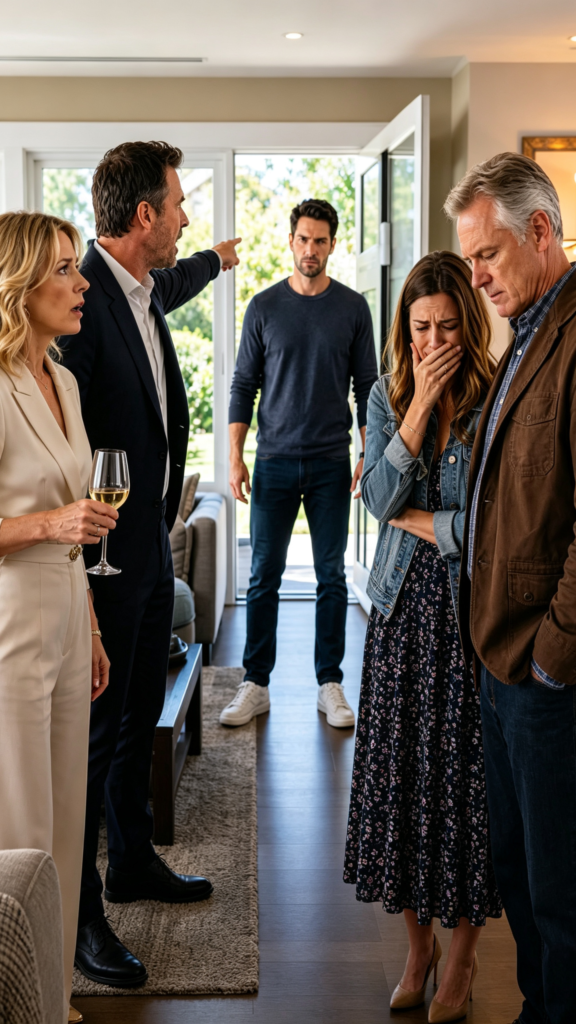
Braulio was inches from him, red with anger, pointing to the exit.
“This house is mine now, old man,” he shouted. “You and Elvira grab your things and get out.”
Renata leaned against the kitchen, sipping wine from her mother's crystal glass.
“Dad, don’t make a scene,” she said. “You don’t need so much space anymore. We have kids. Santiago won't even get involved.”
Braulio kicked the box.
“The door is right there,” he spat. “Use it before I really get angry.”
Don Manuel wanted to respond, but he couldn’t.
Then Santiago closed the door behind him.
The music stopped abruptly.
Renata turned pale.
Braulio slowly turned around.
Santiago looked at the box, his mother’s tears, his father’s trembling hands, and then at his brother-in-law.
“How interesting,” he said, his calm voice chilling the room. “Repeat that for me, Braulio… whose house did you say this was?”
PART 2
Braulio tried to smile, but the fear was evident in his jaw.
“Santiago,” he said, adjusting his shirt. “You arrived at a bad time, dude.”
“No,” Santiago replied. “I arrived just in time.”
Renata set down the glass on the counter.
“Don’t come in here trying to be a hero,” she snapped. “You don’t know what’s going on.”
Santiago didn’t reply.
He looked at his mother’s wrist. There was a reddish mark, like tight fingers had gripped it. It wasn’t a huge wound, but it was enough to understand someone had held her tightly.
Don Manuel lowered his gaze.
“We didn’t want any trouble, son,” he said quietly.
Braulio let out a dry laugh.
“Trouble? The problem is two old folks are occupying a mansion they can’t afford, while their own daughter is struggling with her family.”
“Struggling?” Santiago asked.
Renata crossed her arms.
“Not all of us are business owners with an office in Santa Fe and a personal accountant.”
Santiago almost laughed.
Renata had always been like this. When he won a scholarship, she said it was luck. When he worked two jobs to pay for college, she said he loved playing the victim. When he built his business, she said it had gone to his head.
Now she was in the house he bought for his parents, acting like she was the aggrieved one.
Braulio pointed at Don Manuel.
“Your dad already accepted that they’d move to the guest room in the back. Then we’d look for a place in assisted living. We’re making practical decisions.”
Doña Elvira lifted her head.
“We never agreed to that.”
Renata rolled her eyes.
“Mom, you’re confused.”
That was enough.
Santiago pulled out his phone and called 911.
Braulio changed his expression.
“Who are you calling?”
“The police.”
“For what?” Renata demanded.
“For trespassing, threats against the elderly, and for the mark on my mom’s wrist.”
Braulio stepped toward him.
“You don’t want to do that.”
Santiago didn’t move.
“Take another step.”
Braulio stopped.
Renata lowered her voice.
“Santi, we’re family.”
“No,” he said. “Mom and Dad are family. You’re acting like an intruder with our last name.”
The patrol arrived 14 minutes later.
By then, Braulio was already pretending to be the victim. Renata cried, saying she just wanted to help her parents live more comfortably.
Santiago handed Officer Medina a copy of the deed, the lifelong use agreement prepared by his lawyer, and the security system records.
It showed Braulio had changed the entry code two days prior.
The officer looked at Don Manuel.
“Sir, I need you to tell me what happened.”
Don Manuel looked at Renata.
For a second, Santiago thought he would protect her.
It had always been like that. His parents confused love with infinite forgiveness. When Renata crashed their mother’s car at 18, they said it was an accident. When she withdrew $60,000 from their savings at 27, they said she was desperate. When Braulio humiliated Don Manuel at Christmas, everyone pretended they didn’t hear because “he was drunk.”
But that day something changed.
Don Manuel took a deep breath.
“They arrived three weeks ago,” he said. “At first, it was a visit. Then Braulio started bringing boxes to the garage. They turned my study into the kids’ room. Renata said she needed space to make videos.”
“It's my job,” Renata protested.
Don Manuel continued.
“Two days ago, they changed the door code. Yesterday, Braulio told me not to answer Santiago’s calls. Today, Renata asked Elvira to put away her jewelry because they were going to reorganize the master bedroom.”
Doña Elvira whispered:
“She said that bedroom suited her better because it faced the sea.”
Renata put a hand to her forehead.
“Mom, it was for you. You can’t go up the stairs anymore.”
“The master bedroom is on the ground floor,” Santiago said.
Renata fell silent.
Then Don Manuel let out the worst of it.
“When I told Braulio that this wasn’t his house, he grabbed Elvira by the wrist and told me to stop acting like a man if I didn’t want him to treat me like one.”
Braulio exploded.
“That's a lie!”
Officer Medina looked at him sternly.
“Sir, lower your voice.”
At that moment, another officer came out to speak with the neighbors. He returned with Doña Lupita, the little old lady next door, wearing large glasses and a sharp gaze.
“That man has been yelling for days,” she said. “Yesterday, he left Mr. Manuel outside for almost 20 minutes. I was about to call, to be honest.”
Renata covered her face.
Braulio looked down.
Officer Medina didn’t hesitate.
“Mr. Braulio, Mrs. Renata, gather your essential belongings and leave today. With these documents, you have no right to remain on this property.”
Braulio clenched his teeth.
“Are you going to kick a family with children out?”
“We are removing people who are no longer welcome after allegations of threats and intimidation.”
Renata glared at Santiago.
“Don’t do this to us.”
Santiago held her gaze.
She was his older sister. The girl who taught him to ride a bike and then mocked him when he fell. The woman who sent flowers to their mom on Mother’s Day and two weeks later asked for money.
The daughter who knew how much their parents loved her and used that love as a spare key.
“I’m not doing anything to you,” he said. “You did this.”
They packed under supervision.
That’s when the extent of the abuse was revealed.
Braulio had stuffed Don Manuel’s fishing rods into black bags. Renata had placed Doña Elvira’s embroidered blankets in boxes labeled as DONATE.
In the master bedroom, their parents’ clothes were piled in baskets while Renata’s dresses filled the closet.
In the bathroom, Braulio’s razor sat next to Don Manuel’s toothbrush.
In the study, the kids had scratched the wooden floor with a gamer chair.
Doña Elvira put a hand to her chest.
“I didn’t know they had moved your Army box, Manuel.”
Don Manuel entered the study.
The box was open on the desk. Inside were medals, old letters, photos from his service, and the folded flag from his brother’s funeral. On top, someone had left dirty papers.
Don Manuel took the flag in both hands.
His face changed.
He had always been calm. Not weak. Calm. Very few people understand the difference.
He had endured hunger, debts, and humiliation without raising his hand. He believed peace was protected by swallowing his pride.
But that afternoon he stopped swallowing it.
He turned to Braulio.
“You will never speak to my wife again.”
Braulio smiled crookedly.
“Mr. Manuel…”
“For you,” he said, his voice trembling but firm, “I am Mr. Ríos.”
Renata cried louder.
“Dad, please.”
Don Manuel looked at her.
“And you will never ask your mother for money again. Don’t send your kids to ask for gifts. Don’t say we abandoned you. You brought this into our house.”
Renata froze, as if the consequences were a language she had never learned.
By sunset, Braulio’s truck was packed.
His kids left without looking at their grandparents.
Renata stopped on the steps.
“And where are we supposed to go?”
“To the house where you live,” Santiago replied.
Braulio murmured:
“We’re behind on payments.”
Santiago heard, but felt no pity.
Later he learned the truth.
Renata and Braulio's house in Querétaro was on the verge of foreclosure. Braulio had lost his job for falsifying expenses. Renata's business on social media was all for show: pretty photos, debts, and maxed-out credit cards.
They hadn’t come for a visit.
They had come to steal a rescue.
Braulio convinced Renata that if they occupied the mansion for a sufficient time, guilt would do the rest. Their parents would agree to move to the back room. Then she would pressure Santiago to “arrange things.”
Because she had kids.
Because she had problems.
Because her entire life she had believed that needing something was the same as deserving it.
But Braulio got desperate.
He yelled too soon.
He squeezed too hard.
He confused Don Manuel’s kindness with surrender.
When the truck left, the house felt enormous.
Not peaceful yet.
Just empty of danger.
Doña Elvira looked around the living room: crumbs on the carpet, marked glasses on the table, a broken vase, and the anniversary photo turned face down.
“I’m sorry,” she said.
Santiago turned.
“Why?”
“For letting them in.”
Don Manuel sat down slowly.
“She’s our daughter. We thought we could help without being swallowed.”
Santiago took a deep breath.
“You can love Renata. But she can’t have keys.”
Doña Elvira cried softly.
The following week was practical.
Santiago changed locks, codes, and cameras. His lawyer updated the agreement: his parents would have lifelong use of the house, and no guest could stay more than ten days without written permission.
Doña Elvira protested.
“That sounds very cold.”
Don Manuel responded from the table:
“No. It sounds necessary.”
It was the first time he set a limit before she could soften it.
Renata called 11 times in 4 days.
Doña Elvira didn’t answer.
Then she sent a long message. She said Braulio was under pressure, that their kids were traumatized, that Santiago humiliated her in front of the police, and that Don Manuel exaggerated.
In the end, she wrote:
“You owe me at least a conversation.”
Doña Elvira read the message in the kitchen.
Her hands trembled, but she didn’t cry.
Don Manuel placed his palm over hers.
“You don’t owe her a second chance to hurt you.”
Doña Elvira blocked her daughter’s number.
For the first time, Santiago saw his mother choose peace without asking for forgiveness.
Three months later, they celebrated the anniversary they should have had from the start.
It was something simple: neighbors, old friends, fish, rice, hibiscus water, vanilla cake, and soft music on the terrace.
Doña Elvira wore a light blue dress. Don Manuel donned a white guayabera and the watch she gave him when he retired.
During the meal, Don Manuel stood up with a glass of cider.
“I had a speech,” he said.
Everyone laughed because the page was blank.
He looked at his wife.
“Fifty years ago, Elvira married a man without money, with one good suit and a Volkswagen that stalled at traffic lights. She never made me feel poor.”
Doña Elvira covered her mouth.
He continued.
“We raised two children. We made mistakes. We forgave too quickly. We confused avoiding fights with living in peace.”
Then he looked at Santiago.
“Our son gave us this house. But more than that, he reminded us that a gift doesn’t become the property of someone who wants to snatch it away.”
The terrace fell silent.
Only the sea could be heard.
Don Manuel raised his glass.
“To Elvira,” he said. “And to the doors that do close.”
First came the laughter.
Then the applause.
Doña Elvira cried again, but those tears didn’t break her. They seemed to lift a weight off her.
That night, Santiago found his father alone on the terrace.
The moon lit the sea. The house glowed warmly inside. There were no shouts. No threats. No one demanding what wasn’t theirs.
Don Manuel handed him a cup of coffee.
“When Braulio told me to leave,” he confessed, “I almost did.”
Santiago looked at him.
“Not because I believed him. But because I thought maybe old folks should step aside. Not be a burden.”
“You’re not a burden, Dad.”
“I know.”
They fell silent.
Then Don Manuel said:
“I’m proud of you.”
Santiago smiled.
“For buying a house?”
“No,” his father said. “For walking in and not becoming Braulio.”
That stuck with him.
Because Santiago had indeed wanted to destroy him. He wanted to sink him with lawsuits, debts, evidence, and public shame.
Part of that happened anyway.
Renata’s house was foreclosed. Braulio didn’t regain his reputation. Renata ended up renting far from the neighborhood where she once bragged about her perfect life. Her kids changed schools.
Life didn’t protect them from the consequences.
But Santiago didn’t pursue them.
He protected his parents and stopped there.
One year later, Renata sent a handwritten letter.
She admitted some things. Not all. She blamed Braulio less than expected and blamed herself more than Santiago thought possible.
She wrote that she had confused her parents’ love with available money to spend. She asked if they could talk someday.
Doña Elvira read the letter twice.
Then she folded it and put it in a drawer.
“Not yet,” she said.
Don Manuel nodded.
It wasn’t a yes.
It wasn’t a never.
Just not yet.
And for now, that was enough.
The house by the sea remained theirs.
Every morning, Doña Elvira opened the blue windows. Every afternoon, Don Manuel walked on the beach with coffee.
On their 51st anniversary, Santiago visited them again.
This time, as he entered the gravel road, there were no strange trucks. No boxes on the terrace. No broken glass. No music or shouts.
Doña Elvira opened the door before he knocked.
Don Manuel stood behind her, smiling peacefully.
“Welcome home, son,” she said.
And for the first time, no one in that house feared who might cross the door.





