PART 1
For 8 years, Santiago Beltrán visited a grave without a body in Guadalajara.
There was no coffin, no remains, no last look. Just a photo of Valeria in a white dress, fresh flowers every Sunday, and a cold plaque with a date that still felt like a lie to him.
Valeria had disappeared on a Mediterranean cruise when she was 31 years old.
According to the report, a railing on the deck failed during the night. 2 passengers claimed to have seen her fall into the sea. They found her handbag, her Mexican passport, and a silver bracelet Santiago had given her on their first anniversary.
But the sea never returned her body.
Santiago was an architect in Zapopan, a serious man, the kind who measured everything before deciding. Valeria was the opposite: loud, spontaneous, the type who played music in the kitchen and danced even if the beans burned.
They met at a party in Tlaquepaque, when she stained his shirt with red sauce and instead of getting nervous, she said:
—No way, handsome, now you look less boring.
From that day on, Santiago stopped being so square.
They married a year later. They lived 5 years of laughter, small fights, plans to have children, and Sundays with her family. Valeria's mom, Doña Rebeca, treated him like a son. At least, that’s what he thought.
When Valeria died, Doña Rebeca cried so much at the mass that Santiago had to hold her. Then, little by little, the woman distanced herself. She no longer answered calls. No longer invited him to lunch. No longer wanted to talk about Valeria.
Santiago thought it was pain.
He never imagined it was guilt.
At 43, his firm sent him to Rome for a historical restoration conference. He didn’t want to go. His best friend, Mauro, forced him to leave the hotel on the second night.
—That’s enough, man. You didn’t cross half the world to eat just a sad salad.
They ended up in a café near a plaza filled with tourists. Mauro talked about work, but Santiago stared into the distance.
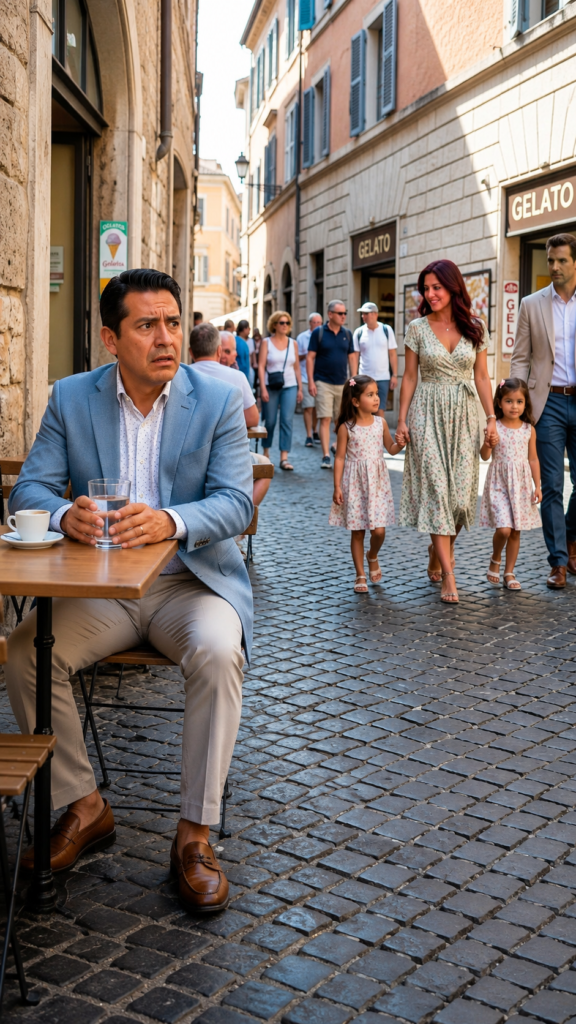
Until he saw her.
Across the street, in front of an ice cream shop, a woman in a green dress laughed while holding hands with 2 little girls. Next to her walked a tall man with a backpack.
Santiago felt the air leave his lungs.
It was Valeria.
The same brown hair with reddish highlights. The same way of tilting her head when she laughed. The same mouth. The same left eyebrow slightly higher.
Then the woman turned to speak to a girl, and her hair moved from her neck.
Under her ear was a crescent-shaped mark.
Valeria’s mark.
—Mauro —Santiago whispered—. Take a picture.
—What?
—Take a picture, damn it.
Mauro obeyed with trembling hands.
Santiago wanted to run, shout her name, demand 8 years of hell. But something stopped him.
If Valeria was alive, why had she let him bury her?
And if that woman wasn’t Valeria, then someone in Mexico had been hiding a monstrous truth from him for 8 years.
PART 2
That night, Santiago couldn’t sleep.
He sat on the hotel bed with his cell phone in hand, zooming in on the blurry photo over and over. The image was shaky, the streetlight distorted the faces, and the girls appeared almost as shadows.
But the woman in the green dress was still there.
Too much alike.
Too real.
Mauro sat across from him in silence. For the first time in years, he didn’t joke. He just left one coffee on the table and said:
—Tomorrow we go back. But without doing something crazy, okay?
For 3 days, they returned to the same area. Santiago felt ridiculous, like a broken detective waiting for a ghost to come out to buy gelato. He sat in front of the ice cream shop, pretended to review blueprints on his tablet, and watched every face that passed.
On the third day, the woman appeared alone.
She came out of an old building with a fabric bag and sunglasses. She walked quickly, checking messages on her cell phone.
Santiago stood up before he thought.
—Don’t scare her —Mauro said.
But Santiago was already crossing the street.
When he stood in front of her, he could hardly speak. The woman lifted her gaze, and their eyes met.
It was Valeria’s face.
The same nose. The same mouth. The same deep gaze that had disarmed him so many times in the kitchen of their home.
But there was no recognition.
No fear.
No guilt.
Just a calm courtesy.
—Scusa… can you let me pass? —she said, with a strange accent, mixing Italian and Spanish.
Santiago swallowed hard.
—Sorry.
She smiled slightly and continued walking.
Santiago returned to the table pale.
—It’s her —Mauro murmured.
—No —Santiago replied, his voice breaking—. That woman didn’t know who I am.
The phrase hit him harder than seeing her alive.
Because Valeria could hide many things, but she could never look at him like a stranger. Her eyes always betrayed her. If she had pretended, he would have noticed.
That same night, he called Doña Rebeca.
They hadn’t spoken in almost 4 years. The call rang 6 times.
—Hello?
—Doña Rebeca, it’s Santiago.
On the other end, there was a dry silence.
It wasn’t surprise.
It was fear.
—Santiago… did something happen?
He closed his eyes.
—I need to ask you a question, and I want you not to lie to me this time.
—I don’t understand.
—Did Valeria have a sister?
The silence grew enormous.
Then, Doña Rebeca’s voice came out almost like a whisper.
—Who told you that?
Santiago’s blood ran cold.
She didn’t say “no.”
She didn’t say “you’re crazy.”
She said “who told you that?”.
—I saw her in Rome —he said—. I saw a woman just like Valeria. With the same mark under her ear. She was with 2 girls and a man. Tell me what the hell is going on.
Doña Rebeca hung up.
Santiago looked at his phone as if it had spat in his face. Mauro muttered a curse.
—We’re going back to Mexico —Santiago said.
—There are no direct flights today.
—Then with a layover. I don’t care.
2 days later, they were in front of Doña Rebeca’s house in the Chapalita neighborhood in Guadalajara. The facade looked the same: purple bougainvilleas, a white gate, a Virgin of Guadalupe by the entrance.
But when the woman opened the door, Santiago felt like he was looking at another person.
Doña Rebeca seemed smaller. Older. As if she had spent 8 years carrying stones on her back.
—Come in —she said.
In the living room, the photo of Valeria in her graduation gown was still there. Santiago looked at it and felt the same pain as always, but now mixed with rage.
—Tell me the truth —he pleaded—. You owe me no consolation. You owe me the truth.
Doña Rebeca sat with her hands clenched.
—Her name is Lucía.
Santiago didn’t blink.
—Valeria had an identical twin sister.
Mauro, who had stayed by the door, opened his mouth without saying anything.
Santiago felt the floor shift beneath him.
—Why didn’t Valeria ever tell me?
Doña Rebeca began to cry.
—Because Valeria didn’t know either.
That answer was worse than any betrayal.
The woman told the story between sobs. When the girls were 6 years old, their father, Hernán Rivas, got involved with dangerous people in Tamaulipas. He wasn’t just a violent man. He moved money, favors, and threats. When Rebeca tried to leave him, he swore that if she took his daughters, he would find them even if he had to burn half the country.
Rebeca’s sister lived in California and couldn’t have children. In a desperate night, they made a deal that neither of them knew how to repair later.
Rebeca kept Valeria.
Her sister took Lucía.
They changed last names, broke contact, destroyed photos, and never spoke about the issue again.
—They separated them —Santiago said, with a dangerous calm.
—I saved them —Doña Rebeca replied, crying—. That’s what I told myself my whole life to stay sane.
—And when Hernán died? Because he died, right? Valeria told me her father had died when she was a child.
Doña Rebeca looked down.
There appeared the second truth.
Hernán hadn’t died when Valeria was a child. He died 3 years before the cruise.
Santiago froze.
—3 years before?
—Yes.
—Then he had 3 years to tell Valeria she had a sister.
—I couldn’t.
—She wouldn’t.
The woman covered her face.
—I was afraid she would hate me.
Santiago let out a bitter laugh.
—And you preferred she died not knowing she had a living twin?
Doña Rebeca didn’t answer.
That silence was a confession.
Santiago’s rage rose like fire. For 8 years, he had thought his pain was only against the sea, against fate, against a broken railing. But now he understood he had also been a victim of a family that decided to bury truths to avoid facing consequences.
—Did Valeria really die? —he finally asked.
Doña Rebeca lifted her tear-streaked face.
—Yes, Santiago. My daughter died on that cruise. That was never a lie.
He wanted to hate her more for saying it with such certainty.
But a part of him broke again.
He had returned to Mexico with an absurd, shameful, almost childish hope. He wanted everything to have been a lie, for Valeria to be alive, to be able to confront her, shout at her, hug her even after hating her.
But no.
Valeria was still dead.
The woman in Rome wasn’t his wife.
She was a life that had existed at the same time as hers, separated by a decision made in secret.
—Does Lucía know? —Santiago asked.
Doña Rebeca nodded.
—I told her after the accident. When I knew Valeria wouldn’t come back, I couldn’t take it anymore. I called her. I told her she had a sister, but that it was too late.
—How convenient —Mauro said from the door, unable to hold back.
Doña Rebeca looked at him with shame.
Santiago took a deep breath.
—I want to talk to her.
—She has a husband. She has daughters. She lives in Italy. She doesn’t want problems.
—Problems? —Santiago stood up—. The problem was created by you when you played God with 2 girls. I don’t want to take anything from her. I just want to know if she wants to meet the woman she lost without ever having had.
Doña Rebeca didn’t respond that day.
Santiago left without saying goodbye.
For 2 weeks, life seemed false again. He worked, ate, answered messages, but everything felt distant. At night, he pulled out a box that had been closed for years: letters from Valeria, photos, movie tickets, a napkin where she had written “don’t be so intense, Beltrán.”
He also found a blue notebook.
It was Valeria’s.
He had never read it completely. It felt like an invasion. But that night, with the truth biting inside, he opened it.
On a page dated 4 months before the cruise, Valeria had written:
“Today I dreamed of a girl just like me. It wasn’t me. She looked at me from a road and told me I didn’t arrive on time. How strange. Sometimes I feel like I’m missing someone, but it sounds crazy to say it.”
Santiago covered his mouth.
Valeria had felt the void without knowing how to name it.
On another page, she wrote:
“My mom gets weird when I ask about my childhood. She changes the subject, her voice cracks. Maybe all families hide things. Or maybe mine is stranger than normal.”
Santiago cried like he hadn’t cried since the funeral.
Not for himself.
For Valeria.
Because she died thinking her loneliness was a mania, an unexplained sadness, when in reality it was a sister ripped from her life.
3 days later, he received a message from an unknown number.
“Hello, Santiago. I’m Lucía. My mom told me you saw me in Rome. I don’t know if this is right or wrong, but I think you knew the sister I could never hug. And I have questions that no one here can answer.”
Santiago read the message 12 times.
Then he replied:
“I also have questions. But above all, I have memories of her. They are yours if you want to hear them.”
The first call lasted 6 hours.
Lucía wasn’t Valeria.
That was the first thing Santiago had to accept to avoid being unjust. Her voice was similar, but her way of thinking was different. Valeria spoke quickly, got excited, interrupted, and then apologized. Lucía was measured, careful, like someone used to weighing every word before opening a door.
Valeria hated coffee.
Lucía drank 4 cups a day.
Valeria danced even in the supermarket if an old song played.
Lucía said she had 2 left feet and that her daughters teased her.
But when Lucía laughed for the first time, Santiago had to close his eyes.
She wasn’t Valeria.
But something of Valeria lived in that sound.
He told her everything.
He spoke of the time Valeria filled the house with candles because she wanted a romantic dinner and almost set off the fire alarm. He told her that she cried during commercials of abandoned puppies. That she hid gifts in the closet, always in the same drawer, and got mad when Santiago found them.
He told her that she said “neta” when she was indignant, “oh, no way” when something made her laugh, and “I’ll love you even if you’re so square” when she wanted to make peace.
Lucía cried on the other end.
—I feel like I miss her —she said—. And that makes me guilty because I never knew her.
—It’s not guilt —Santiago replied—. It’s love arriving late.
Months later, Lucía traveled to Mexico with her husband, Matteo, and their 2 daughters. The meeting was in the same house in Chapalita where everything had been hidden.
Doña Rebeca prepared pozole as if a meal could repair decades of silence.
It couldn’t.
When Lucía entered, the woman almost fell to her knees. It was like seeing Valeria and not seeing her. It was the same face with another story behind it.
The girls ran to the garden, excited about Mexican candies and the neighbors’ dogs. The adults stayed in the living room, surrounded by photos.
Santiago arrived with a box.
Inside were letters, earrings, the blue notebook, an embroidered blouse of Valeria, and the silver bracelet recovered from the cruise.
When Lucía saw the bracelet, she gasped, bringing her hands to her chest.
—Can I touch it?
Santiago nodded.
Lucía picked it up carefully, as if it were a relic.
—I thought I was an only child my whole life —she whispered—. And now I have a sister, but only in things that no longer breathe.
Doña Rebeca began to cry.
—Forgive me, daughter.
Lucía lifted her gaze.
—Which one of us are you talking to?
The question left the room silent.
Doña Rebeca trembled.
—To both.
—That’s not enough —Lucía said—. Because you took Valeria from me. And you took me from Valeria. I understand you were afraid when we were kids. I can understand that. But when the danger ended, you chose your comfort. You chose not to lose a daughter’s love, even if it meant stealing the truth.
Santiago lowered his head.
It was the first time someone said what he hadn’t dared to say so clearly.
Doña Rebeca didn’t defend herself.
She just cried.
That afternoon, there was no easy forgiveness. There was no novel embrace. There was no music or complete miracle.
There was truth.
And sometimes the truth doesn’t fix a family. It just clarifies where the wound began.
Lucía stayed several days in Guadalajara. Santiago took her to Tlaquepaque, to the place where he had met Valeria. He showed her the exact table where she had stained his shirt with sauce. Lucía laughed with tears.
—That sounds like something I would have done by accident.
—She did it on purpose —Santiago said—. I’m sure.
They also visited the grave without a body.
Lucía left 2 white flowers and 1 drawing made by her daughters. In the drawing, there were 3 women holding hands: a mom, an aunt, and a grandmother. The girls didn’t understand the whole story, but they had understood enough to want someone they would never see.
Santiago stood in front of the plaque.
For the first time in 8 years, he didn’t feel like he was talking to emptiness.
He felt Valeria was no longer alone.
Before returning to Rome, Lucía gave Santiago a photo. It was her with her daughters in the plaza of Tlaquepaque, wearing huge mariachi hats. Behind them, Matteo smiled confusedly with a mango popsicle in hand.
On the back, Lucía wrote:
“To remind you that Valeria didn’t come back, but she also wasn’t completely lost.”
Santiago kept the photo in his wallet.
Weeks later, sitting on his balcony in Zapopan, he opened Valeria’s blue notebook once more. He read the line where she said she felt like she was missing someone.
Then he looked at the dark sky and whispered:
—You were right, Vale. You were missing someone. And we were all missing you.
That night, he didn’t leave flowers on a grave.
He sent a message to Lucía.
“When your daughters come back to Mexico, I’ll show them where their aunt used to dance without music.”
Lucía replied almost immediately:
“Then get ready. They say they want to dance just as ridiculously.”
Santiago smiled with tears.
Death didn’t bring Valeria back. The truth didn’t return the lost years either. But it gave him something no one expected: a family born from pain, a sister found too late, and a question that many couldn’t stop discussing.
Can you forgive a mother who separated her daughters to save them, but then stole their whole life out of fear of losing her love?





